This is perhaps the most heavily paraded "gotcha" fact by armchair food historians. They absolutely love to smirk & tell us, "You know Jalebi is not Indian, right? It is a Persian dish called Zolbiya/Zalabiya brought by invaders in the medieval era!"
They mistake a linguistic corruption for the birth of a culinary concept. They confuse the trade name that eventually stuck with the actual evolutionary genealogy of the recipe. The entire liberal historian argument rests on 1 fragile pillar: the 10th century Arabic cookbook Kitab al-Tabikh, which mentions Zalabiya. They smugly point out that detailed Indian texts appear only in the 15th century & declare victory.
But here is the fatal flaw in their timeline trap: They mistake the date of the 1st surviving written recipe for the date of invention & popular practice. Ancient Indian texts were primarily medical & philosophical, they classified broad food principles, not every street vendor’s technique. The absence of a detailed halwai-style recipe earlier does not mean the dish did not exist. It means our ancestors did not write down casual street sweets the way later cookbooks did.
Technically, India had already mastered the 2 pillars that define real Jalebi centuries earlier: large-scale sugarcane crystallization into refined sarkara & syrup (perfected during the Gupta era) & the uniquely subcontinental art of lactic acid fermentation (khameer). These gave us the signature tangy, porous batter that aggressively absorbs syrup, something far superior to the honey-based versions in West Asia.
Our dish was referred to as Jalavallikā (from Jala meaning water/juice & Vallikā meaning a creeping vine/coil). It literally translates to "the juice-filled coil." Another classical name was Kundalikā (derived from Kundala, meaning a circular coil/ring, the exact same root used for Kundalini energy).
If Jalebi was some foreign royal import tied to Islamic court culture, why does it make its 1st formal appearance in Indian literature inside a strict, vegetarian Jain religious text? The Priyamkara-nrpa-katha, composed by the Jain author Jinasura in 1450 CE, describes an elaborate feast hosted by a wealthy indigenous merchant. Jalebi appears right alongside deeply traditional Indian sweets, already fully integrated into local high cuisine.
Shortly after, the 16th century Sanskrit text Bhojana Kutuhala by Raghunatha & the Gunyagunabodhini (pre-1600 CE) give the exact, unambiguous recipe for making Kundalikā: fermented fine flour batter, fried in pure desi ghee & immersed in flavored sugar syrup, 100% identical to what our local halwai does today.
Ancient Indian culinary science was obsessed with the sour-sweet axis (Amla-Madhura). The genius of Jalebi lies in leaving the batter to ferment naturally overnight. This lactic acid fermentation creates that perfect tangy, porous crust. When deep-fried in hot ghee & plunged into hot sugar syrup, a spectacular thermodynamic reaction occurs, the sour crust aggressively drinks up the sweet syrup. This mastery of fermented frying (khameer-pakwa) is uniquely subcontinental.
India was never a culinary blank slate waiting for outsiders to teach it how to fry flour in circles. When West Asian traders arrived, they encountered a popular, thriving local street sweet called Jalavallikā/Kundalikā. They had a similar (but inferior) fried sweet back home called Zalabiya, so over centuries of marketplace haggling the 2 names merged.
The shorter foreign name stuck in common parlance, but the dish itself, its technique, its fermentation, its syrup mastery, its crisp-yet-juicy soul & its deep roots in vegetarian feasts was entirely home-grown. The invaders did not bring Jalebi to us. We perfected it & they simply borrowed the name.
I'm telling this again: My hunch is Air India & Indigo are being run down by the GLISCO-DS using insiders and other sabotage.
It's time India takes action. First step must be to make sure the CEO and board are Indian patriots. Not foreigners and Indians with foreign interests.
At a time when India's aviation sector must be growing and Indian carriers becoming top international carriers bringing revenue to India, we are seeing the reverse happening.
So this rout of AI doesn't seem organic. There's no way a company like TATA can't run an airline in partnership with Singapore Airlines to at least do as well as an Ethihad or Malaysian, if not Emirates and Qatar.
This is unacceptable.
Abhijit Sarkar’s murder cannot be buried.
Abhijit Sarkar was not just killed. He was hunted. He was chased. He was murdered in front of his mother. And they even killed his dogs and puppies. And sexually assaulted his old mother.
Swapan Samaddar, the TMC councillor and one of the prime accused in the 2021 killing of Abhijit, has finally been arrested in West Bengal.
And yet, for years, his brother Biswajit fought relentlessly while an entire political ecosystem tried to bury the truth under power, fear and silence.
We petitioned the Supreme Court where we have names every accoused.
This arrest is not closure.
It is the beginning.
Bengal does not need selective memory.
There must be justice for:
Every murder.
Every rape allegation.
Every displaced family.
Every burnt home.
Every silenced witness.
Every cadre-protected accused.
Abhijit Sarkar’s last words in this video must haunt Bengal’s conscience.
Because his case was not an exception.
It is a window into what political terror looked like under the Trinamool Congress when the state government of Mamata Banerjee looked away.
India must issue notice to all Indian sailors to strike and return back to India. Let the world's shipping stall. Let's see how Trump keeps energy moving and China its exports shipping.
I have long been suggesting India create a network for Indian diaspora, of nurses and doctors, shippers and pilots, workers and constructors etc.
Every Indian going out to work from India - record their skills, put them into a database, give them a community to connect to, with GoI giving info and incentives for them there.
Use the power of this network when needed. Tap their skills if they return to India. And utilize their value outside India.
All countries will be much more respectful to India if India can unify its diaspora workers and make them act in national interests like China does.
This is a big win for India in the last decade.
But even with all such positives, there's an attempt at psyops by foreign seeded narrative using local politicians & account farms that India's environment is at threat.
So it can be used to program the public to fight India's strategic Andaman Nicobar port and military base development.
Public should not fall for it. Remember they are the same forces and it is same playbook adopted in Kenya to evict Adani from doing a project and capture it later.
1. Chief Engineer Patnala Suresh
2. Deck cadet Aditya Sharma
3. Engine fitter Shivanand Chaurasiya
3 Indian sailors killed in U.S. attack on ship off Oman coast, statement awaited from U.S. Embassy https://t.co/HvB2NYmG9N
I don’t care about the rest. But Saayoni Ghosh, TMC MP, posted a meme showing a condom being put on a shivling. It shook me to my innermost being. I had filed a police complaint against her at Rabindra Sarobar PS, Kolkata - predictably with no results. Then she sung a song as part of TMC’s election campaign, which said she had the Kaaba in her eyes, Madina in her heart.
For Lord Shiva’s sake, do not have anything to do with her. @narendramodi@AmitShah@BJP4India
WE ARE SO BACKKKKK!!!!!!!!!😭😭❤️🇮🇳
Sadiq has gone absolutely nuts, he has already dismantled his 7 telegram channels, and finally the main channel is also dismantled, he has announced to temporarily suspend his operations until he finds out the imposter which is me.
He's also begging his members to mass report my account and get me BANNED.
He'll restart his operations after some days meaning we still hv some to prepare for counter assault.
Kolkata Metro work was stalled for 15 years.
The only reason was that if the metro project had been completed, Narendra Modi would have inaugurated it, and Mamata Banerjee did not want that. Because the central government is building it.
Yes, Rail Vikas Nigam Limited, which was working on the Kolkata Metro's rail line, had to build a bypass over a bypass, but that required a 15-day traffic stoppage.
15 years ago, RVNL sent a letter to the local administration asking them to stop traffic for 15 days. The TMC government did not stop the traffic!
4 more letters were sent, but traffic was not stopped.
After that, RBNL had to approach the High Court. The HC immediately ordered the West Bengal government to halt traffic so that the Metro project could be completed.
But Mamata Banerjee's stubbornness led her to appeal the High Court's decision to the Supreme Court.
When the Supreme Court ruled that traffic must be halted for 15 days, Mamata Banerjee filed a review petition.
And most surprisingly, no media outlet even reported the dirty game being played in West Bengal just to prevent Modi from inaugurating the project.
Millions of people in her own state were wasting their time stuck in traffic jams, but Mamata Banerjee's pride was paramount.
Then came the elections, and this issue was widely discussed.
Then the Mamata government was gone, and a project that had been stalled for 15 years was completed in just 15 days.
That's why I say that India's opposition is the biggest enemy of the country's development.
A so-called “organic” protest against paper leaks suddenly turned into a loud campaign to defend Umar Khalid.
Coincidence? On June 1 Abhijeet Dipke announced the Cockroach protest at Jantar Mantar, the exact day Umar Khalid walked out of jail on interim bail.
The same ecosystem behind the Delhi riots immediately backed it. Same old Shaheen Bagh formula: a secular mask, radical intent.
Was this really a protest or the latest attempt to revive an old network and its agenda? @UnSubtleDesi connects the dots.
Yes, Britain famously transferred wealth to India. When British arrived in India its share of the world economy was 4%. When they left in 1947, they had taken it to 23%, roughly equal to all of Europe combined.
On a serious note.
The Indian railways were financed entirely by bonds sold on the London Stock Exchange. British investors were guaranteed a return of 5% per annum by the colonial government. A guaranteed return, in an era when no other safe investment in Britain offered anything close. And who guaranteed those returns? Indian taxpayers. Indians paid for the construction. Indians paid the guaranteed profits to British shareholders. Indians paid for the equipment, which was manufactured exclusively in Britain and shipped to India at inflated prices. One mile of Indian railway cost twice what the same mile cost to build in Canada or Australia, because the guaranteed return meant there was no incentive to control costs. The more it cost, the more British investors and suppliers earned.
And what were these railways designed to do? Move raw materials from India’s interior to ports. Cotton from the Deccan to Bombay. Jute from Bengal to Calcutta. Coal from Bihar to wherever the Empire needed it. Tea from Assam to London’s drawing rooms. The routes connected mines and plantations to harbors. Not cities to cities. Not people to opportunities. Raw materials to ships. The Indian public’s transportation needs were, as Shashi Tharoor put it, entirely incidental.
Oh, and the railways also moved troops. Very efficiently. So that when Indians protested being looted, the British could deploy soldiers to shoot them. That was the other “infrastructure investment.”
But wait, there is more. Before the railways, India had the world’s finest textile industry. The British smashed the looms, broke the weavers’ thumbs (this is not metaphor, this is documented history), imposed tariffs on Indian cloth, and shipped raw cotton to Manchester to be manufactured into garments that were then sold back to Indians. India went from being the world’s largest textile exporter to an importer of British cloth within a generation.
The Bengal Famine of 1943 killed an estimated 3 million people. Churchill diverted food supplies from Bengal to already well-supplied British troops and European stockpiles. When informed of the famine, his response, on the record, was to ask why Gandhi had not died yet. This is the “infrastructure investor” Musk is defending.
India contributed 2.5 million soldiers to fight in two World Wars on Britain’s behalf.
So let us summarize the colonial “investment” in India. They took a 23% global economy and left it at 4%. They destroyed the world’s finest textile industry. They built railways with Indian money, for Indian resources, generating British profits. They engineered famines that killed millions. They drained an estimated $45 trillion in today’s value over 200 years.
That’s some unprofitable adventure.
If we open almost any global culinary history book, we will find a common narrative: Ancient Europeans & Mesopotamians were the masters of baking bread, while ancient Indians only knew how to boil grains/fry them on a flat griddle. Baking, we are told, was introduced to India much later through Middle Eastern & Central Asian migrations.
This is a complete historical distortion.
Long before the 1st medieval wood-fired ovens of Europe were built, the chefs & engineers of the Indus Valley Civilization had already mastered the physics of thermal radiation, refractory clay engineering & controlled baking.
The ultimate weapon against the imported baking myth lies buried in the soil of Kalibangan (an ancient Indus Valley city in modern-day Rajasthan) & Harappa. During excavations, archaeologists unearthed several perfectly preserved, subterranean (underground) & overground cylindrical clay ovens dating back to 2500 BCE.
These ovens are structurally identical to the modern Indian tandoor. They feature thick, smooth clay walls designed to trap a massive amount of heat from a bed of charcoal/wood embers at the base.
We do not build a sophisticated, structurally reinforced vertical clay cylinder just to boil water/roast a piece of meat on a stick. The physical architecture of a vertical cylindrical oven serves exactly 1 scientific purpose: to trap hot air, creating a convection & radiant heat environment, which is the exact thermodynamic definition of baking.
Baking requires an incredibly high level of metallurgical & ceramic sophistication. If we take regular river clay, build an oven & subject it to intense, direct fire, the moisture inside the clay expands rapidly, causing the walls to crack/collapse/explode. The Harappans solved this through advanced material science:
They blended their clay with precise ratios of sand, quartz & organic binders like cattle dung/husk. This created what modern engineers call refractory ceramics, materials that can absorb immense thermal energy w/o structurally failing.
The interior walls were finished with a smooth, fine slips so that raw dough could be slapped directly onto the hot vertical surface, baking it via conduction on 1 side & intense radiant air heat on the other.
Now, to bake, we need a grain that can form a cohesive dough. While India later became synonymous with rice, the Indus Valley Civilization was heavily reliant on wheat & barley. Archaeologists have found massive public granaries packed with carbonized remains of Triticum aestivum (bread wheat) & barley.
They did not just boil these grains into porridge. The discovery of heavy stone saddle querns (grinding stones) & flat mullers at every residential unit proves that grains were systematically milled into fine flour. This flour was kneaded with water, shaped into flat/raised loaves & baked inside those ancient clay ovens.
When we look at the modern Indian kitchen today, whether it is a rustic village chulha/a tandoor in a dhaba/the traditional baked breads of North & Western India, we are not looking at borrowed traditions from the West/the Middle East. Our ancestors were masters of the oven when the Pyramids were still being built. They mapped out how clay interacts with fire, how dough behaves under radiant heat & built a baking legacy that has remained unbroken for 1000s yrs.
The next time someone claims baking is a Western/foreign concept, tell them about the ancient clay ovens of Kalibangan.
This is the condition of the Punjab mansion of Hindu businessman Todar Mal who paid 7,800 gold coins and bought 4 yards of land from the Mughal emperor Aurangzeb to bury the bodies of the 2 young sons and mother of Guru Gobind Singh on December 13, 1705.
The Mughal faujdar Wazir Khan had ordered the two young children be bricked alive as they refused to accept Islam. When they died, their grandmother died of shock
The Mughals did not want to allow the cremation to humiliate the martyrs. They stipulated that the buyer can take only as much space as he could cover with give gold coins for the land. All the Sikh chiefs just stood helplessly
That's when Todar Mal produced the coins and bought the piece of land, and cremated the three bodies.
This is biggest irony of life, India is only country where its true heritage is hidden from next generation and falsehood Is taught.
Fox News LIED to their audience.
They called LCAs “visas.” ( deliberately misleading)
They CLAIMED 90% of Indian H1bs are fraudulent.
They recycled a decade-old anecdote ( by a Pakistani American ) as current fraud evidence.
They dragged in unrelated fake degree cases ( that had nothing to do with H1b visas )
They turned India’s share of skilled-worker approvals into a conspiracy.
Then they used that fake narrative to blame Indians for America’s housing crisis, tech layoffs, wages, and economic anxiety.
That is a DELIBERATE smear campaign against Indians.
Rupert Murdoch’s media empire is manufacturing anti-Indian hate for ratings and India should stop treating them like a normal media business.
Review every Murdoch-linked channel, bureau, feed, access pass, distribution deal, and commercial privilege in India.
Bar them where appropriate.
You do not get to lie about Indians abroad and profit from India at home.
@FoxNews
Hello Sikhs, the last Sikh emperor was Maharaja Ranjit Singh. His capital was Lahore. So you must liberate Lahore from Pakistan if you want to restore that old glory. Also, most of his territory is now under Pakistan and Afghanistan. Very little is in India. So your slogan should be: “We want our territory back from Pakistan & Afghanistan.”
वैसे तो RTI लगाना चाहिए, पर @dpradhanbjp से पूछना चाहूँगा कि नवोदय, केन्द्रीय विद्यालय आदि के बोर्ड के साथ पिछले डेढ़ वर्ष में कितनी बार बैठक हुई है? साथ ही, यह भी बताएँ कि इस संदर्भ में कितनी चिट्ठियाँ मंत्रालय में पड़ी हुई हैं?
@EduMinOfIndia को ऐसा क्यों लगता है कि हम RTI लगा कर आपको ये जानकारियाँ सार्वजनिक करने को विवश नहीं कर सकते?
प्रधान अगले रीशफल तक रहें या न रहें, आप लोग अब RTI के एक बाढ़ की प्रतीक्षा कीजिए। इसमें यूजीसी, सीबीएसई समेत हर विद्यालय समूह आदि से संबद्ध जानकारी हम दो-दो स्रोतों से मँगवाएँगे।
जिन्हें शिक्षा व्यवस्था सही करने के लिए वोट दिया था, उन्होंने उसे अपनी प्राथमिकता में सबसे नीचे रखा है और ‘परीक्षा पर चर्चा’ कर के इसकी क्षतिपूर्ति नहीं कर सकते। बच्चों का मानसिक स्वास्थ्य आज के समय में सर्वोपरि है।
What does Islamic law actually say about property, partnerships, trade, and charitable endowments?
For decades, debates around Waqf, Sharia, and Islamic jurisprudence have been shaped by interpretations, opinions, and secondary sources. But what do the original legal texts themselves say?
The Jaipur Dialogues presents Fatawa-e-Alamgiri – Volume 4, a rare and meticulously translated edition of one of the most influential compilations of Islamic law from the Mughal era.
Translated from Persian to Urdu to Hindi, this volume allows readers to examine the original legal doctrines that shaped governance, property rights, commerce, and religious endowments during the Mughal period.
Read this and share it with all your secular friends who believe in Ganga Jamuni tehzeeb
https://t.co/Un82Ofkyxf
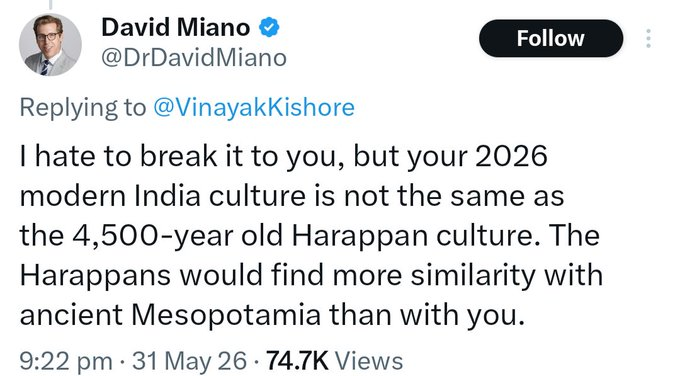
What's this guy talking about?
The wells we see in backyard of Indian homes, the brick houses, the bullock carts, the rangoli, the co-existence with wild animals, the bangles, the pottery, the toys, the ditches on the side of roads, the use of millet, the textiles - so much hasn't changed in India since Harappan times.
Perhaps no other civilization has such an unchanged continuous history for some 7000+ years preserving itself and its dangerous wild animals as well. If a Harappan time travels to present day India, he will instantly feel at home. Albeit scoff at the bad sanitation and cleanliness of our modern towns, I am sure.