This morning, myself and Dr. Fred Matiang’i held talks as part of ongoing consultations with other opposition leaders to enhance opposition unity with the hope of building a broad coalition committed to transforming Kenya. The overarching goal remains forming a government based on constitutionalism and rule of law, and the total eradication of state capture and corruption.
In Africa, Kenya recently confirmed its first-ever national discovery of coltan across six counties, a strategic and valuable mineral used to manufacture capacitors in smartphones, laptops, and electric car batteries.
Imagine waking up one day and realizing a neighbouring country can now partly influence fuel prices in Kenya.
That is exactly what is happening through the KPC share sale.
Uganda can now partly influence fuel prices in Kenya after the government handed it significant powers within the Kenya Pipeline Company.
And the scary part?
Uganda owns only 20.15%, yet it reportedly got veto powers over pipeline tariffs.
Meaning they can object when tariffs go down if it affects KPC revenue, and even keep prices up.
So while Kenyans cry over high fuel prices, Uganda now has leverage inside the system that determines those costs.
They also reportedly secured:
• Veto power on dividend policy
• Influence over hiring/firing the CEO
• Veto on restructuring decisions
• Two seats on the KPC board
This is not a small company.
This is strategic national infrastructure.
How do you give this level of control away and expect Kenyans not to be alarmed? No serious country would allow this.
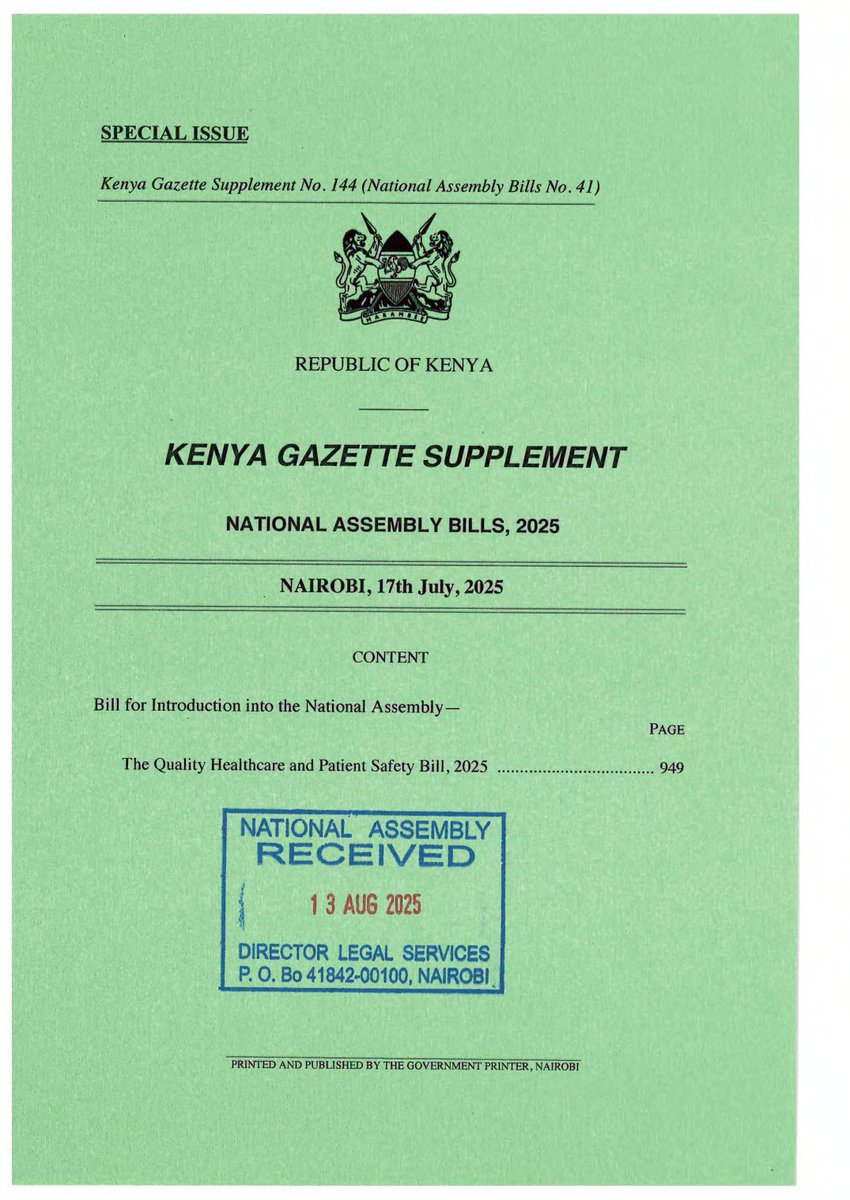
So there’s a healthcare bill in Parliament by Kimani Ichung’wah, currently at Second Reading
And if you care about your taxes, you should be paying attention.
In fact, I warned about this last week, that a lot of these bills in Parliament aren’t really about solving problems
They’re about creating offices that the Executive can fill.
Now look at this one 👇🏾
It proposes creating a new body called the Quality Healthcare & Patient Safety Authority.
Its roles?
- License hospitals
- Accredit facilities
- Inspect and audit
- Enforce compliance
- Handle complaints
- Set national standards
But, aren’t these roles already being done by KMPDC, PPB, even SHA, etc.?
And the bill is NOT scrapping those existing bodies.
This new authority will have duplicate roles to existing bodies.
They are creating another layer, offices,s and another budget.
Now, check the appointments side.
The CEO and top officials? Appointed by the Health CS.
And the CS? Appointed by the President.
This is exactly what I was talking about.
This is what parliament is doing now,
Create a new authority → create positions → Executive then uses them to reward friends.
And it’s all funded by our taxes.
At the same time, we’re being told:
“There’s no money.”
“We need austerity.”
But somehow there’s always money for:
-new authorities
-new boards
-new tribunals
Meanwhile:
Hospitals are struggling
Patients are fundraising
Healthcare workers are overwhelmed
I don’t know,
Maybe I’m overthinking it.
But it’s starting to look like these “reforms” are less about wananchi
and more about expanding space for appointments.
What do you think?
Citizen TV just exposed something heartbreaking.
Students are dropping out of university because of Ruto ’s new university funding model.
A medicine 2nd-year student from a poor background, whose father is a boda boda rider, was placed in Band 5.
His appeal was rejected.
Now drowning in over KSh 200K arrears and expected to raise another 200K+ every year.
Tell me, how is that even realistic?
And he’s not alone. Another student at Kabianga University is facing the same predicament, and many others are already out.
This is exactly what some of us warned about, but they didn’t care.
Because this model was never about helping students.
It was about optics, enrollment numbers, headlines, and PR.
“Get them in first, deal with the fallout later.”
Now the fallout is here.
Students are dropping out quietly.
Families are breaking under pressure, and dreams are dying in silence.
And suddenly, silence from the same people who were selling this model.
No more updates or hashtags.
Same thing with CBC.
Children at home because of fees, but the government keeps pretending and lying that everything is fine.
Then you hear “TUTAM.”
Tutam, what exactly?
You cannot destroy people’s futures and expect TUTAM to cover it up.
When I say we need to start visiting these Mpigs,
You need to take me seriously.
Yesterday, Mpigs passed the National Infrastructure Fund bill that allows this gluttonous regime to borrow 5.9T in 3 years.
Look, our current debt is at around 12.5T, a borrowing of 5.9T takes that to 18.9T.
If currently our debt ratio to GDP is at 68% which is above the 55% debt anchor .
These parliamentarians need to be reminded that THE PEOPLE SHALL EXERCISE THEIR POWER DIRECTLY !
This bill should make us just as angry as Finance Bill 2024 did.
Amkeni 📌
Because aflatoxin contamination in milk has been linked to serious health risks, including liver cancer, we began conducting independent milk testing in Nairobi and Mombasa to protect consumers.
Since December, we have completed four more rounds of testing. Our most recent samples from Tuzo, Ilara, Brookside, and Bio Milk passed the 3 aflatoxin tests, and camel milk samples collected in Eastleigh also showed no contamination.
Only one sample of camel milk had very minute traces of formalin, an improvement from last December, when several camel milk samples had traces. We are still awaiting results for metal contaminants, such as lead, before releasing a full report.
We will continue regular testing every 4-8 weeks for milk and 8-12 weeks for sugar.
Kenyans deserve safe food. We will keep watching.
May you all have a blessed weekend.
Serious question for Kenyans.
How does a country that says it has no money for free education,
- no money for rural roads,
- no money for hospitals
while children in some rural areas are still studying under trees,
Suddenly have:
- KSh 17 Billion for State House, higher than even the US
- MPs are among the highest paid globally
- And plans to borrow trillions more
What exactly are Kenyans supposed to conclude from this?
And then they ask why Kenyans are angry.
Ruto Must Go
I’m a landlord. It’s a tough business. I had a tenant, Mr. Alvarez. Never late on rent for 5 years. Then, the checks stopped. I went to his apartment. He didn’t open the door. I used my key. The apartment was empty. No furniture. Just a mattress on the floor and Mr. Alvarez sitting on it. “I’m sorry,” he said, looking down. “My wife got sick. The medication… I sold everything. I’ll leave today.” I looked at the empty room. I went to my truck. I grabbed my tools. “I’m not kicking you out,” I said. “But I am raising the rent.” He looked terrified. “I’m raising it to $0 for the next six months.” He started to cry. “And,” I added, “I’ve got an extra sofa in storage. And a table. Let’s get this place looking like a home again.” That was three years ago. His wife recovered. He’s back on his feet. He insists on paying me double rent now to "pay back the debt." I put the extra money into a fund for other tenants who struggle. A roof over someone’s head is a business. Keeping a roof over their head when they’re drowning? That’s a duty.
Anonymous participant
The candidate stopped mid-interview. "Can I ask you something?"
HR nodded.
"This is my 7th interview this month," she said.
"And you're the 7th person to ask about my biggest weakness."
HR shifted in his chair.
"I've prepared for everything.
Technical assessments.
Behavioral questions.
Case studies.
Culture fit."
She opened her notebook.
Pages of research.
Company values highlighted.
Recent news articles printed out.
"But you haven't asked me a single question about how I'd actually do this job."
Silence.
"Where do I see myself in five years?" she continued.
"I see myself solving the problems you're hiring me to solve.
But we haven't talked about those problems yet."
HR replied.
"These are standard questions to assess..."
"To assess what?" she gently interrupted.
"Whether I can recite the same answers everyone else memorized from career blogs?"
She wasn't angry. Just tired.
"You have a 30% turnover problem in customer success"
"Three competitors just poached your best people."
HR's eyes widened.
"I know because I researched.
I prepared."
She closed her notebook.
"I need this job. I really do.
My savings run out next month.
But I need you to need someone who can solve problems.
Not someone who performs well in interviews."
Long pause.
"So, what would you like to know about how I'd fix your retention crisis?"
HR pushed aside his question sheet.
"Tell me everything."
They talked for one hour.
Real problems. Real solutions.
No script.
Go the offer.
She started three weeks later.
Within six months:
Turnover down to 8%.
Two competitors tried to poach her.
She stayed.
Because they finally asked the right questions.
And she'd been waiting 7 interviews
to give the right answers.
Cookie-cutter questions get cookie-cutter candidates.
The exceptional ones?
They're interviewing you right back.
And if you're not ready for that conversation,
you're not ready for exceptional talent.
Ending slums sounds noble but we must be honest. You cannot end slums by moving people, you end slums by ending the conditions that create slums. If people are earning wages that cannot sustain basic living then relocating them to new buildings does nothing. You’ve only changed the structure not the situation.