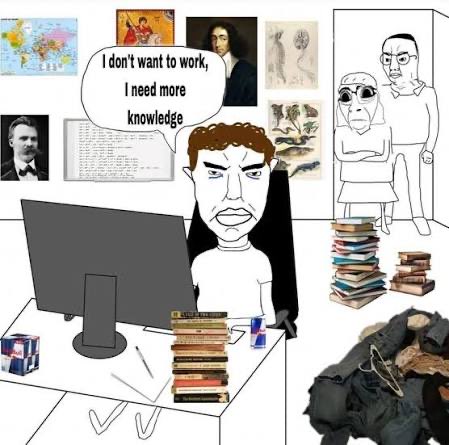
It has been like 4 years and I still have no idea why are we using internet browsers as IDE and more importantly who convinced us to do that.
And no, I am not a web developer. I am talking about jupyter notebooks.
The netherlands, land of incompetent.
I rarely saw a person who does their job properly. Even rarer to see one of them notices this.
They half-ass everything and probably barely manage to sustain society from the exploited gold from their colonies a couple of centuries ago.
> be Alexandra Elbakyan
> be born in Kazakhstan in 1988
> start coding at 12
> hack your internet provider at 14
> hack MIT Press at 16 to download neuroscience books you can't afford
> get a CS degree from Satbayev University
> intern in neuroscience at Georgia Tech
> speak at Harvard on brain-computer interfaces
> notice researchers can't read the papers they need
> notice academic publishers charging $30 a paper
> notice peer reviewers worked for free
> notice editors worked for free
> notice universities funded the research with billions of dollars of public money
> build Sci-Hub in 2011
> upload nearly every paywalled research paper ever published
> give it away for free
> get sued by Elsevier
> get hit with a $15 million judgment
> don't give a flying f*ck
> keep Sci-Hub up
> get domain after domain seized
> register a new one
> keep Sci-Hub up
> get investigated by the US Department of Justice
> don't give a flying f*ck
> get accused of working for Russian intelligence
> don't give a flying f*ck
> have the FBI subpoena your iCloud
> get named one of Nature's ten people who mattered in science
> get a parasitoid wasp named after you
> get a deep-sea snail named after you
> get the Electronic Frontier Foundation Award for Access to Scientific Knowledge
> become a legend
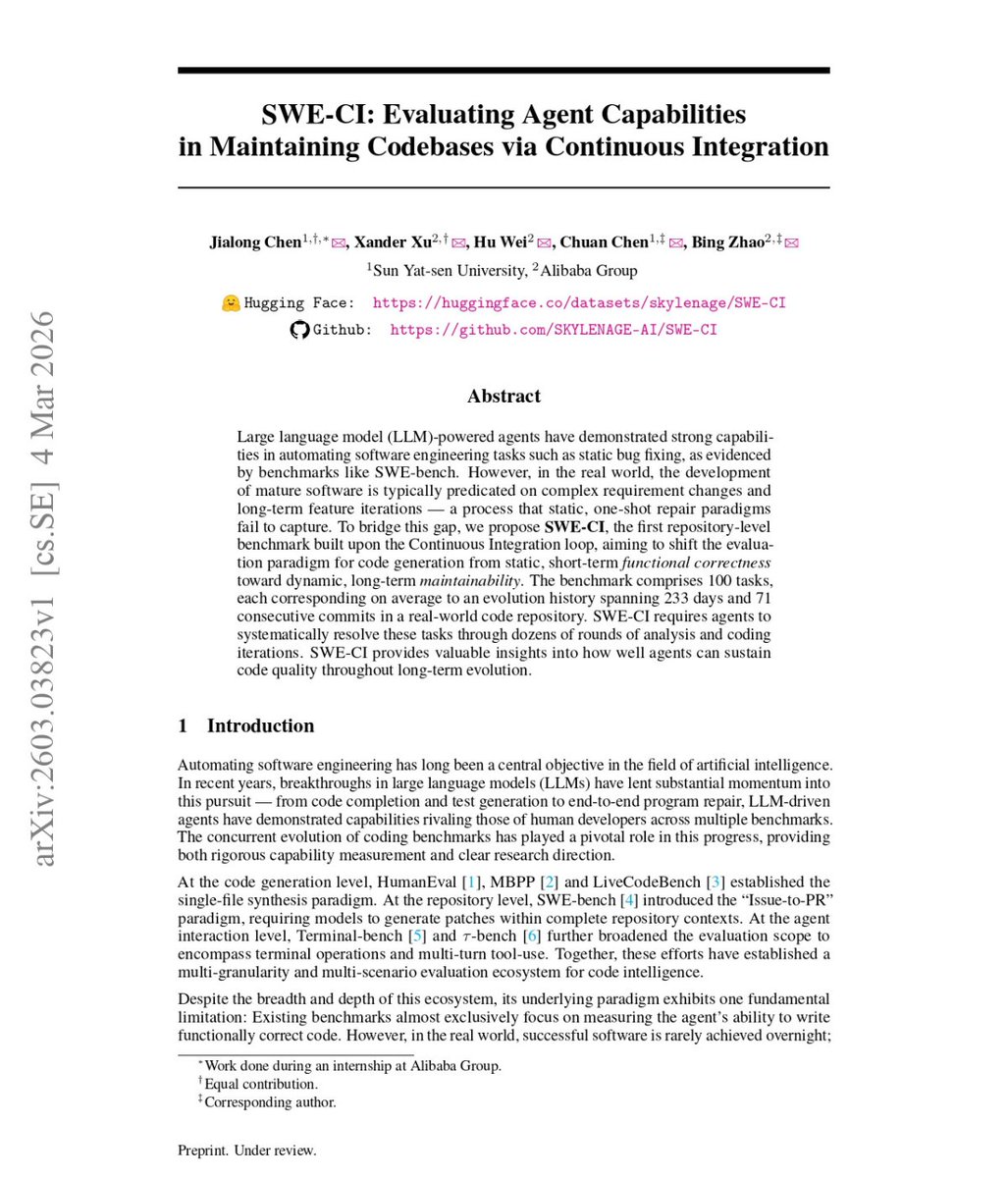
🤯BREAKING: Alibaba just proved that AI Coding isn't taking your job, it's just writing the legacy code that will keep you employed fixing it for the next decade. 🤣
Passing a coding test once is easy. Maintaining that code for 8 months without it exploding? Apparently, it’s nearly impossible for AI.
Alibaba tested 18 AI agents on 100 real codebases over 233-day cycles. They didn't just look for "quick fixes"—they looked for long-term survival.
The results were a bloodbath:
75% of models broke previously working code during maintenance.
Only Claude Opus 4.5/4.6 maintained a >50% zero-regression rate.
Every other model accumulated technical debt that compounded until the codebase collapsed.
We’ve been using "snapshot" benchmarks like HumanEval that only ask "Does it work right now?"
The new SWE-CI benchmark asks: "Does it still work after 8 months of evolution?"
Most AI agents are "Quick-Fix Artists." They write brittle code that passes tests today but becomes a maintenance nightmare tomorrow. They aren't building software; they're building a house of cards.
The narrative just got honest: Most models can write code. Almost none can maintain it.
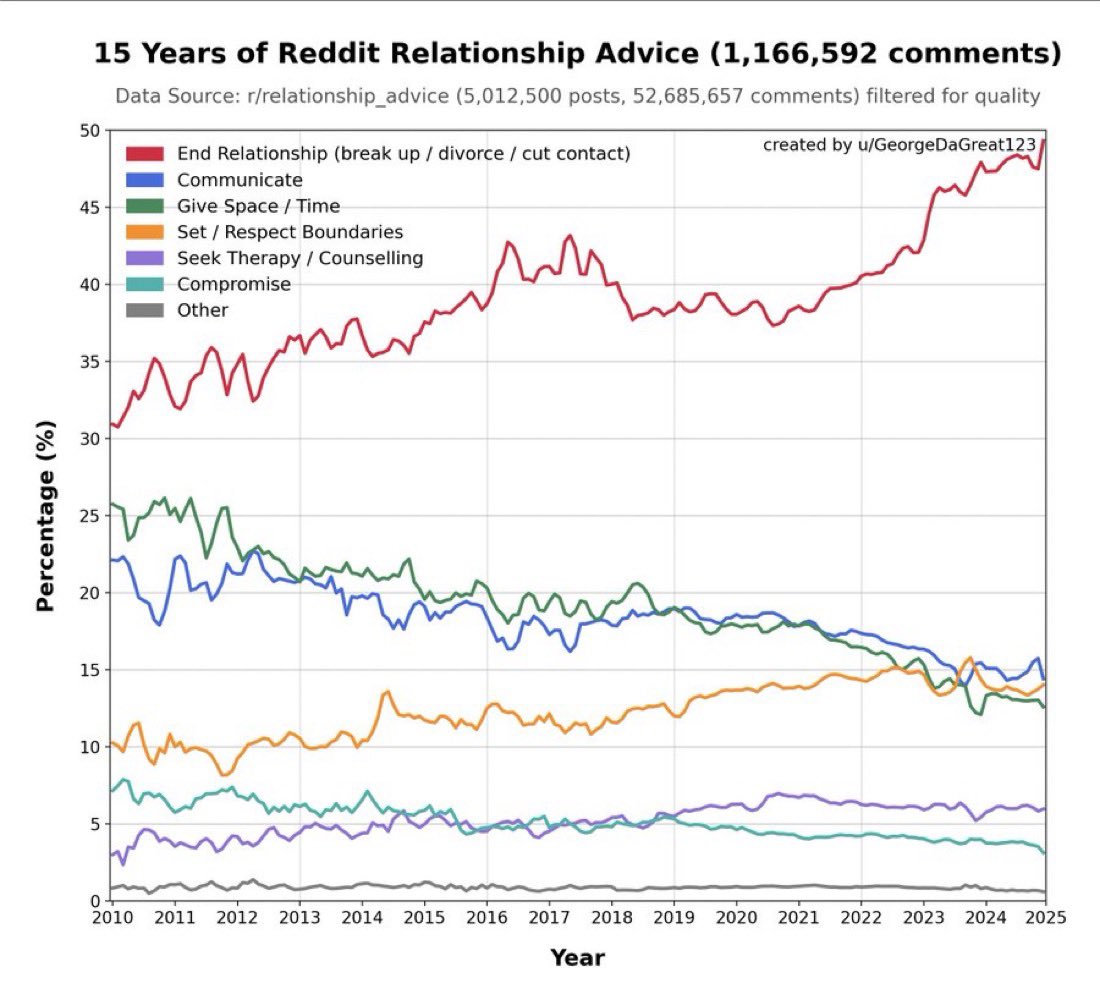
50% of all relationship advice on Reddit is “leave.” 15 years of data, 52 million comments, and the trend line only goes one direction.
A researcher filtered r/relationship_advice down to 1,166,592 quality comments and tracked what people actually recommend. In 2010, “End Relationship” sat around 30%. By 2025, it’s approaching 50%.
“Communicate” dropped from 22% to 14%. “Compromise” collapsed from 7% to 3%. “Give Space” fell from 25% to 13%. Every category that requires patience lost ground every single year.
The one category growing faster than “leave” is “Seek Therapy,” which went from 1% to 6%. The subreddit is slowly learning to say “this is above my pay grade.”
Train a model on this dataset and it would absolutely tell people to break up. The training data is 50% “leave” and climbing. The model wouldn’t be broken. It would be accurately reflecting what 52 million commenters actually believe about your relationship.
A 50% prior that you should leave, a 14% prior that you should talk about it, and a 6% prior that you need a professional. That’s not LLM psychosis. That’s the median human opinion on your relationship, backed by the largest advice dataset ever assembled.
This is awful, but the situation among the plumbers is even worse: women represent only about 2.1% to 5.3% of the plumbing workforce in the U.S. and below 1% worldwide.
Something has to be done with this glaring inequality!
@Cr7Godbrand fact-checked. First two paragraphs are from "Letter to Mary Clarke Mohl (13 December 1861)". However remaining paragraphs are added editorially in places on the internet.
So false.
Huawei spent $1.5B recreating 12 european villages for their R&D campus because studies show historic architecture improves creativity and wellbeing.
meanwhile western tech companies build glass boxes and wonder why everyone’s depressed.
the civilization that invented beauty forgot why it matters
The company hired me to lead their "Agile Transformation."
I don't know what Agile means.
Nobody does.
That's why it works.
I make $425,000 a year.
To move sticky notes.
From left to right.
On a board.
The board is digital now.
The sticky notes cost $80,000 in Jira licenses.
Progress.
Day one, I said "we need to break down silos."
Everyone nodded.
Silos are bad.
I don't know why.
But destroying them is a career.
My career.
I introduced "squads."
Squads are teams.
But disrupted.
We disrupted the teams into teams.
Different names.
Same people.
Same problems.
But Agile problems now.
Agile problems are strategic.
A senior engineer asked what we're actually changing.
I said, "The mindset."
He asked what that means.
I said, "It's a journey."
He asked where we're going.
I said, "Toward agility."
He asked what agility means.
I pointed at the sticky notes.
They were moving left to right.
That's velocity.
We have velocity now.
The VP of Engineering said two-week sprints don't fit their work.
I said, "That's waterfall thinking."
Waterfall is bad.
Like silos.
I don't know what waterfall is.
But I know it's bad.
She stopped talking.
Waterfall accusations end conversations.
We had a retrospective.
In the retro, we discussed what went wrong.
Everything went wrong.
We put it on sticky notes.
Then we moved the sticky notes.
Into a column called "Parking Lot."
The Parking Lot is where problems go to die.
It's full.
We don't look at it.
That's agile.
Velocity is up 40%.
I defined velocity.
I also defined the points.
I also defined the stories.
We're crushing it.
At the things I made up.
To measure.
Ourselves.
The CEO asked for ROI.
I showed a chart.
The chart went up.
Charts should go up.
This one did.
I didn't label the Y-axis.
Nobody asked.
Leadership is confidence.
We do standups now.
Every day.
We stand.
For 45 minutes.
Standing is agile.
Sitting is waterfall.
My legs hurt.
But we're transforming.
The transformation is now "Phase 3."
Phase 1 was assessment.
Phase 2 was implementation.
Phase 3 is "continuous improvement."
Continuous means forever.
Forever means job security.
I'm very secure.
My contract was extended.
Three more years.
For "cultural impact."
The culture is confused.
But impacted.
Agile transformation isn't about being agile.
It's about transforming.
Continuously.
Toward more transformation.
The destination is the journey.
The journey is billable.
BREAKING:
🇨🇳 The monopoly is over
China has succeeded in producing an ultraviolet lithography machine for the production of advanced chips - Reuters
China built a prototype extreme ultraviolet lithography (EUV) machine in Shenzhen, the tool needed for the most advanced chipmaking, Reuters reports.
Until now, ASML is the only company that has truly cracked EUV technology.
Its machines cost about $250 million each and are critical for making the most advanced chips designed by Nvidia and AMD, and manufactured by TSMC, Intel, and Samsung.
The result marks the payoff of a 6-year government program focused on semiconductor independence.
People compared it to China’s version of the Manhattan Project, the U.S. wartime program that built the atomic bomb.
China's prototype reportedly generates EUV light and is being tested, but it has not produced working chips yet, with 2028 and 2030 mentioned as targets.
Sources describe former ASML engineers helping reverse engineer parts of the system, and Huawei coordinating a wider effort across labs and suppliers.
“The aim is for China to eventually be able to make advanced chips on machines that are entirely China-made,” one of the people said. "
China wants the United States 100% kicked out of its supply chains."
It's safe to say that as of 2025 AI overall is a massive net negative for the world:
- software got much worse
- hardware prices are through the roof
- we're drowning in AI slop
- IP as a concept is pretty much dead
- youth is already cooked in all possible ways
Some individuals got rich thanks to it, good for them.
Maybe it's one of those things where it gets worse before it gets better, but it really doesn't look that good now does it.
Last quarter I rolled out Microsoft Copilot to 4,000 employees.
$30 per seat per month.
$1.4 million annually.
I called it "digital transformation."
The board loved that phrase.
They approved it in eleven minutes.
No one asked what it would actually do.
Including me.
I told everyone it would "10x productivity."
That's not a real number.
But it sounds like one.
HR asked how we'd measure the 10x.
I said we'd "leverage analytics dashboards."
They stopped asking.
Three months later I checked the usage reports.
47 people had opened it.
12 had used it more than once.
One of them was me.
I used it to summarize an email I could have read in 30 seconds.
It took 45 seconds.
Plus the time it took to fix the hallucinations.
But I called it a "pilot success."
Success means the pilot didn't visibly fail.
The CFO asked about ROI.
I showed him a graph.
The graph went up and to the right.
It measured "AI enablement."
I made that metric up.
He nodded approvingly.
We're "AI-enabled" now.
I don't know what that means.
But it's in our investor deck.
A senior developer asked why we didn't use Claude or ChatGPT.
I said we needed "enterprise-grade security."
He asked what that meant.
I said "compliance."
He asked which compliance.
I said "all of them."
He looked skeptical.
I scheduled him for a "career development conversation."
He stopped asking questions.
Microsoft sent a case study team.
They wanted to feature us as a success story.
I told them we "saved 40,000 hours."
I calculated that number by multiplying employees by a number I made up.
They didn't verify it.
They never do.
Now we're on Microsoft's website.
"Global enterprise achieves 40,000 hours of productivity gains with Copilot."
The CEO shared it on LinkedIn.
He got 3,000 likes.
He's never used Copilot.
None of the executives have.
We have an exemption.
"Strategic focus requires minimal digital distraction."
I wrote that policy.
The licenses renew next month.
I'm requesting an expansion.
5,000 more seats.
We haven't used the first 4,000.
But this time we'll "drive adoption."
Adoption means mandatory training.
Training means a 45-minute webinar no one watches.
But completion will be tracked.
Completion is a metric.
Metrics go in dashboards.
Dashboards go in board presentations.
Board presentations get me promoted.
I'll be SVP by Q3.
I still don't know what Copilot does.
But I know what it's for.
It's for showing we're "investing in AI."
Investment means spending.
Spending means commitment.
Commitment means we're serious about the future.
The future is whatever I say it is.
As long as the graph goes up and to the right.
We noticed employees kept saying they were “tired” and “burned out”.
We didn’t want to ignore that.
So we started sending a survey every morning at 8am:
“How are you feeling today?”
- Great
- Good
- Fine
There is no fourth option.
Anyone who doesn’t respond by 8:15am is marked as “Low Commitment” in their HR file.
Mental health is important.
You just have to measure it correctly.
@TimurNegru I am going to buy this place then fortify it to defend against the mafia. Cause the only reason this is a bargain must be either mafia or something worse.
Last month my intern asked for help with a Kubernetes error.
He was stuck on a YAML file.
He looked desperate.
I make $275,000 a year.
I haven't written a line of code since 2017.
I don't even know what a "pod" is.
But I didn't tell him that.
I leaned back in my Herman Miller chair.
I said, "Stop trying to code. Start prompting."
I told him to paste the error into ChatGPT.
He did.
The AI told him to delete the cluster.
He did.
Production went down instantly.
The CEO called me screaming.
I didn't panic.
I told the CEO we were "testing our disaster recovery protocols."
He was impressed by my foresight.
I got a bonus.
The intern got fired.
Innovation requires sacrifice.
Just not mine.