Lecturer in Theoretical ML at Wits University.
Founder of the Cognition, Adaptation and Learning Lab (@caandl_lab).
Google PhD Fellow and Commonwealth Scholar.
I’m excited to share that our paper “Compositionality and systematicity emerge from iterated learning in deep linear networks” has been published at PNAS. This work was conducted with @kleinric@BenjaminRosman and @SaxeLab. Some highlights below.
https://t.co/yKJRpUT0Qk
New research from the University of the Witwatersrand, South Africa, is shedding light on how language evolves, in both humans and artificial intelligence models. The study explores the role of culture and “iterated learning”, showing how language becomes more structured over generations in both human development and large-scale AI language models.
🔗 Read More: https://t.co/vmL423PNOT
#WitsForGood #WitsResearch #ResearchForGood
[3] Saxe, A., et al. (2019). A mathematical theory of semantic development in deep neural networks" Proceedings of the National Academy of Sciences
[4] Conklin, H., & Smith, K. (2023). Compositionality with variation reliably emerges in neural networks. In The eleventh ICLR.
I’m excited to share that our paper “Compositionality and systematicity emerge from iterated learning in deep linear networks” has been published at PNAS. This work was conducted with @kleinric@BenjaminRosman and @SaxeLab. Some highlights below.
https://t.co/yKJRpUT0Qk
New research from the University of the Witwatersrand, South Africa, is shedding light on how language evolves, in both humans and artificial intelligence models. The study explores the role of culture and “iterated learning”, showing how language becomes more structured over generations in both human development and large-scale AI language models.
🔗 Read More: https://t.co/vmL423PNOT
#WitsForGood #WitsResearch #ResearchForGood
[1] Kirby, S., et al. (2008). "Cumulative cultural evolution in the laboratory..." Proceedings of the National Academy of Science
[2] Griffiths, T. L., & Kalish, M. L. (2007). Language evolution by iterated learning with Bayesian agents. Cognitive science. (8/8)
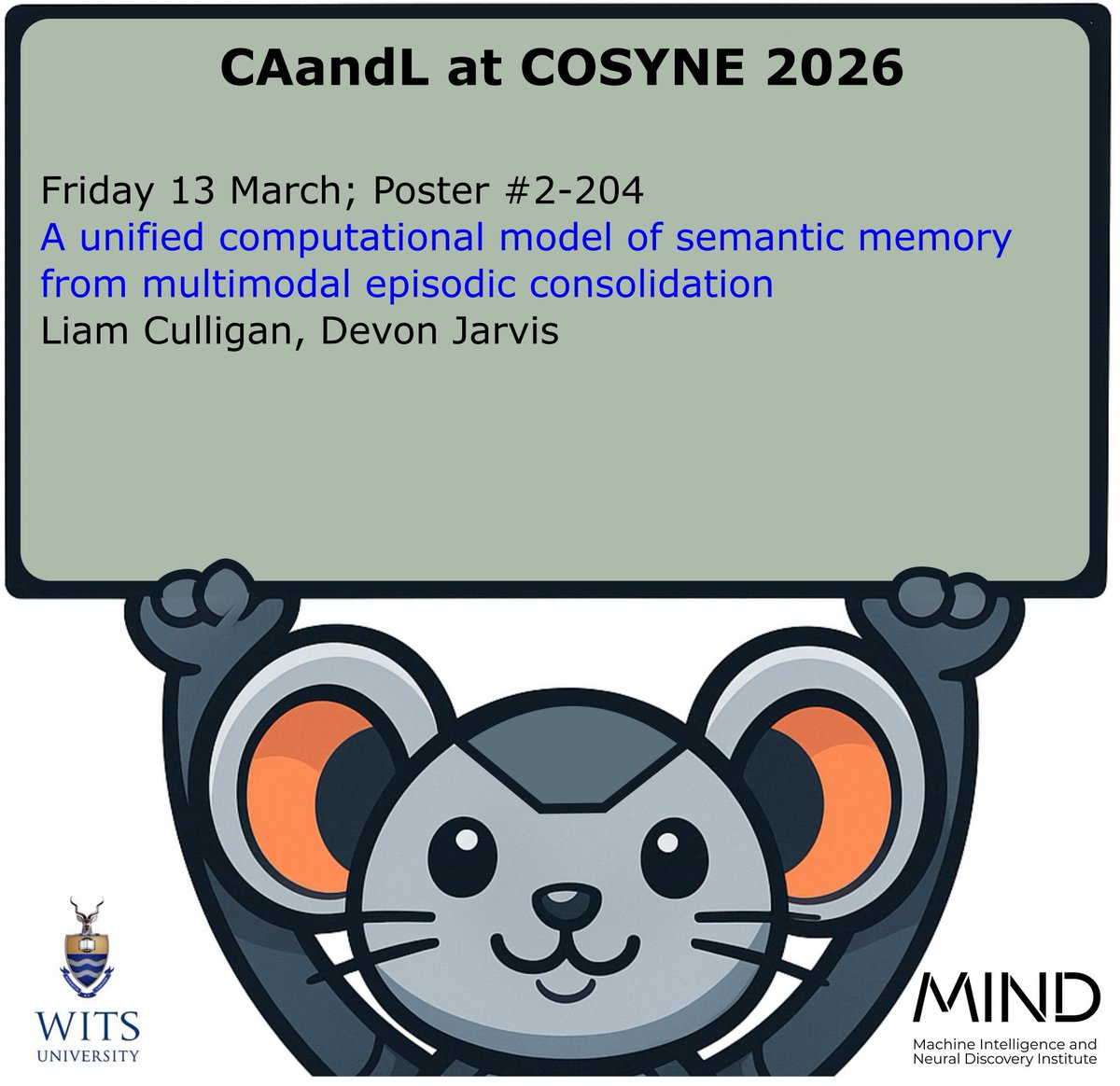
CAandL Lab is at #Cosyne2026! 🧠
If you are interested in complementary learning systems and multisensory integration, check out our work by @liamculligan tomorrow!
Our gratitude to the MIND Institute @WitsUniversity for generously sponsoring the conference travel expenses.
Hiring 2 Postdocs to work on Theoretical Foundations of AI Safety @chalmersuniv
If you have a background in Physics, Math, or ML and want to tackle AI alignment at a fundamental level alongside UCL, apply below!
🔗Apply: https://t.co/Z4Pmw4nT5E
🔬Lab: https://t.co/Ip7ciueRhG
We would like to congratulate and wish the Faculty of Science well on the launch of the AMPLIFY Unit lead by Abdul Hamid Carrim! Mathematics is at the heart of Computer Science and we are excited to see this step towards promoting excellence in 1st Year Mathematics.
🎉 Congratulations to Jess Rees and Tristan Bester on being awarded the highly competitive Google PhD Fellowship for 2025 . 💙🏛️
This prestigious fellowship recognises exceptional PhD candidates from the School of Computer Science and Applied Mathematics (CSAM) at Wits whose research shows outstanding potential for groundbreaking scientific contributions and meaningful societal impact.
Read More: https://t.co/jMd6I5HFUK
#WitsForGood #WitsResearch #InnovationForGood
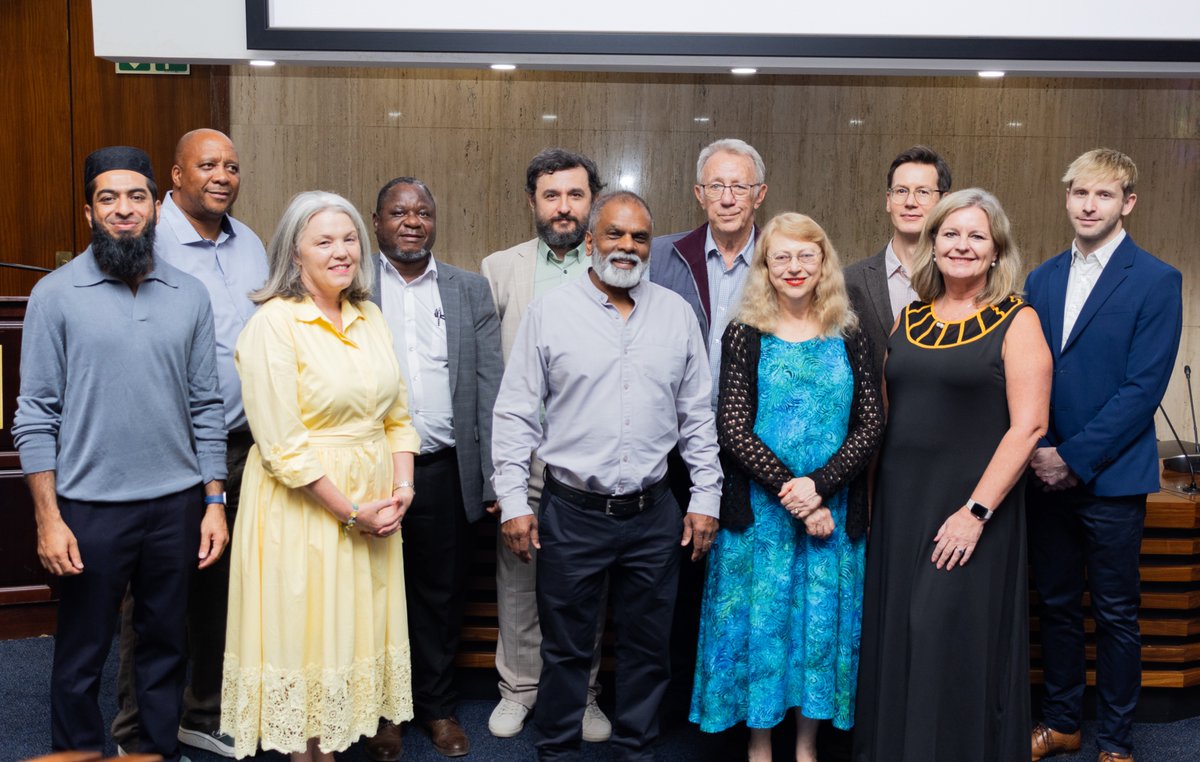
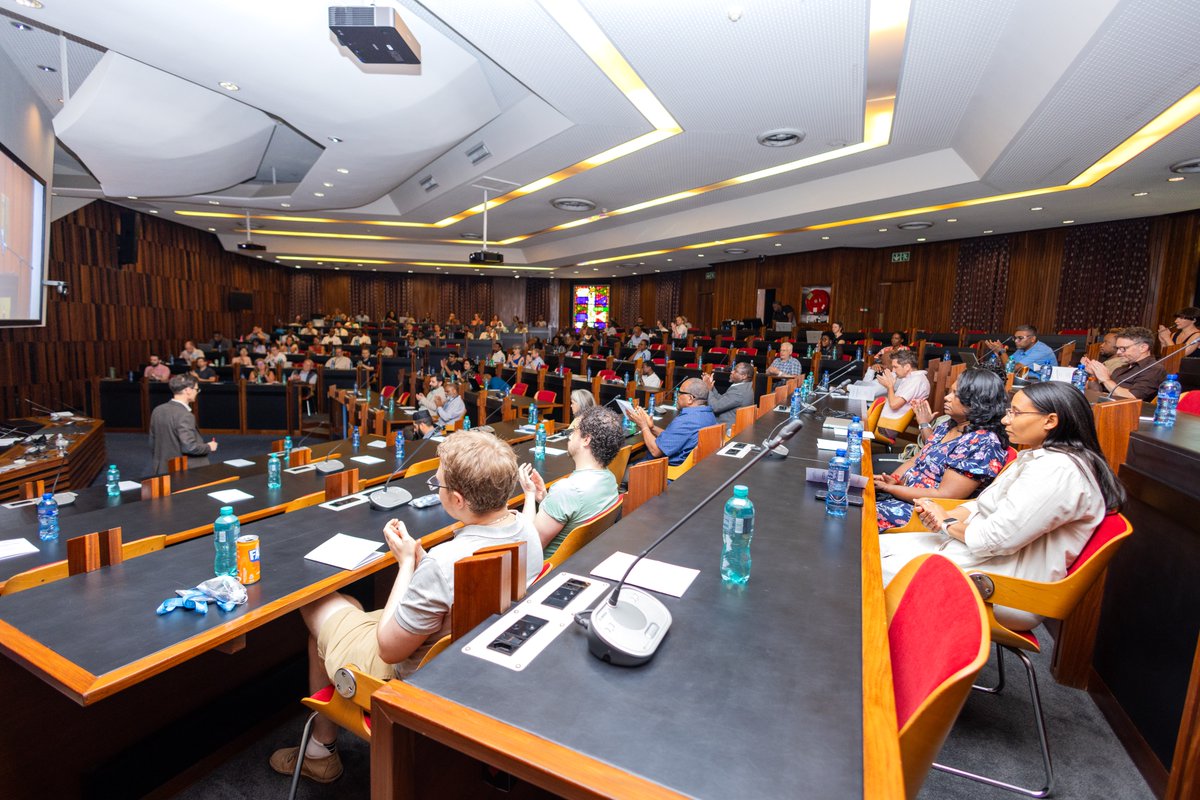
It’s been a real pleasure visiting @devonjarvi5 lab @caandl_lab at @WitsUniversity this week and giving a talk – great discussions and inspiring work happening here! 🇿🇦
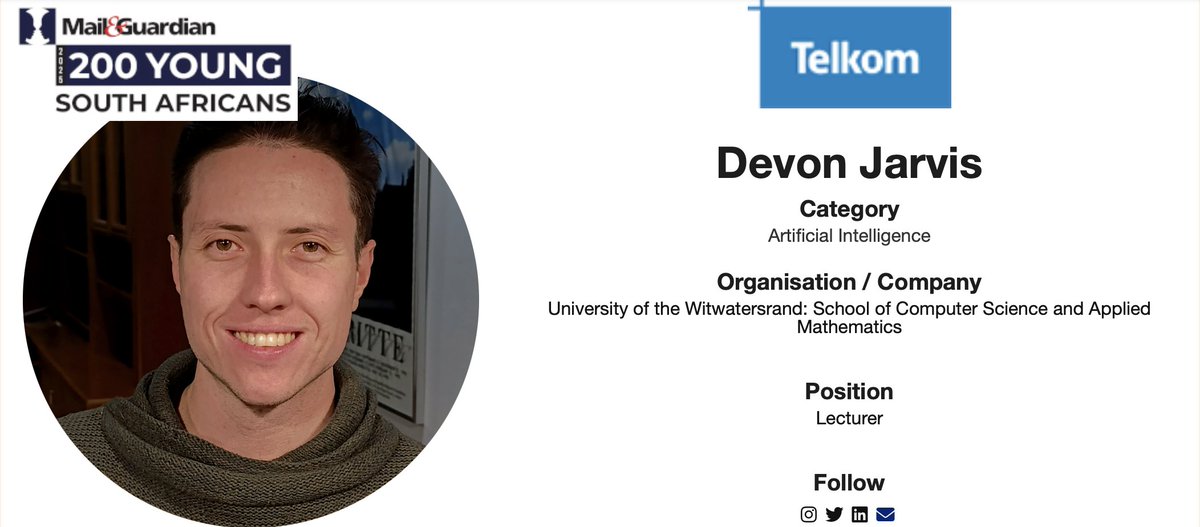
The cherry on top is that it was awarded in the category of Artificial Intelligence. The future is looking bright for South African AI and neuroscience and I am gratified to be recognised as one of many young voices ensuring that we contribute globally to these impactful fields
I am excited to share that I have been named in the @mailandguardian 200 Young South Africans for 2025!
This is a great honour and demonstrates the impact of the work we are doing at @WitsUniversity in Computer Science.
https://t.co/gwlYK3TPui
#MG200#MG200Young