Was @dfat, @agdgovau & private law, now @globalshieldhq. Posting on AI, trade, supply chain resilience, and more, from Aus perspective. Views only my own.
NEW: The Department of Commerce just published new AI and semiconductor export control regulations that close some major loopholes in existing export controls. The regulation includes new rules to: (1) counter Chinese smuggling of AI chips; (2) restrict Chinese companies from renting access to AI chips; and (3) block Chinese chip designers from making AI chips at TSMC.
These rules are a major step forward. They still contain some key gaps that need to be filled urgently in a follow-up rule, namely, they do not block Chinese companies from buying AI chips inside the United States or renting access to AI chips at US-based data centers. However, this rule will help and is the first good-faith effort to actually close loopholes in export controls in a year and a half. Hopefully more will follow.
1. Countering Chinese smuggling of AI chips. The rule expands export controls on AI chips to five new countries: Singapore, Malaysia, Thailand, Indonesia, and Brazil. It does not block AI chip orders to these countries, but requires a US government review (unless it is a US company that meets certain requirements). This is a massively needed step. Singapore, Malaysia, Thailand, and Indonesia have been the second, fourth, fifth, and eighth biggest importers of AI chips this year.
The rule doesn’t cover Taiwan itself, where chip smuggling is a massive issue (exports of AI chips to China are still not illegal under Taiwanese law), and still doesn’t prevent AI chip sales to Chinese companies in the United States, which somehow remain legal. Ultimately, large orders of AI chips by untrusted companies in any country should require a license to fully combat smuggling, as Chinese companies will move to buy AI chips anywhere there isn’t a license requirement. But this is a start.
2. Restricting Chinese companies from renting access to AI chips. The rule creates a new remote access control that restricts companies from providing Chinese companies with remote access to AI chips. It requires a US export license to provide Chinese companies with access to 12 million TPP or more (equivalent to ~200 of the most advanced Blackwell chips, or ~800 H100 chips). This applies to chips already shipped, as well as all future shipments. Some of these requirements even apply retroactively; Commerce says existing rules already barred data supplying a majority of a data center’s compute to Chinese companies, and tells companies that violated this to self-disclose. This effectively kills the business of neoclouds like Megaspeed that exist to provide remote access to large amounts of AI compute to China.
The biggest gap is the remote access controls do not apply to data centers in the United States. So Chinese companies can legally train on large numbers of Blackwells at data centers in Northern Virginia. This gap should be closed immediately with a new rule that uses Commerce’s US persons authority to capture this activity. The rule also exempts recommendation algorithms, so impact will depend on enforcement. Last, new authorities included in the text of the AI Overwatch Act would strengthen Commerce's ability to enforce these controls--that bill should pass immediately.
3. Blocking Chinese chip designers from making AI chips at TSMC. The rule closes loopholes in existing controls that Chinese companies are likely exploiting to illicitly make AI chips at TSMC or Samsung. Specifically, it now requires any Chinese chip designer who is seeking to make a 16/14nm or more advanced chip at TSMC/Samsung to get a U.S. export license, and restores old rules that weren’t being enforced until now that require any untrusted company anywhere in the world to get a license to make an AI chip at TSMC or Samsung. This is a significant upgrade.
Overall, this is a major step forward to countering Chinese smuggling of and access to advanced AI chips. The work here is not done, as there are some critical loopholes that remain open and need to be closed in a follow-up rule (namely those related to activities inside the United States). Commerce should move extremely quickly to close these. But this is the first time in over 18 months that the administration is starting to take export controls seriously, and does represent a meaningful step forward.
Last, the fact that the Commerce press release says this rule was “written by and at the direction of the Department of Treasury and the National Security Council” is remarkable and unprecedented. I have never seen a BIS rule that was not written by BIS. That implies that Commerce was dragged kicking and screaming over the finish line by the White House and Treasury, and instructed to publish this rule rather than the rumored weaker one that it preferred. Remarkable.
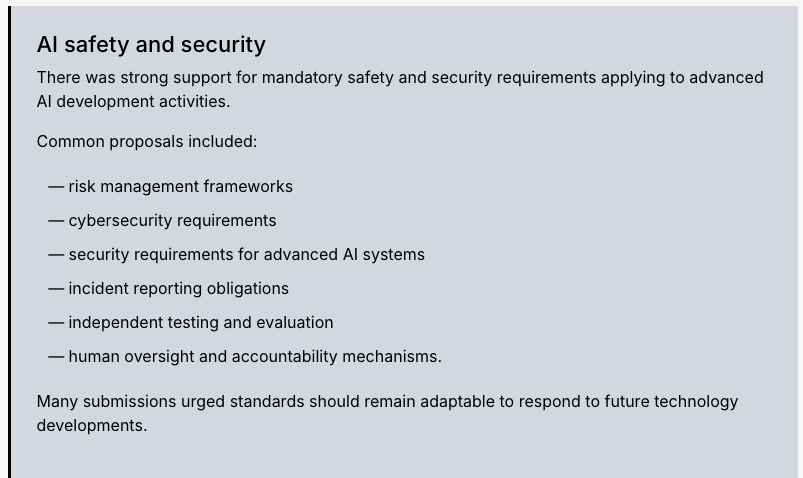
Australia's Office of AI has released a summary of the feedback it received in consultations to establish Australian Standards for AI (from 1,533 submissions!). No major surprises 1/2
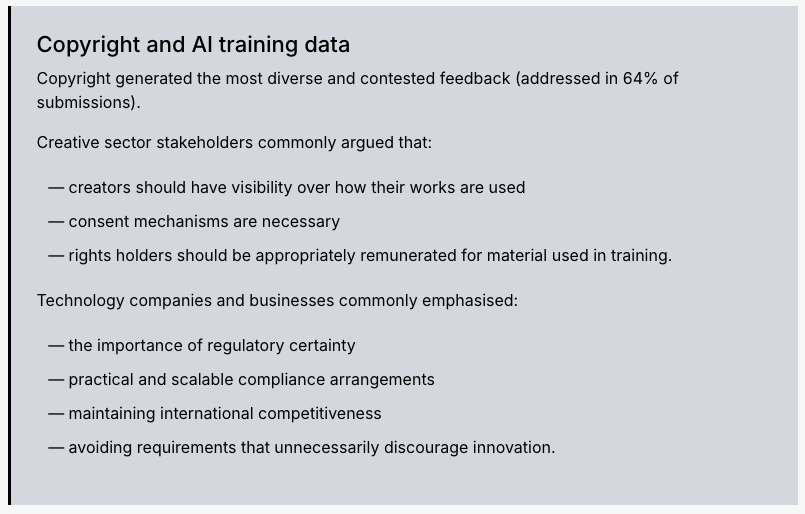
Who is the best legal academic in the US to speak with about (1) what’s likely to happen when generative AI fair use cases start reaching the Supreme Court, and (2) whether / how any changes to Australia’s Copyright Act & training compute regime could be used as evidence in those cases?
Great overview of where the EU AI Act is now and where it's going, from @longtermgov and @Christophkw. This question on the legal basis for regulating AI companies is one that is often raised in Australia too.
🇪🇺 How is the EU AI Act shaping AI governance? Here, Prof. Christoph Winter explains the AI Act and GPAI Code of Practice. He also discusses the challenges of enforcement, European AI sovereignty, and international cooperation. Many thanks Christoph! https://t.co/JdN6ZEj87k
There are some significant recommendations coming out of the Rapid Review into the Services Australia OpenAI incident (the government says they have accepted all of them). Here are some hot takes on what's good and some potential pitfalls to watch for.
Australia’s PM has just announced new mandatory AI Safety & Security protections which will be legislated, including a new AI regulator, security requirements, risk management obligations, independent evaluation, and mandatory incident notification. https://t.co/NVn4TUY56p
Looking forward to seeing the legislation itself once it is released - but a very exciting time in Australia's AI governance journey. Busy few months ahead before Christmas.