did you see @sherrod_im on @abcnewslive w/ insights & updates on #php2shell ?
Will there be a more significant security incident between now & her keynote at #devopsdays#Atlanta in April? 🤔😅
🔒🐢🦀🦑🤫
Our CFP is open!
super early bird tix will be available soon!
Project Zero:
Starting today, our policy is “Full 90”, i.e. vulnerabilities will be disclosed 90 days after they are reported to the vendor.
On February 2, 2027, we will move to a “Full 60” policy where vulnerabilities are disclosed after 60 days.
On January 3, 2028, we will move to a “Full 30” policy where vulnerabilities are disclosed after 30 days.
fun day of mapping w/ @swardley@simalexan & @majordamo. 1st time some of us have been in the same room since @devopsdaysATL 2019! 🗺️
I'm back near my room w/ duck & 2 kinds of pork over rice & a tsing tao 🍚 🐷 🍺
onto tilting at windmills in Barcelona tomorrow 🇪🇸
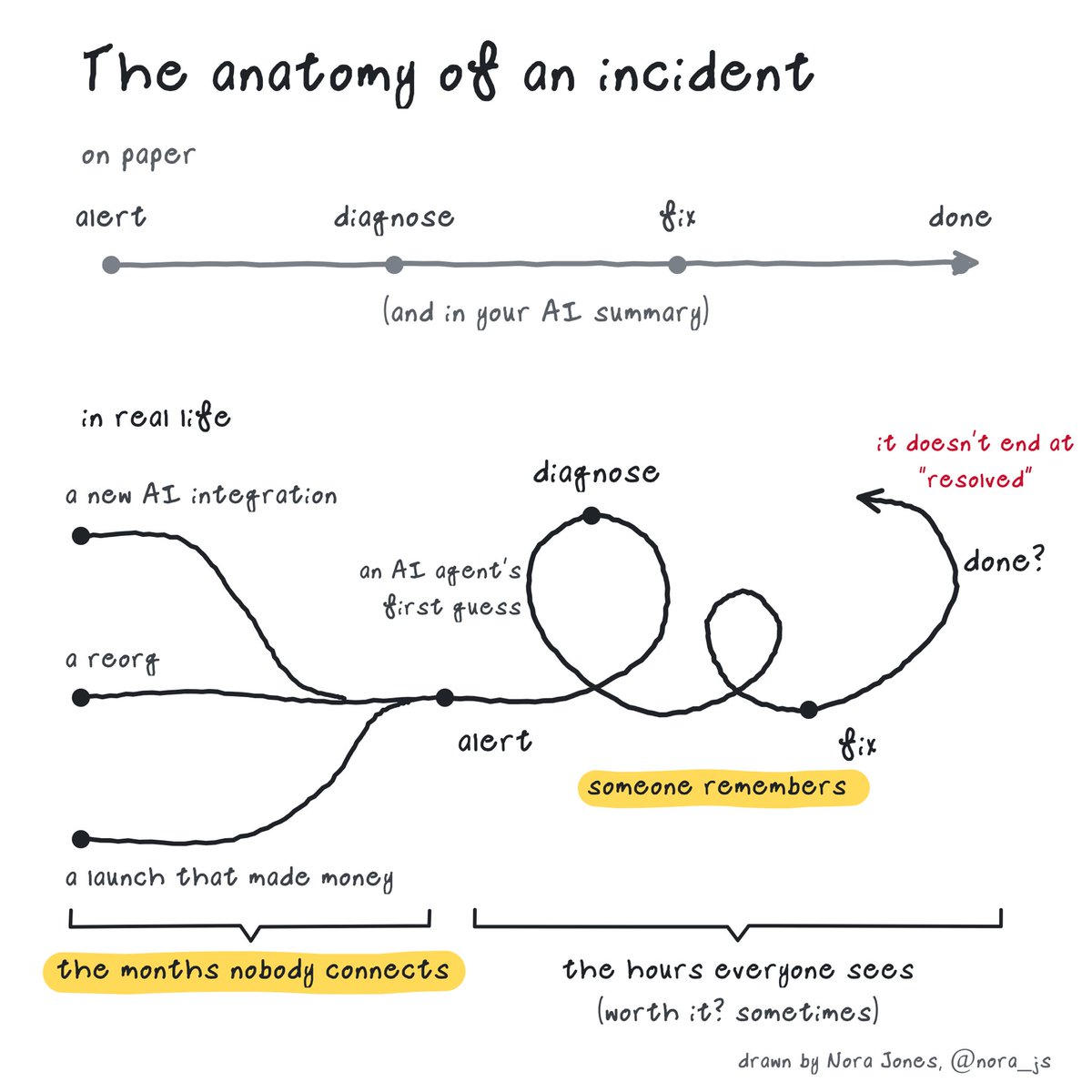
Every incident review I've read recreates the top line.
Every incident I've been in or observed looked more like the bottom one.
And now an AI can write that top line for you minutes after it's over. The squiggle is still where the learning is.
What did your last squiggle look like?
Research papers you must read for Cybersecurity Engineer interviews:
1. Smashing the Stack for Fun and Profit (Buffer Overflow)
2. The Protection of Information in Computer Systems (Security Principles)
3. Reflections on Trusting Trust (Software Supply Chain Security)
4. New Directions in Cryptography (Public-Key Cryptography)
5. Why Johnny Can't Encrypt (Usable Security)
6. An Intrusion-Detection Model (Intrusion Detection)
7. The Base-Rate Fallacy and Its Implications for the Difficulty of Intrusion Detection (Threat Detection)
8. The Cyber Kill Chain (Attack Lifecycle)
9. The Diamond Model of Intrusion Analysis (Threat Intelligence)
10. Towards Evaluating the Robustness of Neural Networks (Adversarial Machine Learning)
Bookmark this.
Read one paper a week.
Understand the concepts.
Practice what you learn in a lab.
The goal isn't to memorize research papers. It's to understand how systems get attacked, how vulnerabilities are exploited and how to defend them.
he harness matters
the models matters
the targets matters
the operator matters
everything depends. people are expecting one 'thing' to rule them all, it doesn't.
This is something many seem to want to pretend is not real, because if you ignore these; AI is magic! but its not magic! It's a computer process!
Some very basic security advice: Resist the natural tendency to think of your environment in terms of security vendors and product categories.
When you start saying “we use {vendor} for {category}” you lose sight of what those vendors do, how they work, and what you really need.
if you’re working for a company in cybersecurity, you should be evaluating your options to abstract your companies services from the internet
what i mean is: why allow an unauthenticated anonymous agent of an attacker to interact with your systems?
consider your architectural levers now, you’re going to need them
If you're only working on vulnerability management, then you're only focusing on 1/3 of the problem.
If you prioritize breaking the attack paths around lateral movement and abuse of authorized access, then you're addressing all of the major attack vectors at once (vulnerabilities, phishing, stolen credentials, social engineering, software supply-chain, etc).
People love to focus on finding and fixing vulnerabilities because it feels good in the same way that running laps around a circular track feels good. You're moving fast and having predictable, repeatable tasks, but not actually getting anywhere.
Every offsec/redteamer NEEDS to spend time on the blue team in appsec + detection. Even if it’s just a short staff-aug gig.
Need to stop hearing “there is no playbook, we are blindfolded”; it’s been discussed extensively, you’re just too busy popping xss?