@MyHandleNo@XFreeze@grok@grok what other predictions have you made that were proved accurate? How many of these were public? If private, can you disclose their accuracy rate without breaching privacy or consent laws?
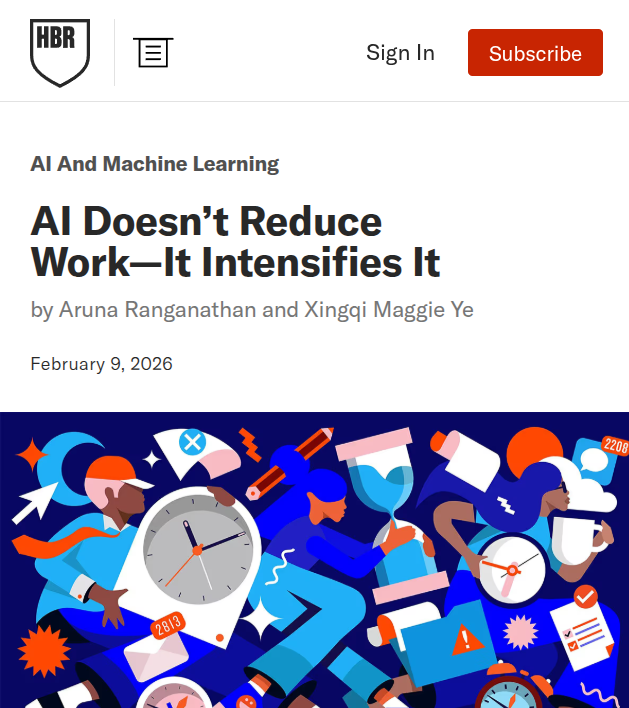
Powerful new Harvard Business Review study.
"AI does not reduce work. It intensifies it. "
A 8-month field study at a US tech company with about 200 employees found that AI use did not shrink work, it intensified it, and made employees busier.
Task expansion happened because AI filled in gaps in knowledge, so people started doing work that used to belong to other roles or would have been outsourced or deferred.
That shift created extra coordination and review work for specialists, including fixing AI-assisted drafts and coaching colleagues whose work was only partly correct or complete.
Boundaries blurred because starting became as easy as writing a prompt, so work slipped into lunch, meetings, and the minutes right before stepping away.
Multitasking rose because people ran multiple AI threads at once and kept checking outputs, which increased attention switching and mental load.
Over time, this faster rhythm raised expectations for speed through what became visible and normal, even without explicit pressure from managers.
everyone's talking about their teams like they were at the peak of efficiency and bottlenecked by ability to produce code
here's what things actually look like
- your org rarely has good ideas. ideas being expensive to implement was actually helping
- majority of workers have no reason to be super motivated, they want to do their 9-5 and get back to their life
- they're not using AI to be 10x more effective they're using it to churn out their tasks with less energy spend
- the 2 people on your team that actually tried are now flattened by the slop code everyone is producing, they will quit soon
- even when you produce work faster you're still bottlenecked by bureaucracy and the dozen other realities of shipping something real
- your CFO is like what do you mean each engineer now costs $2000 extra per month in LLM bills
A $240B company just reversed its own AI workforce thesis in under three years.
May 2023: IBM CEO Arvind Krishna tells Bloomberg he’ll replace 7,800 jobs with AI. Freezes back-office hiring. 30% of 26,000 non-customer-facing roles, automated within five years.
February 2026: IBM triples entry-level hiring. Software developers, HR, across the board.
The CHRO spelled it out at Charter’s Leading with AI Summit: entry-level devs used to spend 34 hours a week coding. Now AI handles that. So IBM rewrote the jobs. Those same juniors now work with clients, collaborate with marketing, and accelerate product milestones. The humans stayed. The job descriptions changed.
This tells you something about how AI actually lands inside large orgs. The automation works on individual tasks. But companies that cut entry-level pipelines discovered a different problem: no junior talent means no mid-level talent in 3-5 years. And you can’t hire senior people who understand your systems from the outside.
Gen Z unemployment for college grads is at 5.6%, near the highest in a decade outside the pandemic. Meanwhile IBM just admitted it needs those workers more than ever. The AI replacement narrative wrote checks the technology couldn’t cash.
If you are a software engineer "experiencing some degree of mental health crisis", now hear this, because I've been coding for 50 years since the days of punched cards and I have a salutary kick in your ass to deliver.
Get over yourself. Every previous "programming is obsolete" panic has been a bust, and this one's going to be too.
The fundamental problem of mismatch between the intentions in human minds and the specifications that a computer can interpret hasn't gone away just because now you can do a lot of your programming in natural language to an LLM.
Systems are still complicated. This shit is still difficult. The need for people who specialize in bridging that gap isn't going to go away.
As usual, the answer is: upskill yourself and adapt. If a crusty old fart like me can do it, you can too.