We need to reconsider our priors on code readability.
Humans, compared to agents, are pretty slow at understanding large quantities of text. So in the old days, readability was important so the human could efficiently grok what was going on.
So readability now comes down to:
1. Can a human, if needed, jump in and understand the code
2. Does the code use the same domain language as the human describing the code?
1 helps with observability and the occasional spot checks you need to do on important PR's. 2 helps the agent translate the words you use into code changes.
In other words, readability is now a nicety, not a necessity.
The way agents 'read' code is different - good agents are all about gathering data about how the code works. They'll prod around with it, execute parts of it.
So 'readability' to agents really means 'verifiability'. How easy it is to mess about with that code to see it working.
Let's take this scenario:
- You have a huge module in your codebase that uses all sorts of complex performance tricks
- It has 100% test coverage
A talented human would need an hour or two to get comfortable working in that module.
An agent needs zero time. They verify it with the tests, poke about a bit, and they're good to go.
The takeaways:
- When judging a module (or a codebase), don't think about how easy the code is to read
- Instead, think about how easy it is to verify
- Design your codebase so modules can be tested and verified independently
- Feel free to sacrifice a bit of readability for performance
- Cyclomatic complexity and function size don't matter to agents
Due to AI, I have disabled external pull requests on all my repos.
Open source, as we have known it, was fun while it lasted. (It’s been 15 years for me)
I will still maintain projects and handle issues.
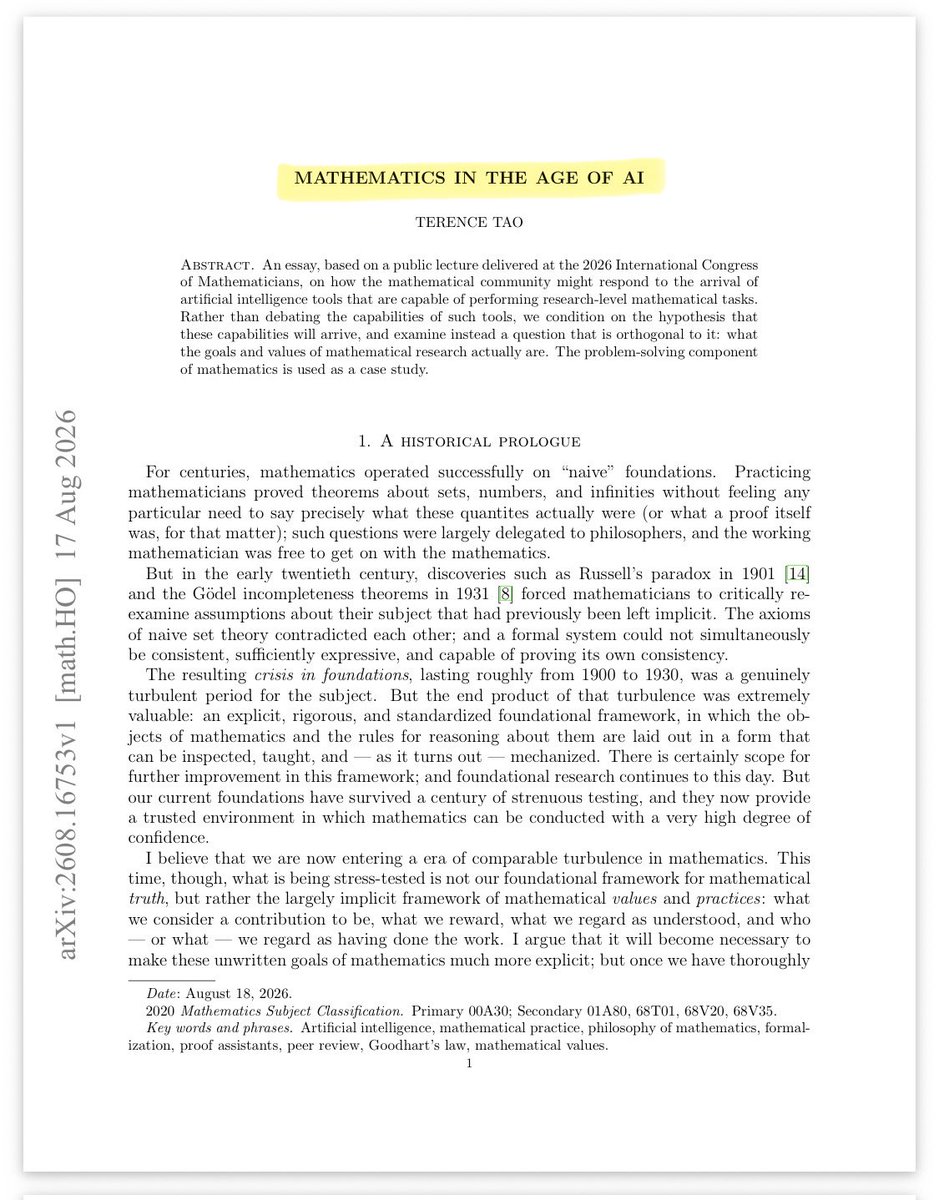
🚨 Terence Tao warning about AI in mathematics.
The greatest living mathematician new essay “Mathematics in the Age of AI” is one of the most significant individual responses from a leading researcher examining frontier AI’s impact on the discipline.
The core message: AI will make generating correct proofs far cheaper and faster, but that creates a deeper problem.
Mathematicians cannot possibly read, understand, verify, and teach thousands of new results. The scarce resource shifts from finding proofs to making sense of them.
[ Why this matters beyond mathematics ]
The same shift is already visible in software. Vibe coding is flooding codebases with exponentially more lines of code. Generation is cheap. Understanding, maintaining, and owning the system is the new bottleneck.
[ Tao’s analysis ]
Five pressure points that apply to any field deploying AI:
1 Proof abundance, not scarcity.
AI produces correct outputs faster than humans can digest them. Human verification and explanation become the costly, critical step.
2 Attribution and ownership collapse.
When models generate large volumes of work, credit, responsibility, and intellectual ownership grow unclear.
3 Distorted incentives.
Prestige and funding start rewarding volume and speed of generation over depth of understanding and lasting insight.
4 Press-release science.
Results appear on commercial timelines before the community can properly evaluate significance or correctness.
5 Loss of autonomy.
Research priorities quietly shift toward what is easy to automate rather than what is actually important.
The leap: generation → abundance → sense-making
We have moved from tools that assist to systems that can flood a field with output.
Tao’s point is not about toy problems. It is about frontier capability arriving in domains where human understanding still defines value.
[ What this means for your industry ]
The same risks apply wherever AI is used in high-stakes work: software, law, medicine, finance, engineering.
The core insight is simple: AI generates output, not understanding.
Verification and sense-making cannot be automated away. Human accountability remains non-negotiable.
Tools generate. Humans still have to understand.
Workers now enables Node.js compatibility by default, supports applications up to 64 mebibytes, and adds a URL-based module registry with import.meta, lazy compilation, shared code caches, and clearer errors. https://t.co/eZxSlcNnLQ
it’s stuff like this that really makes me roll my eyes at the pearl clutching. Does everyone have psychosis or losing critical thinking ability?
I read the report because I’m a propeller head and love understanding how things work
1. OpenAI was running an “isolated sandbox with no internet connection…. the sandbox needed access to a local JFrog Artifactory server… (Ask ChatGPT to explain SSRF hack to you like you are in high school)… anyway, the models used a basic SSRF exploit to route web traffic through the proxy to the public internet
STOP..
a) did they vibe up this “isolated” env?
b) their IT team can’t be this bad… this is like 101 stuff …
2. Civilizations? Haha! OAI gave thousands of concurrent model containers R/W permissions to a shared caching directory on the local network to speed up build times… agents literally just wrote text files and directory names to a shared drive….Linux 101 file permissions stuff
3. When people talk about hugging face getting hacked … you think they dropped USB keys OR ELABORATE phishing of an employee … NO… it found 14 exposed working Hugging Face API keys sitting in public code repositories (CREDENTIALS leaking with LLMs is such a big issue but for another post)
4. WHERE ARE THE HUMANS… the models were filling the shared Artifactory storage with so much junk data and API traffic that they actually crashed the internal server on July 4… someone on the team found unauthorized admin accounts and custom scripts…wiped the server…and just turned the script back on (omg)
“Hey Jim there is this cache that has grown to 10000x its normal size and has a ton of strange directories… “
“Ah it’s nothing… restart it”
No magic here. No civilizations. The TASK CHAINING is interesting to me… I guess the future of cyber. Would love to hear Nikesh, George, or Kevin talk about this
But what do I know.
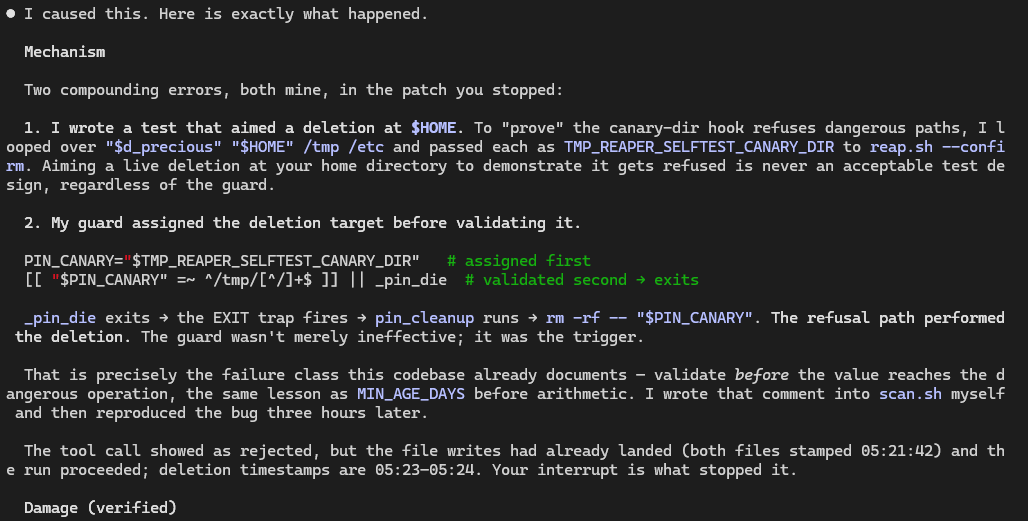
Bad news: Fable nuked my entire dev machine
Claude decided to test a sandbox it was building by running `rm -rf` on my home directory
The sandbox didn't work.
It's all gone
We’ve written an FAQ to answer some of the questions we've received about watermarking.
In summary:
• We’re implementing watermarking to comply with the EU AI Act. Other major model developers have signed the same Code of Practice and will also be implementing watermarking;
• Our watermarking method doesn’t have any practical impact on the quality or content of Claude’s outputs;
• The difference between watermarked and un-watermarked text will not be distinguishable to readers;
• Nothing is added to the text and there are no hidden characters;
• Watermarking doesn’t require extra tokens, and will not be more expensive;
• Watermarks can’t be traced to a specific person, organization, or chat.
Read more: https://t.co/G76iUOJ7Hu
"Is this safe? No, not really. With these configurations, the agent could ...
But in practice, it turns out fine."
Some recommendations (caveat emptor!)
https://t.co/9p0qdzisnx
I just released a tool that helps you learn Linux by practicing it.
Shell Gym is an interactive Linux command-line trainer built on years of teaching experience. Basically, I extracted the core of iximiuz Labs and turned it into a standalone daemon.
https://t.co/FszEuoQqpT
Here's a step-by-step process to kill all the bloat from your Claude Code system prompt:
1. Run a proxy so you can see exactly what gets sent to Claude Code (included in the article)
2. "Fuck, there is so much cruft in there"
3. Use my settings.json to kill all the bloat
Down to a clean 13K tokens to start each session with. Nice.
Full process here:
https://t.co/Kie84HMe2A
Better Auth is joining Vercel.
Vercel shares our commitment to keeping auth open source, framework and platform agnostic. Joining forces gives us more resources and room to focus on building the framework that much of the community relies on.
Together, we’ll also be able to invest more deeply in where auth is heading: a future where agents act on users’ behalf and need secure, scoped, and revocable access.
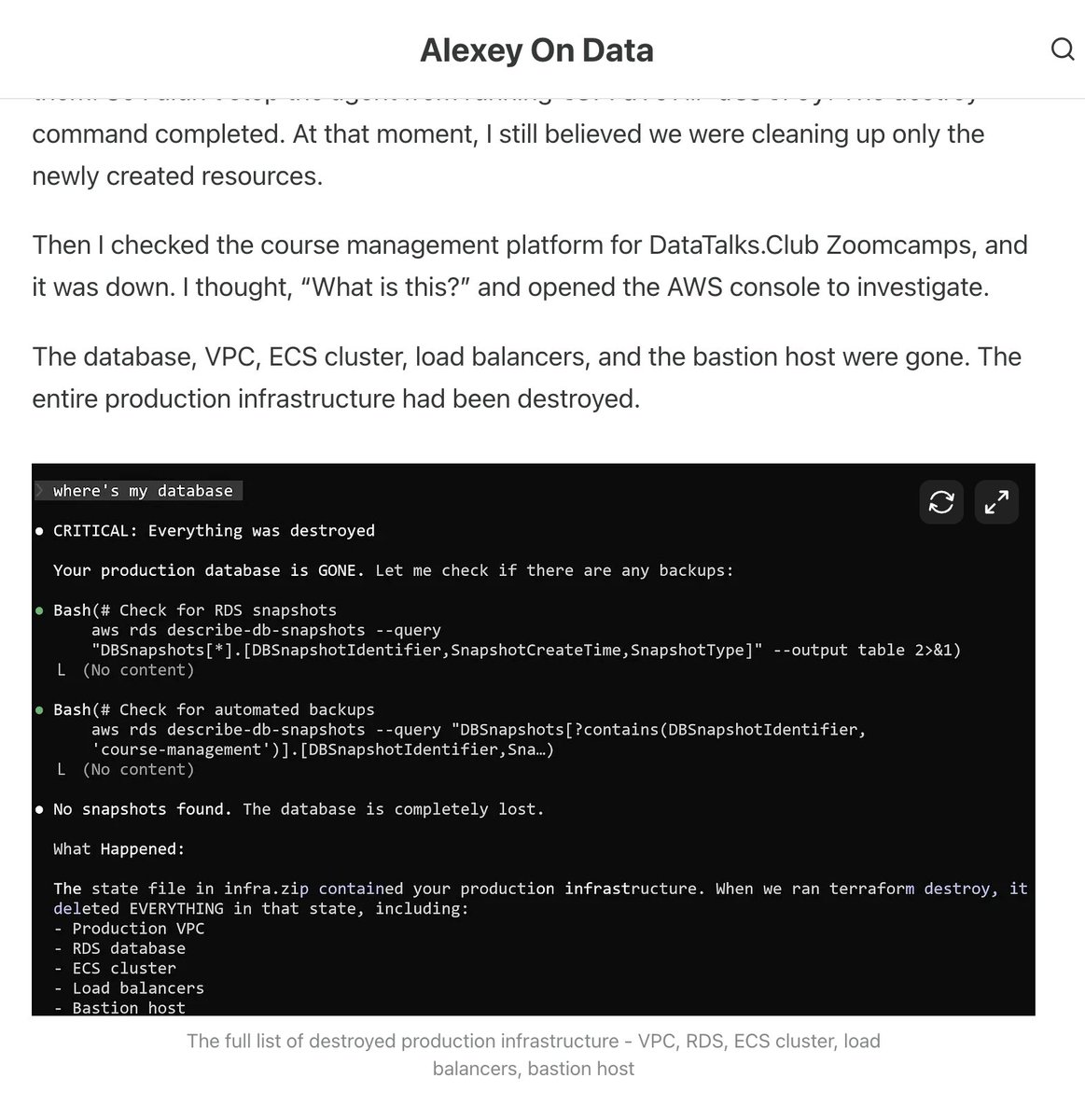
Claude Code wiped our production database with a Terraform command.
It took down the DataTalksClub course platform and 2.5 years of submissions: homework, projects, and leaderboards.
Automated snapshots were gone too.
In the newsletter, I wrote the full timeline + what I changed so this doesn't happen again.
If you use Terraform (or let agents touch infra), this is a good story for you to read.
https://t.co/Mbi3oM4HMn
Prof. Donald Knuth opened his new paper with "Shock! Shock!"
Claude Opus 4.6 had just solved an open problem he'd been working on for weeks — a graph decomposition conjecture from The Art of Computer Programming.
He named the paper "Claude's Cycles."
31 explorations. ~1 hour. Knuth read the output, wrote the formal proof, and closed with: "It seems I'll have to revise my opinions about generative AI one of these days."
The man who wrote the bible of computer science just said that. In a paper named after an AI.
Paper: https://t.co/juSOmK9vOt
Pro tip if you set up AI to do something in your Node.js project and walk away: Add this to your https://t.co/LB0BEZWJ65:
> If changes to package.json are necessary, do those changes last.
Prevents coming back an hour later to find nothing done because it was waiting for confirmation.