Couldn’t disagree more.
Transformer based LLMs are great for general purpose models, but “reasoning over the next token” is not the most effective or efficient if you’re optimizing for a specific field like Law.
Some architecture closer to a neuro-symbolic system could reason over statutes and legal ontologies while being trained on KE’s proprietary dataset which can dramatically reduce hallucinations. This is their competitive advantage moving forward.
Yes, this will be expensive in the short-term, but it’s because KE has the resources that it’s able to have agency over its own destiny in the AI paradigm.
Imagine outsourcing your most important technology to Harvey or a lab and reducing yourself to the level of your competition. Now tell me: what is your moat?
AI’s performance exponential only lasts as long as the funding does.
A case to be bearish on the OpenAI/Anthropic IPOs:
Holding labor output constant, the sustained growth of frontier labs depends on capital, which is a two-pronged problem:
1. How can you scale the free cash flow output of the business?
2. How can you raise enough to either cover for the shortfall or fast-track growth?
1. was easy for SaaS companies whose asset-light nature meant top line could scale with minimal downstream drag from COGS, Operating Expenses, CapEx to free cash flow.
Anyone who has seen an enterprise license billing from OpenAI, paid for developer tokens, or saw their Claude Pro usage limit be hit with one prompt on Opus 4.7 knows this is not the case for these companies. Factoring in token costs, CapEx spending for compute and the R&D required just to remain competitive, these are undoubtedly expensive businesses. The transition to token-based pricing gives us more than enough signal that legacy models are unable to cover the expected spending moving forward.
So they took the risk.
But exercising supplier power with substitutes available is a dangerous game. This Microsoft development should be of no surprise to anyone. Here, the question becomes: as prices correct down to consumers’ willingness-to-pay over time, what margins are you left with?
If CapEx (investments in data centers, best-in-class training and inference chips), OpEx (securing the best talent, marketing, research costs) and COGS (inference costs) are truly mission critical and top-line growth only necessitates more of these investments to remain competitive, then 1. is an immovable lever of capital in the near-term.
The only way I see this changing is if inference or (to a lesser extent) energy costs collapsed by an order of magnitude, which may take years of research, manufacturing and distribution.
Management knows this, which is why 2. has been the default solution.
We’ve all seen the notorious exponential historical ARR growth and time-horizon benchmark charts that have been touted by these labs.
But as we transition into a token-based pricing paradigm, any financially literate investor would begin to question the validity of these metrics. If F500 firms are increasingly cancelling licenses if usage exceeds their budget allocation, then is it truly “Recurring Revenue”? It’s only a matter of time before frontier labs start publicly scrutinizing each other’s accounting practices, especially once an S-1 is released.
Without a scalable lifeline of capital and an uncertain route to profitability, investors in the IPOs of these companies will see their long-term thesis of AGI tested against the volatility of the market. Any significant drawdown could be reflexively exacerbated by a combination of LP pressure from institutional investors, employee RSUs and retail panic-selling.
For the moment, as OpenAI raises $122B and plans to IPO at a $1T+ valuation, these are rightfully tomorrow’s concerns. But when that day comes, and fundraising is no longer as viable an option, a failure to answer these questions could collapse terminal value, and with it, extinguish the lab’s very existence.
Only time will tell.
*Note: I am extremely bullish frontier labs over a long time horizon. My base case is that even if the progression of model intelligence tapers-off into steady state, economic diffusion over a 10+ year period combined with Jevon’s Paradox will see productivity rise across every industry and continent.
But I do see these concerns creating a tail-risk for reflexive downside volatility after the inevitable IPOs of these frontier labs that any judicious investor should be aware of.
If you survive the local minima, you deserve the global maxima that follows.
Beyond the doors of perception lies infinity.
People who are skeptical about the revolutionary potential of AI clearly don’t know how fragile and inefficient human systems are.
Law of large numbers is the only thing that saves us.
All it takes is one LLM with universal memory and it’s game over.
The human endeavour is an unrelenting struggle against entropy.
Energy allows us to impose order on the environment around us and has the highest correlation with living standards.
Abundant, accessible energy should therefore be the primary goal for every civilisation.
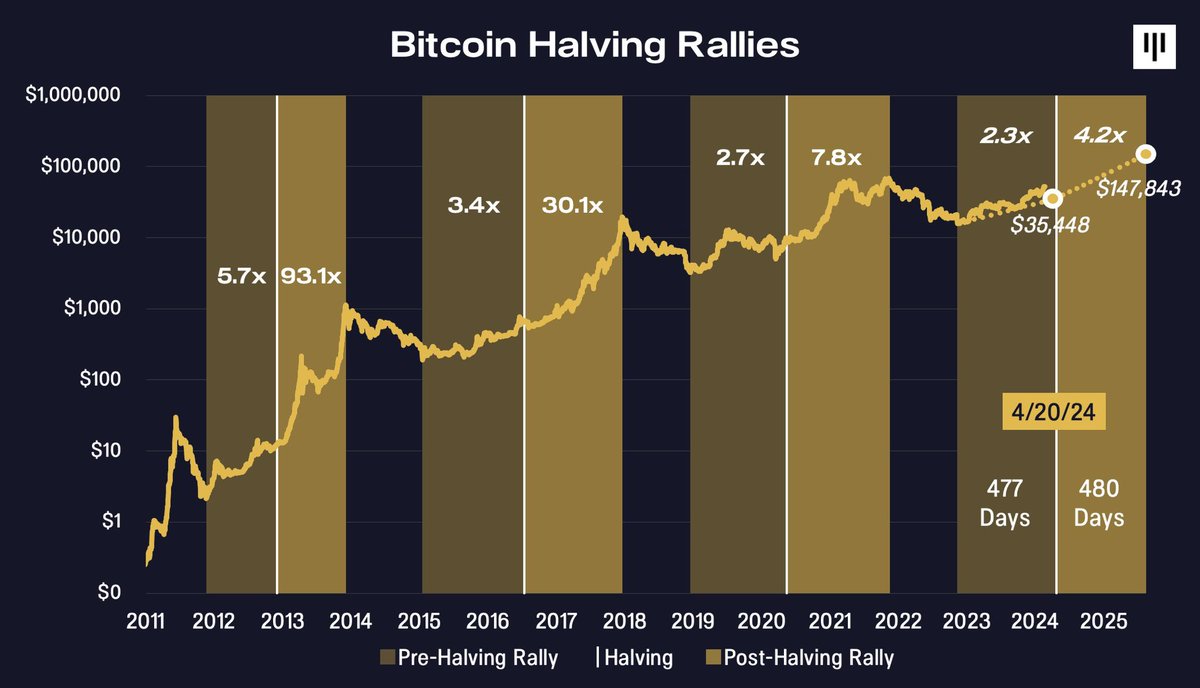
The $BTC top is NOT in.
$BTC has historically bottomed roughly 470 days before and peaked 480 days after the halving. This has played out EVERY SINGLE TIME.
Don’t let short-term market sentiment lead you to forget supply and demand. Production has halved. Price will GO UP.