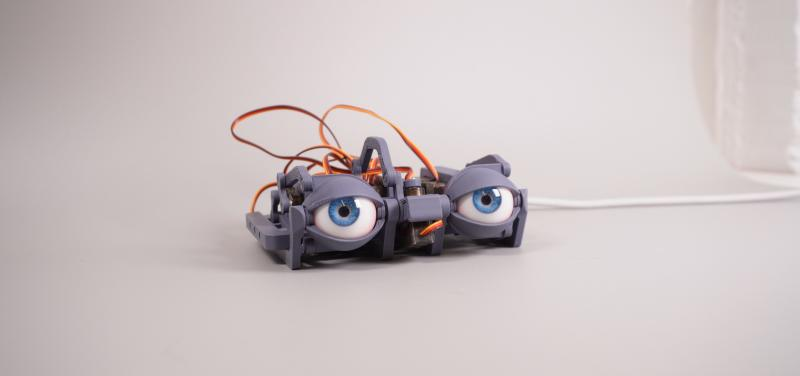
China’s robotics moment is very real.
We just saw open-source bionics creator Will Cogley - Founder of NMRobotics - launch on Douyin with Mandarin narration and cross the six-figure follower mark in days (~170k in under 10 days). The content is classic Will: step-by-step builds for bionic heads, eyes, and hands, with open files and parts available through NMRobotics.
Why this matters (and why we’re paying attention):
- Localization works. Native-language audio (human or AI dub), platform-native pacing, and active comment engagement are accelerating reach.
- Demand is hot. The speed of growth on Douyin contrasts sharply with the years it takes to build a comparable audience on YouTube - a signal of China’s current appetite for practical robotics education and kits.
- Open-source + commerce flywheel. Tutorials drive community -> community drives kit sales -> sales fund better tutorials. Douyin’s native shopping and live-commerce rails could make that loop even tighter for hardware.
- Talent & knowledge flow both ways. A localized open-source playbook seeds a bigger builder base in China while feeding back improvements (translations, parts sourcing, manufacturing know-how) into the global ecosystem.
What we’ll be watching next:
- Voice strategy: continued Mandarin narration vs. AI dubbing - and how that impacts authenticity and retention.
- Format: short build steps, parts lists, livestream Q&A, and community challenges to sustain growth.
- Commerce: in-app storefronts or live demos tied to NMRobotics kits and components.
- Community bridges: more bilingual docs, READMEs, and collabs with local maker spaces and universities.
Net-net: the winning playbook looks like localization + open-source + short video. We’re here for it - and excited about what it means for the next wave of bionic robotics builders.
We’ll get useful robots when building them feels like shipping apps—not writing PhDs. This podcast with Thomas Wolf (Hugging Face) on Sequoia’s Training Data makes a powerful case.
Key takeaways: open communities beat closed labs; LeRobot lowers the barrier so everyday software developers can become roboticists; data diversity (many homes, factories, climates) matters more than raw volume; and for safety, models should run locally—close to the hardware—not over a brittle connection. Also, we don’t need one perfect humanoid; we need a galaxy of affordable form factors that fit real work.
Why “physical AI” now? Edge compute finally caught up—developers can run large, multimodal models on-robot. Generalist policies are emerging (one model for walking, grasping, recovering). And next-gen platforms and form factors are being designed explicitly for real-world deployments, not just demos.
https://t.co/PVcBSQfaFN
“This is going to be the decade of AV, robotics, autonomous machines,” declared Jensen Huang, CEO of NVIDIA, in his CNBC interview at VivaTech. To back the claim, NVIDIA rolled out its Drive platform for automakers and unveiled Cosmos Predict-2, an AI model trained on 20 000 hours of driving data that can handle fog and rain—pushing autonomy from ‘demo’ to daily driver. Europe, he added, has the science, industrial base and clean energy to export AI rather than kilowatts, positioning the region as a hotbed for next-gen mobility.
The momentum is already visible: NVIDIA’s automotive revenue hit $329 M last quarter (+11 % YoY), while Waymo is clocking ~250 k paid robotaxi rides every week across U.S. cities. Hardware, data and demand are finally converging. For leaders in manufacturing, logistics and urban planning this isn’t a moon-shot—it’s a roadmap. Now is the time to audit your tech stack, talent pipeline and partner ecosystem to ride the autonomous wave. How is your organization preparing for a world where vehicles, warehouses and even city streets can think for themselves?
#Robotics #AutonomousVehicles #AI #NVIDIA #FutureOfWork #Innovation
Full CNBC interview: https://t.co/7E2pcJFgPa
📢 Big move in embodied AI: Skild AI just locked in a $135 million+ Series B, led by SoftBank ($100 M) with strategic checks from Nvidia ($25 M) and Samsung ($10 M), pushing the Pittsburgh-based startup to a $4.5 billion valuation.
Skild’s “Skild Brain” is a robotics foundation model that lets any robot learn on the fly—across factories, warehouses, and even the home—much like LLMs unlocked generative AI.
👥 Founders
• Deepak Pathak – CEO https://t.co/7Anc7I09Rg
• Abhinav Gupta – President https://t.co/7QmgqnPK16
Ex-CMU professors who spun the tech out of academia less than a year ago.
🏁 Why investors are excited
• Robotics startups pulled in $6.4 billion in 2024 and are already pacing ahead of 2023.
• Strategic upside: Nvidia needs “physical AI” workloads for GPUs; Samsung is doubling down on consumer robots.
• Lean leverage: Skild still has <30 employees—proof that foundation models scale impact, not headcount.
📊 Competitive landscape
• Covariant – RFM-1 model for warehouse picking.
• Figure AI – in talks to raise $1.5 B at a $39.5 B valuation for humanoids.
• Sanctuary AI – $140 M+ into general-purpose humanoids.
All are racing to ship the “AI brain” that turns single-task bots into versatile colleagues.
🌍 Market take
Industrial arms still rule volume, but the next S-curve is software-defined autonomy. The team that ships the best data flywheel and hardware-agnostic model could become the “Android for robots.”
📅 Next up
Skild plans to scale pilots with logistics and consumer-electronics partners in H2 2025. Watch for an SDK, a sim-to-real API, and maybe a data-licensing marketplace.
#Robotics #AI #EmbodiedIntelligence #VentureCapital #FutureOfWork