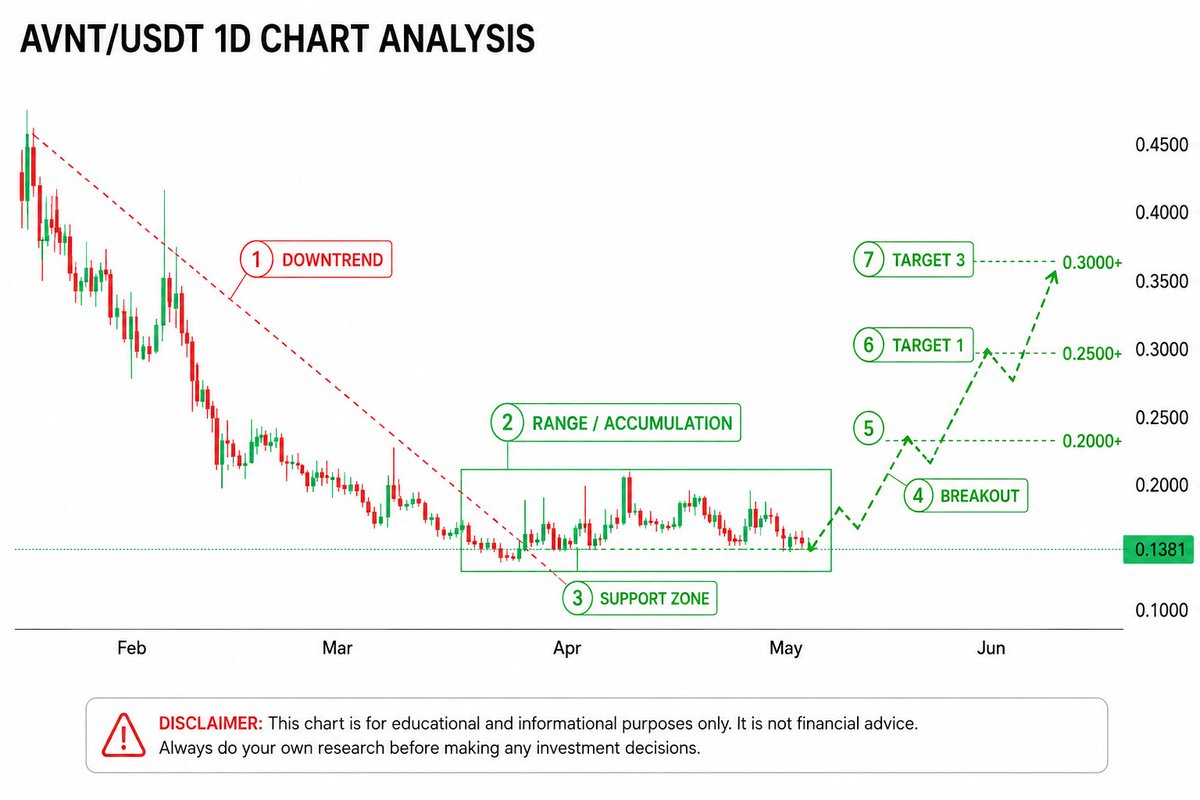
$AVNT — Quiet Before The Storm? 👀
Long downtrend. Strong support. Accumulation in play. 📊
A breakout from here could change the game.
Bullish or fake move ? What do you think ?
#AVNT#Crypto#Altcoins
UPDATE: #Cardano $ADA Founder Charles Hoskinson says "now there's 18,000 DAOs, and they control collectively, $30 billion in assets. The totality of the crypto market space in 2014 was $5 billion. So DAOs hold 6x the value of the entire crypto industry in 2014."
These analysts are the next to be replaced by AI.
Low hanging fruit.
The faster they can implement a successful AI analyst the better they will do compared to their competitors.
Grok 4.3 just became the smartest AI in the world at law and money
It took #1 on TWO brutal private tests no other model could win on “Vals AI” benchmarks
#1 CaseLaw (v2) - 79.31% accuracy
Private Q&A benchmark over real Canadian court cases. Tests deep legal reasoning, precedent understanding, and precise answers from complex judgments. (outranking GPT-5.1 at 73.42%)
#1 CorpFin (v2) - 68.53% accuracy
Private benchmark on long-context credit agreements. Evaluates how well models truly understand dense, multi-page financial contracts, terms, risks, and clauses
These are not just basic tests - they’re real-world, high-stakes legal + financial reasoning challenges
Grok 4.3 leads in accuracy on both, proving it’s not just fast or cheap… it’s the smartest at the hardest real world tasks
xAI is building the reasoning engine the world needs
we are so cooked 😭
these guys let Claude run wild on Wall St.
Look at this insider trades scanner it built in 4 mins that:
> reads every SEC filing where execs buy their own stock
> flags clusters where multiple execs buy at once
> emails me the top 3 trades every morning before the open
US military reaches deal with 7 biggest AI labs to use their AI on classified systems
Pentagon expands classified-network AI agreements to seven to eight firms — Google, Microsoft, AWS, NVIDIA, OpenAI, Reflection, and SpaceX — with Anthropic explicitly excluded.
AI now its core infrastructure. The Pentagon said AI would now be used for any "lawful operational use".
"GenAI[.]mil, the War Department's official AI platform, is already demonstrating the scale and impact of this acceleration. Over 1.3 million Department personnel have used the platform, generating tens of millions of prompts and deploying hundreds of thousands of agents in only five months. "
---
war .gov/News/Releases/Release/Article/4475177/classified-networks-ai-agreements/
NVIDIA JUST DROPPED A FREE AI MODEL THAT READS PDFS, WATCHES VIDEOS, LISTENS TO AUDIO, AND UNDERSTANDS YOUR SCREEN SIMULTANEOUSLY.
Not one at a time.
ALL AT ONCE.
In a single pass.
It is called Nemotron 3 Nano Omni and it runs 9 times faster than every other multimodal model currently available.
Think about what that actually means for how you work.
Right now you are switching between tools constantly.
One tool for transcribing your call recordings.
A different tool for analyzing your client PDFs.
Another tool for processing your training videos.
A separate workflow for understanding what is happening on your screen.
Four tools. Four contexts. Four different outputs you have to manually synthesize into one decision.
Nemotron 3 Nano Omni does all of it in one model.
One pass.
One output.
The use cases that just got dramatically simpler:
Meeting recordings where you need the transcript, the visual context, and the document references all analyzed together.
Training videos where the audio, the slides, and the on-screen demonstrations all feed into one coherent summary.
Client PDFs where you need the document content cross-referenced against your screen data and your call notes simultaneously.
Sales call transcripts analyzed alongside the proposals and the CRM data in one unified pass.
This is not a marginal improvement on existing multimodal models.
It is a 9x speed increase on a capability that was already changing how people work.
Free.
From NVIDIA.
Available right now.
Bookmark this before everyone catches on.
Follow @cyrilXBT for every AI capability shift the moment it drops.
I think this is important at the national level.
There is an immediate need for philosophical thought around how these changes will affect society.
If this were to grow and continue, then society will need to solve the career experience issue. Those without it will be challenged the most. Which is everyone if you carry this out far enough in time. One full generation.
"Anthropic's researchers found a 14% decline in the job-finding rate for workers aged 22 to 25 in highly exposed occupations since ChatGPT launched. No comparable effect for workers over 25. Entry-level roles were never just jobs. They were the training ground where junior analysts became senior analysts, where junior lawyers learned how arguments hold together. If that layer disappears, nobody has answered the question of where the next generation of senior professionals comes from."
🚨BREAKING: Anthropic just published a study mapping exactly which jobs its own AI is replacing right now.
The workers most at risk are not who anyone expected. They are older. They are more educated. They earn 47% more than average. And they are nearly four times more likely to hold a graduate degree than the workers AI is not touching.
The argument is straightforward. Anthropic built a new metric called "observed exposure." Not what AI could theoretically do. What it is actually doing right now in professional settings, measured against millions of real Claude conversations from enterprise users.
For computer and math workers, AI is theoretically capable of handling 94% of their tasks. It is currently handling 33% of them. For office and administrative roles, theoretical capability is 90%. Current observed usage is 40%. The gap between what AI can do and what it is already doing is enormous. The researchers are explicit about what comes next. As capabilities improve and adoption deepens, the red area grows to fill the blue.
The demographic finding is what makes the paper uncomfortable. The most AI-exposed workers earn 47% more on average than the least exposed group. They are more likely to be female. They are more likely to be college educated. This is not a story about warehouse workers or truck drivers. It is a story about lawyers, financial analysts, market researchers, and software developers. The exact group whose education was supposed to insulate them.
Computer programmers showed the highest observed AI exposure at 74.5%. Customer service representatives at 70.1%. Data entry keyers at 67.1%. Medical record specialists at 66.7%. Market research analysts and marketing specialists at 64.8%. These are not predictions. These are measurements of work that is already happening on AI platforms right now.
Then there is the pipeline finding nobody is talking about loudly enough.
Anthropic's researchers found a 14% decline in the job-finding rate for workers aged 22 to 25 in highly exposed occupations since ChatGPT launched. No comparable effect for workers over 25. Entry-level roles were never just jobs. They were the training ground where junior analysts became senior analysts, where junior lawyers learned how arguments hold together. If that layer disappears, nobody has answered the question of where the next generation of senior professionals comes from.
The detail buried in the paper that most coverage missed: 30% of American workers have zero AI exposure at all. Cooks. Mechanics. Bartenders. Dishwashers. The technology reshaping professional careers is completely irrelevant to roughly a third of the workforce. The divide is no longer between high skill and low skill. It is between presence and absence.
The company publishing this study is the same company selling the AI doing the replacing. Anthropic had every commercial incentive to soften these findings. They published them anyway.
If you spent four years and $200,000 on a degree to land a white collar career, the company that builds Claude just confirmed your job is more exposed than the bartender pouring drinks at your graduation party.
Source: Anthropic, "Labor market impacts of AI: A new measure and early evidence"
PDF: https://t.co/taYgsIfiTj
They wonder why banks are hesitant for this space.
One weak security link on a side app and it impacts the primary network significantly. I'm not familiar with Kelp so maybe they're technically mature, maybe they're not.
This will continually be an issue for all major L1's.
$SOL #Kelp







![rohanpaul_ai's tweet photo. US military reaches deal with 7 biggest AI labs to use their AI on classified systems
Pentagon expands classified-network AI agreements to seven to eight firms — Google, Microsoft, AWS, NVIDIA, OpenAI, Reflection, and SpaceX — with Anthropic explicitly excluded.
AI now its core infrastructure. The Pentagon said AI would now be used for any "lawful operational use".
"GenAI[.]mil, the War Department's official AI platform, is already demonstrating the scale and impact of this acceleration. Over 1.3 million Department personnel have used the platform, generating tens of millions of prompts and deploying hundreds of thousands of agents in only five months. "
---
war .gov/News/Releases/Release/Article/4475177/classified-networks-ai-agreements/](https://pbs.twimg.com/media/HHTlbAkaEAAahyz.png)


