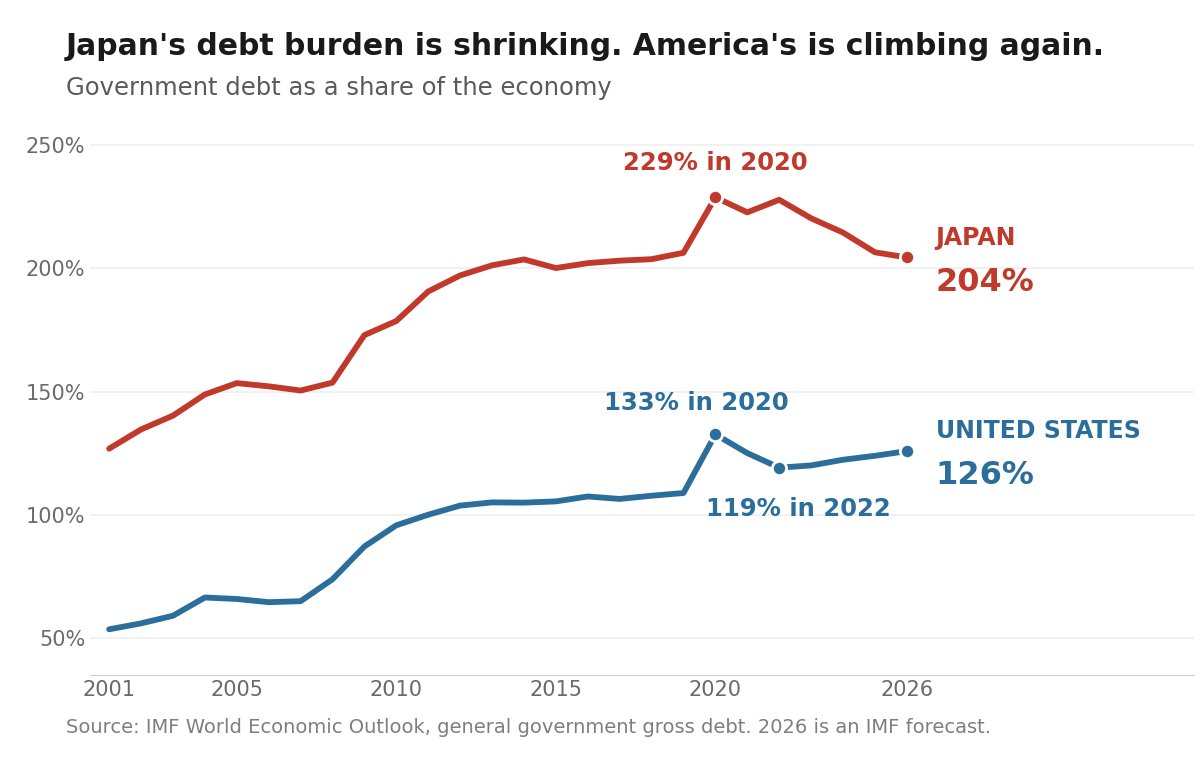
Japan has done something no other big economy has managed. Its debt-to-GDP ratio is falling — from a peak of 229% to 204% — and it didn't repay a thing. Its debt actually rose 11% over those five years.
The method has a name most people never hear: financial repression.
The idea is simple. Keep interest rates below inflation. That's the entire policy.
Think about what a government earns and what it pays. It earns taxes. Taxes are a slice of everything bought, sold and earned in the country, so when inflation pushes up prices and wages, collections rise automatically. Same tax rates, bigger numbers.
What it pays is interest on old debt. If the central bank pins rates down while inflation runs, that cost barely moves.
So the government's income climbs year after year while its debt bill stays flat. Hold that gap open long enough and the ratio has to come down. No spending cuts, no repayment. Just time.
Japan ran exactly this. In 2023, inflation was 3.3% and the Bank of Japan's policy rate was still negative — below zero. Over five years the economy in yen terms grew 20% while debt grew 11%. The ratio fell on its own.
There is a loser, and it isn't foreigners. It's the Japanese saver, whose deposit earned nothing while prices rose 3% a year. The gap between what savers should have earned and what they got is precisely what the government kept. A tax nobody voted on.
Now the catch. This only works if you control your creditors.
Japan does. The Bank of Japan holds 48% of its government's bonds; Japanese banks, insurers and pension funds hold most of the rest. Foreigners hold 8%. When Tokyo suppresses rates, its own institutions absorb the loss. And they stay.
America can't. Foreigners own 31% of US public debt — $9.2 trillion. When Washington let inflation run in 2021-22, the trick began working there too: debt fell from 133% of GDP to 119%. Then the foreign holders did what captive ones can't. They sold, and demanded more to stay. The 10-year yield crossed 5% in October 2023, the highest since 2007. Higher rates on every new bond wiped out the gains, which defeats the entire purpose. The ratio is back at 126% and climbing.
So the one number that decides who can run this play isn't debt-to-GDP at all. It's the net international investment position — what a country owns abroad minus what foreigners own of it. Japan: plus ¥562 trillion, the savings of decades. America: minus $21 trillion. The first country owes itself. The second owes the world.
Views are personal. Not investment advice.