Make Exchanges Boring Again
Why do platforms like @binance, @HyperliquidX, and @Lighter_xyz fuel volatility instead of stop it?
My new analysis argues their bundled design makes them structurally incapable of providing true market stability
Without the Clarity Act, if a digital asset exchange goes bankrupt, customers have no guaranteed right to their own assets. They join a creditor line w/ other Wall Street firms and expensive lawyers and hope for the best. This is a consumer protection failure Congress must fix.
TODAY 🚨: The Commission issued an interpretation that clarifies the application of federal securities laws to crypto assets.
This is a major step to provide greater clarity regarding the Commission’s treatment of crypto assets.
Read the release here: https://t.co/DDykVLHZQI
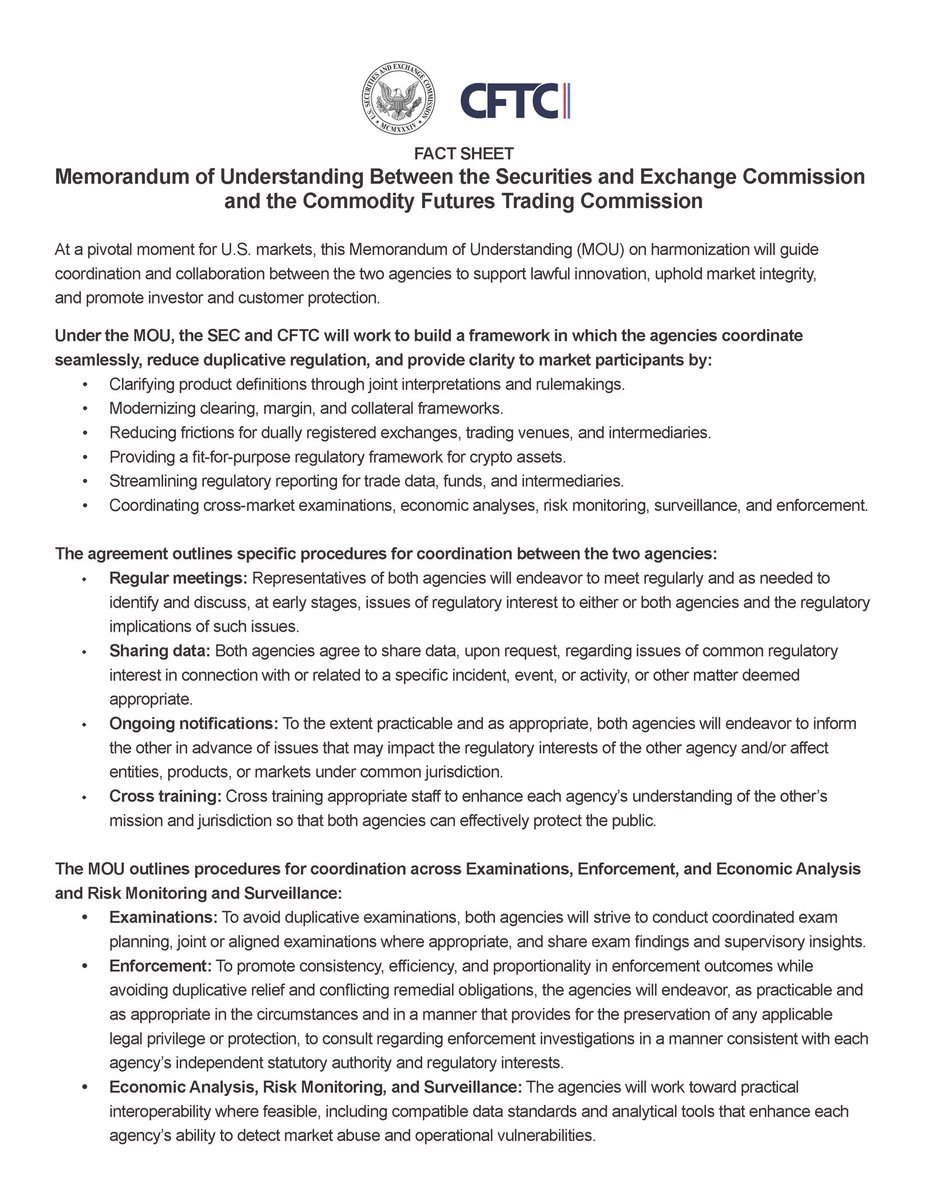
🚨 TODAY: Alongside the @CFTC, we entered into an updated Memorandum of Understanding to guide future coordination between our two agencies.
This MOU will support lawful innovation, uphold market integrity, and promote investor and customer protection.
Link in the comments.
🇺🇸 JUST IN: The US Fed, OCC, and FDIC jointly clarify that tokenized securities should receive the same capital treatment as traditional securities.
The ruling applies regardless of whether they're issued on permissioned or permissionless blockchains.
We really are speed-running TradFi here
Kalshi Inc. just proposed imposing order delays, now under a 10-day CFTC review. Flash Boys are back, baby!
(P.S. @Lighter_xyz uses a similar delay for their "zero-fee" trading.)
curious how long it will take crypto people to discover that tradfi solved all this stuff long time ago and the real issue is not the perp design but the centralized (and quadi decentralized) exchanges that are prime broker, CLOB and custodian all in one
@DeanEigenmann Been the case for years
We treat CEX founders like gods for building entities that are more centralized than the very banks crypto was meant to displace
"react to it" is somewhat simplistic. It's fundamentally different on centralized vs decentralized systems.
Take MMs. It doesn't matter what core devs do, a BFT system cannot guarantee FCFS with sub-millisecond latencies. MMs will therefore quote less aggressively on blockchains than they would on a CEX where FCFS is enforced
I see your point on probabilities, but that's the fundamental disconnect
You'd be asking market participants to trade on a probabilistic signal (your 1% revert risk) that takes high tens of milliseconds to finalize in any BFT system
They already operate on a deterministic signal (final execution) at sub-50μs on Nasdaq
This is the same market where a 350μs deterministic speedbump (IEX) was considered market-breaking. I don't see a good reason why anyone would want to downgrade from 50μs certainty to millisecond-probability
Settlement doesn't directly impact price (I was being too general with "finality" earlier)
If signal doesn't get incorporated into price, it's noise. I don't think any serious market participant updates their internal pricing of an asset based on an OrderAck (returned in about 5μs on CEXs)
@niteshnath With MCP, it gets a lot more complicated on Solana because you have to do conflict resolution across multiple proposers (adding to execution latency times)
@niteshnath A leader's proposal isn't the signal though. It's an optimistic, revertable guess at the next state since leaders can get voted out
The signal is only truly incorporated into price when all transactions are irreversibly ordered and executed. Until then, it's just noise
@niteshnath The leader won't know what the actual state transition is until finality. You'd have to finalize within one consensus round (80% stake for Alpenglow) with co-located validators to compete with CEX latency
At that point, we've given up on geographic distribution no?