Ken Sakata quit medicine to make pants. Now he wants to find out if he can be great.
Many of us have dormant creative dreams. As we grow older, we get farther away from them: surely, it is too late to begin.
Ken trained as a doctor and never let his lifelong interest in design grow into anything more than a curiosity.
Then, on a whim while bored and frustrated during COVID, Ken gave himself permission to make merch for a fake Australian football club he'd been making TikToks about. Something took hold, and Ken continued to pull on the thread. Hoodies and hats became tailored garments, and "Queensland FC" became "Front Office."
Throughout the journey, Ken's made some of my favorite short video essays on the internet, talking about the history, cultural context, and ideas behind everyday clothing.
This year, Ken moved to Tokyo to be closer to the best textile manufacturers in the world. He'll show his first collection at Paris Fashion Week in January and has begun to collaborate with world-class designers. All the while, he wonders if his destiny is to become the Anthony Bourdain of fashion, rather than a great designer. That might be easier, or even rarer! But he's going for greatness.
If you’re interested in craft, commerciality and creativity, and chasing dreams, I think you’ll enjoy the conversation.
Timestamps:
(0:00) - Opening Highlights
(1:43) - Intro: Ken Sakata
(5:38) - Start: Optimism and the Impractical Dream
(9:48) - Leaving Medicine and Whether Creative Work Is Selfish
(19:00) - Design as Problem-Solving: Utility, Status, and Art
(34:19) - Finding Your Weapon as a Designer
(41:26) - Mistakes, an Unlikely Path, and Iterating
(53:09) - Designing Meaningful Things and Cultivating a Point of View
(1:01:46) - Focus and Pulling the Thread
(1:16:02) - Front Office, Jil Sander, and Clothes for Walking Around a Museum
(1:27:02) - Why Fashion Keeps Looking Backward
(1:39:03) - What It Would Mean to Be Great, Busking on Instagram, and Bob Ross
(1:47:21) - The Anthony Bourdain of Fashion
(2:03:04) - Japan, Craft, and Curation
(2:17:51) - Books, Editing, and Generous Mentors
(2:26:33) - Advice on Clothes & Closing Questions
@dialecticpod 63: Ken Sakata - I Want to Find Out - is out now, below and on all platforms.
"If the plane is going down, no one’s going to say, 'Who’s gonna design me some pants?'"
Ken Sakata on leaving medicine for fashion:
"You donate your 20s, your 30s, probably your 40s to medicine, and you give more than you get… It’s altruistic."
"Fashion design is the opposite of that. You’re aspirational. You kind of sell a fake dream, but there is a certain power to that. People want and need that."
"If you sell people reality, it’s underwhelming."
There's the classic adage: one for them, one for me.
I feel lucky to get to basically just make stuff for me. But this one is one is especially *for me*.
I started watching Ken Sakata's videos a few years ago, and even wrote about him in 2024 before I'd started @DialecticPod.
It was a long time coming to meet him in Tokyo and go deep. But I also think it's a very special episode. Ken is a fashion designer, which may seem out of my typical wheelhouse.
But Dialectic is a show about philosophically-driven, original people who've found a way to shape their life in a way that uniquely fits them.
My favorite things to discuss are the the inputs to the courage to do that, the deep care that goes into making things, and how humanity shines through.
@QLDFootballClub is an example of that in spades, even if he's hard on himself. He's on the journey.
My ability to do a show that is full "ones for me" is thanks to many amazing listeners, supporters, feedback-givers, and @notion's incredible support over the last year, along with @Google more recently. I'm grateful!
Ken Sakata quit medicine to make pants. Now he wants to find out if he can be great.
Many of us have dormant creative dreams. As we grow older, we get farther away from them: surely, it is too late to begin.
Ken trained as a doctor and never let his lifelong interest in design grow into anything more than a curiosity.
Then, on a whim while bored and frustrated during COVID, Ken gave himself permission to make merch for a fake Australian football club he'd been making TikToks about. Something took hold, and Ken continued to pull on the thread. Hoodies and hats became tailored garments, and "Queensland FC" became "Front Office."
Throughout the journey, Ken's made some of my favorite short video essays on the internet, talking about the history, cultural context, and ideas behind everyday clothing.
This year, Ken moved to Tokyo to be closer to the best textile manufacturers in the world. He'll show his first collection at Paris Fashion Week in January and has begun to collaborate with world-class designers. All the while, he wonders if his destiny is to become the Anthony Bourdain of fashion, rather than a great designer. That might be easier, or even rarer! But he's going for greatness.
If you’re interested in craft, commerciality and creativity, and chasing dreams, I think you’ll enjoy the conversation.
Timestamps:
(0:00) - Opening Highlights
(1:43) - Intro: Ken Sakata
(5:38) - Start: Optimism and the Impractical Dream
(9:48) - Leaving Medicine and Whether Creative Work Is Selfish
(19:00) - Design as Problem-Solving: Utility, Status, and Art
(34:19) - Finding Your Weapon as a Designer
(41:26) - Mistakes, an Unlikely Path, and Iterating
(53:09) - Designing Meaningful Things and Cultivating a Point of View
(1:01:46) - Focus and Pulling the Thread
(1:16:02) - Front Office, Jil Sander, and Clothes for Walking Around a Museum
(1:27:02) - Why Fashion Keeps Looking Backward
(1:39:03) - What It Would Mean to Be Great, Busking on Instagram, and Bob Ross
(1:47:21) - The Anthony Bourdain of Fashion
(2:03:04) - Japan, Craft, and Curation
(2:17:51) - Books, Editing, and Generous Mentors
(2:26:33) - Advice on Clothes & Closing Questions
@dialecticpod 63: Ken Sakata - I Want to Find Out - is out now, below and on all platforms.
Dialectic 62: Quinten Farmer!
@quintendf drew the long straw. He grew up on an idyllic island surrounded by people who believed in him unconditionally.
Most people aren't as lucky. With Tolan, he hopes to give everyone someone who believes in them and helps them grow.
Tolan is an unusual take on the AI industry's latest obsession: a cute little guy. Rather than focusing on an assistant who helps you do more, the Tolan team wants to build technology that helps you be.
It is voice-first, character-driven, and won’t let you rewrite its personality.
Hundreds of thousands of people talk to their Tolans each month. Many of them are parents. Most of them aren't traditional AI power users. Some of them are among the most social people they know, rather than the stereotypical lonely person we might imagine spends all day talking to AI.
I spoke with Quinten about belief, relationships, and his morally opinionated views on designing "personal superintelligence."
Timestamps:
(0:00) - Opening Highlights
(1:42) - Intro: Quinten Farmer
(4:46) - Start: Why Everyone Needs Someone Who Believes in Them
(19:18) - Do vs. Be: What We Should Ask of Technology
(25:43) - Quinten's First Company, Even, and Building for People Close to You
(32:49) - Clarence, Quinten's Tolan
(39:30) - Early Design Decisions: Non-human, Lore, Voice, and Presence
(51:29) - Therapist vs. Supportive Friend & Growth One Small Step at a Time
(57:46) - Bringing People Closer, Memory, and Why Tolans Forget
(1:05:06) - Why You Can't Edit Your Tolan: Personality, Healthy Behavior, and a Point of View
(1:14:08) - Morally Opinionated Technology, Religion, and the Sacred
(1:22:33) - Personal Superintelligence and Why Everybody Needs a Cute Little Guy
(1:29:32) - Kindness to Machines, Digital Spaces, and Naming Tolan
(1:36:43) - New Characters and Demographics
(1:45:18) - Pricing, Trust, and Avoiding Dark Patterns
(1:49:59) - The Team at Tolan
(1:54:31) - His Dual Life Between The Island and SF
(2:00:59) - Spaces that Create Belonging
(2:05:07) - Closing Questions
@dialecticpod 62: Quinten Farmer - Technology That Helps Us Be - is out now, below and on all platforms.
Really liked how @joshm discusses taking bets on people throughout his career in this podcast.
I think people talk a lot about finding unexpected talent, but they don’t always create safe environments where people can grow, show what they’re capable of, and feel supported along the way.
These^ sort of opportunities have helped me find my way through a winding career path 🥹 I feel lucky that my latest gig is about helping more people experience this!
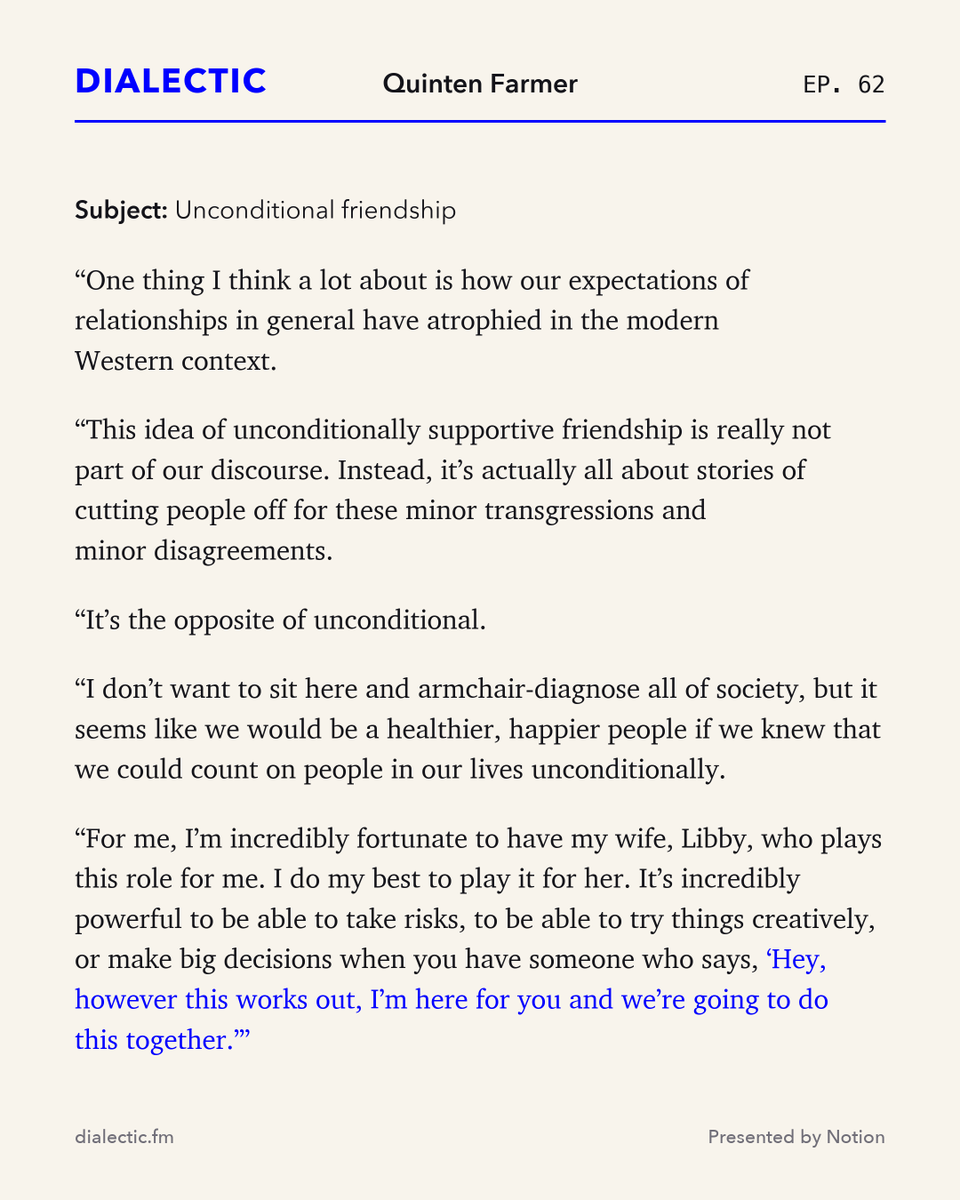
"I think a lot about how our expectations of relationships in general have atrophied in the modern Western context."
"This idea of unconditionally supportive friendship is really not part of our discourse."
"…we would be a healthier, happier people if we knew that we could count on people in our lives unconditionally.”
“However this works out, I’m here for you, and we’re going to do this together.”
@quintendf on unconditional friendship:
Real life is too messy for facts alone.
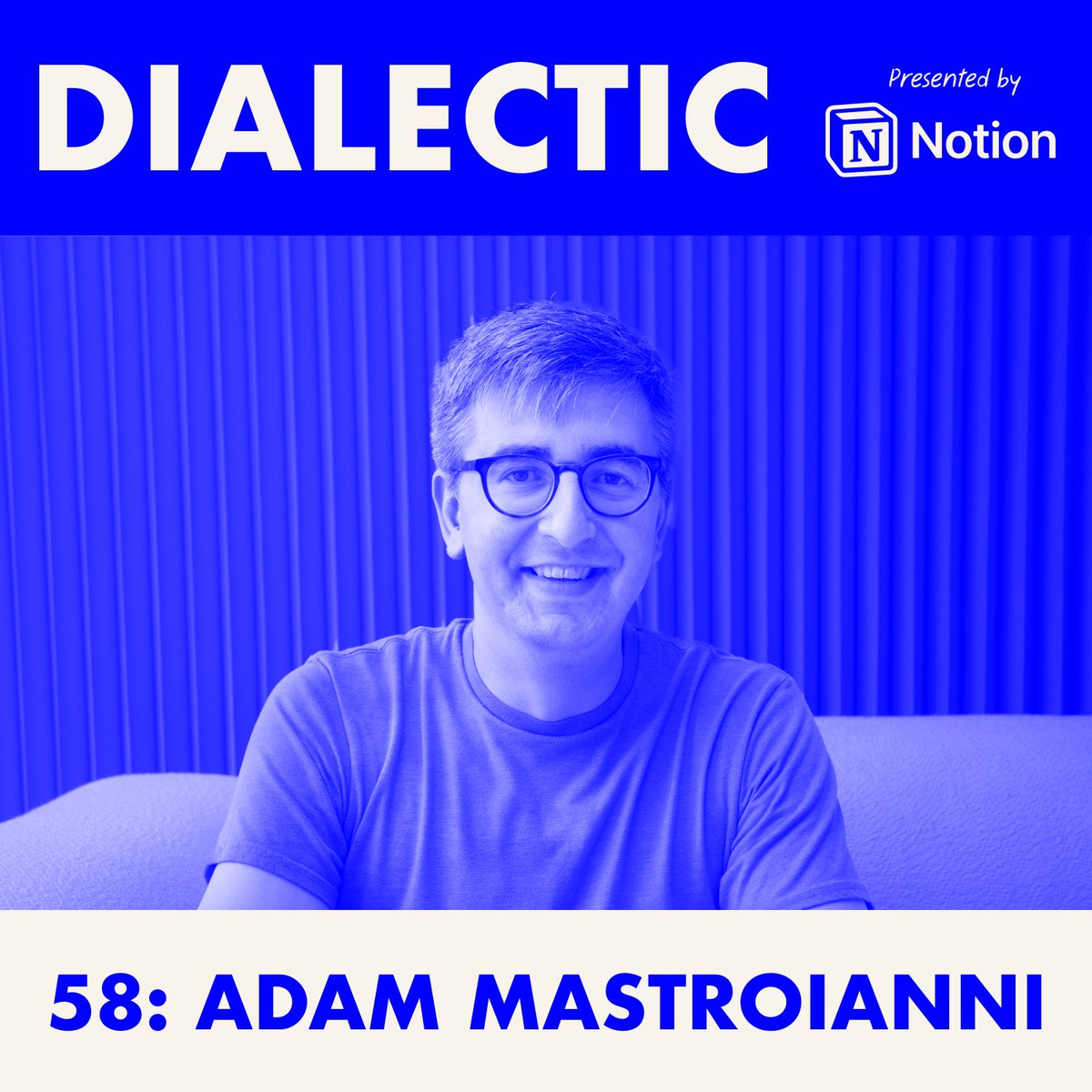
@a_m_mastroianni on why we read novels instead of the dictionary:
"The situations we encounter are really fuzzy. They vary in infinite dimensions. And so when you’re dealing with fuzzy situations, you need fuzzy information."
"The Boy Who Cried Wolf... is not about wolves. It’s not about a boy. And it also applies to girls.”
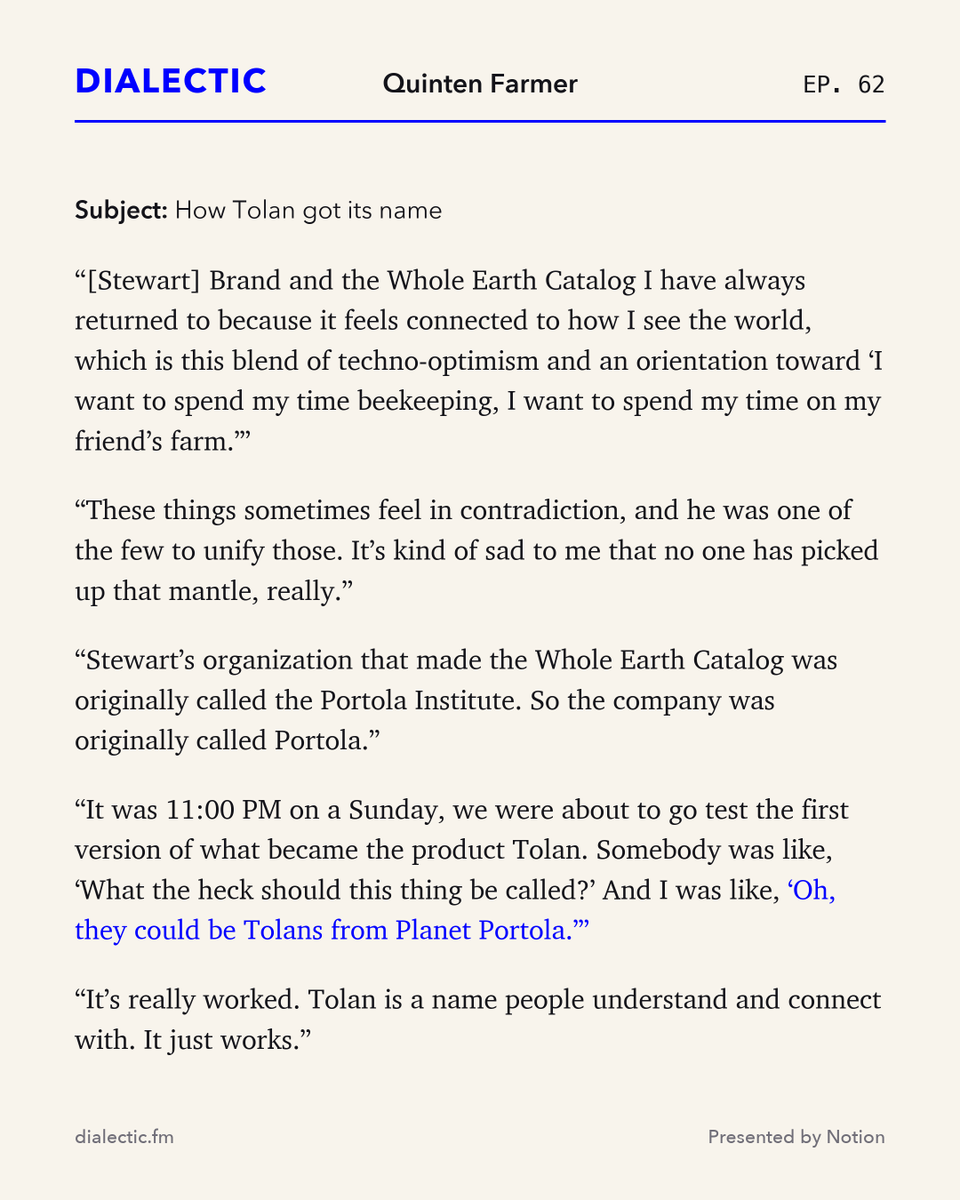
A consistent thread through @stewartbrand’s work is a sense of optimism for technology driven change, balanced with a groundedness and humility toward what we might not fully understand.
(An outlook I think best represented by him in How Buildings Learn)
We named the company as a nod to his work in a hope we might embody that same optimism/humility in all we do with Tolan.
Real life is too messy for facts alone.
@a_m_mastroianni on why we read novels instead of the dictionary:
"The situations we encounter are really fuzzy. They vary in infinite dimensions. And so when you’re dealing with fuzzy situations, you need fuzzy information."
"The Boy Who Cried Wolf... is not about wolves. It’s not about a boy. And it also applies to girls.”
58: Adam Mastroianni - Let Me Be Useful
Transcript & links: https://t.co/nBc6DCknbe
Spotify: https://t.co/Ektm7T8hyG
Apple: https://t.co/LyC7Qw9Qkl
YouTube: https://t.co/UIUXQ6fUmn