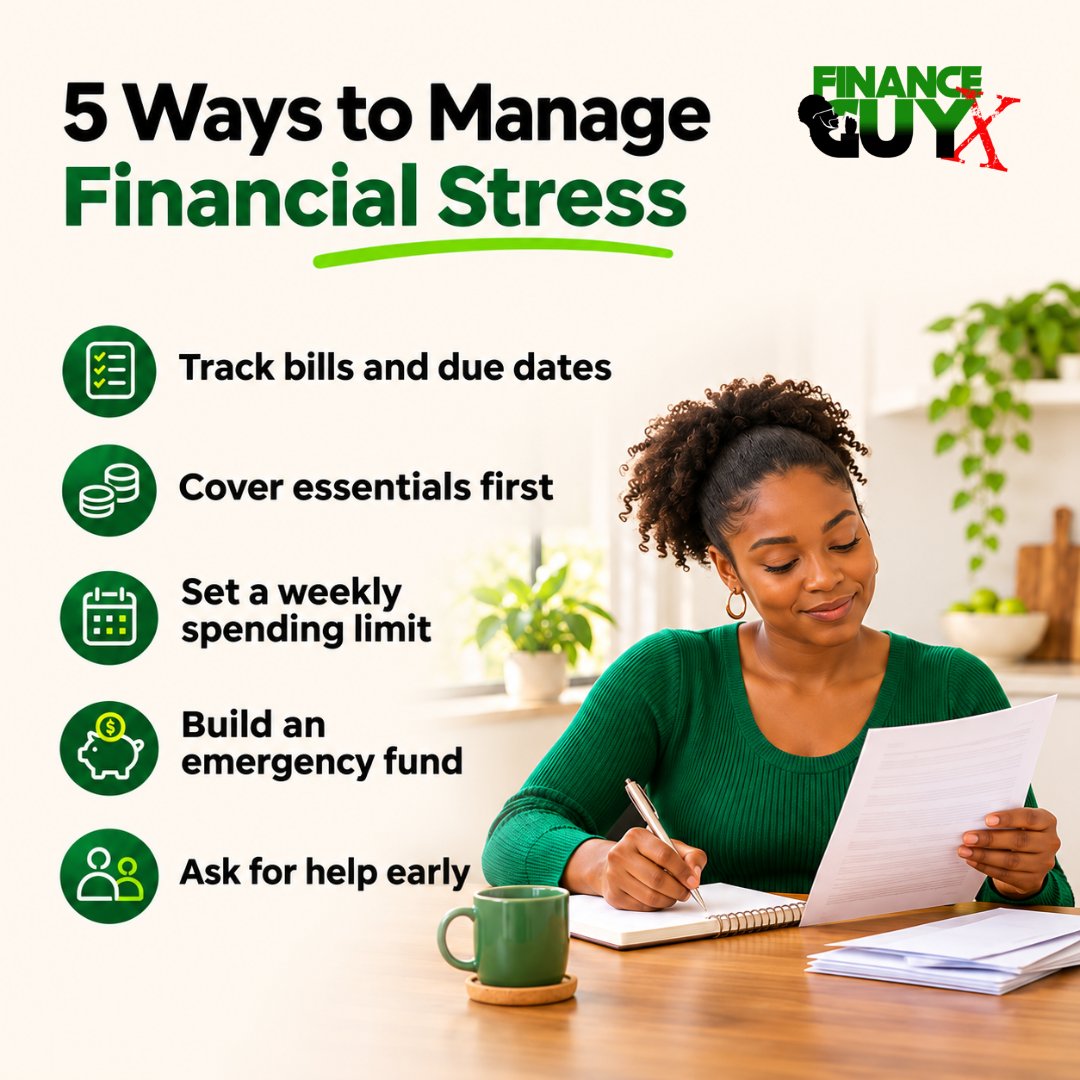
When money feels overwhelming, start with what’s due this week. 💚
Write down your bills and due dates, cover the essentials first, and set a spending limit that fits your week. If there’s room in your budget, set a little aside for emergencies. And if a bill feels unmanageable, it’s okay to ask for help early.
Save this for your next money check-in. Which step feels most doable today?
#FinancialStress #MoneyManagement #BudgetingTips #EmergencyFund #FinancialWellness
In Genesis 41, Joseph told Pharaoh to store food during seven years of plenty, because seven years of famine were coming.
When the famine came, Egypt didn’t just survive. It fed the nations around it.
That’s an emergency fund and an investment plan in one story.
Save in your good years. The lean years always come, and the people who prepared are the ones who can help others when they do.
My wife used nearly all our emergency savings to invest in a business idea I'd told her I wasn't comfortable with
She wanted to open a small restaurant with a friend who had experience in the food industry.
I'd looked at their numbers and felt the costs were too high. We had a mortgage, and our emergency savings were meant to cover several months of essential expenses if either of us lost our job
My wife said we'd been talking about starting a business for years and that opportunities didn't wait for perfect conditions
I told her I wasn't willing to risk our safety net.
She agreed to keep looking for alternatives.
Two months later, I discovered a large transfer from our joint account
When I confronted her, she admitted she'd invested the money. The restaurant had already signed a lease
She said she'd planned to tell me after everything was finalised because she knew I'd try to stop her
I asked her whether she'd thought about what would happen if the business failed
She said she'd thought about it more than I realised. Then she showed me the figures.
The business wasn't as reckless as I'd imagined.
Her friend had negotiated a favourable lease, they had a realistic operating budget, and the location had a steady stream of customers
My wife had also invested some of her personal savings, but the money she'd taken from our emergency fund was still gone.
I told her I could acknowledge the business might succeed without accepting how she'd made the decision
She said she knew I'd never agree to the investment, and waiting for my approval meant missing the opportunity
That was the part I couldn't get past.
She hadn't made a mistake because she misunderstood our finances. She'd decided my answer didn't matter
We met with a financial adviser and agreed on a plan to rebuild our emergency savings.
My wife took on additional work, and we put a strict limit on how much more household money could go into the restaurant.
The restaurant is still operating, and it may eventually become profitable.
Sometimes I wonder whether my caution would have cost us an opportunity worth taking.
Then I remember that my wife didn't simply risk her own money. She made a decision for both of us and left me to discover it afterward
When Emily Carter agreed to marry Daniel, she knew she wasn't marrying into a wealthy family.
Daniel was a schoolteacher in Philadelphia. He lived modestly, drove an old car, and rarely spent money on unnecessary things.
Emily loved that about him.
What Daniel didn't know was that Emily carried a heavy responsibility. Her father had passed away several years earlier, leaving behind unpaid loans, medical bills, and a struggling family business.
Her mother had been trying to settle the debts for years.
Emily had even considered postponing the wedding because she didn't want Daniel to inherit problems that weren't his.
One evening, while preparing documents for their marriage, Emily received a call from a bank.
"Good afternoon, ma'am. We're calling to confirm that the outstanding balance on your family's loan has been fully settled."
Emily was confused.
"What loan?"
The representative mentioned her father's name.
She immediately called her mother.
Her mother began crying before Emily could finish asking questions.
"Daniel paid everything, sweetheart."
Emily couldn't speak.
Apparently, Daniel had discovered the family's financial situation months earlier. Without telling her, he had been making payments whenever he received extra income.
He had also sold a small piece of land he inherited from his grandfather to settle the largest outstanding debt.
Emily was overwhelmed.
That evening, she confronted him.
"Why would you do something so big without telling me?"
Daniel looked uncomfortable.
"Because I didn't want you to feel like you had to choose between marrying me and helping your family."
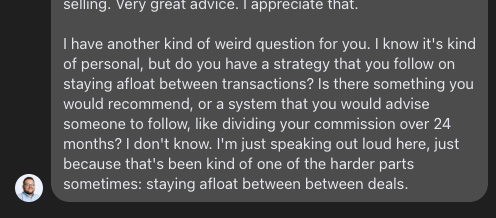
From my DMs: Personal Finance strategy if you're doing big ticket commission sales (like business brokerage).
> figure out your normal lifestyle spending by analyzing the last 6 months of your personal spending, excluding large discretionary purchases, and know exactly what your monthly "nut" is (normal necessary cost of living excluding big/fun/optional things)
> save 6-18 months of necessity-spending cash, get it from your first big deal/s if you need to. Number of months depends on job and industry, but more is better. This is your baseline that keeps you safely in the game. Set a round dollar figure that represents fully funded cash reserves that's close to the amount of months you want to have. When you're at or above that dollar figure, you're "topped off" on your liquidity needs.
> live off that liquidity pool between deals, making no large discretionary purchases, to preserve your runway to the next big payday
> your family might pressure you to make a big discretionary purchase (new car, nice vacation, remodel a room, whatever) when you're not topped off. Never do this. That's your cash runway for survival. Never say "no, we can't afford that right now." which makes you perpetual scrooge and also unleashes a floodgate of pent up requests when your next deal hits. Instead, always say, "YES! Great idea! Let's do that. I'm adding it to the list." Put all your wants on the WANTS LIST and share the list with your spouse and review it periodically. Agree together on what the next things you're going to spend excess money on together after you're topped off. Now you never have to fight or say no. Just add stuff to the list and periodically re-prioritize it together.
Now it's just a game, you know you can survive till the next deal. You never have to say no to anything. And the game is how fast can you close deals that make you zoom past "topped off" that let you knock out all your wants list spending, in agreed priority. The decision now is never "can we afford this?" it's simply a prioritization discussion and makes it "it's coming, as soon as we can"
<but oops we forgot something>
Big problem with this is your wants list has a lot of stuff on it that mostly doesn't increase your wealth or Net Worth, and you need to bring investing into this game too!
Make a couple more rules:
1) Never buy your next thing on your wants list until you can afford to buy it twice. (So if your next thing is $10K, don't buy it until you're $20K above topped off.) And take an equal amount to the thing you're spending and set it aside for investing.
2) NEVER touch or sell your investments and investing capital. Your cash reserves are for living expenses, not your investments. Let investments grow and compound and don't tap them for lifestyle needs or sell them to buy wants. The only time you're allowed to sell an investment is if you're doing it to invest it in something else that's a better investment.
This system takes the stress out of big, lumpy paydays with large gaps between them.
You know you're not gonna run out of money and will always be able to pay your bills because your reserves are bigger than your largest anticipated gap between your big hits.
You never have to be scrooge and can always say yes to anything without being irresponsible.
You're building wealth and letting it compound as you go.
Fiancé tried to put me on a pitch count for buying Halloween candy after I went too far last year…. I am now at the grocery store unsupervised. She poked the bear.
Some people have no emergency fund, no savings, and unpaid bills.
But they’ll open a $100 trading account and start calculating how to buy a Benz by Friday😂😭
Before you chase financial freedom, learn financial discipline.📌
I got laid off today due to company restructuring.
Looking for urgent opportunities.
My friend called me yesterday and shared this news. And let me tell you he's freaking genius at what he does.
In today's job market nobody's job is "secure"
✦ You can be good at what you do.
✦ You can have years of experience.
✦ You can be doing everything right.
So protect yourself from landing in this:
• Don’t assume a degree guarantees a job. No matter which degree you have, keep building skills that the market needs.
• Never quit without an offer or backup plan.
• Always maintain a 6-7 months liquid emergency fund.
• Keep giving interviews every few months to stay relevant.
• Try avoid joining startups or companies with high attrition.
• Build multiple income streams. Create content, sell digital products, mentorship, invest whatever aligns with your skills.
Having something of your own gives you an additional layer of financial security.
Your emergency fund isn't supposed to earn you anything
Its whole job is keeping a flat tire from becoming a credit card balance
Boring money is still doing work
How many months of expenses do you keep parked?👇
Please don’t quit your job and go full time selling on Amazon.
Invest an hour a day like I did then two hours a day. Then more.
Once you replace 80% of your monthly salary, quit your job and go all-in!
Also, I always recommend a 12 month emergency fund.
Trust.