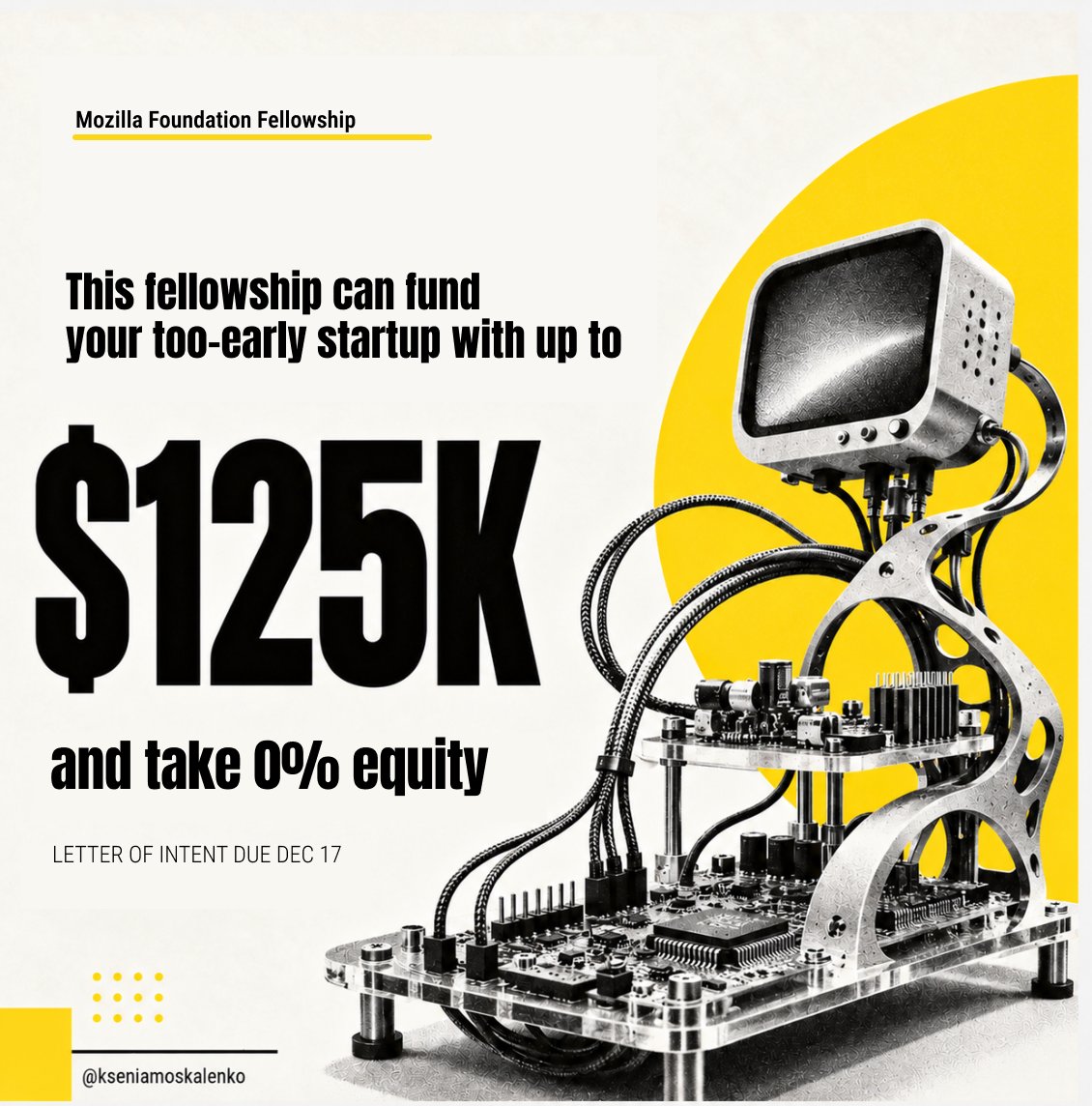
FELLOWSHIP‼️: Working on tech that's too early or too weird for VCs? Mozilla Foundation is giving up to $125,000. No equity.
This is @Mozilla Foundation Fellowship 2027.
What you get:
- $100K stipend + $25K project budget
- 12 months, starts June 1
- only 10 fellows
- 200+ fellow alumni network
What they want:
- neurotech, biotech, physical AI
- compute, energy, quantum
- business models for the agentic web
- security tools for small orgs
Who qualifies:
- individual builders, apply directly
- building alternatives, not polishing the status quo
- host-nonprofit track pays $100K
The catch: it backs a person and a project, not your cap table. Letter of intent first, and only a small shortlist gets invited to a full application in February.
Deadline: letter of intent Thu Dec 17, 11:59pm PT
🖇️ Apply → https://t.co/KYfr0H1tqv
P.S. Keep your project, traction and links in one place before you go out & raise → @ThePageform
@kyleichan Chan's right. DeepSeek trained frontier models on H800s and Huawei's Ascend 910C is shipping in volume for inference now. I keep saying it, the controls mostly accelerated the domestic stack they were meant to slow.
@Srinivas_091294 Ran numbers on a similar GPU cluster setup last year. Power was the biggest opex line by a mile. Whoever controls energy integration controls the margin on deployments like this.
@pauliusztin_ Agreed. The hard part is knowing what's the 10% before the agent writes it. My list: anything touching money, auth, or user data gets read. Everything else ships on tests.
Businesses don't care who owns the utility, they care what they pay per kWh. UK industrial electricity runs $0.25-0.35/kWh, 4-5x competitors. That's levies and network charges, not shareholder dividends. Public control doesn't touch it.
The British government will seek to persuade business leaders to support greater public control of water and energy utilities, arguing that the approach would improve services and lower costs without requiring wholesale nationalization https://t.co/OHstgoSdPd
@harikesh_devops Solved is doing a lot of work in that sentence. But I've run the numbers on always-on agents and $3/$15 with 95% cache pricing genuinely changes the math at seed burn rates.
The CO2 story is the same. I bought a bunch of monitors for the office after a guest convinced me. Levels regularly hit 1,000+ PPM, which hurts cognitive performance. Monitor costs 30 quid. Hardly anyone owns one.
A bit like the studies which suggest that remote work collaboration is worse for teams than in-office collaboration, lots of science which would massively impact our productivity gets ignored because it’s not ‘efficient’ in a narrow sense of the term.
@pauliusztin_ The teams shipping fastest in our portfolio spend most of their time on evals, not generation. Generation got cheap. Verification is the job now.
@StephNass Does it model option pool top-ups between rounds? That's the bit most simulators skip and it quietly wrecks the founder ownership maths. Commenting for the link, nice build.
@rdominguezibar The Pied Piper photo is accurate. A fund that closed in 2022 is mostly out of dry powder. 148 verified fresh funds beats 1,605 names. Building the list after the raise starts is how you end up cold emailing at week 8.
@TheMinuend The two exec exits tell you more than the production numbers. When the COO from LG and the division head both walk inside four months, the internal view of the yield problem is darker than the press release.
You can turn Claude Code and a free Obsidian vault into a second brain that gets smarter every time you drop a file in 🤯
Drop a paper, PDF or podcast transcript into one folder, say "ingest this", and Claude:
- writes a summary page
- updates every related note
- links them all together
It's based on Karpathy's LLM Wiki idea. Obsidian is the IDE, Claude is the programmer, the wiki is the codebase.
how to set it up (5 min):
1. Download Obsidian (free) and create a vault
2. Add a raw/ folder for your sources
3. Open the vault folder in Claude Code
4. Put a CLAUDE.md in the root with your rules (starter in the image)
5. Drop a file in raw/ and say "ingest this"
Then ask questions, and it answers from your own pages, not the internet.
Stanford University just released free online courses. No payment Required.
Here are best courses you don't want to miss in 2026:
1. Google Prompting Essentials Specialisation
https://t.co/TMK0zZ4O6t
2. GPT Vision: Seeing the World through Generative AI
https://t.co/fzX34TDe56
3. Start Writing Prompts like a Pro
https://t.co/qCMoNYM3Yz
4. Agentic AI and AI Agents for Leaders Specialisation
https://t.co/Nf1pfvxYW2
5. Google Prompting Essentials Specialisation
https://t.co/TMK0zZ4O6t
6. AI Foundations for Business Professionals Specialisation
https://t.co/GKcSwIICpf
7. Advanced Topics in Artificial Intelligence
https://t.co/xjGoMWDJ4p
8. Deep Learning Specialisation
https://t.co/YHkg6uGquv
If you're serious about AI in 2026, start there. Most people will save this 🔁
i gave Kling Image 4.0 and GPT Image 2.6 the exact same prompt, a model next to a giant orange, and i genuinely can’t pick a winner..
Kling went full high fashion, with a brighter cobalt coat, sharp clean styling, and that blue eyeshadow detail
GPT Image 2.6 leaned more vintage film, with a deeper navy coat you can almost feel the texture of, softer shadows and a more relaxed pose
both nailed the oversized orange, the scale looks surreal without the rest of the shot falling apart, and either one could pass for a magazine editorial
Kling’s Black Friday offer is still on: 2K images from $0.022 each and native 8K from $0.033 each
which one would you pick?
1. Kling Image 4.0
2. GPT Image 2.6
@StephNass Top-down sizing is the tell. $10T divided by 'if we capture just 1%' is a lotto ticket. The founders worth backing can tell you how many customers at what price gets to $10m ARR.
@StephNass The ex-Stripe CTO got $50M pre-product on the name alone. That's the game. For everyone else the signal has to be revenue or growth. If you've got neither, take the smaller round and build.