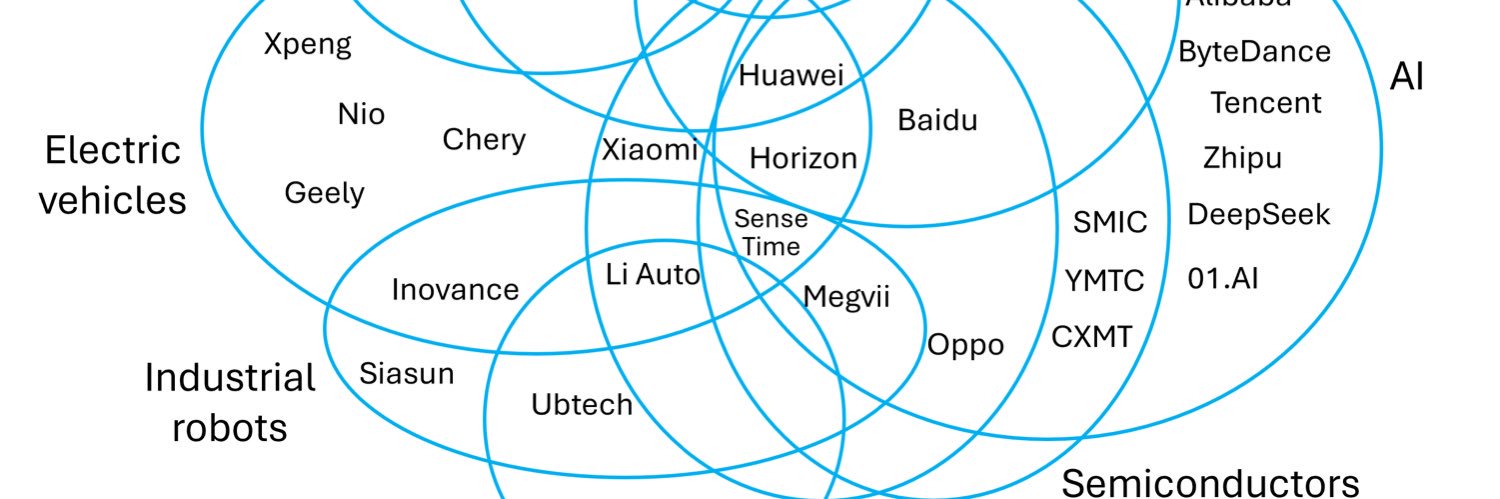
My take: China is not run by engineers. It’s run by economists.
Chinese policymakers are obsessed with incentives.
They believe that by shaping incentives, they can shape society. They’re constantly worried about principal-agent problems. They’re worried about signaling—sending the right signals, avoiding the wrong signals.
But the world is not full of rational actors. And they get frustrated when behavior defies their “rational expectations.”
It’s ironic that just as @danwwang’s characterization of China as an “engineering state” (vs the US as a “lawyerly society”) gained popularity China may have peaked being an engineering state.
Where its political leadership used to be full of engineers, the standing committee of the politburo doesn’t have a single engineer anymore.
Even the one almost textbook Imperial College trained environmental engineer turned Shanghai party secretary, who seemed destined to join the standing committee, has now fallen.
China’s era of engineers and technocrats as ideology-lite leaders was ushered in by Deng’s pragmatism, which was a reaction to the Mao revolutionary political thought-heavy era. “Black cat or white cat, the cat that catches mice is the good cat.” Alas that’s sadly over now.
One consequence of closing the remote access loophole to Chinese AI companies is the crashing of older GPU rental rates, specifically the 3-4 year old Hoppers.
This consequence, intended or not, in turn is crashing a major pillar of the AI trade that kept the party going through August/September: higher than expected rental rates, especially these old Hoppers. With a sudden increase in supply, these rental rates can no longer hold.
This is happening as we speak.
Chinese AI labs are the only ones keeping these older chips useful, because they've been stuck on them due to export control, thus spent the most time and energy optimizing to make the most out of their precious Hoppers, thus made them more valuable, thus kept their rental rates higher than expected, thus lengthened depreciation schedule, and thus is also why the Chinese gov't are *not* allowing more H200s in and letting them rot in Hong Kong, because they want their own companies to kick this dependency and use support domestic chips.
(Yes, obviously Blackwells are making them way there too, both legally and illegally, but still in much smaller quantity.)
A cratering rental rate of old Hoppers leads to long depreciation schedule being indefensible, which leads to lower projected profitability of all clouds, neo or hyper, which leads to higher borrowing cost of future buildout, which leads to a shrinking window to threading the needle between AI ROI and profitability kicking in before too much debt is taken on
Whether intended or not, closing remote access may be the final nail in the coffin of the AI trade
Likely surprising to those who believe most of China’s AI performance comes from distillation.
Distillation might give Chinese labs a performance boost of several months, which does matter.
But this is on top of a real fundamental capability in AI development.
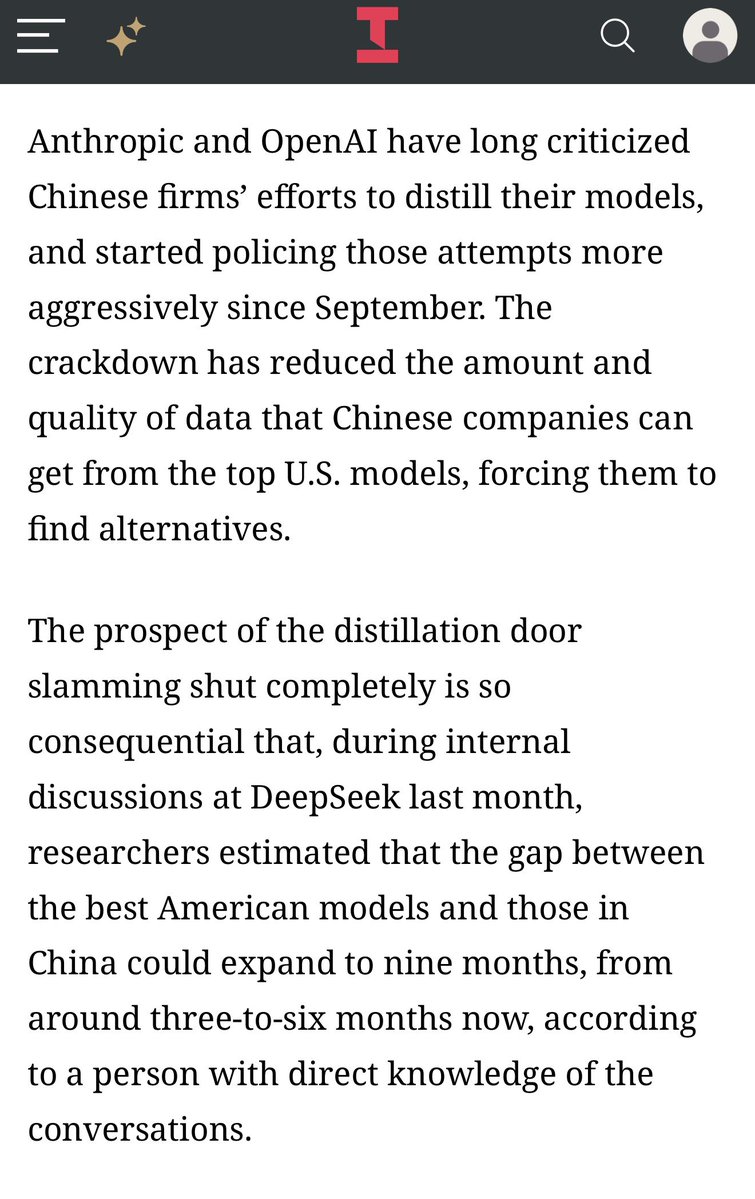
"The prospect of the distillation door slamming shut completely is so consequential that, during internal discussions at DeepSeek last month, researchers estimated that the gap between the best American models and those in China could expand to nine months, from around three-to-six months now"
The gray market price of Nvidia’s powerful Blackwell AI chips is going up in China.
A server with 8 B300 GPUs sells for $3 million now in Shenzhen.
Glad to share my views for this piece by @joshuaqyang https://t.co/q2P3ypbJmy
A huge surprise to many.
China just purged one of their rising political stars who played a big role in building up China’s AI ecosystem, including the World AI Conference in Shanghai.
Chen Jining played a role in a number of China’s key AI efforts over the past few years. Shocking downfall.
As Mayor of Beijing, he set up the Beijing Academy of Artificial Intelligence, which included talent like Tang Jie and Yang Zhilin, who later started https://t.co/jafZZKMYeb and Moonshot AI.
As Party Secretary of Shanghai, Chen amplified the World AI Conference, which put China on the map for global AI governance.
US open-weight models have caught up.
We post-trained four US models from @meta, @nvidia, @reflection_ai and @thinkymachines with the Harvey Tenet recipe we used on Kimi K3.
They are now competitive with non-US models, and Muse Spark Open is the first model to pass 30% all-pass on Legal Agent Bench.
ARTEX, an open-source Chinese AI cyber tool, seems to be involved in a number of AI cyberattacks: Korean banks, Japanese firms, and now a Microsoft alert.
Crucially, this is not an AI model. It’s a harness that can use any AI model—American or Chinese—to autonomously find and exploit cyber vulnerabilities in a given target.
The original tool, developed by Chinese cybersecurity firm ThreatBook, was available as a public repo on GitHub that has since been removed. But forked versions seem to still exist on GitHub and elsewhere.
Most interestingly, China’s new AI export controls seem to target tools like ARTEX, i.e. “AI-assisted vulnerability discovery technologies” 人工智能辅助漏洞挖掘技术. I wonder if this part of the export controls was added at the last minute to block a tool like ARTEX from being available outside China.
MORE:
The National-Geospatial Intelligence Agency was also affected by the breach, sources say.
The AI hacking tool ARTEX is believed to have been used in attack, sources say.
And early clues suggest China may be responsible, but the investigation is in very early stages.
BYD travaille avec la France à une implantation industrielle en Moselle !
Une conséquence directe de notre politique économique et de notre action européenne sur l’automobile pour accélérer l’implantation des constructeurs sur le sol européen, annoncée au Mondial de l’Auto en octobre.
Rendez-vous le 18 janvier à Choose France pour les annonces détaillées, et tant d’autres ! Jusqu’au bout.
New: Shanghai party chief Chen Jining, who is also a member of the Politburo, has been placed under investigation on suspicion of corruption, state broadcaster CCTV reported on Tuesday. https://t.co/SgEIZIOs0o
Big news. Chen had been spearheading efforts to make Shanghai a global AI hub, including hosting the annual WAIC and making the city the headquarters of the World AI Cooperation Organisation or WAICO, China's main international AI governance initiative.
For lithography, you need to stick with one vendor.
Nikon’s failure in the advanced lithography market despite very strong tech is a fascinating case study—with big implications for US export controls and China’s chip industry.
Trump: If we didn't do this. I could see China coming in and saying to Jensen, hey, how would you like to come to China? He's got a little blood in him. You know, he's got a little blood there
On this episode of the Odd Lots podcast, @kyleichan joins @TheStalwart and @tracyalloway to discuss China’s response to the global AI boom and how companies like Huawei and DeepSeek are working closely together to help the country achieve technological self-reliance. Listen at https://t.co/RqFaugaTL4 or watch at https://t.co/fcjUvfje6d.
MAJOR: President Trump dialed into Nvidia board meeting to argue for Jensen’s return, source with knowledge tells me - WH affirms to @semafor
“President Trump was totally involved and this is a great decision by the NVIDIA board. We have to protect our geniuses,” WH communications director Steven Cheung tells @ShelbyTalcott $NVDA
“Kyle Chan of the Brookings Institution, a think tank in Washington, thinks further controls will yield diminishing returns. American restrictions have already spurred a drive for self-sufficiency. “That horse is sort of out of the barn,” he says.” https://t.co/R4HmJUlwjN