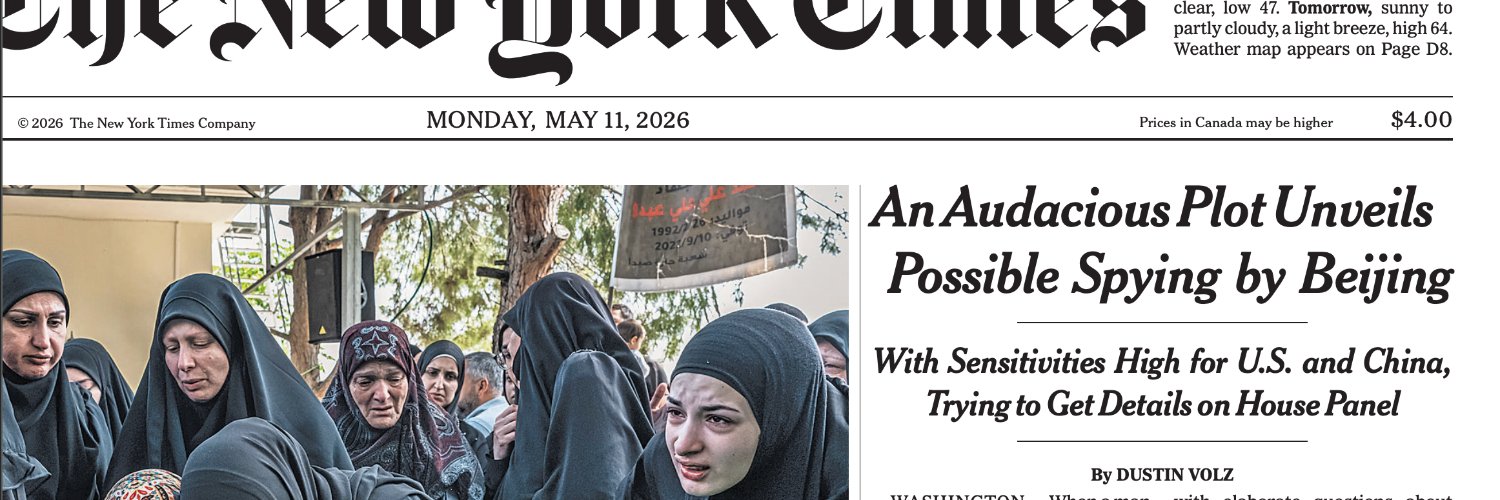
"Passengers on domestic flights are being trapped on an airplane between the gate and the runway for more than three hours at rates not seen in more than 15 years. This year is on pace to be the worst since 2009." https://t.co/f9t3XkYqiC
"The story of a factory worker’s daughter from rural China who found herself at the center of a global struggle over technology and espionage is one of ambition, reinvention and China’s rise from a drab socialist state to a shiny world power." https://t.co/Tyw9NFpwTM
If this rumors are true, it would explain why OpenAI and Anthropic are holding back their latest models:
Scott Aaronson says he's heard OpenAI or Anthropic may have found a way to factor large numbers in polynomial time.
Why this would be massive? RSA secures a huge chunk of the internet, and its whole security relies on factoring big numbers being impossible on normal computers. If an algorithm like this actually works on real key sizes, you wouldn't even need a quantum computer to break it. Fake software updates could pass signature checks, RSA-encrypted data could be read, and systems across the internet would have to migrate off RSA fast.
So yeah, something we expected might now actually happening.
My latest: Amid the Jensen Huang news, WaPo sent me to shop for export-controlled Nvidia chips in Shenzhen… here’s what I found
https://t.co/P6KtoKrgIn
The Dutch Institute of Vulnerability Disclosure has released the full forensic report of the September hack of its network, which used ARTEX. It took 1.3 seconds to hijack an admin account and 20 minutes to take full control of server. Report is here: https://t.co/xJZpB1hlKX
New: As the Treasury Department dealt with the fallout of a hack that took down some of its services, its Chief Information Officer and DOGE hire Sam Corcos was pushing updates to Legatum, his vibe coded Civilization clone
https://t.co/oeadGaT08s
MORE:
The National-Geospatial Intelligence Agency was also affected by the breach, sources say.
The AI hacking tool ARTEX is believed to have been used in attack, sources say.
And early clues suggest China may be responsible, but the investigation is in very early stages.
Very difficult to square the circle between Silicon Valley’s rhetorical and ideological shift toward “new Cold War” thinking and its behavior over the past few days
CIA and ODNI discovered a breach of an unclassified system used to analyze public and commercially available information, better known as open-source intelligence, or OSINT. Confirming NYT:
https://t.co/WlmecWZLHL
MORE:
The National-Geospatial Intelligence Agency was also affected by the breach, sources say.
The AI hacking tool ARTEX is believed to have been used in attack, sources say.
And early clues suggest China may be responsible, but the investigation is in very early stages.
News: The CIA and ODNI recently discovered a hack that exposed some of their unclassified info related to an open-source intelligence analysis system, sources say, the latest in a string of government breaches.
w/ @tylerpager@julianbarnes
https://t.co/Yv45vyQh69
Scoop: Law enforcement agents who safeguard U.S. tech, including computer chips, were assigned to be Howard Lutnick’s personal security guards. W/ @vmsalama
https://t.co/uluTzKyRCr
News: The CIA and ODNI recently discovered a hack that exposed some of their unclassified info related to an open-source intelligence analysis system, sources say, the latest in a string of government breaches.
w/ @tylerpager@julianbarnes
https://t.co/Yv45vyQh69
"You really had it," Trump said to @maggieNYT, basically acknowledging that the NYT's stories about the Nvidia spy scandal were accurate: https://t.co/iiHpFcMHZZ
News: The CIA and ODNI recently discovered a hack that exposed some of their unclassified info related to an open-source intelligence analysis system, sources say, the latest in a string of government breaches.
w/ @tylerpager@julianbarnes
https://t.co/Yv45vyQh69
Our latest: Alice Huang is from a small town built around an old weapons factory in Hunan. A house that belonged to her family is in a town whose name is almost too on the nose: Patriotic Village No.5.
Her rise traces, in surprising ways, China’s own recent history. From a town hit by state-owned enterprise restructuring to the glitzy get-rich-quick world of Shanghai finance, and finally chasing hot trends in tech.
A remarkable origin story for a woman now at the center of this raging Nvidia spy saga:
https://t.co/ZdDxz0d08z
"President Trump set in motion several days of maneuvering to provide the company’s board with assurances that Mr. Huang was not facing criminal charges..." Far more potentially significant--to the Nvidia board and to future congressional investigations--than saying he wasn't a national security risk.
https://t.co/NLF4QUmzNA
The legal and reputational risk of hiring a CEO who may very well be convicted in the United States or other nations of violating espionage and export control laws is now born by the board of Nvidia, but the national security risk is passed along to the United States military and its citizens. The risk of extortion by a Chinese asset who’s been banned by Singapore is risk enough to not rehire Huang. The worst part of this is what we may never know. Congress should immediately pass the strictest export controls possible. I hope it’s not too late.