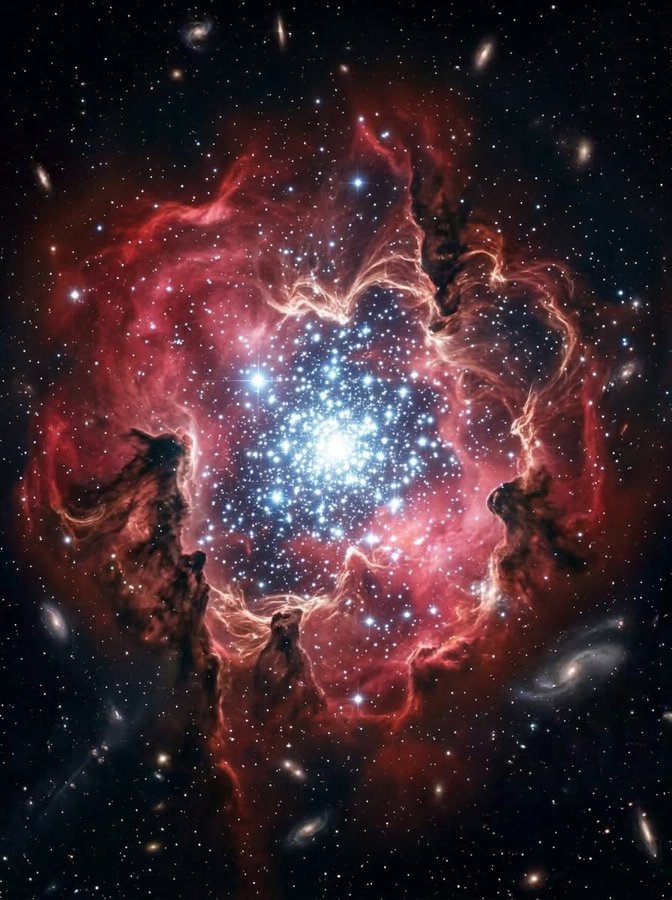
NGC 3603: The Milky Way’s Most Extreme Stellar Nursery
Deep in the Carina spiral arm, about 20,000 light-years from Earth, lies one of the most powerful star factories in our entire galaxy: NGC 3603.
This is not just another nebula — it is home to the most massive young star cluster known in the Milky Way. Here, a dense core of newborn stars blazes with unimaginable fury, including some of the heaviest stars ever discovered — titans exceeding 100 times the mass of the Sun. All of this cosmic drama unfolded in a single explosive burst of star formation just 1 to 2 million years ago.
A Blazing Heart That Reshapes Its Surroundings
The cluster’s hottest, most massive stars pour out ferocious ultraviolet radiation, carving out one of the largest H II regions in the galaxy. This ionized hydrogen glows with a vivid red-pink light — the unmistakable signature of hydrogen-alpha emission — creating a breathtaking nebula that surrounds the cluster like a glowing cradle.
At the turbulent edges where this intense radiation slams into cooler, neutral gas, something spectacular happens. Powerful stellar winds and radiation pressure sculpt the material into towering pillars and dark, dense globules. Far from destroying everything, this violence often triggers the next round of creation through radiation-driven implosion — compressing gas clouds until they collapse and form brand-new stars.
Bok Globules: Seeds of Future Suns
High-resolution images from the Hubble Space Telescope reveal dozens of Bok globules — small, cold, ink-black knots of molecular gas silhouetted against the brilliant pink nebula. These are the earliest visible stages of low-mass star formation. Inside each one, a new star (or small group of stars) is quietly preparing to ignite. In a few hundred thousand years, they will collapse under their own gravity and light up, continuing the cycle of stellar rebirth.
NGC 3603 is a perfect example of nature’s grand recycling program: the most massive stars live fast, die young, and in doing so, both destroy and create — sculpting the galaxy while seeding the next generation of suns.
It is one of the closest and most spectacular laboratories we have for studying how the universe builds its biggest, brightest, and most influential stars. A place where the cycle of cosmic life and death plays out on a breathtaking scale
L'anterior mundial el van guanyar amb 8 jugadors dels Països Catalans. Aquest mundial el podrien guanyar amb 12 jugadors dels Països Catalans.
La Selecció dels Països Catalans cada dia és més poderosa i són els millors. Enteneu perquè els borbons invasors no ens deixen jugar?
- Soc català i el meu país va de Salses a Guardamar i de Fraga fins a l’Alguer.
- Sóc català i la meva llengua és la de Jacint Verdaguer, Caterina Albert i Ramon Muntaner.
- Sóc català i el meu himne és “Els Segadors” i la meva bandera la senyera.
Visca Catalunya lliure!
Guerra 1936-1939. El Fons de Documentació d'Estat Català en motiu del 90 aniversari de la guerra dels tres anys, a partir del 18 de juliol , publicarem notícies i imatges del partit , amb estelades en tots els fronts de combat, en defensa de Catalunya i contra el feixisme.
Dues embarcacions amb les veles pintades amb estelades s'han apropat a la línia de la costa d'Empúries aconseguint que els Borbons haguessin de veure els símbols independentistes directament durant la seva visita a les ruïnes
Mentre espanyols i francesos estan distrets jugant a pilota nosaltres hauríem d’estar treballant per la reconstrucció nacional. Ens hem de concentrar en allò que importa.
🪐 This image shows the ice giant Uranus in infrared light, captured by the Keck Observatory telescope!
Uranus—along with its rings and even its moons—rotates at an angle of more than 90 degrees relative to the other planets.
🌅 Sunset from Orbit: Atmospheric Layers in Focus
This image, captured from the ISS, reveals the mesmerizing gradient of Earth's atmospheric layers during sunset. Unlike the view we are accustomed to, the stratosphere, mesosphere, and thermosphere are clearly visible here, each displaying unique hues resulting from the scattering of sunlight at varying altitudes.
🌌 A giant among giants: S5 0014+81 versus the Solar System
The black hole S5 0014+81 is a monster with a mass 40 billion times that of our Sun. If our Milky Way were placed in its vicinity, it would appear insignificant. The diameter of the region occupied by our Solar System (including the Oort cloud) is merely a fraction of a percent of the size of this supermassive black hole's accretion disk.