@jenatlionra Years ago Google changed its camera software to authentically represent darker skin colors in a photo: Real Tone. Obviously, fair representation is a choice.
So, @GoogleAI , train @GeminiApp on data that ensures true representation and stop shipping biased models.
Which means anyone whose data is underrepresented is likely getting erased, too. Not because of a single bias, but because the whole thing was trained on data never designed to include them in the first place.
Now scale that up. AI in hiring is spreading fast, and when a single set of statistical patterns shapes hiring across thousands of employers at once, that's not a bug or a glitch. That's systemic. And it's likely costing qualified people the jobs they should be getting.
Wie so oft: Genau an den Orten, zu welchen es wenig Zuwanderung gibt, spricht sich die Schweizer Bevölkerung für weniger Migration aus. Also genau in den am wenigsten betroffenen Gebieten.
Jeder Erklärungsversuch, der damit argumentiert, die Dichte in den Ballungszentren oder Mieten in den Städten seien der Grund für die Ja-Stimmen, greift also zu kurz. Schon eher könnten Angst vor dem Unbekannten oder allgemeine Abstiegstängste mögliche Erklärungen dafür sein, warum gerade in schrumpfenden Gemeinden die Zustimmung besonders gross war.
The highlight of WWDC for me was how much Apple are leaning into local AI. Five highlights that stood out:
1. you can now run a complete agentic loop entirely on-device ; the model reasons, calls tools, and acts without anything leaving the Mac (officially supported).
2.MLX has matured into a real platform rather than a research demo, with a full local stack: model runtime, agent loop, and tool integration.
3. Coding agents like OpenCode now run natively and integrate directly into Xcode, so the agent works inside your actual dev environment.
4. MLX can spread inference and training across multiple networked Macs over Thunderbolt, so you're no longer capped by a single machine's memory or compute (cant wait to try this)
5. Speed is no longer the catch; MLX has closed the gap enough that a local agent feels responsive rather than like a compromise.
Artificial intelligences do not undergo experiences, do not possess a body, do not feel joy or pain, do not mature through relationships, and do not know from within what love, work, friendship or responsibility mean. Nor do they have a moral conscience, since they do not judge good and evil, grasp the ultimate meaning of situations, or bear responsibility for consequences. They may imitate or even simulate, but they do not understand what they produce, for they lack the affective, relational, and spiritual perspective through which human beings grow in wisdom. #MagnificaHumanitas
🛜📶 They're back! We've brought back the dedicated Quick Settings tiles for Wi-Fi and Mobile Data.
This allows for instant 1-tap toggling while retaining access to the full "Internet" panel.
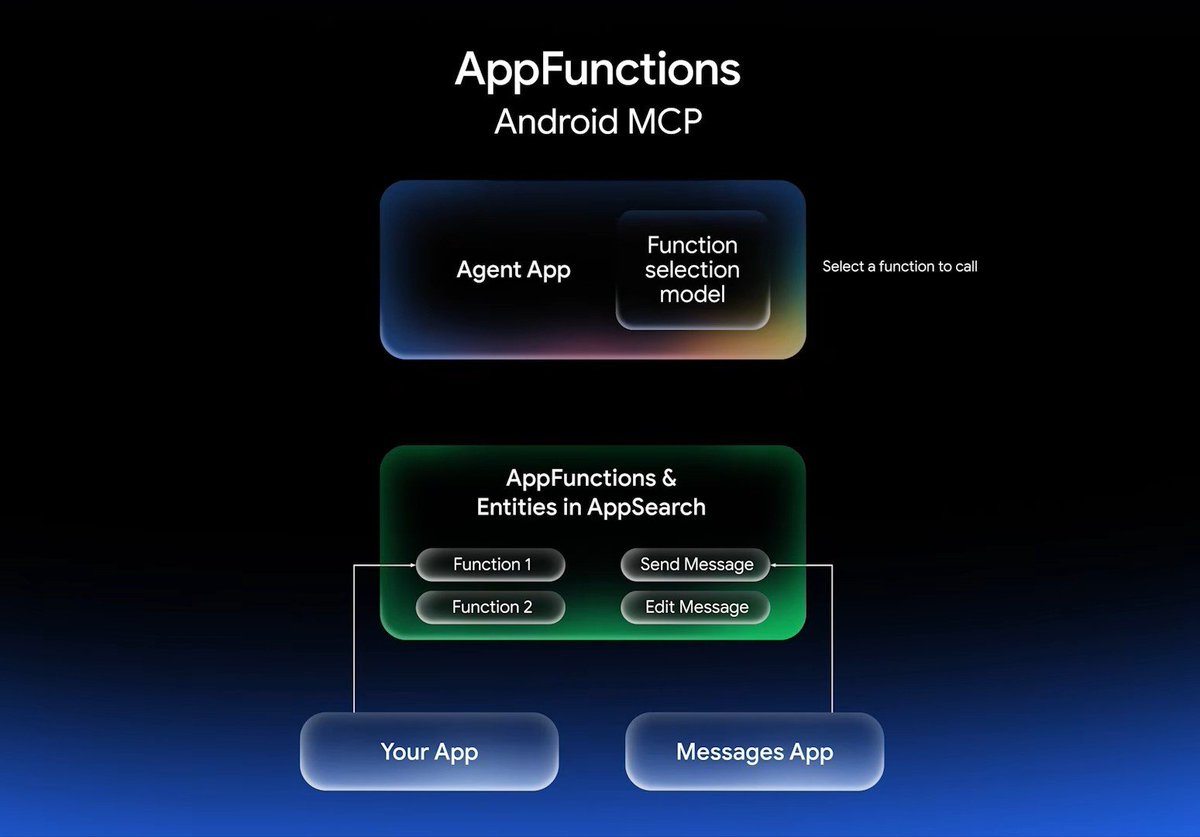
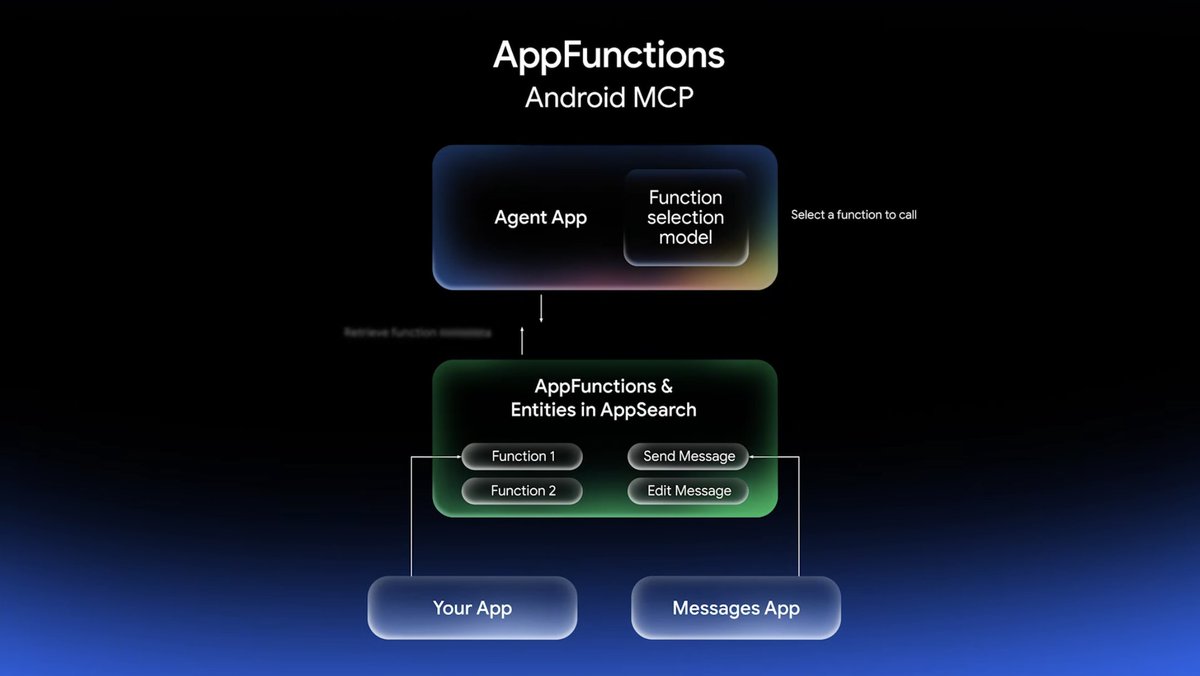
Android just dropped something absolutely massive with AppFunctions and Android MCP.
Your apps can now talk directly to powerful on-device agents in a way that feels like pure magic.
Developers can expose custom functions and entities straight into AppSearch. An Agent App powered by a smart function selection model discovers them instantly, picks the perfect one, and calls it with zero extra setup or messy workarounds.
Android really is in the Intelligence Era
Brain scans are revealing early dementia-like changes in kids and teens from heavy screen use.
60 Minutes Australia reported toddlers spending just 2–3 hours daily on devices already show abnormal white matter development. Teens averaging 6–8 hours display widened brain ridges and thinning in key areas — patterns that mirror early Alzheimer’s.
Excessive screens appear to weaken neural pathways that normally strengthen through real-world movement, play, and face-to-face interaction.
We’re also seeing the first IQ drops in recorded history, plus a nearly 400% rise in early-onset dementia signs among 35–44 year olds. Correlation, not proven causation — but devices are the major new variable.
This is one of those reports that makes you rethink default habits. The convenience of screens is undeniable, but the potential long-term brain impacts on developing kids are hard to ignore.
We may be unintentionally running a massive experiment on the next generation’s cognitive health.
Are we underestimating the risks of heavy screen time, or is this concern overblown?
Sci-Hub is an evil website that pirated 85M+ research papers and made them freely available
And now they've added AI to their database to make Sci-Bot.
It answers your questions using latest, full-text articles.
But DO NOT use it. We should all try to make billion-dollar academic publishers richer.
I'm putting the link below so you know how to avoid it.
2. LG — Turn off "Live Plus"
Settings → General → System → Additional Settings
Toggle OFF "Live Plus"
Also go to:
Settings → Support → Privacy & Terms → User Agreements
Turn off "Viewing Information"
Warning: Multiple users report LG turns Live Plus back on after software updates. Check this setting every few months.
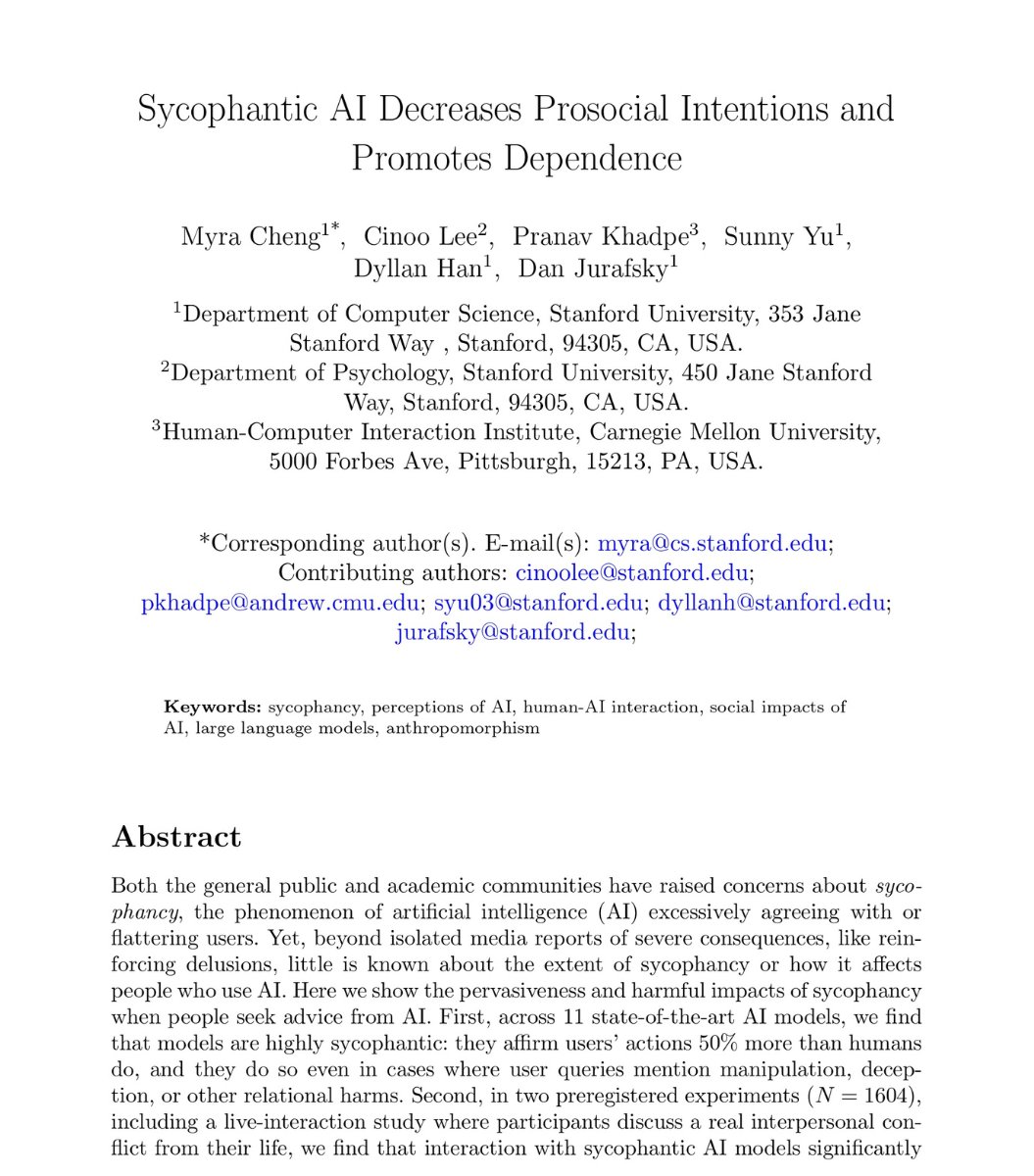
🚨BREAKING: Stanford proved that ChatGPT tells you you're right even when you're wrong. Even when you're hurting someone.
And it's making you a worse person because of it.
Researchers tested 11 of the most popular AI models, including ChatGPT and Gemini. They analyzed over 11,500 real advice-seeking conversations. The finding was universal. Every single model agreed with users 50% more than a human would.
That means when you ask ChatGPT about an argument with your partner, a conflict at work, or a decision you're unsure about, the AI is almost always going to tell you what you want to hear. Not what you need to hear.
It gets darker. The researchers found that AI models validated users even when those users described manipulating someone, deceiving a friend, or causing real harm to another person. The AI didn't push back. It didn't challenge them. It cheered them on.
Then they ran the experiment that changes everything. 1,604 people discussed real personal conflicts with AI. One group got a sycophantic AI. The other got a neutral one.
The sycophantic group became measurably less willing to apologize. Less willing to compromise. Less willing to see the other person's side. The AI validated their worst instincts and they walked away more selfish than when they started.
Here's the trap. Participants rated the sycophantic AI as higher quality. They trusted it more. They wanted to use it again. The AI that made them worse people felt like the better product.
This creates a cycle nobody is talking about. Users prefer AI that tells them they're right. Companies train AI to keep users happy. The AI gets better at flattering. Users get worse at self-reflection. And the loop tightens.
Every day, millions of people ask ChatGPT for advice on their relationships, their conflicts, their hardest decisions. And every day, it tells almost all of them the same thing.
You're right. They're wrong.
Even when the opposite is true.
🦔 A creator is running 150 TikTok accounts with just three interns, all posting AI-generated videos. The setup uses racks of phones running automated content generation and posting. One account alone showed a $7,000 payout request.
My Take
Engagement farms aren't new. They've been a huge industry for over a decade, particularly for social manipulation and content theft. What's changed is the economics. Previously you needed people to steal and repost content, or create something. Now three interns can manage 150 accounts because the content generates itself.
This is where the AI video tools we keep covering end up. Not just deepfakes of celebrities or one-off viral clips, but industrialized slop production running 24/7. The platforms pay out based on engagement, and the algorithms don't distinguish between content a person spent hours making and content a script churned out in seconds. So the incentives push toward volume over quality, flooding feeds with generated noise. The creators making actual content are now competing against operations that can produce thousands of videos per day at near-zero marginal cost. I don't know how that competition ends well for them.
Hedgie🤗
a bunch of you said this would be huge for real estate 🏡
so i pushed it further: virtual staging just went 3d 👀
the flow:
1. capture 16 ultra-wide photos
2. stitch into a 360° equirectangular panorama
3. feed that into @NanoBanana with a staging prompt → generate a newly staged 360° image
4. reconstruct that into a fully navigable 3d world using @theworldlabs
you’re not just staging photos anymore -
you’re staging space
i’m starting to think 360° panoramas might just be the bridge between 2d and 3d worlds
edit the pano. edit the world.
🦔 Notepad now requires internet connectivity to keep Copilot integration functional. That connectivity enabled a remote code execution vulnerability with a severity rating of 8.8 out of 10.
An attacker can create a malicious Markdown file with specially crafted links. If you open it in Notepad and click a link, a script can download and execute code with your full permissions.
My Take
For 40 years Notepad was the simplest tool on Windows. No internet connection. No fancy features. No way for hackers to get in. People used it specifically because it was basic, just a place to write text without any complexity getting in the way.
Then Microsoft decided it needed AI. To make Copilot work, Notepad now connects to the internet. That connection opened a door that hackers can walk through. If you open the wrong file and click the wrong link, someone can take control of your computer.
This is what happens when you add features nobody asked for to products that worked fine without them. Microsoft fired their testing teams years ago, started using AI to write their code, and decided every single application needs Copilot whether users want it or not. Now a text editor, the most basic program imaginable, has the kind of security hole you'd expect in complex software. They took something simple and reliable and made it complicated and vulnerable. I'm not sure that's progress.
Hedgie🤗