So long, America🫡🇺🇸
49 days ago we landed in the USA to follow our country at the World Cup. We had no idea it would turn into the trip of a lifetime.
Thank you to everyone who followed along, and to all the people we met who made this journey even more special. We honestly don’t have the words to express how grateful we are for everything you did for us.
This trip exceeded every expectation we had. We came here with an open mind, wanting to experience as much of the country as possible. I still remember telling my friends on the flight to Atlanta that I hoped we’d get to meet a few locals on this trip. Now we’re flying home with friends all across the USA.
Before we came, we heard so many stereotypes and warnings about America. People told us about safety concerns, that they might check our social media at the border, and all kinds of other things. None of it matched our experience. This was probably the most welcoming country we’ve ever visited.
So if you have the chance to travel, do it. The world isn’t nearly as bad as the media often makes it seem. 99% of people are awesome!
I heard this quote somewhere during the World Cup, and I think it sums up our experience perfectly:
“If you want to hate the world, watch the news. If you want to love it, travel it.”
Thank you, America ❤️🇺🇸
HAVANA, July 6 (@Reuters) - Cuba's national electric grid collapsed on Monday at midday, the country's grid operator said, leaving around 10 million people on the Caribbean island without power.
https://t.co/7L2bHbBb3J
Posted by former US Congressman @AdamKinzinger on Facebook. Beautifully written, in both form and substance:
Hey everyone, happy Sunday. Are you ready for some good news? I know I am.
We are told, over and over, that America has gone cold on the rest of the world. That we have decided the people on the other side of the ocean are a threat to be kept out. That the welcome mat got rolled up and put away for good.
Then a soccer team from the North African nation of Algeria showed up in Lawrence, Kansas, and within a week the whole town was wearing green.
For today's Good News Sunday, I want to tell you about one of the best things happening in this country right now. It is happening at a soccer tournament, and it has almost nothing to do with soccer.
The World Cup is here, 48 teams playing across the United States, Canada, and Mexico. Each team in the tournament picks a base camp, one town to live and train in between matches. Germany set up shop in Winston-Salem, North Carolina. Spain is training in Chattanooga, Tennessee. And Algeria, playing two of its games up the road at Arrowhead, picked Lawrence and made it home for the summer.
What the people of Lawrence did with that is the part I can't stop thinking about.
It started small, with a whole town of people who had never given Algeria much thought deciding, more or less overnight, that this was their team now. Flags went up in shop windows. Folks pulled on the green jerseys. People drove over just to catch a glimpse of the players. And then a local news crew stopped an older gentleman on a Lawrence sidewalk, standing in front of a storefront draped in a whole row of Algerian flags he had clearly just gone out of his way to find.
They asked him what he actually knew about the country whose colors he was flying. He grinned, paused for a beat, and said something along the lines of: not much yet — but we want to welcome you here. There is no agenda in that man. Nothing performative. Just a neighbor, thrilled to his bones that these strangers chose his town, and perfectly at ease with the fact that he has a lot left to learn about them.
The welcome only got bigger from there.
The University of Kansas, the state's flagship school that calls Lawrence home, sent its marching band out to the training ground. They had spent the previous days learning Algeria's national anthem, note for note, and they played it as the players walked out for practice. Think about what that means for a moment.
These men are thousands of miles from their families, living out of a hotel in the American Midwest, preparing for the biggest sporting event of their professional lives. And the first thing they hear when they step onto the grass is the sound of their own country's song, played by a hundred American college kids in red and blue who learned it just for them. Several of the players stopped walking. A few of them looked like they weren't sure what to do with themselves.
Algeria did its part, too. The team opened a training session to the public and spent the afternoon out on the grass with neighborhood kids, walking them through drills, signing autographs, posing for pictures. There are children from small-town America who are going to be telling the story of the day they trained with a World Cup team for the rest of their lives. And the Algerians have spent the last week calling themselves honorary Kansans, falling hard for a corner of a state most of them could not have found on a map two months ago.
But it's not just Lawrence.
This is happening all over the country, in towns you would never expect.
The city of Alexandria, Virginia threw a street festival with an evening of Croatian food and music, and wrapped a city bus in the team's red and white. After crowds in Spokane, Washington flocked to watch Egyptian superstar Mohamed Salah, a brand-new Egyptian restaurant in town suddenly had locals lining up for food most of them had never tasted. All told, 19 American communities that are not hosting a single match still raised their hand to take in a national team and call them neighbors for a month.
There is a story we get told constantly about who we have become. That Americans have soured on outsiders. That we have decided the rest of the world is a threat. That we look at people who do not talk like us or pray like us or come from where we come from and see a problem instead of a person.
And then a college town in Kansas goes and learns every note of a North African country's national anthem, just so a group of strangers feel at home for a few weeks. An old local stands in front of a row of its flags and tells them, in so many words: we don't know much about you yet, but we are awfully glad you came.
That is who we actually are when nobody is telling us to be afraid. The band on the field, playing somebody else's song as if it were their own. The neighbor who knows next to nothing about you and waves you in anyway. We forget it sometimes. The good news is that it takes about one afternoon to remember.
That, my friends, is good news for your Sunday.
— Adam
Senator Chris Coons (D) on the fate of Ukraine support bill in the Senate: "It has broad support among democrats and republicans" - why is it taking such a long time in this case, I ask - "because President Trump refuses to recognize that defending Ukraine is defending America"
Rep. McCaul was one of 18 Republicans who voted for Ukraine Support Act in the House, defying GOP leadership. "This is the time to standup", he tells me. "And I wish my own party could put the bill on the floor"
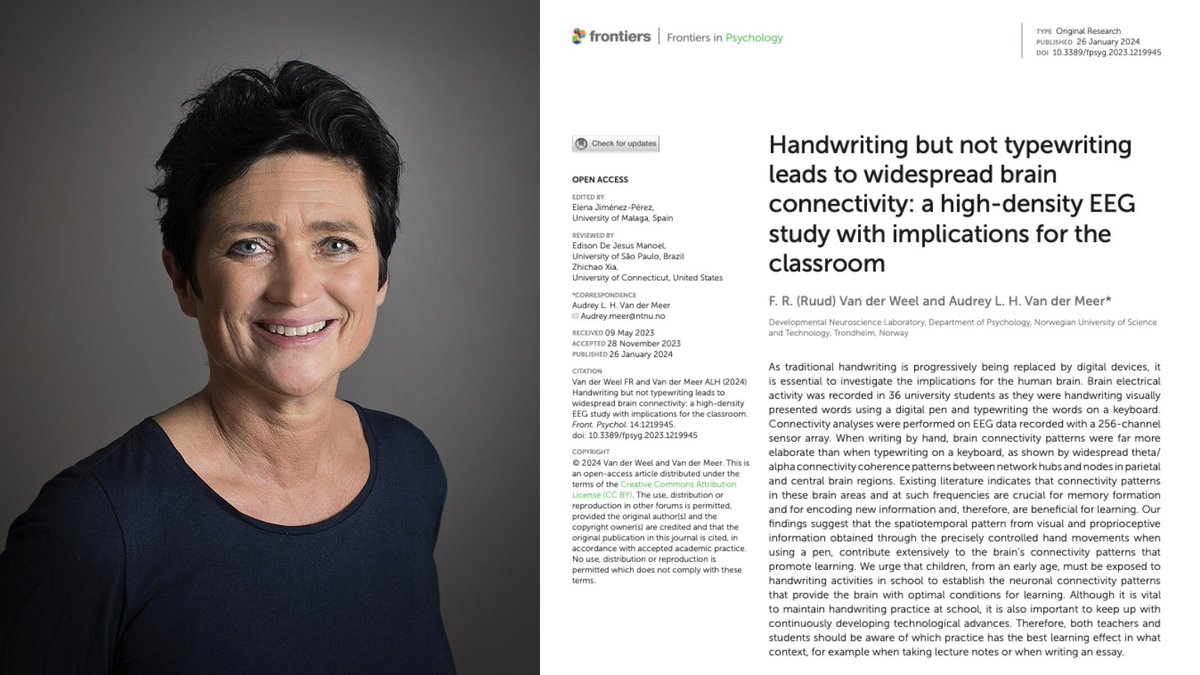
A Norwegian neuroscientist spent 20 years proving that the act of writing by hand changes the human brain in ways typing physically cannot, and almost nobody outside her field has read the paper.
Her name is Audrey van der Meer.
She runs a brain research lab in Trondheim, and the paper that closed the argument was published in 2024 in a journal called Frontiers in Psychology. The finding is brutal enough that it should have changed every classroom on Earth.
The experiment was simple. She recruited 36 university students and put each one in a cap with 256 sensors pressed against their scalp to record brain activity. Words flashed on a screen one at a time.
Sometimes the students wrote the word by hand on a touchscreen using a digital pen, and sometimes they typed the same word on a keyboard. Every neural response was recorded for the full five seconds the word stayed on screen.
Then her team looked at the part of the data most researchers had ignored for years, which is how different parts of the brain were communicating with each other during the task.
When the students wrote by hand, the brain lit up everywhere at once.
The regions responsible for memory, sensory integration, and the encoding of new information were all firing together in a coordinated pattern that spread across the entire cortex. The whole network was awake and connected.
When the same students typed the same word, that pattern collapsed almost completely.
Most of the brain went quiet, and the connections between regions that had been alive seconds earlier were nowhere to be found on the EEG.
Same word, same brain, same person, and two completely different neurological events.
The reason turned out to be something nobody had really paid attention to before her work. Writing by hand is not one motion but a sequence of thousands of tiny micro-movements coordinated with your eyes in real time, where each letter is a different shape that requires the brain to solve a slightly different spatial problem.
Your fingers, wrist, vision, and the parts of your brain that track position in space are all working together to produce one letter, then the next, then the next.
Typing throws all of that away. Every key on a keyboard requires the exact same finger motion regardless of which letter you are pressing, which means the brain has almost nothing to integrate and almost no problem to solve.
Van der Meer said it plainly in her interviews.
Pressing the same key with the same finger over and over does not stimulate the brain in any meaningful way, and she pointed out something that should scare every parent who handed their kid an iPad.
Children who learn to read and write on tablets often cannot tell letters like b and d apart, because they have never physically felt with their bodies what it takes to actually produce those letters on a page.
A decade before her, two researchers at Princeton ran the same fight using a completely different method and ended up at the same answer. Pam Mueller and Daniel Oppenheimer tested 327 students across three experiments, where half took notes on laptops with the internet disabled and half took notes by hand, before testing everyone on what they actually understood from the lectures they had watched.
The handwriting group won by a wide margin on every question that required real understanding rather than surface recall.
The reason was hiding in the transcripts of what the two groups had actually written down.
The laptop students typed almost word for word, capturing more total content but processing almost none of it as they went, while the handwriting students physically could not write fast enough to transcribe a lecture in real time, which forced them to listen carefully, decide what actually mattered, and put it in their own words on the page.
That single act of choosing what to keep was the learning itself, and the keyboard had quietly skipped the choosing and skipped the learning along with it.
Two studies. Two countries. Same answer.
Handwriting makes the brain work. Typing lets it coast.
Every note you have ever typed instead of written went into your brain through a thinner pipe. Every meeting, every book highlight, every idea you captured on your phone instead of on paper was processed at half depth.
You did not forget those things because your memory is bad. You forgot them because typing never woke the part of the brain that would have made them stick.
The fix is the thing your grandmother already knew.
Pick up a pen. Write the thing down. The slower road is the faster one.
😂😂😂🤬 That’s not how the Estonians, Latvians, and Lithuanians see it—or the rest of Europe.
And let’s not forget that Soviet troops killed Latvians and Lithuanians in 1991 in an attempt to stop them from becoming independent.
Chancellor Merz: For far too long, we in Germany didn’t want to hear our Baltic neighbours’ warnings about Russia’s imperialist policies. We have recognised this mistake – and there is no going back from this realisation.
Da draußen ist die Stimmung irgendwie anders als auf Twitter.
66% der Deutschen fänden die Verdopplung der Verteidigungsausgaben bis 2032 grundsätzlich richtig.
Chairs of Foreign Affairs Committees of Seven European Parliaments Urge Trump Not to "Repeat the Mistakes" of the Munich Agreement
The chairs of the foreign affairs committees of the parliaments of the United Kingdom, France, Czech Republic, Lithuania, Latvia, Estonia, and Ukraine issued a joint statement urging U.S. President Donald Trump to put an end to the "policy of appeasement" toward Russia.
"We cannot repeat the mistakes of Munich 1938," the authors of the document emphasized.
In Kyiv, Schoolchildren Watched Over Bombed Building All Day, Hoping to Find Their Classmate
He had not been in contact since the previous night. The children showed photos of the 17-year-old boy to rescuers and passersby. Unfortunately, the miracle didn’t happen. After lunchtime, rescuers recovered the bodies of several victims from the rubble, including the schoolboy.
A journalist from Suspilne, while reporting on this live, couldn’t hold back tears.
The death toll from the overnight missile strike on Kyiv has risen to 12, with around 100 injured. A day of mourninghas been declared in the city for tomorrow.
„Ich lebe lieber in Unfreiheit, als für Freiheit zu sterben“ – Philosophie oder Gerede?
Hier ist zwar kein guter Ort für das Philosophische Quartett. Dennoch hab ich mir die Freiheit einer Kritik dieses kontroversen Satzes von @nymoen_ole genommen. Ein🧵 in 4 Teilen: