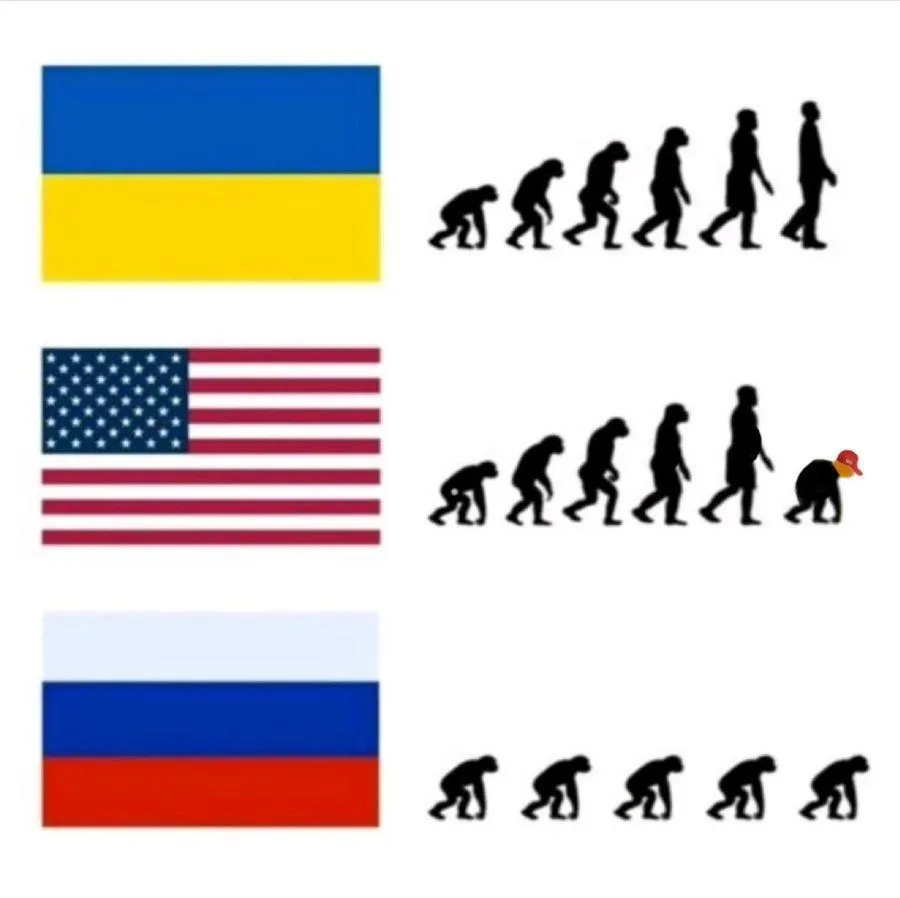
Путин радуется снижению числа безработных в России. Говорит, что это благодаря развитию «гибких, платформенных видов занятости».
Число безработных в России
Февраль 2022: 3 071 000 чел
Февраль 2026: 1 636 000 чел
Потери России в Украине: 1 400 000 чел
Ну так совпало
In 2009, Stanford professor Robert Sapolsky explained why depression is not a mental problem but a biological breakdown.
He revealed:
- Why “just be strong” is nonsense
- Why stress rewires your future
- How biology + psychology collide
15 lessons on the science of depression:
Nome di battaglia "Gothmog", combattente italiano arruolato in un battaglione d'élite delle forze armate ucraine. E' rimasto ferito in un attacco di droni, ma è intenzionato a tornare al fronte: "Continuerò a fare il mio dovere sino alla fine". @RaiNews
In 45 years on Wall Street, I've never seen anything like this.
Sam Altman just convinced 3 of the world's smartest investors to fund his losses.
$110 billion. But ZERO profit in sight.
The largest private funding round in history.
Let me explain why this is borderline criminal & what you have to understand as an investor:
Amazon. Nvidia. SoftBank.
3 of the world's most sophisticated investors just handed OpenAI $110 billion at an $840 billion valuation.
That's more than double the $40 billion OpenAI raised last year.
For context: all US venture capital combined invested $170 billion into American startups in all of 2023.
Altman just raised 65% of that. Alone. In one round.
And the company STILL isn't profitable.
Let's look at the actual numbers:
OpenAI burned $8 billion in 2025. They project burning $17 billion in 2026. $35 billion in 2027. $47 billion in 2028.
Cumulative losses before any projected path to profitability: over $115 billion.
Meanwhile, Amazon's $50 billion comes with strings attached. $35 billion is contingent on OpenAI either achieving AGI or completing its IPO by year end.
Read that again.
$35 billion is conditioned on ACHIEVING AGI.
They're literally writing checks against a scientific breakthrough that may not happen on any predictable timeline.
This is what peak cycle financing looks like.
The circular logic every investor should understand:
Amazon invests $50 billion in OpenAI.
OpenAI commits to spending $100 billion on Amazon Web Services.
Nvidia invests $30 billion.
OpenAI commits to buying 3 gigawatts of Nvidia compute.
These aren't arms-length investments. They're vendor financing dressed up as venture capital.
Amazon and Nvidia are essentially paying OpenAI to buy their own products.
The $840 billion valuation prices in a future that doesn't exist yet.
At $13 billion in 2025 revenue, that's 65x revenue.
Even in 2021 - the most speculative bubble in recent tech history - Snowflake peaked at 50-80x revenue.
And Snowflake was actually profitable.
J.P. Morgan calculates that the AI industry needs $650 billion in annual revenue just to generate a 10% return on total infrastructure buildout.
The entire industry currently generates a fraction of that.
I've seen cycles my entire 45-year career.
The 1980s defense build-up. The dot-com bubble. The 2008 mortgage machine.
The pattern is always the same:
When the biggest players start financing each other's growth through circular investment structures, you're not witnessing a revolution...
You're watching the LAST PHASE of a credit cycle.
Amazon CEO Andy Jassy said OpenAI is going to be "one of the very big winners long term."
Maybe.
But $840 billion assumes they've already won.
Stock prices follow earnings. Always have. Always will.
And right now, OpenAI's earnings are deeply, structurally, massively negative.
The IPO is coming. The hype will peak. And the question every serious investor needs to answer is simple:
At what price does this actually make sense?
Sam Altman doesn’t know either - he just keeps raising money faster than he can burn it.
This can’t end well.
At birth, success is being alive
At age 3, success is not pooping your pants
At age 10, success is having friends
At age 16, success is having a driver's license
At age 20, success is having sex
At age 30, success is having money.
At age 40, success is having money
At age 55, success is having sex
At age 70, success is having a driver's license
At age 75, success is having friends
At age 80, success is not pooping your pants
At age 90, success is being alive
We all start somewhere and finish where we start, time is the real success so use it wisely
The Pentagon just blacklisted one of America’s most valuable AI companies.
For refusing to build surveillance tools aimed at American citizens.
Hours later, its biggest rival OpenAI quietly signed the deal of the decade.
Here’s what just happened and why it changes everything.
This week, the US Department of War gave Anthropic an ultimatum.
Drop your safety restrictions and let us use your AI for anything we want.
The deadline was 5:01 PM today and Anthropic said no.
Their CEO, Dario Amodei, drew two red lines.
No mass surveillance of Americans.
No fully autonomous weapons without a human pulling the trigger.
The Pentagon called this “woke AI.”
Anthropic called it a conscience.
The Pentagon’s response was swift and brutal.
Defense Secretary Pete Hegseth branded Anthropic a “supply chain risk”, a designation normally reserved for Chinese and Russian companies.
President Trump ordered every federal agency to stop using Anthropic immediately.
But here’s where the story turns.
That same night, Sam Altman, CEO of OpenAI, Anthropic’s biggest competitor posted a message.
“Tonight, we reached an agreement with the Department of War to deploy our models in their classified network.”
The twist? OpenAI’s deal includes the exact same red lines Anthropic was just destroyed for demanding.
No mass surveillance and no autonomous weapons.
Human control over the use of force.
The Pentagon punished one company for demanding protections it then gave to another company the same day.
Altman even defended Anthropic on live television hours earlier.
“For all the differences I have with Anthropic, I mostly trust them as a company and I think they really do care about safety.”
Then he signed the deal Anthropic couldn’t get.
Anthropic was the first and only, AI model deployed on the Pentagon’s classified networks.
Replacing it will take months.
OpenAI just positioned itself to fill the most powerful AI vacancy in the U.S. military.
The stakes are staggering.
Anthropic just raised $30 billion and it was preparing for an IPO.
Now over 300,000 enterprise clients may be forced to cut ties.
Not because the technology failed.
Because the company refused to remove a guardrail that said “don’t spy on Americans.”
But here’s the real question no one’s asking:
If the Pentagon never intended to use AI for mass surveillance as they claim, why was this the hill they chose to die on?
Why blacklist a $380 billion American company over a clause the government says doesn’t even matter?
Sam Altman called for de-escalation.
He asked the Pentagon to offer these same terms to every AI company.
Including Anthropic.
The world just watched a company get punished for saying “no” to surveillance and a competitor rewarded for saying “yes, but with the same conditions.”
Bookmark and share this.
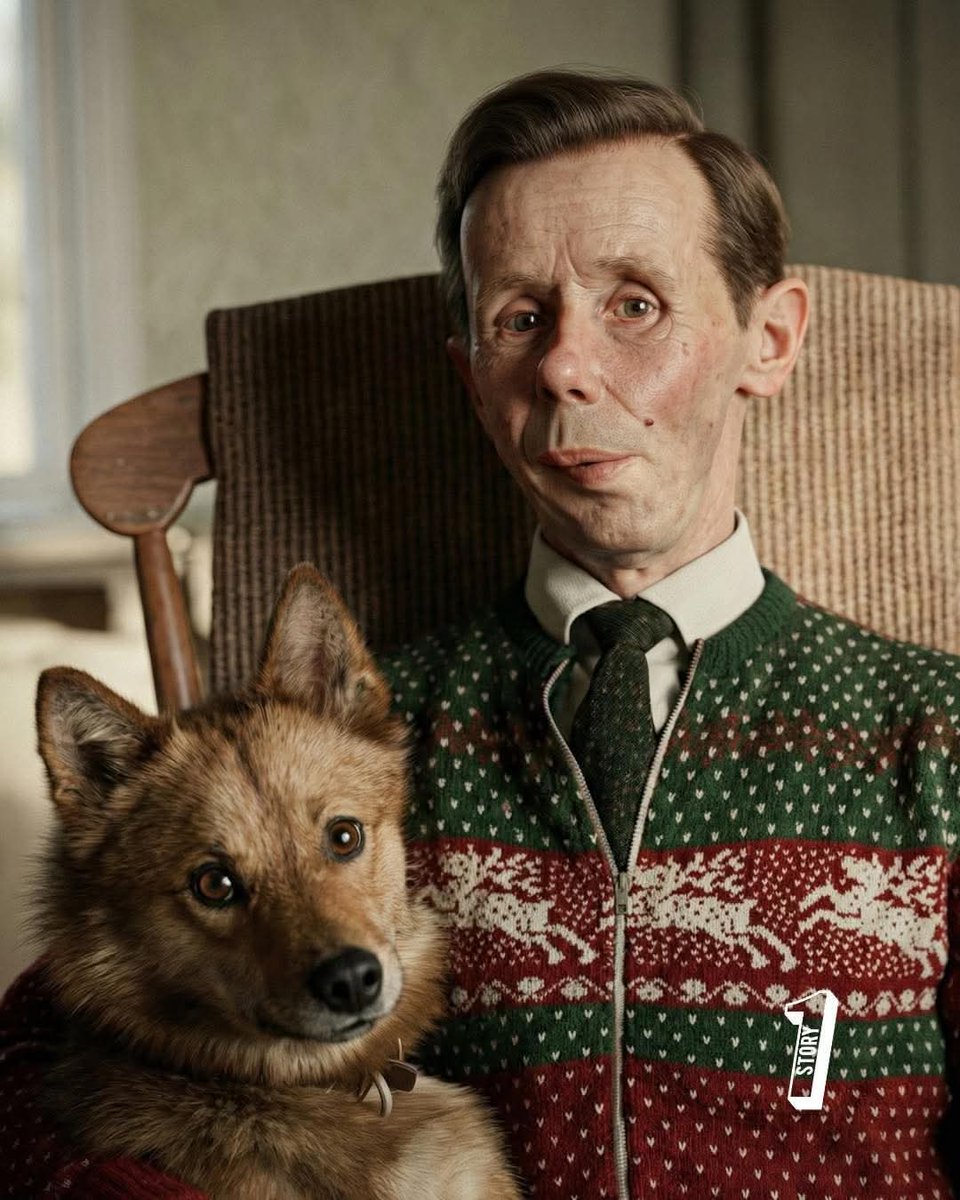
He killed 542 men in 100 days without ever looking through a scope.
Then he disappeared back into an ordinary life — so ordinary that the world nearly forgot he had ever existed.
Simo Häyhä was small in stature — five foot three — stocky and quiet. His hands were calloused from farm tools, not polished by ceremonial sabers. In the rural southeast of Finland, near the village of Rautjärvi, he was known as a dependable neighbor. He hunted. He farmed. He kept to himself.
Nothing about him suggested legend.
Then came November 30, 1939.
The Soviet Union invaded Finland, beginning what would later be known as the Winter War. Moscow expected a swift campaign. The Red Army brought roughly half a million soldiers, along with tanks, aircraft, and artillery. They outnumbered Finnish forces by nearly three to one. On paper, it looked less like a war and more like an inevitability.
But snow does not follow paper calculations.
That winter was merciless. Temperatures dropped to minus 40 degrees. Engines froze. Metal stuck to bare skin. Forests swallowed sound. The Finns knew the terrain the way farmers know their fields and hunters know animal tracks.
Simo Häyhä was one of those men.
He had grown up skiing through those forests, reading wind and shadow, standing motionless until game appeared. When he joined the Finnish Army, he did not transform into something new. He simply applied the skills he had built over years to a different purpose.
Dressed head to toe in white, he vanished into the snowfields. He packed snow in front of his rifle barrel so the muzzle blast would not kick up powder and reveal his position. He held snow in his mouth to cool his breath, reducing the visible vapor that could give him away in the cold air. He lay still for hours, sometimes entire days, letting the forest settle around him.
He did not stalk.
He waited.
What made him especially dangerous was a choice most snipers would consider illogical.
He refused to use a telescopic sight.
While others relied on scopes, Häyhä used only iron sights — the simplest aiming system available. He believed a scope could reflect sunlight like a signal mirror. It required lifting the head slightly higher, increasing visibility. In extreme cold, lenses could fog or freeze. Iron sights were lower, sturdier, and more reliable.
He trusted his rifle and his eyes.
In fewer than 100 days of combat, he recorded more than 500 confirmed kills with his rifle. Some estimates place the number at 542. That figure does not include additional enemy soldiers he killed with a submachine gun in close combat.
Five hundred men. In forests locked in ice. In a war his country was not expected to survive.
The Soviets gave him a name: the White Death.
White Death.
Sniper teams were dispatched to hunt him. Entire units were tasked with finding one farmer in a white jacket. Artillery shelled forests where scouts believed he might be hiding. Officers warned soldiers against careless movement across open ground. The idea that one man could inflict such damage deeply unsettled them.
He was no longer just a sniper.
He became winter with a trigger.
On March 6, 1940, a Soviet explosive bullet — designed to maximize damage — struck him in the face. It shattered his jaw, tore through his cheek, and disfigured the left side of his face. Comrades found him unconscious, barely recognizable, and carried him from the battlefield, assuming he would not survive.
He fell into a coma.
Seven days later, he opened his eyes.
The day he regained consciousness was the day the war ended.
Despite overwhelming odds, Finland endured. The country lost territory but retained its independence. Häyhä, disfigured and permanently changed, survived the conflict that turned him into a myth.
Then he did something almost no one expected.
He went home.
No book deals. No speeches about heroism. No attempt to turn reputation into money. He returned to Rautjärvi, to fields and forests.