#ICML2022 week!📜
DiffeqML is contributing to the ICML22 AI4Science workshop:
1) Transform Once: Efficient Operator Learning in Frequency Domain
w/ Michael Poli, Stefano Massaroli, Federico Berto, Jinkyoo Park, Tri Dao, Christopher Ré, Stefano Ermon
When: July 23, 9.00AM EST.
❗New deadline for the #NeurIPS2022 workshop❗
"Symbiosis of Deep Learning and Differential Equations":
October 1st.
Website: https://t.co/WKy76ZMlLw. Send us your work on neural differential equations, learnable numerical methods, continuous-time diffusion and more!
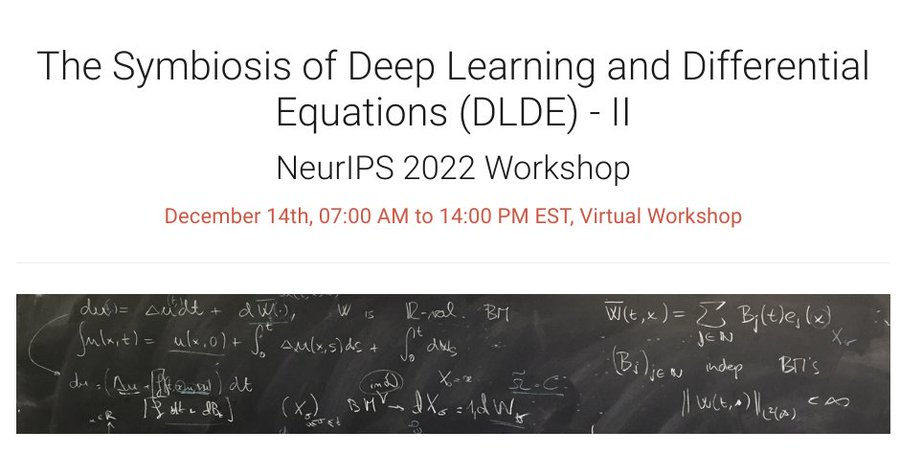
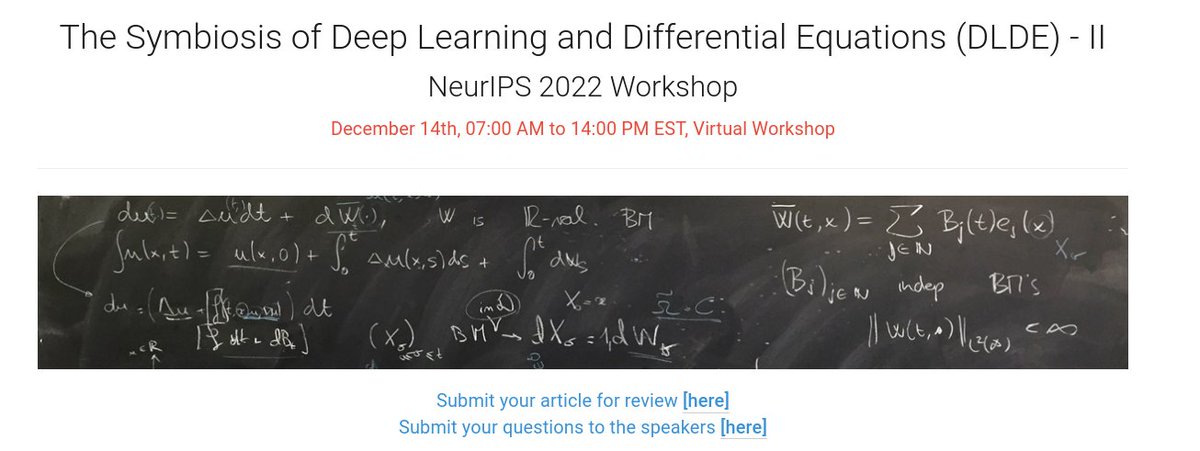
Join us for the second edition of the #NeurIPS2022 workshop "The Symbiosis of Deep Learning and Differential Equations"🌀
We're looking for your AI <> DE ideas: neural diff. eqs., neural operators, diffusion models and novel applications!
website: https://t.co/O7VVNVLRX3
3) Unsupervised Discovery of Inertial-Fusion Plasma Physics using Differentiable Kinetic Simulations and a Maximum Entropy Loss Function
w/ Archis Joglekar, Alexander Thomas
All papers can be found at: https://t.co/RsDSj2brsp
#ICML2022 week!📜
DiffeqML is contributing to the ICML22 AI4Science workshop:
1) Transform Once: Efficient Operator Learning in Frequency Domain
w/ Michael Poli, Stefano Massaroli, Federico Berto, Jinkyoo Park, Tri Dao, Christopher Ré, Stefano Ermon
When: July 23, 9.00AM EST.
2) Efficient Continuous Spatio-Temporal Simulation with Graph Spline Networks
w/ Chuanbo Hua, Federico Berto, Michael Poli, Stefano Massaroli, Jinkyoo Park
Oral: July 23, 10.45AM EST.
The website for our 'The Symbiosis of Deep Learning and Differential Equations' #NeurIPS2021 workshop is up: https://t.co/hU4sHcCqZD
We have a special track for already published papers. Share your work from adjacent fields with the NeurIPS community!
Deadline: Sept. 17 AoE
[1/6] Announcing **torchdyn version 1.0**: https://t.co/62Z9vnh9OT! @MichaelPoli6@Massastrello.
We roughly doubled the number of tutorials (optimal control, parallel-in-time solvers, hybrid systems), added new models and developed a numerics suite for diff eqs and root finding
[2/2] "Hypersolvers: Toward Fast Continuous-Depth Models" accepted at @NeurIPSConf#NeurIPS2020.
Come chat with us:
Poster: Tue, Dec 8th, 2020 @ 09:00 – 11:00 PST (Session 2)
“Dissecting Neural ODEs” (#neurips2020 _oral_ paper) unveils the dynamical systems anatomy of continuous-depth learning from back-propagation to depth-varying parameters or state augmentation, while introducing several new models (e.g. data-control, adaptive depth) @MichaelPoli6
As our first NeurIPS experience, I have to say the results surpassed even the wildest of expectations. This is the culmination of a team effort with my dear friend @Massastrello, leading to @Diffeq_ml as an open-source effort for neural differential equations.
A new paper from DiffEqML research group! We speed up Neural ODE inference by learning how to solve them efficiently through *hypersolvers* @Massastrello@MichaelPoli6 The code will be released soon in torchdyn
[1/n] The community has been hard at work to speed up Neural ODEs, e.g. regularization strategies @DavidDuvenaud@chuckberryfinn to keep the ODE easy to solve. We've also been thinking about the same problem, and we propose a different (compatible!) direction. @Massastrello
We just open-sourced differentiable SDE solvers in PyTorch:
https://t.co/v1f08mjgCq
Now you can put stochastic differential equations in your deep learning models, and neural nets in your SDEs! Credit to @lxuechen.
We finally got around to open-sourcing more Neural ODE variants in the "torchdyn" library https://t.co/bT6Hm22onx, including our latest "stacked neural ODEs" aka continuous-depth models with piece-wise constant parameters. @MichaelPoli6
[1/4] Excited to share the first experimental release of *torchdyn* https://t.co/BycdsMx9Jf, a PyTorch library for all things neural differential equations! torchdyn is developed by the core DiffEqML team. @Massastrello@Diffeq_ml




![Diffeq_ml's tweet photo. [2/2] "Hypersolvers: Toward Fast Continuous-Depth Models" accepted at @NeurIPSConf #NeurIPS2020.
Come chat with us:
Poster: Tue, Dec 8th, 2020 @ 09:00 – 11:00 PST (Session 2) https://t.co/mgN3xm6XIW](https://pbs.twimg.com/media/Eoh5-3yUcAE-ady.jpg)
![Diffeq_ml's tweet photo. [1/2] NeurIPS is almost here!
"Dissecting Neural ODEs" accepted at @NeurIPSConf #NeurIPS2020 as oral.
Looking forward to your questions:
Oral: Tue, Dec 8th, 2020 @ 06:30 – 06:45 PST
Poster: Tue, Dec 8th, 2020 @ 09:00 – 11:00 PST (Session 2)
Code: https://t.co/pEzQB7ygDI https://t.co/zZuK2bZ2NA](https://pbs.twimg.com/media/Eoh5QegUUAEI-34.jpg)


![MichaelPoli6's tweet photo. [1/4] Excited to share the first experimental release of *torchdyn* https://t.co/BycdsMx9Jf, a PyTorch library for all things neural differential equations! torchdyn is developed by the core DiffEqML team. @Massastrello @Diffeq_ml https://t.co/2hF3UYKkzY](https://pbs.twimg.com/media/EWlpA9lU0AI6ylV.jpg)


