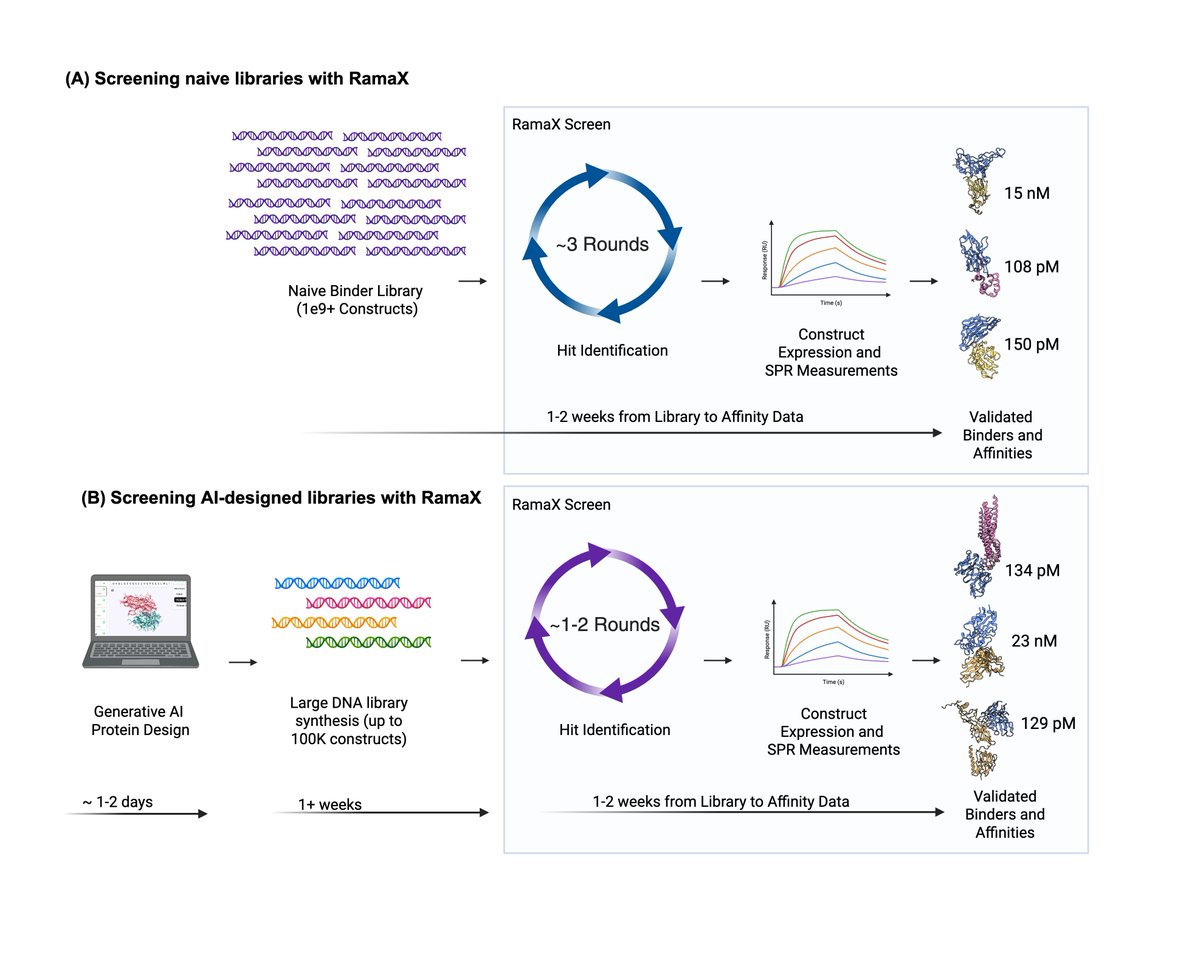
RamaX screens large naive or AI-designed libraries at incredible speed (<1 week). But how accurate is it?
Answer ➡️very
Our new case study shows RamaX has high precision and recall on a benchmark minibinder set. We also share two partner projects where we go from AI design to data in <2 weeks—and find binders that computational metrics miss. Library-scale screening is critical.
Thrilled to share our technical report on this progress. Incredibly grateful for the work we’ve accomplished together as a team 💪https://t.co/acJi6wTwxx 8/
Announcing ProxyTm: our platform for measuring protein thermostability at library scale 🔥🌡️❄️
ProxyTm is 100–1000× lower cost and higher throughput than conventional methods like CD spectroscopy or DSF 1/
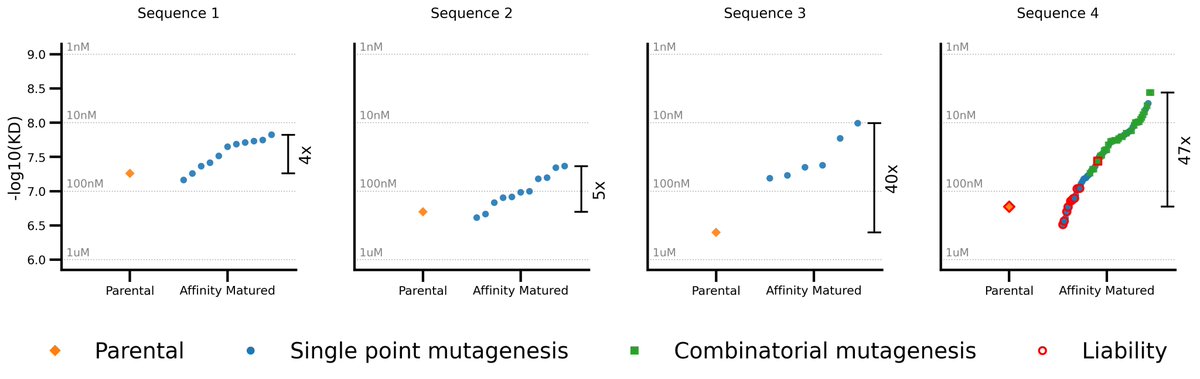
RamaX Opt yields 4–50× affinity improvements across 4 starting CD3 binders, while removing sequence liabilities in parallel — all in ~1 week.
And this is just a limited first pass— single point mutations for Seq 1-3 and modest combinatorial diversity for Seq 4. RamaX can handle very large, diverse libraries, so there's plenty of room to push further.
Update: we can now do affinity maturation in as little as 1 week with RamaX Opt from @diffuse_bio!
To our knowledge, this is the fastest affinity maturation method available, outperforming even the most advanced existing experimental and AI approaches 🧵
When I proposed building generative models for protein design for my PhD ~8 years ago, the idea was seen as impractical and a toy problem. The models were hilariously bad at the start, producing noodle-like structures and incoherent sequences.
I just kept working on it because I thought it was cool -- and I had huge dreams for what would be possible *if* it worked. I was lucky to have a few people who really believed and encouraged me to keep going.
Cut to our diffusion models breakthrough which has led to many incredible papers, many companies being founded, and of course -- the amazing team at @diffuse_bio
AI will design the therapeutics, diagnostics, enzymes, and molecular machines of the future.
Stick with the silly ideas!
Been inspiring and humbling to learn about all the academic projects that would be accelerated with RamaX. So as an early Christmas present we’re making it easier for academic groups to access RamaX. Get in touch with us for special academic rates! 🎄🎁
One place AI startups struggle is generating real world data and having fast feedback loops. Without that, how do you know if your AI model is good?
@diffuse_bio has made a huge breakthrough that 10x's the speed of generating real-world data. This'll be a huge unlock for AI+bio!
In 2022, Diffuse kicked off the wave of generative AI for protein design by introducing the first diffusion models for protein sequence and backbones. Today they’ve done it again by shipping RamaX, the world’s first platform for screening AI designs at scale.
Thrilled to launch RamaX: our platform for ultra-fast, accurate, and sensitive screening of massive binder libraries (from 1K to 1B minibinders, VHHs, or scFvs) in just 1-2 weeks.
This method has been an absolute game-changer for us at @diffuse_bio. Internally, we’ve completely switched from yeast display to RamaX for screening our designs. We’re also using RamaX to generate enormous datasets to train our protein generative models. 🧵 1/
We’ve just launched Minibinder Design on https://t.co/FC5z0MNaft! You can now design minibinders alongside scFvs and nanobodies. We’ve also upped our design limit. Read more on our blog post: https://t.co/Zh3rFMbGmU
New features available now on our protein GenAI platform DiffuseSandbox! scFv design with DSG2-mini is now live. We’ve also made open-source models RFAntibody + pMPNN available. https://t.co/jceeek63BQ 1/
👋We’re excited to launch DSG2-mini, our newest AI protein design model, now available in DiffuseSandbox⏳🎁, our new app for protein binder design. Click through to design a protein yourself! https://t.co/h8CKF4kwGI 1/
Foundation AI models in biology can result in a 7 orders of magnitude better hit rate for protein binders
We are only beginning to see what can happen to biopharma in this next phase of AI