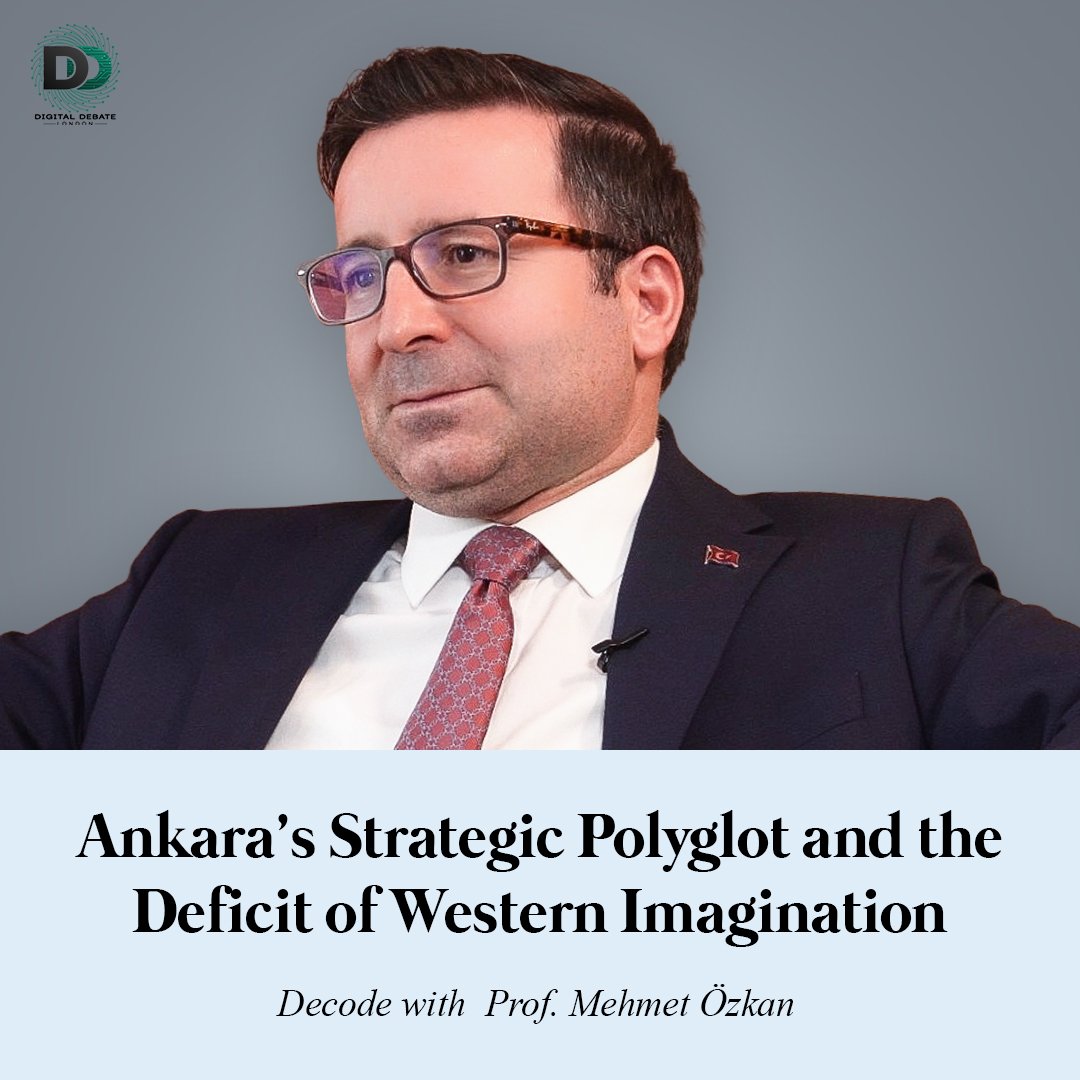
Turkey defies every Western analytical category, simultaneously a NATO ally, a Russian arms buyer, and a credible peace mediator. That apparent contradiction is not an inconsistency; it is strategy. Rooted in a triple civilizational identity that is Islamic, Turkic and European, and built on centuries of Ottoman imperial experience managing dozens of distinct civilisations, Turkey operates on a logic of sovereign range rather than strategic subordination.
Its Africa's engagement, growing from $5.4 billion in 2003 to $35 billion by 2023, its successful Ethiopia-Somalia mediation, and its role across the Ukraine conflict all reflect the same principle: position yourself as indispensable across overlapping networks, speak multiple strategic languages, and leverage historical depth as a living resource. In a fracturing multipolar world, Ankara's approach may be less an anomaly than a model.
@_MehmetOzkan
BREAKING: PPP has boycotted the Federal Budget 2026-27 session in the National Assembly.
A significant political development, no official reason disclosed by PPP leadership yet.
PM Shehbaz addressed the federal cabinet on June 12 ahead of budget presentation, presenting the government's third budget.
He thanked 240 million Pakistanis for bearing inflation with patience, noting it fell from 38% to single digits and the policy rate dropped from 22.5% to 11%, both now under pressure again due to the US-Iran war's energy impact.
He also paid tribute to martyred security personnel, including two Christians, whose funeral he attended this morning.
Iran's FM Spokesperson Esmaeil Baqaei rejected Trump's "settlement" announcement on June 12, stating Iran has "not reached a conclusion." Fars News denied that any MOU text was approved. Tasnim noted Trump has announced imminent deals 38 times in two months.
Meanwhile, Iran attempted fresh drone strikes on Hormuz shipping early on June 12, two drones were shot down by US forces. The naval blockade remains in place.
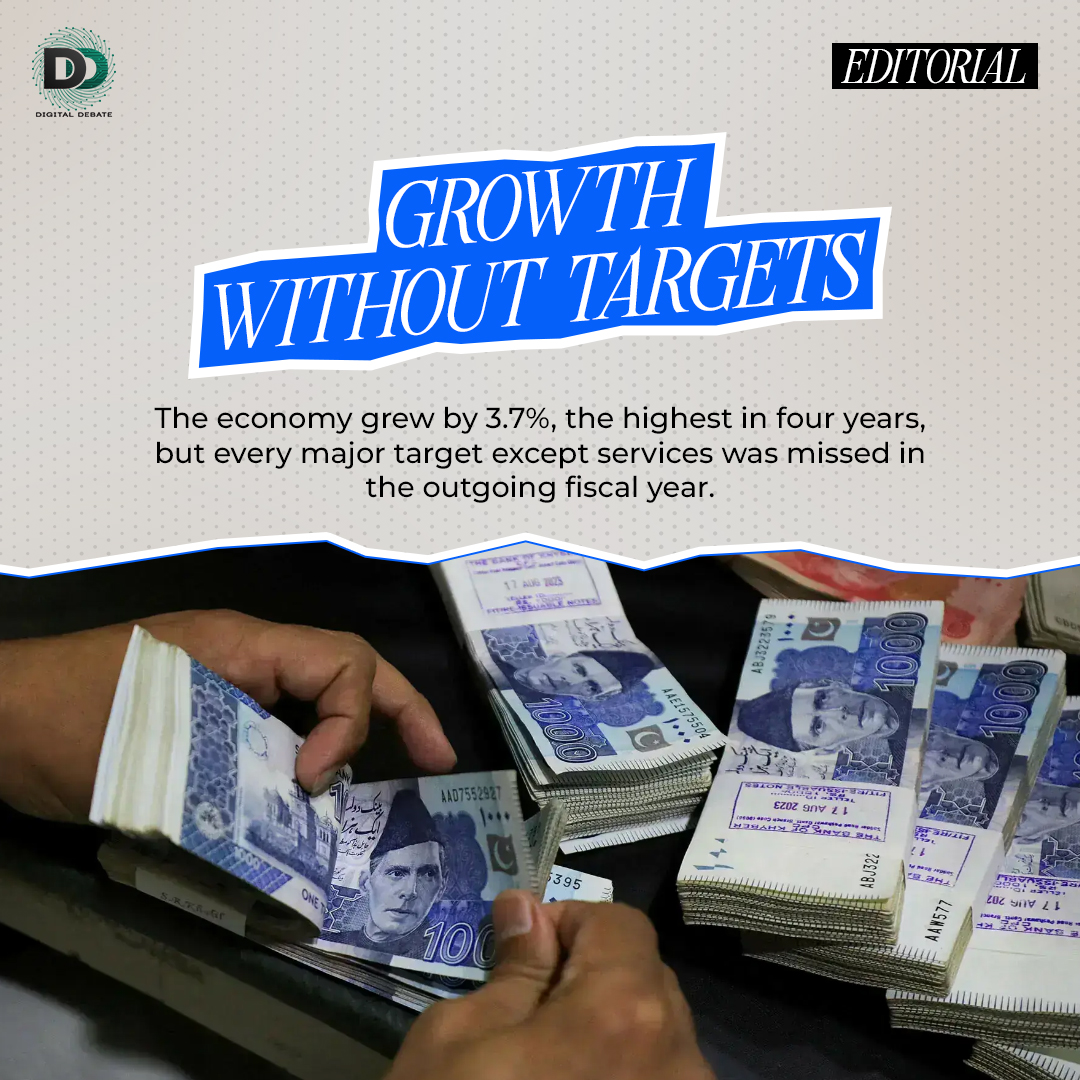
Pakistan's Economic Survey 2025-2026 confirmed that its economy grew 3.7% in FY26, the highest in four years. Agriculture 2.89%, industry 3.5%, services 4.09%. Every sector except services missed its target. Three genuine shocks absorbed: global tariff uncertainty, two floods causing Rs430 billion in agricultural losses, and the Iran war's closure of the Strait of Hormuz, adding $1 billion to the April oil import bill alone.
1/3
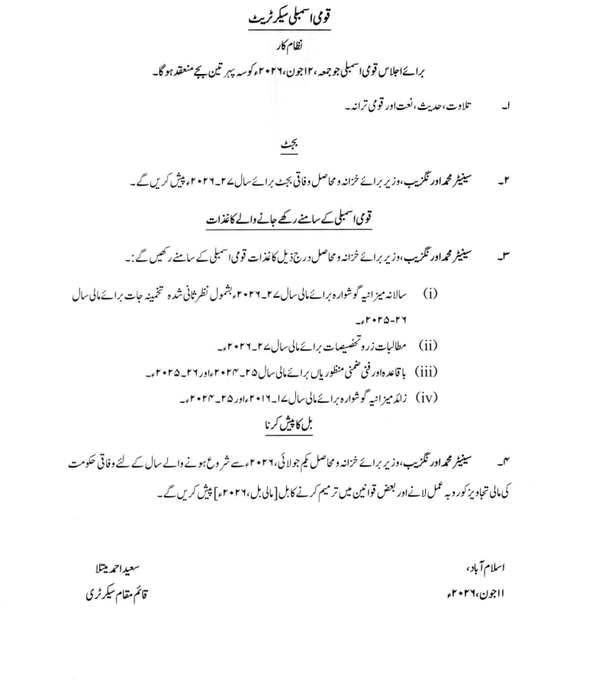
Federal Budget FY2026-27 will be presented today. Total outlay is approximately Rs18 trillion. Key measures: 10% salary increase, income tax relief for earners between Rs1.2 million and Rs2.2 million, 2% super tax cut, single-digit interest rates for agriculture and housing for 10 years. Most contested: Rs900 billion provincial development freeze extended beyond one year, testing federal-provincial consensus.
3/3
President Trump on June 11 cancelled scheduled strikes against Iran and announced from the Oval Office that a "great settlement" had been reached, stating discussions had been brought to the highest level of Iranian leadership and approved. Trump said the deal could be signed as early as this weekend, likely in Europe, adding, "Stock market's up 1,000 points, that means they like the deal."
In his Truth Social statement, Trump confirmed the deal was approved by all parties, including the United States, Israel, Saudi Arabia, the UAE, Qatar, Turkey, Pakistan, Bahrain, Kuwait, Jordan, and Egypt, while maintaining the naval blockade in full force until the transaction is formally finalised.
Trump confirmed the Strait of Hormuz will officially open the moment a deal is signed, stating: "Yes, that's part of the deal, and you'll have oil prices dropping like a rock.
Pakistan's Federal Budget 2026-27 is to be presented today, June 12, at 3 pm by Finance Minister Aurangzeb in the National Assembly, delayed twice from June 5 amid coalition negotiations over Rs1 trillion in additional fiscal space.
Key expected measures: Income tax relief for salaried workers, 8 tax slabs replacing 6, Rs220 billion in new taxes, PDL target at Rs1.727 trillion.
GDP growth target set at 4% for FY2026-27. Foreign reserves at USD 21.3 billion.
Budget to be presented within IMF programme constraints.
How do fiscal policies translate into the everyday realities of citizens?
In this upcoming episode of "DD Economy", renowned economist Dr. Farrukh Saleem examines Pakistan’s evolving fiscal landscape through the lens of the ordinary Pakistani, exploring the implications of taxation, inflation, energy costs, employment challenges, and public spending priorities. The conversation highlights the broader questions of economic fairness, distribution, and opportunity, offering insights into how policy choices shape household welfare and long-term economic outcomes.
@SaleemFarrukh
June 1984 remains one of the most contested chapters in modern Sikh and Indian history. While the Indian state presented Operation Bluestar as a security operation, many Sikhs remember it as a Ghallughara (massacre).
Among the most significant records of the human cost is “Bhan Singh’s List”, a 120-page document compiled by SGPC Secretary Sardar Bhan Singh, documenting 706 individuals killed during the assault on Sri Harimandar Sahib and Akal Takht Sahib.
Preserved and later digitized, the list continues to serve as a crucial historical record, challenging official casualty figures and highlighting ongoing efforts to document, preserve, and understand the events of June 1984.
@aishaghazi
The merchant tanker MT Jalveer was hit off Shinas port, Oman, on June 11. Approximately 20 Indian sailors were onboard, and all have been reported safe. India’s embassy in Oman is monitoring the situation and coordinating with Omani authorities.
This is the third commercial vessel with an Indian crew struck in the region within four days. On June 9, MT Settebello was struck in an incident India’s MEA condemned as a US maritime attack, killing three Indian sailors: deck cadet Aditya Sharma, engine fitter Shivanand Chaurasiya, and chief engineer Patnala Suresh.
Following that strike, the MEA summoned US Chargé d’Affaires Jason Meeks to lodge a formal diplomatic protest. A day earlier, on June 8, MT Marivex was also struck off the Oman coast, though all 24 Indian crew members were rescued with no casualties reported.
Foreign Office Spokesperson Tahir Andrabi on Thursday firmly rejected India's recent statements on Azad Jammu and Kashmir in their entirety, stating it was "untenable for a state like India, which has consistently denied the people of IIOJK their right to self-determination, to claim concerns over the rights of Kashmiris."
Andrabi said India was attempting to divert attention from the unresolved status of Jammu and Kashmir and its own record in Indian Illegally Occupied Jammu and Kashmir, rejecting any false equivalence between IIOJK, which he described as an illegally annexed internationally recognised disputed territory where people have suffered systemic abuses under draconian laws, and the situation in AJK, which is being addressed through democratic and constitutional mechanisms.
The spokesperson also strongly rejected India's Water Resources Minister's remarks that "not a single drop of water will go to Pakistan in the coming years."
Kashmiri lobbyist Shaista Safi highlights the importance of unity, dialogue, and collective engagement in addressing regional challenges. Emphasizing cooperation over division, she argues that resilience, mutual understanding, and a shared sense of purpose remain essential for safeguarding common interests and working toward a peaceful and stable future.
@Shaista_Safi
India's Water Minister CR Patil confirmed on June 10, under direct PM Modi directives, that India is "actively working" to ensure not a single drop of water flows into Pakistan. This is a stated government policy, not a political talking point.
It follows India's suspension of the 1960 Indus Waters Treaty after the Pahalgam attack, removing 65 years of legal constraints governing upstream water infrastructure on rivers allocated primarily to Pakistan.
1/7