‘The darkness of depth is a place in mind, integrating amongst the chaotic notions of imagination as depth intertwines throughout time and space, frame of mind’
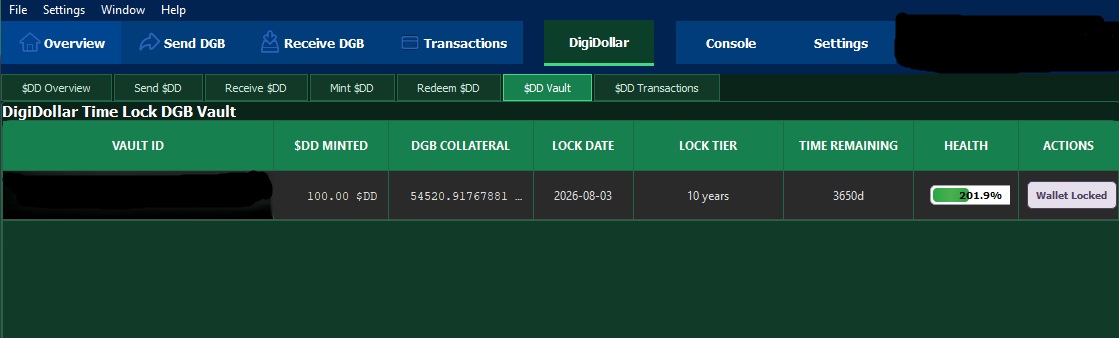
It’s official: We’re 🔒locked in for the next decade!
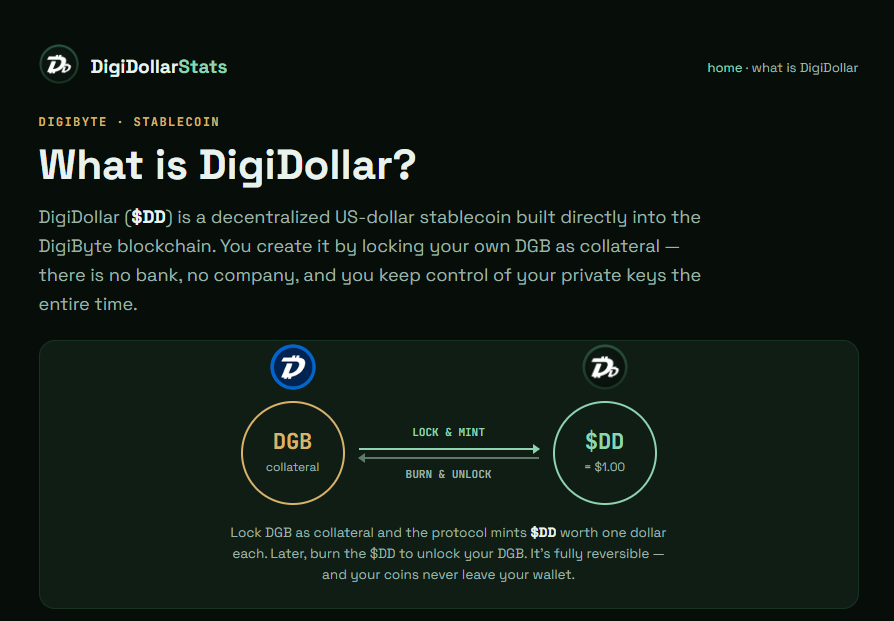
Our 10-year $DGB lock is complete, and #DigiDollar has been minted. 🚀
A milestone worth celebrating. Who’s joining us?
Spread the word - $DGB and $DigiDollar Legal Framework Bounty is LIVE and we need your help to reach our goal!
https://t.co/MLfc6roYXJ 🚀
Donation address:
dgb1qqdm3p3v7s4lj8np0clrdn8pf5cgaftclsptqse
So on the DGB/Bitcoin Core wallets on desktop, the passphrase it asks to create is considered the 25th word?
No, In Bitcoin Core (and DigiByte Core, which is based on it) the passphrase you are asked to create is not the BIP-39 “25th word.”
What the desktop Core wallets actually use
Term in Core wallets
What it really is
What it does
Wallet passphrase (the one you set when creating or encrypting the wallet)
Encryption password for the local wallet.dat file
Encrypts the private keys stored on your computer so that someone who steals the file still cannot spend the coins without the password.
BIP-39 passphrase / 25th word
Optional extra secret mixed into seed derivation
Creates an entirely different set of keys/addresses from the same seed phrase. Not used by Bitcoin Core or DigiByte Core at all.
Bitcoin Core and DigiByte Core do not use BIP-39 seed phrases as their primary backup method. They generate and store private keys (or descriptors) directly inside the wallet file. The passphrase simply encrypts that file.
Key differences in practice
•Core wallet passphrase
◦Protects the file on this computer.
◦If you forget it → the wallet.dat is locked forever (funds are lost unless you have an unencrypted backup).
◦It does not change the actual addresses or private keys.
◦You unlock it temporarily with walletpassphrase when you want to send.
•True BIP-39 25th-word passphrase (used on D’Cent, Trezor, Ledger, Coldcard, Sparrow, etc.)
◦Is mixed into the mathematical derivation of the seed itself.
◦Same 24 words + different passphrase = completely different wallet.
◦Is never stored on the device.
◦Required every time you restore the wallet on any device.
Bottom line
When Bitcoin Core or DigiByte Core asks you to “create a passphrase” or “encrypt the wallet,” it is only asking for a password to lock the local wallet file. It has nothing to do with the optional BIP-39 passphrase (25th word) that hardware wallets and modern seed-phrase software wallets use.
This naming overlap is one of the biggest sources of confusion in Bitcoin, which is exactly why the terms feel so messy.
$DGB #DD (Digi$) #DigiDollar
So to dumb this down, every address is already in space, they are waiting for tenants. Once filled, the seed is the coordinate within the space (location). Secrecy is the given but the given is only, truly satisfied when randomness is fully implemented.
So if this is the case, what makes randomness so hard to guess. I mean, doesn’t a random thought of a word, number, character and space, group or set mean anything? What deciphers randomness and/or a true and secret coordinate?
This is a must. If you want to mint the TRUE DECENTRALIZED Stable Coin, downloading and installing the Core is of the utmost.
It is imperative to do your research and understand.
Believe me not, once you figure it out and KNOW, YOU Will KNOW and will never look back.
“‘Go Forth to meet the shadowy future without fear and with a manly heart”’-A Psalm of Life
@pete_rizzo_ This public servants has no idea that blockchain is transparent? Maybe she's against it because fiat transactions can be hidden and she can't miss the next inside job that'll retire her and her whole fam!
🎓️ If you had never heard of $DGB before today, start with the protocol.
Everything else makes more sense after that:
https://t.co/AB7jG03B4W
https://t.co/4XYAC5hdvE
https://t.co/chH1QxJSjw