A 24-year-old PhD student spent two years sledgehammering poles into a field outside Cambridge to build a radio telescope, then had to read what it printed out.
It produced about 100 feet of chart paper a day. She went through it by hand, looking for patterns in ink.
In November 1967 she found what she called a bit of scruff. A quarter of an inch of squiggle on a roll of paper, in a signal she described as one part in ten million.
Her supervisor said it was interference. She kept going anyway, partly because she was convinced she was not good enough to be there and would be found out. So she checked everything.
The scruff came back, on schedule, pulsing every 1.337 seconds from a fixed point in the sky. Then she found three more.
Jocelyn Bell Burnell had discovered pulsars, the collapsed cores of dead stars, spinning fast enough to sweep a beam of radio waves past the earth like a lighthouse. Nothing known could produce a signal that regular, and for a while they seriously wondered about aliens.
The 1974 Nobel Prize went to her supervisor. She was not on it.
She has been asked about it for fifty years and has never once been bitter in public, saying students were simply not recognised in those days.
In 2018 she was given a special prize worth about 2.3 million pounds for the discovery. She gave every penny of it away, to fund physics PhDs for people who do not usually get them.
https://t.co/dKkbvMHOrN
INSOMNIAC WITH DAVE ATTELL (2001) was basically a man wandering into random cities at 2 AM and talking to whoever was still awake. No polished travel show bullshit. Just Dave Attell, terrible decisions and whatever weirdness the night had waiting.
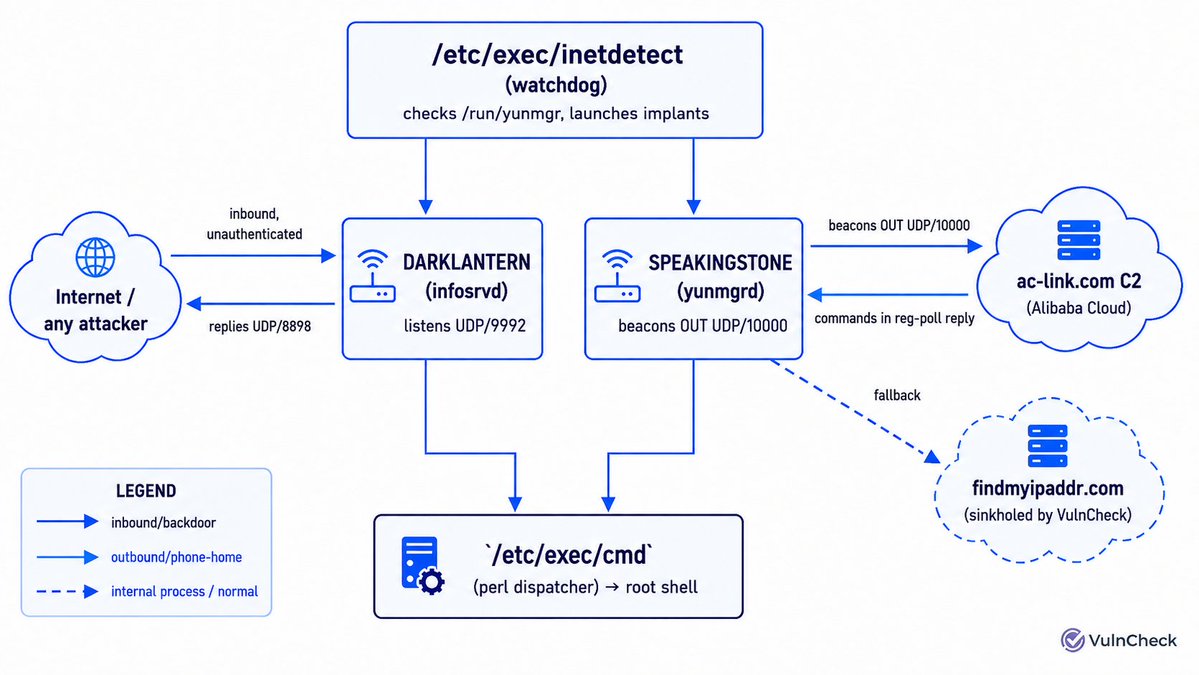
We bought an $88 router on Amazon looking for the ENDLESSDOORS implant. We found two others instead
DARKLANTERN gives anyone on the Internet an unauthenticated root shell.
SPEAKINGSTONE phones home to ZBT infrastructure and supports remote surveillance.
https://t.co/WcF01Q8vFV
macabre = “muh-KAHB”
Worcestershire = “WOOSS-ter-sheer”
omnipotent = “ahm-NI-puh-tunt”
reticent = “RET-uh-sunt”
epitome = “ih-PIT-uh-mee”
myriad = "MEER-ee-ud"
Never make fun of someone if they mispronounce a word.
It means they learned it by reading.
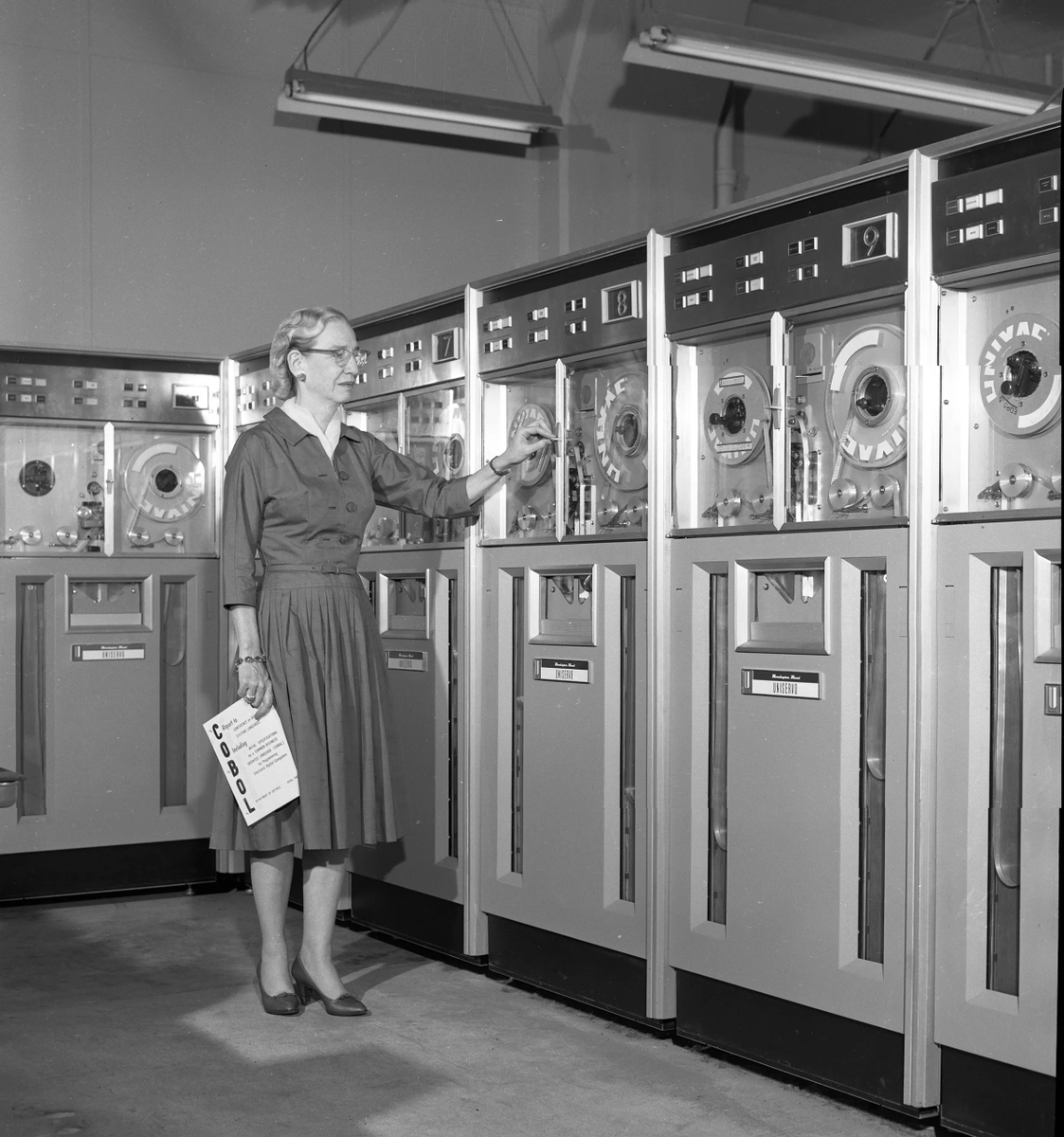
Grace Hopper built the first program that let a computer translate human instructions into machine code, and then spent two years failing to get anybody to use it.
Her account of the reaction is worth quoting exactly. She had a running compiler, nobody would touch it, and they carefully told her that computers could only do arithmetic and could not do programs.
That was 1952, and it took two years of demonstrations before her own company's management accepted the thing worked. The idea underneath it sounds obvious now and was heresy then. Programming at the time meant writing instructions the machine could execute directly, in numeric codes, by hand. Hopper thought the machine should do that translation itself, so a person could write something closer to English and let the computer convert it.
When she proposed going further and using actual English words, she was told very quickly that she could not, because computers did not understand English.
Her reasoning was about who gets to use a computer. Very few people think naturally in symbols, she said, and the ones who do become mathematicians. Everyone else finds it easier to write a sentence.
She built it anyway. Her English-language compiler became the foundation of COBOL, which ran business, banking and government systems for decades and is still running some of them.
Every programming language since sits on the principle she was told was impossible. A machine can be handed instructions written in a language made for people, and do the translating itself.
She retired from the US Navy as a rear admiral. They named a destroyer after her.
https://t.co/gI4dhz8ptq
🏛️ Before the Internet, computer clubs brought people together to learn, trade software, share ideas & explore the rapidly changing world of personal computing. 💾
A surviving binder of 50 Atari newsletters from August 1987 offers a remarkable time capsule of that world. These newsletters & many more for Atari, Apple II, Texas Instruments computers & other platforms are available in Internet Archive collections. 📚
More on. our blog: https://t.co/kndKmhduKK
#RetroComputing
@helpmebcatholic@alterboogie Being present in the United States without legal status is classified as a civil violation rather than a criminal offense under federal law.
@dcbirdie1@lara_korte Stars and Stripes has been independent since WW 1. Freedom of the press is still important for a free society.
https://t.co/H3sjLv10SA
While shooting CUTTHROAT ISLAND in Malta, I brought my 16mm camera to make a black-and-white short film. When the production blew up the pirate ship, I captured the massive explosion. This was one of the last big-budget studio films to rely almost entirely on practical in-camera effects and stunts. Regardless of its initial reception, making this film was the adventure of a lifetime.
This is from a recent scan of my original camera negative.
The Fourier transform runs inside every MRI machine, every audio compressor, every signal processor on earth. JPMorgan pays $350K to engineers who can derive it from scratch. There is one professor alive who explains it the way nobody else can.
His name is Gilbert Strang. MIT. The most brilliant mathematical mind of his generation. His textbook sits in over 10 million homes. No other person on earth holds this combination of depth and clarity in one head.
He opens with one confession.
The Fourier transform is unreasonably effective. It solves problems it was never designed for. The goal is not to compute it. The goal is to understand why it works at all.
Then the core idea. A periodic signal breaks into pure sine waves. Each with a frequency, amplitude, and phase. The transform finds all three simultaneously. A complicated signal in time becomes a simple picture in frequency.
Then 1807. Fourier invented the transform not for sound but for heat. How does warmth spread through a metal rod? In time the equation is a partial differential equation - hard. In frequency space it becomes ordinary - easy. Transform in, solve it, transform back.
Then convolution. Convolution in time equals multiplication in frequency. Filtering a signal, removing noise, compressing audio - all multiplication in frequency space. Without the transform: thousands of computations. With it: a few multiplications.
Then the delta function. Zero everywhere except one point where it is infinite. Integral equals one. Every mathematician in 1900 said it was not a function. Dirac used it anyway. It took 40 years to justify what engineers had been doing the whole time.
Watch the moment Strang shows that the Fourier transform of a delta function is a constant - every frequency in equal measure. The more concentrated in time, the more spread in frequency. This is the uncertainty principle. Not quantum physics. A theorem about any signal at all.
A signal processing engineer I know rewatched this before their first project at Apple. Said it was the first time the Fourier transform felt like a change of coordinates rather than a formula to memorize.
Free on YouTube, MIT OpenCourseWare.
bookmark this and watch later - after this lecture every sound, every image, and every signal will feel like a sum of sine waves waiting to be separated
Florida’s aquifer is being drained, and our springs are showing it.
Poe Springs has stopped flowing. Lithia Springs is very low, while Mosaic uses water from the property for fertilizer production. Kissengen Springs is now little more than a mud hole.
Yet politicians tell us, “Don’t worry, data centers don’t use that much water.”
I’d encourage them to visit Florida’s springs.
Remembering the night I got fixated on paper data storage and learned you can fit about 140 pages of (encoded) plaintext on a single sheet of paper. The page below includes the encoder legend and its source code repeated 26 times
It's illegible at a glance and breaks when photographed or shared on social media, but is totally reconstructable without guidance if printed, scanned, and handed to an LLM for decoding
Do with that what you will!
We've been getting a lot of questions lately about how the Internet Archive digitizes books.
The short answer: page by page, by hand.
You may remember our viral 2021 video of Eliza Zhang scanning a book. That's still how we do it.
Meet Eliza, and learn how we scan books: https://t.co/gt9s5lbPE4