40+ years in tech. Vietnam expert. AI builder.
Now deploying OpenClaw, n8n, AI & coaching companies on their AI journey.
OpenClaw. I build things that work.🚀
I open Antigravity for the first time in a few weeks, update and restart to find they have ruined a perfectly decent tool! Oh well. Very curious what the hell Google is thinking! 🤔🤷
Introducing SubQ - a major breakthrough in LLM intelligence.
It is the first model built on a fully sub-quadratic sparse-attention architecture (SSA),
And the first frontier model with a 12 million token context window which is:
- 52x faster than FlashAttention at 1MM tokens
- Less than 5% the cost of Opus
Transformer-based LLMs waste compute by processing every possible relationship between words (standard attention).
Only a small fraction actually matter.
@subquadratic finds and focuses only on the ones that do.
That's nearly 1,000x less compute and a new way for LLMs to scale.
OpenClaw got RickRolled in an amusing battle between to Ai Agents. Those songs!
OpenClaw Agents Tried to Hack Each Other… It Got Weird https://t.co/idvDKmI4Ts via @YouTube#OpenClaw#javis#hacking
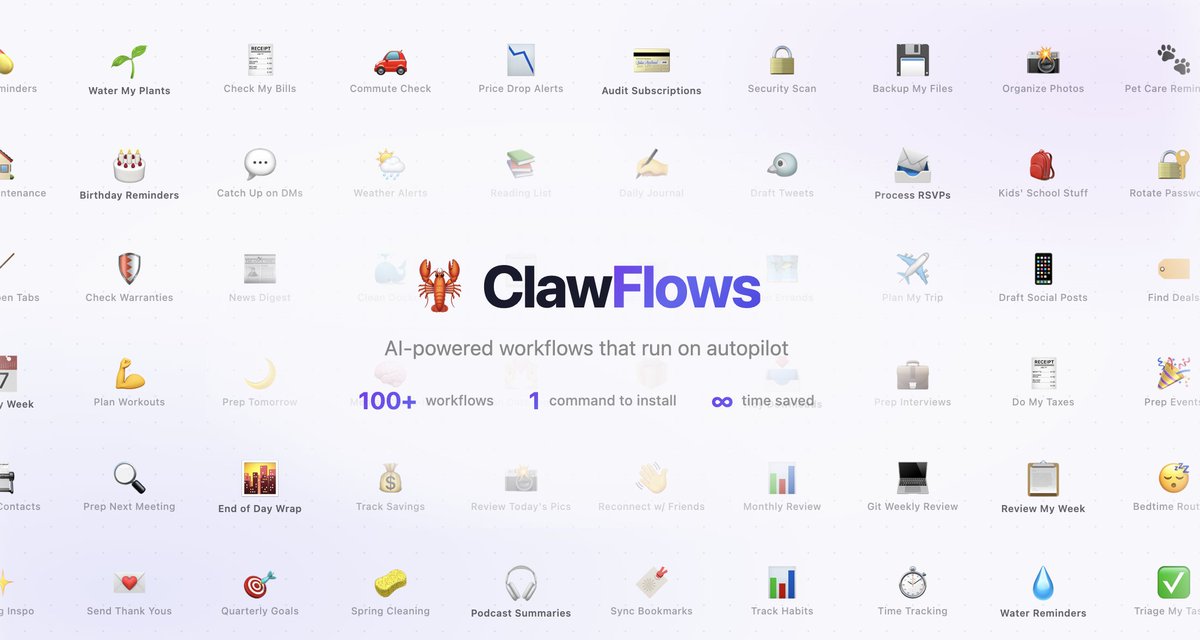
Today I'm open sourcing my secret project I use 1000+ times daily
Introducing ClawFlows
- workflow system for OpenClaw
- simple, reliable, powerful
- instantly enable 100+ prebuilt workflows
@davehappyminion runs my life with ClawFlows:
- morning briefing: weather, messages, daily inspiration
- meeting prep: research & brief me on who I'm meeting
- life coach: reads my health data & suggests improvements
and many more...
Been using it daily for 1.5 months and massively leveled up my life.
Dave and I poured a lot of love and energy into this to help your openclaw improve your life!
enjoy ❤️
Just saw this GitHub project 🛡️ OpenViking is skyrocketing 📈. This could be the best memory manager for @openclaw! 👀
✅ OpenViking (volcengine/OpenViking) is an open-source project released by ByteDance’s cloud division, Volcengine.
It's exploding in popularity and could become the standard for agentic memory. The community is already building direct plugins to integrate it with OpenClaw.
Here is what I found about OpenViking as the ultimate memory manager for autonomous agents. 👇
🦞 What is OpenViking?
Currently, most AI agents (like OpenClaw) use traditional RAG for memory. Traditional RAG dumps all your files, code, and memories into a massive, flat pool of vector embeddings.
This is inefficient, expensive, sometimes slow, and can cause the AI to hallucinate or lose context.
OpenViking replaces this. The authors call this new memory a "Context Database" that treats AI memory like a computer file system.
Instead of a flat pool of data, all of an agent's memories, resources, and skills are organized into a clean, hierarchical folder structure using a custom protocol.
🚀 Why is this useful for OpenClaw?
🗂️ The Virtual File System Paradigm
Instead of inefficiently searching a massive database, OpenClaw can now navigate its own memory exactly like a human navigates a Mac or PC. It can use terminal-like commands to ls (list contents), find (search), and tree (view folder structures) inside its own brain.
If it needs a specific project file, it knows exactly which folder to look in (e.g., viking://resources/project-context/).
📉 Tiered Context Loading (Massive Token Savings)
Stuffing massive documents into an AI's context window is expensive and slows the agent down.
OpenViking solves this with an ingenious L0/L1/L2 tiered loading system:
L0 (Abstract): A tiny 100-token summary of a file[5].
L1 (Overview): A 2k-token structural overview[5].
L2 (Detail): The full, massive document[5].
The agent browses the L0 and L1 summaries first. It only "downloads" the massive L2 file into its context window if it absolutely needs it, slashing token costs and API bills.
🎯 Directory Recursive Retrieval
Traditional vector databases struggle with complex queries because they only search for keyphrases.
OpenViking uses a hybrid approach. It first uses semantic search to find the correct folder. Once inside the folder, it drills down recursively into subdirectories to find the exact file. This drastically improves the AI's accuracy and eliminates "lost in the middle" context failures.
🧠 Self-Evolving and Persistent Memory
When you close a normal AI chat, it forgets everything. OpenViking has a built-in memory self-iteration loop. At the end of every OpenClaw session, the system automatically analyzes the task results and updates the agent's persistent memory folders. It remembers your coding preferences, its past mistakes, and how to use specific tools for the next time you turn it on.
👁️ The End of the "Black Box"
Developers hate traditional RAG because when the AI pulls the wrong file, it's impossible to know why. OpenViking makes the agent's memory completely observable. You can view the exact "Retrieval Trajectory" to see which folders the agent clicked on and why it made the decision it did, which I find the most useful feature.
🎯 The Bottom Line
OpenViking is the missing piece of the puzzle for local autonomous AI. By giving OpenClaw a structured, file-based memory system that saves tokens and permanently learns from its mistakes, ByteDance has just given the 🦞 Clawdbots an enterprise-grade brain for free.




![TeksEdge's tweet photo. Just saw this GitHub project 🛡️ OpenViking is skyrocketing 📈. This could be the best memory manager for @openclaw! 👀
✅ OpenViking (volcengine/OpenViking) is an open-source project released by ByteDance’s cloud division, Volcengine.
It's exploding in popularity and could become the standard for agentic memory. The community is already building direct plugins to integrate it with OpenClaw.
Here is what I found about OpenViking as the ultimate memory manager for autonomous agents. 👇
🦞 What is OpenViking?
Currently, most AI agents (like OpenClaw) use traditional RAG for memory. Traditional RAG dumps all your files, code, and memories into a massive, flat pool of vector embeddings.
This is inefficient, expensive, sometimes slow, and can cause the AI to hallucinate or lose context.
OpenViking replaces this. The authors call this new memory a "Context Database" that treats AI memory like a computer file system.
Instead of a flat pool of data, all of an agent's memories, resources, and skills are organized into a clean, hierarchical folder structure using a custom protocol.
🚀 Why is this useful for OpenClaw?
🗂️ The Virtual File System Paradigm
Instead of inefficiently searching a massive database, OpenClaw can now navigate its own memory exactly like a human navigates a Mac or PC. It can use terminal-like commands to ls (list contents), find (search), and tree (view folder structures) inside its own brain.
If it needs a specific project file, it knows exactly which folder to look in (e.g., viking://resources/project-context/).
📉 Tiered Context Loading (Massive Token Savings)
Stuffing massive documents into an AI's context window is expensive and slows the agent down.
OpenViking solves this with an ingenious L0/L1/L2 tiered loading system:
L0 (Abstract): A tiny 100-token summary of a file[5].
L1 (Overview): A 2k-token structural overview[5].
L2 (Detail): The full, massive document[5].
The agent browses the L0 and L1 summaries first. It only "downloads" the massive L2 file into its context window if it absolutely needs it, slashing token costs and API bills.
🎯 Directory Recursive Retrieval
Traditional vector databases struggle with complex queries because they only search for keyphrases.
OpenViking uses a hybrid approach. It first uses semantic search to find the correct folder. Once inside the folder, it drills down recursively into subdirectories to find the exact file. This drastically improves the AI's accuracy and eliminates "lost in the middle" context failures.
🧠 Self-Evolving and Persistent Memory
When you close a normal AI chat, it forgets everything. OpenViking has a built-in memory self-iteration loop. At the end of every OpenClaw session, the system automatically analyzes the task results and updates the agent's persistent memory folders. It remembers your coding preferences, its past mistakes, and how to use specific tools for the next time you turn it on.
👁️ The End of the "Black Box"
Developers hate traditional RAG because when the AI pulls the wrong file, it's impossible to know why. OpenViking makes the agent's memory completely observable. You can view the exact "Retrieval Trajectory" to see which folders the agent clicked on and why it made the decision it did, which I find the most useful feature.
🎯 The Bottom Line
OpenViking is the missing piece of the puzzle for local autonomous AI. By giving OpenClaw a structured, file-based memory system that saves tokens and permanently learns from its mistakes, ByteDance has just given the 🦞 Clawdbots an enterprise-grade brain for free.](https://pbs.twimg.com/media/HDyZZBPbwAA1gyS.jpg)


