🚀 Building my digital identity, one project at a time.
I’m a Software Engineer & Web Developer passionate about building functional digital experiences and exploring the possibilities of AI, Blockchain, and Web3.
From writing code to creating digital solutions, I’m constantly learning, building, and pushing forward.
My portfolio is live. Take a look at what I’m building 👇🏽
🔗 https://t.co/fqDLEkZLux
More to come. We’re just getting started. 🫡🔥
#WebDevelopment #SoftwareEngineering #Web3 #BuildInPublic
🔥 𝐁𝐈𝐓𝐓𝐎𝐑𝐑𝐄𝐍𝐓’𝐒 𝐅𝐈𝐑𝐒𝐓 $𝐁𝐓𝐓 𝐁𝐔𝐑𝐍: 𝟐𝟏.𝟔𝟐 ����𝐑𝐈𝐋𝐋𝐈𝐎𝐍 𝐓𝐎𝐊𝐄𝐍𝐒 𝐑𝐄𝐌𝐎𝐕𝐄𝐃 𝐅𝐑𝐎𝐌 𝐒𝐔𝐏𝐏𝐋𝐘
BitTorrent’s brand upgrade comes with an important change to its token economics: the introduction of a quarterly, revenue-backed $BTT buyback-and-burn program.
The first execution is complete.
On October 16, 2026, BitTorrent permanently burned 21,621,611,570,729.6 BTT, representing approximately 2.184% of the initial total supply under the updated denomination.
The reported estimated value was approximately $7.6 million.
But the more significant development is the funding model behind the burn.
𝐅𝐑𝐎𝐌 𝐄𝐂𝐎𝐒𝐘𝐒𝐓𝐄𝐌 𝐑𝐄𝐕𝐄𝐍𝐔𝐄 𝐓𝐎 𝐒𝐔𝐏𝐏𝐋𝐘 𝐑𝐄𝐃𝐔𝐂𝐓𝐈𝐎𝐍
According to BitTorrent’s published program framework, 100% of revenue generated from its decentralized services is allocated to purchasing BTT on the open market.
The purchased tokens are then permanently removed from circulation.
This establishes a clear economic relationship:
🔹 Decentralized services generate revenue.
🔹 Eligible revenue funds BTT repurchases.
🔹 Repurchased tokens are permanently burned.
The distinction matters. Rather than treating token burns as isolated promotional events, BitTorrent is connecting supply reduction to the economic activity of its decentralized services.
𝐖��𝐘 𝐓𝐇𝐄 𝐁𝐑𝐀𝐍𝐃 𝐔𝐏𝐆𝐑𝐀𝐃𝐄 𝐌𝐀𝐓𝐓𝐄𝐑𝐒
BitTorrent is also bringing three major infrastructure areas under one unified brand:
🌐 Content distribution: Building on its established peer-to-peer file-sharing infrastructure.
🤖 Decentralized AI inference: BTTInferGrid is designed to connect distributed GPU resources with AI computing workloads.
🔗 Blockchain infrastructure: BTTC provides Layer 2 infrastructure for blockchain applications and cross-chain activity.
These are different service categories, but their economic connection is important.
If these products generate sustainable revenue, they can contribute to the funding base for future BTT repurchases.
That creates a potential feedback loop between product adoption, service revenue, and token supply management.
𝐓𝐇𝐄 𝐑𝐄𝐀𝐋 𝐓𝐄𝐒𝐓 𝐈𝐒 𝐒𝐔𝐒𝐓𝐀𝐈𝐍𝐀𝐁𝐈𝐋𝐈𝐓𝐘
One successful burn establishes an execution record, not a guarantee that future rounds will have the same size.
Revenue can fluctuate, and the number of tokens purchased depends on available funding and market prices.
For that reason, the metrics worth monitoring go beyond cumulative BTT burned:
• Revenue generated by decentralized services.
• Consistency of quarterly buyback execution.
• Adoption and usage of BTTInferGrid and other services.
• Verifiable repurchase and burn transactions.
A deflationary model becomes more meaningful when it is supported by genuine product demand and recurring economic activity.
𝐓𝐑𝐀𝐍𝐒𝐏𝐀𝐑𝐄𝐍𝐂𝐘 𝐌𝐀𝐊𝐄𝐒 𝐓𝐇𝐄 𝐃𝐈𝐅𝐅𝐄𝐑𝐄𝐍𝐂𝐄
The first burn transaction is publicly verifiable on TRON.
Transaction hash:
4d9596617780e329bbd4e644ee0dffd780ec4cf3749f324d03eb98157eb04ae5
The TRON ECO × BBW 2026 challenge now gives the community an opportunity to explore the records directly.
🔗 Official dashboard: https://t.co/P0ZdrzTGEr
The bigger story is not simply that 21.62 trillion BTT have been burned. It is whether BitTorrent can continue turning useful decentralized services into sustainable revenue and verifiable token-economic activity.
REAL UTILITY. REVENUE-BACKED BUYBACKS. ON-CHAIN TRANSPARENCY.
@BitTorrent @justinsuntron #TRONEcoStar
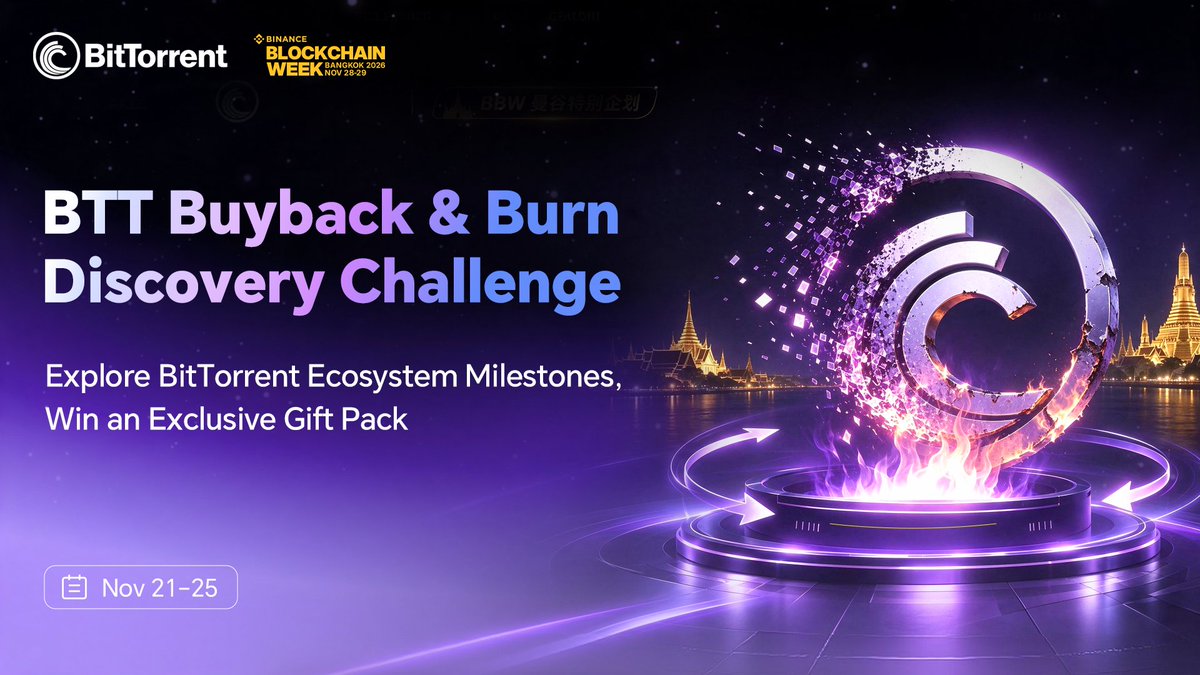
Following the master brand upgrade, BitTorrent has established a deflationary economic model through the first quarterly $BTT buyback and burn.
Verify the $BTT on-chain burn data to join the BBW giveaway. 10 #TRONEco merch bundles are available from Nov 21 to 25.
How to participate:
▫️ Follow @BitTorrent, like, and QRT.
▫️ Take a screenshot of the data page: https://t.co/CZyk83LmkQ
▫️ Reply with the screenshot, tag 3 friends, and the exact text: "BitTorrent has burned 21.62 trillion $BTT."
Please note that due to international logistics and shipping restrictions, the organizer reserves the right to adjust physical prizes, with final arrangements subject to official notice.
#BinanceBlockchainWeek #TRONEcoBBW
🔍 𝐖𝐈𝐍𝐤𝐋𝐢𝐧𝐤: 𝐅𝐑𝐎𝐌 𝐎𝐑𝐀𝐂𝐋𝐄 𝐈𝐍𝐅𝐑𝐀𝐒𝐓𝐑𝐔𝐂𝐓𝐔𝐑𝐄 𝐓𝐎 𝐎𝐍-𝐂𝐇𝐀𝐈𝐍 𝐓𝐎𝐊𝐄𝐍 𝐓𝐑𝐀𝐍𝐒𝐏𝐀𝐑𝐄𝐍𝐂𝐘
Smart contracts can execute predefined instructions, but they cannot independently access every piece of information outside their blockchain environment.
This is where oracle networks become essential.
WINkLink provides oracle services that connect external data sources with smart contracts on-chain, supporting applications that depend on information such as market prices and other real-world data.
Now, another part of the WINkLink ecosystem deserves attention: WIN Buyback & Burn Round 1.
𝐖𝐇𝐘 𝐓𝐇𝐄 𝐁𝐔𝐘𝐁𝐀𝐂𝐊 𝐌𝐄𝐂𝐇𝐀𝐍𝐈𝐒𝐌 𝐌𝐀𝐓𝐓𝐄𝐑𝐒
A buyback-and-burn mechanism creates a measurable process for reducing a token’s circulating supply.
The process involves purchasing WIN and permanently transferring the acquired tokens to a designated burn address.
But the important question is not simply how many tokens disappear from circulation. It is whether the mechanism is transparent, verifiable, and supported by sustainable economic activity.
𝐓𝐑𝐀𝐍𝐒𝐏𝐀𝐑𝐄𝐍𝐂𝐘 𝐈𝐒 𝐏𝐀𝐑𝐓 𝐎𝐅 𝐓𝐇𝐄 𝐒𝐓𝐎𝐑𝐘
Publishing buyback-and-burn records gives the community an opportunity to examine the actual execution rather than rely entirely on announcements.
Participants can explore the dashboard, inspect the reported figures, and follow the available transaction information.
That distinction matters in Web3: public claims become more meaningful when users can independently verify the underlying records.
𝐖𝐇𝐀𝐓 𝐓𝐎 𝐖𝐀𝐓𝐂𝐇 𝐍𝐄𝐗𝐓
Round 1 provides an initial reference point. Future rounds will make it possible to assess the consistency of the mechanism, the cumulative amount burned, and how the process develops over time.
Supply reduction alone does not guarantee price appreciation. Demand, utility, liquidity, and the sustainability of the funding model still matter.
The real value of this exercise is giving the community access to the data and encouraging independent verification.
𝐓𝐇𝐄 𝐖𝐈𝐍 𝐁𝐔𝐘𝐁𝐀𝐂𝐊 & 𝐁𝐔𝐑𝐍 𝐄𝐗𝐏𝐋𝐎𝐑𝐄𝐑 𝐂𝐇𝐀𝐋𝐋𝐄𝐍𝐆𝐄
The TRON ECO × BBW 2026 campaign invites the community to explore WIN’s first buyback-and-burn records.
🔗 Dashboard: https://t.co/aD9v1ZoZrF
Check the figures, capture the data, and share what you discover.
In a transparent ecosystem, the community should not only hear the numbers. It should be able to verify them.
@WinkLink_Oracle@BinanceWallet@justinsuntron #TRONEcoStar
🔗WINkLink’s oracle services connect smart contracts with external data, bringing information from beyond the blockchain on-chain.
Now, the spotlight is on WIN Buyback & Burn Round 1. The records are public, and we’d love for you to take a look.
👀Ready to explore? Enter now:
1️⃣Follow @WinkLink_Oracle
2️⃣Like and repost this post
3️⃣Visit https://t.co/SjlNXLhOx3 and take a screenshot of the WIN buyback & burn data. Then comment below using this format with your screenshot:
"WINkLink has bought back and burned XXX WIN! https://t.co/SjlNXLhOx3 @friend1@friend2 @friend3"
🎁10 exclusive TRON Eco merch packs are waiting for their new owners! We’ll randomly select 10 winners from valid participants, with each winner receiving one pack.
📅Nov 21–25
💡Shipping options may differ depending on your location. WINkLink may adjust the prizes to accommodate regional delivery restrictions. Please refer to official announcements for the final prize details and delivery arrangements.
The numbers are out there. Go find them, drop your screenshot, and bring 3 friends along for the challenge! 🧐@BinanceWallet #BinanceBlockchainWeek #TRONEcoBBW
🔥 𝐒𝐔𝐍 𝐁𝐔𝐘𝐁𝐀𝐂𝐊 & 𝐁𝐔𝐑𝐍: 𝟓𝟐 𝐑𝐎𝐔𝐍𝐃𝐒 𝐎𝐅 𝐎𝐍-𝐂𝐇𝐀𝐈𝐍 𝐄𝐗𝐄𝐂𝐔𝐓𝐈𝐎𝐍
52 rounds completed. Hundreds of millions of SUN permanently removed from circulation.
But behind this milestone is a bigger story about how protocol revenue can connect product activity with token supply management.
https://t.co/I1lmJFRKCm’s buyback-and-burn mechanism directs portions of revenue from its ecosystem products toward purchasing SUN, which is subsequently sent to the TRON black hole address.
𝐓𝐇𝐄 𝐍𝐔𝐌𝐁𝐄𝐑𝐒 𝐁𝐄𝐇𝐈𝐍𝐃 𝐓𝐇𝐄 𝐌𝐈𝐋𝐄𝐒𝐓𝐎𝐍𝐄
According to the published 52nd-round report:
🔹 SUN burned in round 52: 7,232,977.17
🔹 Cumulative SUN burned: 685,780,165.49
🔹 Cumulative value reported: More than $11 million
The cumulative burn breakdown also reveals how different parts of the ecosystem contribute:
🔸 SunSwap V2: 388,023,868.41 SUN
🔸 SunPump: 285,879,914.81 SUN
🔸 SunX: 11,876,382.27 SUN
These figures show that the mechanism draws support from multiple product revenue streams.
𝐖𝐇𝐄𝐑𝐄 𝐃𝐎𝐄𝐒 𝐓𝐇𝐄 𝐁𝐔𝐑𝐍 𝐅𝐔𝐍𝐃𝐈𝐍𝐆 𝐂𝐎𝐌𝐄 𝐅𝐑𝐎𝐌?
The model is particularly interesting because each product contributes through a different revenue mechanism:
• SunSwap V2 allocates 0.05% of each transaction amount toward buybacks.
• SunSwap V3 allocates one-sixth of accumulated fees from its specified TRX/USDT 0.05% fee-tier pool.
• SunPump directs 100% of its protocol revenue toward buybacks.
• SunX allocates 50% of net revenue after applicable operating costs.
The result is a mechanism that connects activity across several products to SUN’s supply-reduction process.
𝐖𝐇𝐘 𝐎𝐍-𝐂𝐇𝐀𝐈𝐍 𝐕𝐄𝐑𝐈𝐅𝐈𝐂𝐀𝐓𝐈𝐎𝐍 𝐌𝐀𝐓𝐓𝐄𝐑𝐒
A cumulative number is useful, but transparency means being able to go further.
Community members can inspect individual burn rounds, review transaction records, and compare contributions from different revenue sources.
That makes the dashboard more than a promotional statistic. It provides a way to examine how the mechanism operates.
One important distinction: reducing token supply does not automatically guarantee price appreciation. Sustainable revenue, demand, liquidity, and continued protocol activity remain important.
𝐓𝐇𝐄 𝐂𝐎𝐌𝐌𝐔𝐍𝐈𝐓𝐘 𝐂𝐀���� 𝐄𝐗𝐏𝐋𝐎𝐑𝐄 𝐓𝐇𝐄 𝐃𝐀𝐓𝐀
The TRON ECO × BBW 2026 Thanksgiving Mega Tour is bringing attention to this progress through the SUN Buyback & Burn Explorer Challenge.
Visit the dashboard, check the latest cumulative burn total, and verify the records yourself.
🔗 Dashboard: https://t.co/Fkfzaya9fR
52 rounds tell a story of execution. The next question is how ecosystem growth continues to support the mechanism.
@OfficialSUNio @BinanceWallet @justinsuntron #TRONEcoStar
52 rounds of $SUN Buyback & Burn completed, and counting! 🔥🌞
As part of the TRON ECO × BBW 2026 celebration, we’re inviting the community to explore $SUN’s burn progress and win exclusive rewards!
How to Join:
1️⃣ Follow @OfficialSUNio
2️⃣ Like and repost this post
3️⃣ Visit the dashboard, take a screenshot of the latest cumulative $SUN burn total, and share it in the comments with the following message:
"https://t.co/E4QwBX9M8G has bought back and burned XXX $SUN! https://t.co/i6y5o0eILn @Friend1@Friend2 @Friend3"
📅 Campaign Period: November 21–25, 2026
🎁 Rewards: 10 lucky winners will each receive a https://t.co/E4QwBX9M8G gift pack!
@BinanceWallet #BinanceBlockchainWeek #TRONEcoBBW
🔥 𝐓𝐑𝐎𝐍 𝐄𝐂𝐎 𝐁𝐔𝐘𝐁𝐀𝐂𝐊 & 𝐁𝐔𝐑𝐍: 𝐖𝐇𝐘 𝐎𝐍-𝐂𝐇𝐀𝐈𝐍 𝐓𝐑𝐀𝐍𝐒𝐏𝐀𝐑𝐄𝐍𝐂𝐘 𝐌𝐀𝐓𝐓𝐄𝐑𝐒
A token burn announcement gives us a headline. On-chain records give us something much more valuable: a way to verify what actually happened.
JUST has completed five rounds of JST buyback and burn, permanently removing purchased tokens from circulation.
But the interesting part is not just the number of tokens burned. It is the process behind those numbers.
𝐅𝐑𝐎𝐌 𝐑𝐄𝐕𝐄𝐍𝐔𝐄 𝐓𝐎 𝐏𝐄𝐑𝐌𝐀𝐍𝐄𝐍𝐓 𝐒𝐔𝐏𝐏𝐋𝐘 𝐑𝐄𝐃𝐔𝐂𝐓𝐈𝐎𝐍
JUST’s buyback mechanism connects eligible protocol and ecosystem revenue to JST purchases.
The process has three important stages:
🔹 Revenue allocation: Eligible revenue provides the funding for buybacks.
🔹 Market purchases: JST is repurchased using the allocated funds.
🔹 Permanent removal: Purchased tokens are transferred to a designated burn address, with transactions recorded on TRON.
This creates an auditable connection between ecosystem revenue and token supply management.
𝐖𝐇𝐘 𝐓𝐇𝐄 𝐓𝐑𝐀𝐍𝐒𝐏𝐀𝐑𝐄𝐍𝐂𝐘 𝐃𝐀𝐒𝐇𝐁𝐎𝐀𝐑𝐃 𝐌𝐀𝐓𝐓𝐄𝐑𝐒
A cumulative burn figure is useful, but serious analysis goes further.
We should be able to examine individual rounds, compare the amounts, inspect transaction records, and understand how each execution contributes to the overall result.
That is the difference between accepting a headline and independently checking the underlying data.
𝐓𝐇𝐄 𝐁𝐈𝐆𝐆𝐄𝐑 𝐏𝐈𝐂𝐓𝐔𝐑𝐄
Burning tokens reduces supply, but it does not automatically guarantee price appreciation.
The long-term significance depends on the quality of the revenue model, continued protocol activity, demand for JST, and transparent execution.
This is why verifiable records matter: they allow the community to evaluate the mechanism using evidence rather than assumptions.
Five rounds have created a substantial history to examine. Now it is time to explore the records and see what the data reveals.
🔗 JUST Transparency Dashboard: https://t.co/idJwsYurNN
@DeFi_JUST@justinsuntron@BinanceWallet #TRONEcoStar
🔥The TRON ECO × BBW 2026 Thanksgiving Mega Tour continues! This stop puts the spotlight on buyback & burn progress across the TRON ecosystem.
JUST has completed five rounds of JST buyback & burn. Curious about the numbers? Dive into the records and join the JUST Buyback & Burn Explorer Challenge 👇
1️⃣Follow @DeFi_JUST
2️⃣Like & repost this post
3️⃣Visit https://t.co/zj34fKINWD, take a screenshot of the JST buyback & burn data, and comment below with your screenshot using this format:
"JUST has bought back and burned XXX JST! https://t.co/zj34fKINWD @friend1@friend2 @friend3"
🎁10 exclusive TRON Eco merch packs (10 winners will be randomly selected from valid participants).
📅Challenge period: Nov 21–25
📌Please note that shipping and delivery may vary depending on the country or region. JUST reserves the right to make adjustments to prizes where necessary. Official prize details and delivery arrangements will be announced separately.
The numbers are waiting to be discovered. Head to the transparency page, see what you find, and share your findings with us! @BinanceWallet #BinanceBlockchainWeek #TRONEcoBBW
@Lucky__gmi@BitTorrent What I appreciate about this update is that these features aren’t just about adding more buttons to an application. They are focused on reducing friction
🚀 𝐁.𝐀𝐈: 𝐁𝐑𝐈𝐍𝐆𝐈𝐍𝐆 𝐀𝐈 𝐌𝐎𝐃𝐄𝐋𝐒, 𝐀𝐆𝐄𝐍𝐓 𝐈𝐃𝐄𝐍𝐓𝐈𝐓𝐘, 𝐀𝐍𝐃 𝐏𝐀𝐘𝐌𝐄𝐍𝐓 𝐈𝐍𝐅𝐑𝐀𝐒𝐓𝐑𝐔𝐂𝐓𝐔𝐑𝐄 𝐓𝐎𝐆𝐄𝐓𝐇𝐄𝐑
The next stage of AI development will involve more than powerful models. It will require infrastructure that allows different models and autonomous agents to communicate, access services, establish identity, and coordinate economic activity.
https://t.co/c0irTNC9m0 is building around this broader vision, bringing several important components into one platform.
𝐎𝐧𝐞 𝐩𝐥𝐚𝐭𝐟𝐨𝐫𝐦, 𝟕𝟎+ 𝐀𝐈 𝐦𝐨𝐝𝐞𝐥𝐬
Access to more than 70 leading AI models gives users and developers greater flexibility when choosing tools for different tasks.
Different models have different strengths in reasoning, coding, content generation, and other workloads. Real-time model insights can also help users make more informed choices instead of treating every model as interchangeable.
The value is not simply having more models available. It is making model selection and integration easier.
𝐱𝟒𝟎𝟐: 𝐁𝐫𝐢𝐧𝐠𝐢𝐧𝐠 𝐩𝐚𝐲𝐦𝐞𝐧𝐭𝐬 𝐢𝐧𝐭𝐨 𝐀𝐈 𝐰𝐨𝐫𝐤𝐟𝐥𝐨𝐰𝐬
For AI agents to operate more independently, they need ways to access paid services and settle transactions.
The x402 payment protocol introduces a framework for internet-native payments, allowing services to request payment as part of an API interaction.
This creates an opportunity for agents to pay for resources and services without relying entirely on manual payment processes.
𝟖𝟎𝟎𝟒: 𝐆𝐢𝐯𝐢𝐧𝐠 𝐀𝐈 𝐚𝐠𝐞𝐧𝐭𝐬 𝐚 𝐯𝐞𝐫𝐢𝐟𝐢𝐚𝐛𝐥𝐞 𝐢𝐝𝐞𝐧𝐭𝐢𝐭𝐲
An agent’s capabilities are only part of the equation. In a connected environment, other systems also need ways to identify and evaluate the agents they interact with.
The 8004 protocol introduces on-chain agent identities and associated information, creating a foundation for verifiable registration and more structured agent-to-agent interactions.
Combined with payment infrastructure, this points toward an ecosystem where agents can be identified and participate in digital transactions.
𝐀𝐏𝐈 𝐭𝐨𝐨𝐥𝐬: 𝐓𝐡𝐞 𝐛𝐫𝐢𝐝𝐠𝐞 𝐭𝐨 𝐫𝐞𝐚𝐥 𝐚𝐩𝐩𝐥𝐢𝐜𝐚𝐭𝐢𝐨𝐧𝐬
https://t.co/c0irTNC9m0 also provides unified API access, giving developers a way to integrate supported models into applications and automated workflows.
This matters because infrastructure becomes more useful when developers can build on top of it rather than interact with every service separately.
𝐓𝐡𝐞 𝐛𝐢𝐠𝐠𝐞𝐫 𝐯𝐢𝐬𝐢𝐨𝐧
The interesting part of https://t.co/c0irTNC9m0’s direction is how these components complement one another:
🔹 Models provide intelligence.
🔹 APIs connect intelligence to applications.
🔹 8004 provides an identity framework for agents.
🔹 x402 introduces a payment layer for digital services.
Together, they address several building blocks needed for a more connected agent economy.
The real test will be interoperability, security, adoption, and whether developers can use these tools reliably in practical applications.
https://t.co/c0irTNC9m0’s six-minute walkthrough offers a closer look at what is already available and where the platform is heading.
Explore: https://t.co/Gng8fsmBRF
@BAI_AGI@justinsuntron #TRONEcoStar
🚀 𝐖𝐈𝐍 ��𝐍 𝐉𝐔𝐒𝐓𝐋𝐄𝐍𝐃: 𝐀 𝐋𝐎𝐎𝐊 𝐀𝐓 𝐋𝐈𝐐𝐔𝐈𝐃𝐈𝐓𝐘 𝐀𝐍𝐃 𝐁𝐎𝐑𝐑𝐎𝐖𝐈𝐍𝐆 𝐀𝐂𝐓𝐈𝐕𝐈𝐓𝐘
WINkLink’s WIN market continues to be part of the lending landscape on JustLend DAO, where users can supply assets to earn interest and borrow against eligible collateral.
The latest weekly snapshot provides a useful look at how capital is positioned in the WIN market.
𝐓𝐡𝐞 𝐧𝐮𝐦𝐛𝐞𝐫𝐬 𝐚𝐭 𝐚 𝐠𝐥𝐚𝐧𝐜𝐞
🔹 Total Supply: $1.61 million
🔹 Total Borrow: $19,830
Based on these figures, borrowing represents approximately 1.23% of supplied value.
𝐖𝐡𝐚𝐭 𝐝𝐨𝐞𝐬 𝐭𝐡𝐢𝐬 𝐭𝐞𝐥𝐥 𝐮𝐬?
JustLend operates through smart-contract-based money markets. Suppliers deposit assets and receive corresponding jTokens, while borrowers access liquidity by providing eligible collateral.
The relationship between supply and borrowing is an important market indicator.
With approximately $1.61 million supplied against $19,830 borrowed, the snapshot points to relatively low borrowing utilization in the WIN market.
However, this figure should be viewed in context. A single weekly snapshot does not establish a long-term trend or explain why borrowing activity is at its current level. Changes in borrowing demand, interest rates, liquidity preferences, and market conditions can all influence these figures.
𝐖𝐡𝐲 𝐭𝐡𝐞 𝐦𝐚𝐫𝐤𝐞𝐭 𝐝𝐞𝐬𝐞𝐫𝐯𝐞𝐬 𝐚𝐭𝐭𝐞𝐧𝐭𝐢𝐨𝐧
For WINkLink, lending-market participation adds another dimension to WIN’s presence within the TRON ecosystem.
Tracking supply, borrowing, utilization, and interest rates over time gives a more complete picture than looking at supply figures alone.
The important question is how these indicators evolve across subsequent reporting periods.
DeFi growth is not measured by liquidity alone. The interaction between supplied capital and actual borrowing demand matters too.
Explore the WIN market statistics: https://t.co/NnnFliRHJ0
@WinkLink_Oracle @DeFi_JUST @justinsuntron #TRONEcoStar
🌞 𝐖𝐇𝐘 𝐒𝐖𝐀𝐏 𝐏𝐑𝐈𝐂𝐄𝐒 𝐃𝐈𝐅𝐅𝐄𝐑 𝐀𝐂𝐑𝐎𝐒𝐒 𝐋𝐈𝐐𝐔𝐈𝐃𝐈𝐓𝐘 𝐏𝐎𝐎𝐋𝐒?
A token can trade at slightly different prices across decentralized exchanges, even when the asset is exactly the same.
The reason lies in how automated market makers work.
𝐄𝐚𝐜𝐡 𝐩𝐨𝐨𝐥 𝐡𝐚𝐬 𝐢𝐭𝐬 𝐨𝐰𝐧 𝐦𝐚𝐫𝐤𝐞𝐭 𝐜𝐨𝐧𝐝𝐢𝐭𝐢𝐨𝐧𝐬
Liquidity pools maintain independent token reserves. When a trade changes the balance between those reserves, the pool’s quoted price changes too.
Differences in liquidity depth, trading volume, fee structures, and trade size can therefore produce different quotes across pools.
A large trade against a shallow pool, for example, may experience greater price impact than the same trade against a deeper pool.
𝐖𝐡𝐞𝐫𝐞 𝐚𝐫𝐛𝐢𝐭𝐫𝐚𝐠𝐞 𝐜𝐨𝐦𝐞𝐬 𝐢𝐧
Arbitrage activity helps reduce price discrepancies.
When an asset becomes cheaper in one pool than another, traders may buy from the lower-priced pool and sell into the higher-priced one. This activity changes the reserves in both pools and can bring their prices closer together.
However, differences do not always disappear immediately. Trading fees, network costs, liquidity constraints, and market movements all affect whether arbitrage is worthwhile.
𝐇𝐨𝐰 𝐒𝐔��.𝐢𝐨’𝐬 𝐔𝐧𝐢𝐯𝐞𝐫𝐬𝐚𝐥 𝐑𝐨𝐮𝐭𝐞𝐫 𝐚𝐝𝐝𝐫𝐞𝐬𝐬𝐞𝐬 𝐭𝐡𝐢𝐬
This is where liquidity aggregation becomes important.
https://t.co/I1lmJFRKCm’s Universal Router searches across SunSwap V1, V2, V3, V4, SunCurve, and PSM to identify possible swap paths.
It evaluates candidate routes using factors such as expected output, fees, and price impact. It can also combine multiple protocols into a multi-hop transaction when that produces a more cost-effective route.
The objective is simple: users choose the assets and amount, while the routing system handles the complexity of finding an appropriate liquidity path.
𝐓𝐡𝐞 𝐛𝐢𝐠𝐠𝐞𝐫 𝐃𝐞𝐅𝐢 𝐥𝐞𝐬𝐬𝐨𝐧
Liquidity fragmentation is one of the challenges of decentralized trading. Having multiple pools creates flexibility, but it also makes route selection important.
A well-designed router helps connect those separate liquidity sources, potentially improving execution without requiring users to manually compare every pool.
Of course, the best quoted route is not a guarantee of the final execution price. Slippage, changing liquidity, and transaction conditions still matter.
That is why intelligent routing is becoming an important part of the DeFi trading experience.
@OfficialSUNio @justinsuntron #TRONEcoStar
The answer is… FACT! ✅🌞
The same token can have slightly different prices across liquidity pools.
Each pool has its own liquidity and trading activity, so prices may temporarily differ. Arbitrage traders help bring them back into alignment.
That's why https://t.co/E4QwBX9M8G's Universal Router compares quotes across liquidity sources to find a more cost-effective swap route. 🔍
🌞 𝐖𝐇𝐘 𝐒𝐔𝐍.𝐢𝐨? 𝐁𝐄𝐂𝐀𝐔𝐒𝐄 𝐃𝐄𝐅𝐈 𝐍𝐄𝐄𝐃𝐒 𝐌𝐎𝐑𝐄 𝐓𝐇𝐀𝐍 𝐎𝐍𝐄 𝐓𝐎𝐎𝐋.
The strength of a DeFi ecosystem is not just about how many products it offers. It is about how those products address different financial needs and work together to create a connected on-chain experience.
That is the idea behind https://t.co/I1lmJFRKCm on TRON.
𝐎𝐧𝐞 𝐩𝐥𝐚𝐭𝐟𝐨𝐫𝐦, 𝐝𝐢𝐟𝐟𝐞𝐫𝐞𝐧𝐭 𝐥𝐢𝐪𝐮𝐢𝐝𝐢𝐭𝐲 𝐦𝐨𝐝𝐞𝐥𝐬
SunSwap supports multiple automated market maker versions, including V3 concentrated liquidity and V4 Hooks. These models give liquidity providers different ways to allocate capital while supporting token trading across the ecosystem.
The Universal Router adds another layer by connecting liquidity sources and selecting routes based on available quotes. This matters because fragmented liquidity can make efficient execution more challenging.
𝐒𝐭𝐚𝐛𝐥𝐞𝐜𝐨𝐢𝐧 𝐬𝐰𝐚𝐩𝐬 𝐚𝐫𝐞 𝐚 𝐝𝐢𝐟𝐟𝐞𝐫𝐞𝐧𝐭 𝐠𝐚𝐦𝐞
Stablecoins do not always need the same trading model as volatile assets.
SunCurve uses a StableSwap design for stablecoin exchanges, while the PSM supports direct 1:1 USDD-to-USDT swaps under its defined conditions.
Different mechanisms serve different use cases, helping the platform address both general token trading and stable-value exchanges.
𝐋𝐢𝐪𝐮𝐢𝐝𝐢𝐭𝐲, 𝐢𝐧𝐜𝐞𝐧𝐭𝐢𝐯𝐞𝐬, 𝐚𝐧𝐝 𝐠𝐨𝐯𝐞𝐫𝐧𝐚𝐧𝐜𝐞
https://t.co/I1lmJFRKCm also connects liquidity provision with mining incentives and community governance.
Users can provide liquidity, stake eligible LP tokens, or lock SUN to receive veSUN. veSUN holders can participate in governance voting, including decisions on liquidity pool weights and protocol proposals.
This creates a connection between providing liquidity, participating in incentives, and helping shape the platform’s direction.
𝐓𝐡𝐞 𝐛𝐢𝐠𝐠𝐞𝐫 𝐩𝐢𝐜𝐭𝐮𝐫𝐞
What makes https://t.co/I1lmJFRKCm interesting is the combination of these mechanisms rather than any single feature.
Different AMM models address different trading conditions. StableSwap serves stablecoin liquidity. Incentives encourage participation, while governance gives the community a role in protocol decisions.
Of course, more options also mean users need to understand the risks: impermanent loss, smart-contract exposure, price impact, and changing reward conditions.
https://t.co/I1lmJFRKCm’s value proposition is its breadth of DeFi infrastructure within the TRON ecosystem. The real measure is how effectively these tools deliver useful liquidity and a reliable experience.
Not just more options. Different tools for different DeFi needs.
@OfficialSUNio@justinsuntron #TRONEcoStar
Why https://t.co/E4QwBX9M8G? 😎
Well, we do like having options.
Different liquidity models? We've got them.
Stablecoin swaps? Covered.
Staking, incentives, and governance? There's room for those too.
DeFi comes with different needs. We just happen to have quite a few ways to meet them.
Not that we're bragging. 🌞
🌐 𝐉𝐔𝐒𝐓’𝐒 𝐁𝐑𝐀𝐍𝐃 𝐔𝐏𝐆𝐑𝐀𝐃𝐄: 𝐓𝐇𝐑𝐄𝐄 𝐂𝐎𝐑𝐄 𝐏𝐑𝐎𝐃𝐔𝐂𝐓𝐒, 𝐎𝐍𝐄 𝐔𝐍𝐈𝐅𝐈𝐄𝐃 𝐄𝐂𝐎𝐒𝐘𝐒𝐓𝐄𝐌
A brand upgrade becomes meaningful when it reflects a clearer product structure and a more connected operating model.
JUST has introduced a redesigned ecosystem architecture built around three core product lines: JustLend, USDD, and GasFree, with governance and JST buyback-and-burn operations consolidated under JUST DAO.
This is more than a visual refresh. It presents a clearer way to understand how different financial services connect within the TRON ecosystem.
𝐓𝐡𝐞 𝐭𝐡𝐫𝐞𝐞 𝐩𝐫𝐨𝐝𝐮𝐜𝐭 𝐩𝐢𝐥𝐥𝐚𝐫𝐬
🔹 JustLend — Lending and Network Resources
JustLend brings together lending markets, TRX staking through sTRX, and Energy services. These products address different needs, from accessing liquidity to obtaining resources required for smart contract interactions.
🔹 USDD — Stablecoin Infrastructure
USDD focuses on decentralized stablecoin services, including overcollateralized issuance, PSM swaps, and structured yield opportunities. Its role is to provide another layer of stable-value infrastructure within the ecosystem.
🔹 GasFree — Simplified On-Chain Transfers
GasFree addresses transaction friction by allowing supported transfers to pay network fees directly in USDT or USDD. This creates an alternative to requiring users to hold TRX specifically for eligible transfer fees.
𝐖𝐡𝐲 𝐮𝐧𝐢𝐟𝐢𝐞𝐝 𝐠𝐨𝐯𝐞𝐫𝐧𝐚𝐧𝐜𝐞 𝐦𝐚𝐭𝐭𝐞𝐫𝐬
The consolidation of governance and JST buyback-and-burn operations under JUST DAO gives the ecosystem a central coordination structure.
This is particularly relevant because the three product lines operate in different areas of on-chain finance. Their integration creates an opportunity to coordinate ecosystem development, revenue allocation, and governance through a shared framework.
The updated JST buyback mechanism also connects this structure to token economics by incorporating revenue streams across the core product lines, subject to the announced reserve and allocation rules.
𝐓𝐡𝐞 𝐛𝐢𝐠𝐠𝐞𝐫 𝐩𝐢𝐜𝐭𝐮𝐫𝐞
Lending, stablecoin infrastructure, and transaction settlement are distinct services, but they are also interconnected parts of the on-chain financial experience.
Bringing them under one architecture can make the ecosystem easier to navigate while giving users, developers, and partners a clearer picture of what each product does.
The real measure of success will be how effectively these products work together, how transparently governance operates, and whether the unified structure improves the experience across the ecosystem.
JUST’s new website and updated whitepaper provide a clearer starting point for exploring this direction.
Explore the upgraded ecosystem: https://t.co/rWSujCMhmA
@DeFi_JUST@justinsuntron #TRONEcoStar
🔥 𝐉𝐒𝐓’𝐒 𝐅𝐈𝐅𝐓𝐇 𝐁𝐔𝐑𝐍: 𝐇𝐎𝐖 𝐏𝐑𝐎𝐓𝐎𝐂𝐎𝐋 𝐑𝐄𝐕𝐄𝐍𝐔𝐄 𝐈𝐒 𝐒𝐇𝐀𝐏𝐈𝐍𝐆 𝐓𝐎𝐊𝐄𝐍 𝐒𝐔���𝐏𝐋𝐘
The completion of the fifth JST buyback and burn on October 16, 2026, marks an important point in the development of JUST DAO’s tokenomics.
But the bigger story is not simply the number of tokens removed. It is the economic mechanism behind the reduction: using protocol-generated revenue to repurchase JST and permanently remove those tokens from circulation.
𝐓𝐡𝐞 𝐟𝐢𝐟𝐭𝐡 𝐫𝐨𝐮𝐧𝐝 𝐛𝐲 𝐭𝐡𝐞 𝐧𝐮𝐦𝐛𝐞𝐫𝐬
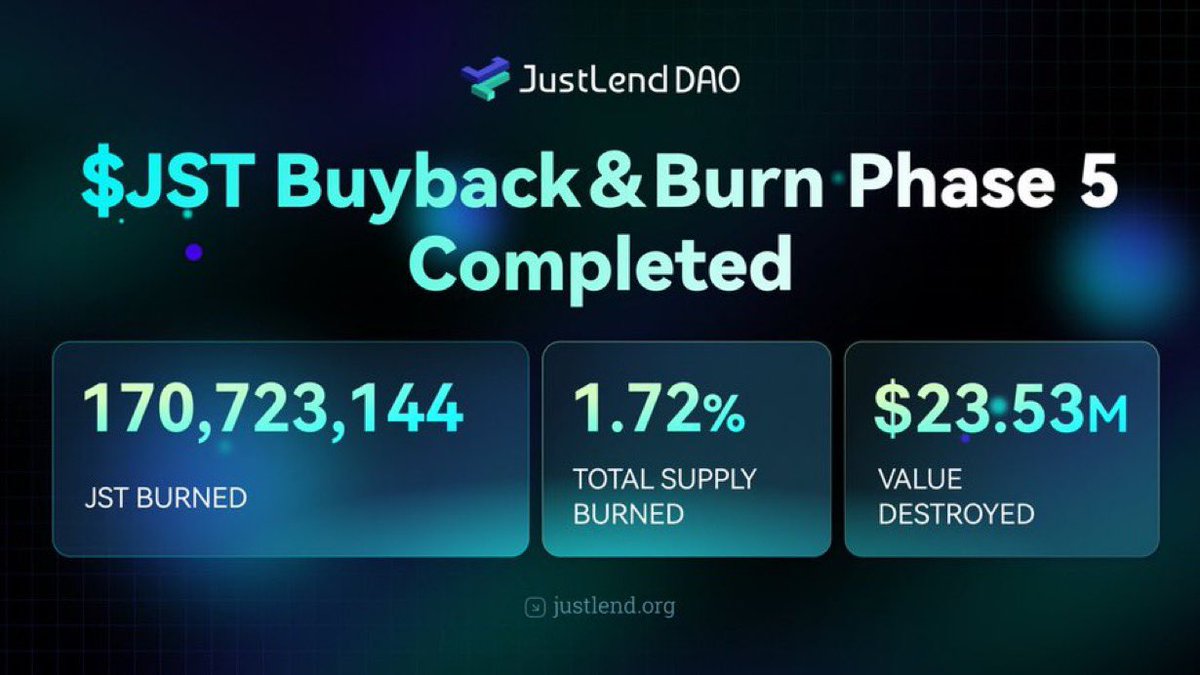
🔹 JST burned: 170,723,144
🔹 Estimated value at execution: $23.53 million
🔹 Share of initial maximum supply: 1.72%
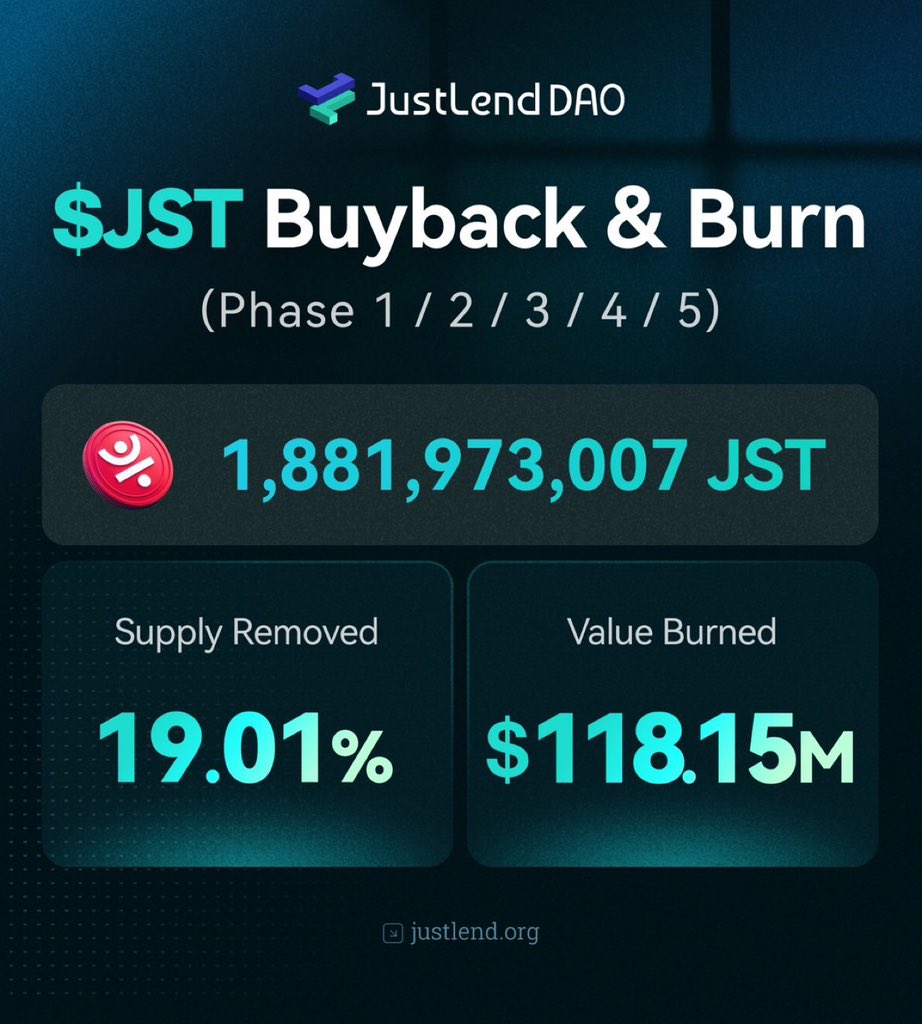
🔹 Cumulative burn across five rounds: 1,881,973,007 JST
🔹 Cumulative share of initial maximum supply: 19.01%
The fifth round was funded by two disclosed sources: $9.28 million in JustLend DAO net income from Q3 2026 and $10.34 million in historical revenue allocation.
The burned tokens were transferred to the designated burn address, with the transaction publicly verifiable on TRON.
𝐖𝐡𝐲 𝐭𝐡𝐞 𝐟𝐮𝐧𝐝𝐢𝐧𝐠 𝐦𝐨𝐝𝐞𝐥 𝐦𝐚𝐭𝐭𝐞𝐫𝐬
A burn mechanism is only as sustainable as the economic activity supporting it.
JUST DAO’s approach connects protocol earnings to JST supply management. This creates a direct relationship between the performance of its financial products and the resources available for future buybacks.
It also introduces an important distinction: the tokens are not being removed through an arbitrary supply adjustment. They are first repurchased using allocated revenue and then transferred to a burn address.
That makes revenue generation, capital allocation, execution, and on-chain verification essential parts of the model.
𝐉𝐒𝐓 𝐢𝐬 𝐦𝐨𝐫𝐞 𝐭𝐡𝐚𝐧 𝐚 𝐬𝐮𝐩𝐩𝐥𝐲 𝐬𝐭𝐨𝐫𝐲
JST is the governance token of JUST DAO. Holders can lock JST to obtain voting rights and participate in governance decisions covering protocol parameters, risk management, supported assets, and ecosystem development.
This means the token’s broader role should be evaluated through both its governance utility and the economic mechanisms connected to the ecosystem.
A declining supply can influence scarcity, but it does not independently guarantee higher market value. Demand, liquidity, revenue consistency, and actual token utility remain important factors.
𝐖𝐡𝐚𝐭 𝐜𝐨𝐦𝐞𝐬 𝐚𝐟𝐭𝐞𝐫 𝐟𝐢𝐯𝐞 𝐫𝐨𝐮𝐧𝐝𝐬?
The completion of this round closes the initial five-round phase and creates a transition point for the buyback mechanism.
The subsequent upgrade expands the funding framework beyond JustLend and qualifying USDD revenue to include GasFree, introduces a $50 million treasury reserve floor, and outlines a continuous-buyback, periodic-burn approach.
This is a significant structural development because future JST buybacks are designed to draw support from a broader range of JUST ecosystem activities.
The real test will be how consistently these revenue streams generate funds while maintaining the reserve requirements and transparent execution.
Five rounds have established a measurable foundation. The next phase will show how a broader ecosystem revenue model can sustain that progress.
@DeFi_JUST @justinsuntron #TRONEcoStar
📢Announcement: just:native Buyback & Burn Phase 5 Completed
Following the community-approved JST buyback & burn proposal, JustLend DAO has successfully completed the 5th just:native buyback & burn on October 16, 2026 (SGT).
✅Total just:native burned: 170,723,144 JST
All burned tokens have been sent to the burn address, with transactions verifiable on-chain.
⬇️Full details:
https://t.co/BZskgwHZdg
📢关于 just:native 完成第五次回购销毁的公告
根据 JustLend DAO 社区正式通过的 JST 回购销毁计划提案,JustLend DAO 已于 2026 年 10 月 16 日(SGT)顺利完成第五次 just:native 回购与销毁。
✅本次销毁 just:native 总量:170,723,144 JST
本次销毁的代币已全部转入黑洞地址,相关交易均可在链上查询。
⬇️详情内容:
https://t.co/BZskgwHZdg
🔥 𝐅𝐈𝐕𝐄 𝐁𝐔𝐑𝐍 𝐑𝐎𝐔𝐍𝐃𝐒. 𝟏.𝟖𝟖𝐁 $𝐉𝐒𝐓 𝐑𝐄𝐌𝐎𝐕𝐄𝐃 𝐅𝐑𝐎𝐌 𝐒𝐔𝐏𝐏𝐋𝐘.
The completion of the fifth JST buyback and burn marks an important milestone in the evolution of JUST DAO’s tokenomics.
Across five rounds, approximately 1.882 billion JST have been permanently burned, representing 19.01% of the token’s initial maximum supply. The cumulative estimated value of the burned tokens stands at approximately $118.15 million.
The fifth round alone removed 170,723,144 JST, valued at approximately $23.53 million at the time of execution.
𝐖𝐡𝐲 𝐭𝐡𝐞 𝐛𝐮𝐫𝐧 𝐦𝐞𝐜𝐡𝐚𝐧𝐢𝐬𝐦 𝐦𝐚𝐭𝐭𝐞𝐫𝐬
A token burn is more meaningful when it is connected to an identifiable economic process.
JUST DAO’s model links JST buybacks to protocol and ecosystem revenue. Instead of relying solely on new token emissions to support its economic structure, the mechanism directs eligible revenue toward purchasing JST and permanently removing tokens from circulation.
This creates a measurable connection between protocol operations and token supply management.
𝐓𝐡𝐞 𝐧𝐮𝐦𝐛𝐞𝐫𝐬 𝐭𝐞𝐥𝐥 𝐚 𝐛𝐢𝐠𝐠𝐞𝐫 𝐬𝐭𝐨𝐫𝐲
Removing 19.01% of the initial maximum supply is a substantial tokenomics development. However, reduced supply alone does not guarantee price appreciation.
Long-term outcomes also depend on demand, liquidity, protocol revenue, token utility, and the consistency of future buyback execution.
That is why the funding model matters just as much as the burn total.
𝐓𝐡𝐞 𝐧𝐞𝐱𝐭 𝐩𝐡𝐚𝐬𝐞 𝐢𝐬 𝐭𝐡𝐞 𝐫𝐞𝐚𝐥 𝐭𝐞𝐬𝐭
With the original five-round phase completed, attention now turns to the sustainability of the upgraded mechanism and how broader ecosystem revenue can support future JST buybacks.
The key question is no longer simply how many tokens can be burned in one round, but how consistently real protocol activity can support the process over time.
Five rounds have established a verifiable execution record. The next chapter will show how this model develops.
@DeFi_JUST@justinsuntron #TRONEcoStar
🔥 𝐉𝐒𝐓 𝐁𝐔𝐘𝐁𝐀𝐂𝐊 & 𝐁𝐔𝐑𝐍: 𝐅𝐈𝐕𝐄 𝐑𝐎𝐔𝐍𝐃𝐒, 𝟏.𝟖𝟖𝐁 𝐓𝐎𝐊𝐄𝐍𝐒 𝐑𝐄𝐌𝐎𝐕𝐄𝐃
Five completed rounds. One consistent mechanism. A measurable change in JST’s token supply.
JUST has now burned a cumulative 1,881,973,007 JST, representing 19.01% of its initial maximum supply, with an estimated cumulative buyback-and-burn value of approximately $118.15 million.
But the significance goes beyond the headline numbers. The more important part is how the mechanism connects protocol revenue to JST’s long-term tokenomics.
𝐅𝐫𝐨𝐦 𝐏𝐫𝐨𝐭𝐨𝐜𝐨𝐥 𝐑𝐞𝐯𝐞𝐧𝐮𝐞 𝐭𝐨 𝐒𝐮𝐩𝐩𝐥𝐲 𝐑𝐞𝐝𝐮𝐜𝐭𝐢𝐨𝐧
The buyback-and-burn model creates a direct link between the economic activity of the JUST ecosystem and JST’s supply.
Rather than relying solely on token incentives or market narratives, the mechanism uses eligible protocol revenue to repurchase JST from the market before transferring the acquired tokens to a designated burn address.
This creates a traceable process:
🔹 Protocol revenue provides the funding.
🔹 JST is repurchased through buybacks.
🔹 Purchased tokens are transferred to the burn address.
🔹 On-chain records make the executions publicly verifiable.
𝐖𝐡𝐲 𝟏𝟗.𝟎𝟏% 𝐌𝐚𝐭𝐭𝐞𝐫𝐬
Removing nearly one-fifth of the initial maximum supply is a significant tokenomics milestone.
A smaller token supply can influence the balance between available tokens and market demand. However, supply reduction alone does not guarantee price appreciation. Demand, governance participation, protocol adoption, revenue generation, and broader market conditions remain important factors.
That distinction matters when evaluating whether a burn mechanism is producing lasting ecosystem value.
𝐓𝐡𝐞 𝐍𝐞𝐱𝐭 𝐓𝐞𝐬𝐭: 𝐒𝐮𝐬𝐭𝐚𝐢𝐧𝐚𝐛𝐥𝐞 𝐄𝐱𝐞𝐜𝐮𝐭𝐢𝐨𝐧
Five rounds establish a meaningful track record. The next question is whether the mechanism can continue delivering through recurring ecosystem revenue.
For JST, the long-term significance will depend not only on how many tokens are burned, but also on the strength and consistency of the revenue-generating products behind those burns.
The numbers tell the story so far:
🔥 1,881,973,007 JST burned
🔥 19.01% of initial maximum supply
🔥 ~$118.15M cumulative estimated burn value
🔥 5 completed buyback-and-burn rounds
Transparent execution, verifiable records, and sustainable revenue are the foundations worth watching as the JUST ecosystem moves into its next phase.
@DeFi_JUST@justinsuntron #TRONEcoStar
🔥 𝐓𝐑𝐎𝐍 𝐃𝐄𝐅𝐈 𝐒𝐔𝐌𝐌𝐄𝐑 𝐒𝟑: $𝟐𝐌 𝐈𝐍 𝐈𝐍𝐂𝐄𝐍𝐓𝐈𝐕𝐄𝐒 𝐀𝐂𝐑𝐎𝐒𝐒 𝐅𝐎𝐔𝐑 𝐓𝐑𝐎𝐍 𝐀𝐒𝐒𝐄𝐓𝐒
The collaboration between JustLend DAO and @BinanceWallet highlights how ecosystem incentives can connect DeFi protocols with established wallet infrastructure.
Season 3 of TRON DeFi Summer brings a $2 million reward pool and 60 days of boosted APR opportunities across TRX, USDD, JST, and SUN through Binance Wallet DeFi.
𝐇𝐨𝐰 𝐭𝐡𝐞 $𝟐𝐌 𝐫𝐞𝐰𝐚𝐫𝐝 𝐩𝐨𝐨𝐥 𝐢𝐬 𝐚𝐥𝐥𝐨𝐜𝐚𝐭𝐞𝐝
🔹 TRX: $1,000,000
🔹 USDD: $600,000
🔹 JST: $300,000
🔹 SUN: $100,000
This allocation gives each asset a dedicated incentive pool, connecting different parts of the TRON ecosystem through one campaign.
𝐖𝐡𝐲 𝐭𝐡𝐢𝐬 𝐦𝐨𝐝𝐞𝐥 𝐦𝐚𝐭𝐭𝐞𝐫𝐬
Incentive campaigns can help attract liquidity and increase visibility for DeFi protocols. But their impact should be assessed beyond the headline reward figure.
The more meaningful indicators include how liquidity develops, whether participation remains consistent, and what happens to activity after promotional incentives end.
The Binance Wallet integration also makes the campaign an interesting example of how wallet interfaces can serve as access points to decentralized applications.
𝐀 𝐬𝐦𝐨𝐨𝐭𝐡𝐞𝐫 𝐭𝐫𝐚𝐧𝐬𝐢𝐭𝐢𝐨𝐧 𝐟𝐫𝐨𝐦 𝐒𝟐 𝐭𝐨 𝐒𝟑
Participants already maintaining eligible S2 positions can continue into S3 without making a new subscription, subject to the campaign conditions. This continuity helps reduce friction between campaign seasons.
One important distinction: boosted APR is an incentive, not a guaranteed return. Rates, eligibility, and applicable risks should always be checked in the relevant pool details.
The campaign runs from October 4 to December 3, 2026, SGT.
TRON DeFi Summer S3 is another opportunity to observe how incentives, wallet infrastructure, and protocol liquidity interact across the TRON ecosystem.
@trondao@OfficialSUNio@USDDecentralize@justinsuntron #TRONEcoStar
🔥JustLend DAO × @BinanceWallet TRON DeFi Summer S3 is now LIVE!
We are keeping the TRON DeFi Summer going with 60 days of Boosted APR opportunities. Explore TRX, USDD, JST, and SUN pools via #Binance Wallet DeFi and keep earning through the next chapter.
S3 brings a $2M reward pool, with $1M for TRX, $600K for USDD, $300K for JST, and $100K for SUN.
Already participating in S2? Keep your position and roll seamlessly into S3. No new subscription is required, and you remain eligible for S3 rewards.
🗓October 4, 8:00:00 – December 3, 7:59:59 SGT
📖How to Participate in S3:
https://t.co/hknvBihTom
🔗Join TRON DeFi Summer S3:
https://t.co/jLBY6OiGoT
The summer may move forward, but the yield continues. ☀️ @trondao@OfficialSUNio@USDDecentralize #TRONDeFiSummer
𝗝𝗨𝗦𝗧 𝗪𝗘𝗘𝗞𝗟𝗬: 𝗥𝗘𝗔𝗗𝗜𝗡𝗚 𝗧��𝗘 𝗠𝗢𝗩𝗘𝗠𝗘𝗡𝗧 𝗔𝗖𝗥𝗢𝗦𝗦 𝗧𝗥𝗢𝗡 𝗗𝗘𝗙𝗜 | 𝗡𝗢𝗩 𝟭𝟬–𝟭𝟲
DeFi performance is rarely explained by a single number. Liquidity, lending participation, borrowing demand, yield opportunities, and network resource costs each reveal a different part of the market.
The latest JUST Weekly snapshot for November 10–16 offers an interesting example. Several lending and yield indicators moved lower, while Energy Rental pricing increased.
The important part is understanding why these metrics should be examined together rather than in isolation.
𝗟𝗜𝗤𝗨𝗜𝗗𝗜𝗧𝗬 𝗔𝗡𝗗 𝗟𝗘𝗡𝗗𝗜𝗡𝗚: 𝗔 𝗪𝗘𝗘𝗞 𝗢𝗙 𝗗𝗘𝗖𝗟𝗜𝗡𝗘𝗦
JUST ecosystem TVL declined during the reporting period. JustLend’s supply and borrowing balances also moved lower.
These indicators provide insight into how capital is positioned across decentralized financial markets.
Supply balances represent assets deposited into lending markets, while borrowing balances reflect the amount users have borrowed against eligible collateral.
When both decline, it can indicate reduced lending-market participation, capital withdrawals, lower borrowing demand, or a combination of changing market conditions.
However, a decline should not automatically be interpreted as a weakness in protocol fundamentals. TVL can also move with asset prices and changes in capital allocation.
The more useful question is whether these movements persist and how they compare with actual user activity.
𝗬𝗜𝗘𝗟𝗗 𝗠𝗢𝗩𝗘𝗠𝗘𝗡𝗧: 𝗔𝗣𝗬𝗦 𝗔𝗗𝗝𝗨𝗦𝗧 𝗟𝗢𝗪𝗘𝗥
Featured APYs for sTRX, USDD, and TRX also declined.
This matters because lending and staking yields are influenced by market conditions, available liquidity, participation, and the mechanisms behind each product.
A lower APY does not necessarily mean an opportunity has disappeared. It means the return environment has changed and users need to evaluate current rates alongside liquidity conditions, risks, and the underlying protocol.
For anyone tracking DeFi, understanding why yields change is more useful than looking at the percentage alone.
𝗘𝗡𝗘𝗥𝗚𝗬 𝗥𝗘𝗡𝗧𝗔𝗟: 𝗔 𝗗𝗜𝗙𝗙𝗘𝗥𝗘𝗡𝗧 𝗠𝗔𝗥𝗞𝗘𝗧 𝗦𝗜𝗚𝗡𝗔𝗟
While lending balances and featured yields moved lower, Energy Rental went in the opposite direction.
The reported price increased from 4.006 TRX to 4.128 TRX per 100K Energy.
That represents an increase of approximately 3.05%.
Why is this worth watching?
Energy is a key resource for executing smart contracts on TRON. Applications and transactions that interact with smart contracts require Energy, making access to this resource an important part of the network’s operating environment.
Energy Rental pricing therefore reflects conditions in a different market from lending and yield products.
An increase can indicate changing demand for rented network resources or adjustments in available supply. It should not, by itself, be treated as proof that overall network activity increased.
𝗧𝗛𝗘 𝗕𝗜𝗚𝗚𝗘𝗥 𝗣𝗜𝗖𝗧𝗨𝗥𝗘: 𝗗𝗘𝗙𝗜 𝗜𝗦 𝗠𝗢𝗥𝗘 𝗧𝗛𝗔𝗡 𝗧𝗩𝗟
This week’s movements highlight an important distinction within the TRON ecosystem.
Lending balances help explain how capital is being supplied and borrowed. APYs provide a view of changing yield conditions. Energy Rental pricing offers another perspective on the cost of accessing network resources.
These indicators are connected through the broader ecosystem, but they do not measure the same thing.
That is why tracking them together provides a more useful picture than relying on TVL or yield figures alone.
The next thing worth monitoring is whether lending participation stabilizes, how featured yields respond, and whether Energy Rental pricing continues its upward movement.
JUST Weekly makes these changes easier to follow by putting different parts of the ecosystem into one recurring snapshot.
📊 Different markets. Different signals. One evolving TRON DeFi ecosystem.
@DeFi_JUST @justinsuntron #TRONEcoStar
𝗚𝗔𝗦𝗙𝗥𝗘𝗘 𝗘𝗫𝗣𝗔𝗡𝗗𝗦 𝗨𝗦𝗗𝗗 𝗦𝗨𝗣𝗣𝗢𝗥𝗧: 𝗔 𝗦𝗧𝗘𝗣 𝗧𝗢𝗪𝗔𝗥𝗗 𝗦𝗜𝗠𝗣𝗟𝗘𝗥 𝗦𝗧𝗔𝗕𝗟𝗘𝗖𝗢𝗜𝗡 𝗧𝗥𝗔𝗡𝗦𝗙𝗘𝗥𝗦
One of the biggest usability challenges in blockchain is not always sending an asset. It is understanding everything required to complete the transaction.
Users may hold the token they want to transfer but still need a separate asset to cover network costs. For someone primarily using stablecoins, that extra requirement can introduce unnecessary friction.
GasFree is designed to address this challenge by enabling supported token transfers without requiring users to hold TRX specifically for network fees.
Now, USDD support has been added to GasFree Mainnet, extending the infrastructure’s supported stablecoin options and opening another integration opportunity for developers.
𝗪𝗛𝗔𝗧 𝗧𝗛𝗘 𝗠𝗔𝗜𝗡𝗡𝗘𝗧 𝗨𝗣𝗗𝗔𝗧𝗘 𝗔𝗖𝗧𝗨𝗔𝗟𝗟𝗬 𝗠𝗘𝗔𝗡𝗦
The important technical detail is the update to GasFree’s Mainnet API response data.
This allows developers to integrate USDD support and verify the feature directly in the production environment.
Why does that matter?
An announcement about asset support is only one part of the development process. Applications also need the appropriate API information and integration support to recognize the asset and handle the relevant transaction workflow.
With the Mainnet response updated, developers have a clearer path to implementing and validating USDD compatibility within their applications.
𝗧𝗛𝗘 𝗥𝗢𝗟𝗘 𝗢𝗙 𝗚𝗔𝗦𝗙𝗥𝗘𝗘 𝗜𝗡 𝗧𝗥𝗢𝗡 𝗨𝗦𝗔𝗕𝗜𝗟𝗜𝗧𝗬
GasFree introduces a different approach to handling transaction fees.
Instead of requiring TRX for the supported transfer process, the service allows applicable fees to be deducted in the token being transferred.
This is particularly relevant to stablecoin users because it reduces the need to maintain a separate native-token balance just to move supported assets.
The distinction is important: GasFree does not make transactions completely free. It changes how the applicable service fee is paid.
That abstraction can make blockchain interactions easier for users who do not necessarily want to understand the underlying resource-management process.
𝗪𝗛𝗬 𝗨𝗦𝗗𝗗 𝗜𝗡𝗧𝗘𝗚𝗥𝗔𝗧𝗜𝗢𝗡 𝗠𝗔𝗧𝗧𝗘𝗥𝗦
Adding another supported stablecoin is more than expanding an asset list.
It gives developers another option when designing payment flows and stablecoin-based applications around GasFree infrastructure.
For the wider USDD ecosystem, developer accessibility is an important part of turning asset availability into practical utility.
The real opportunity comes when wallets and applications build around that support, allowing more users to access simpler transfer experiences.
𝗧𝗛𝗘 𝗡𝗘𝗫𝗧 𝗦𝗧𝗘𝗣: 𝗙𝗥𝗢𝗠 𝗖𝗢𝗠𝗣𝗔𝗧𝗜𝗕𝗜𝗟𝗜𝗧𝗬 𝗧𝗢 𝗔𝗗𝗢𝗣𝗧𝗜𝗢𝗡
The most meaningful measure of this development will be how effectively developers integrate the feature and how reliably supported applications deliver it to users.
That is where infrastructure upgrades become real ecosystem value.
GasFree’s expanded Mainnet support for USDD creates another building block for stablecoin transfers on TRON, while giving developers an opportunity to explore more accessible transaction experiences.
The broader direction is clear: blockchain usability improves when the complexity behind transactions becomes less of a barrier to participation.
📖 Read the full announcement:
https://t.co/fFVA859HYc
@DeFi_JUST@USDDecentralize@justinsuntron #TRONEcoStar
��𝗔𝗞𝗜𝗡𝗚 𝗧𝗥𝗢𝗡 𝗧𝗥𝗔𝗡𝗦𝗙𝗘𝗥𝗦 𝗠𝗢𝗥𝗘 𝗔𝗖𝗖𝗘𝗦𝗦𝗜𝗕𝗟𝗘: 𝗣𝗔𝗬 𝗡𝗘𝗧𝗪𝗢𝗥𝗞 𝗙𝗘𝗘𝗦 𝗪𝗜𝗧𝗛 𝗦𝗧𝗔𝗕𝗟𝗘𝗖𝗢𝗜𝗡𝗦
One of the practical challenges of interacting with blockchain networks is understanding how transaction fees work.
A user may hold the token they want to transfer but still need a separate network asset to cover the cost of executing that transaction. This additional requirement can create friction, especially for people who primarily manage stablecoins and other TRC-20 assets.
The stablecoin fee-payment feature in @BinanceWallet introduces a more convenient option for supported TRON transfers.
𝗧𝗛𝗘 𝗜𝗗𝗘𝗔: 𝗨𝗦𝗘 𝗨𝗦𝗗𝗧 𝗧𝗢 𝗖𝗢𝗩𝗘𝗥 𝗡𝗘𝗧𝗪𝗢𝗥𝗞 𝗙𝗘𝗘𝗦
Traditionally, users interacting with TRON need access to TRX to cover applicable network costs when they do not have sufficient Energy or Bandwidth resources.
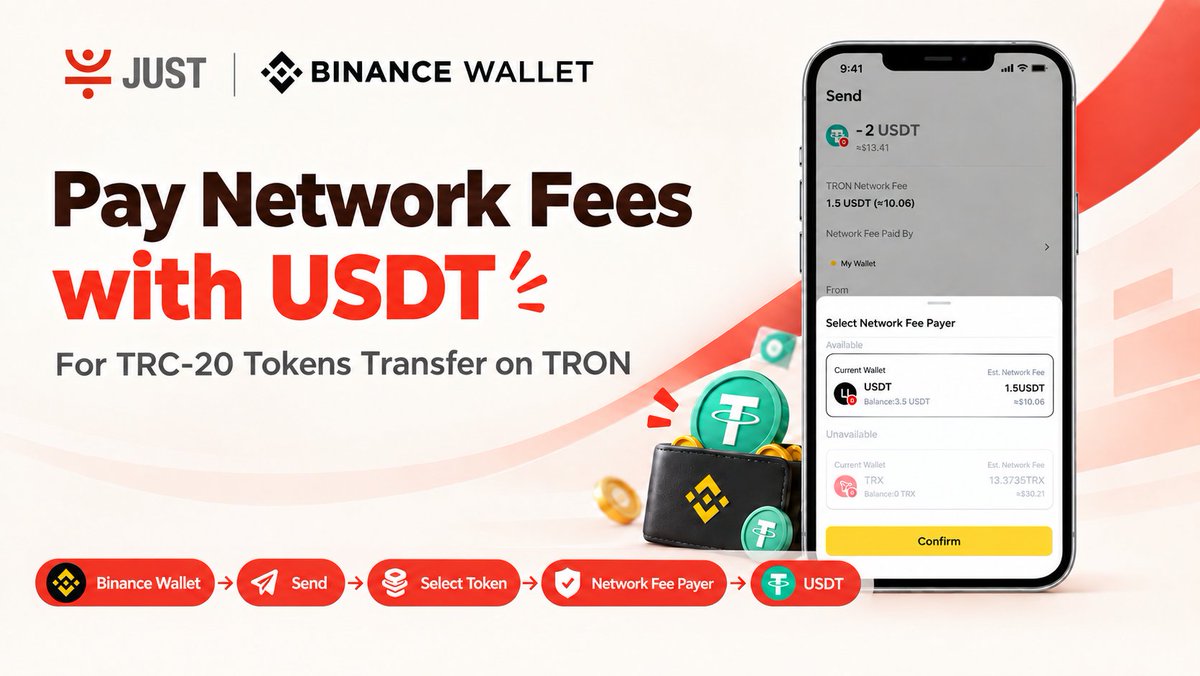
With stablecoin fee payment, eligible users can select USDT as the Network Fee Payer when making supported transfers through Binance Wallet.
For example, someone sending JST can choose USDT to cover the applicable network fee instead of needing to maintain a separate TRX balance specifically for that transaction.
This creates a simpler relationship between the asset being transferred and the asset used to pay for the transaction.
𝗛𝗢𝗪 𝗧𝗢 𝗨𝗦𝗘 𝗧𝗛𝗘 𝗙𝗘𝗔𝗧𝗨𝗥𝗘
The process is designed to fit into the existing transfer workflow:
Open Binance Wallet.
Select Send.
Choose the token you want to transfer.
Open Network Fee Payer.
Select USDT as the fee payment option, where supported.
Review the transaction details before confirming.
The feature reduces the need to manage TRX solely for eligible network-fee payments, making the transfer experience more straightforward.
𝗪𝗛𝗬 𝗧𝗛𝗜𝗦 𝗠𝗔𝗧𝗧𝗘𝗥𝗦 𝗙𝗢𝗥 𝗧𝗥𝗢𝗡
A blockchain’s usability is influenced not only by its transaction speed or infrastructure, but also by how easily people can interact with it.
Reducing the extra steps involved in paying network fees can make token transfers more approachable for users who are already familiar with stablecoins.
It also highlights an important direction for blockchain wallet design: abstracting some of the technical complexity without removing the underlying network mechanisms.
However, stablecoin fee payment does not mean transactions are completely free. The applicable fee is still paid, and availability depends on supported assets, network conditions, and wallet functionality.
𝗔 𝗦𝗠𝗔𝗟𝗟𝗘𝗥 𝗙𝗥𝗜𝗖𝗧𝗜𝗢𝗡, 𝗔 𝗕𝗘𝗧𝗧𝗘��� 𝗨𝗦𝗘𝗥 𝗘𝗫𝗣𝗘𝗥𝗜𝗘𝗡𝗖𝗘
The bigger significance is the reduction of a common barrier in everyday blockchain activity.
When users can manage eligible transfers without separately holding TRX for each network-fee payment, interacting with TRON becomes more convenient.
Practical improvements like this help move blockchain usability beyond technical knowledge and closer to a smoother everyday experience.
@BinanceWallet @trondao @justinsuntron #TRONEcoStar
Transferring assets on TRON just got easier. 😎
With stablecoin fee payment in @BinanceWallet, you can transfer USDT and other TRC-20 tokens without keeping TRX for gas.
Sending JST? Choose USDT as the Network Fee Payer and let it cover the network fee.
🔍How to use it:
Open Binance Wallet → [Send] → [Select Token] → [Network Fee Payer] → [USDT]
Simple setup. One less thing to keep in mind when moving assets on TRON.
𝗧𝗥𝗢𝗡 𝗘𝗡𝗘𝗥𝗚𝗬 𝗖𝗢𝗦𝗧𝗦: 𝗪𝗛𝗬 𝗝𝗨𝗦𝗧𝗟𝗘𝗡𝗗’𝗦 𝗕𝗔𝗦𝗘 𝗥𝗔𝗧𝗘 𝗥𝗘𝗗𝗨𝗖𝗧𝗜𝗢𝗡 𝗠𝗔𝗧𝗧𝗘𝗥𝗦
In blockchain ecosystems, transaction costs are more than just a technical detail. They influence how frequently users interact with decentralized applications, how developers design their products, and how efficiently DeFi protocols operate.
On TRON, Energy is a key resource required to execute smart contracts. Every interaction with a smart contract consumes Energy, making its availability and pricing an important part of the network’s user experience.
That’s why the latest adjustment on JustLend DAO deserves attention.
𝗔 𝗡𝗘𝗪 𝗕𝗔𝗦𝗘 𝗥𝗔𝗧𝗘: 𝟭𝟱% 𝗧𝗢 𝟴%
JustLend has reduced its Energy rental base rate from 15% to 8%.
The announced pricing also places 100,000 Energy at approximately 3.957 TRX, equivalent to the stated rate of 39 sun per Energy unit per day.
This adjustment is significant because Energy rental provides an alternative for users who need the resource to execute transactions but do not want to rely entirely on freezing TRX for Energy.
𝗪𝗛𝗬 𝗘𝗡𝗘𝗥𝗚𝗬 𝗠𝗔𝗧𝗧𝗘𝗥𝗦 𝗢𝗡 𝗧𝗥𝗢𝗡
TRON uses a resource-based model in which Energy supports smart contract execution, while Bandwidth supports transaction data.
When users interact with DeFi protocols, transfer certain assets, or execute other smart contract operations, Energy becomes part of the transaction-cost equation.
Having access to Energy can therefore make blockchain interactions more manageable, particularly for applications that require frequent contract execution.
Lower rental pricing can improve the economics of accessing this resource, although the actual cost of a transaction still depends on its Energy consumption and prevailing network conditions.
𝗧𝗛𝗘 𝗗𝗘𝗙𝗜 𝗘𝗙𝗙𝗜𝗖𝗜𝗘𝗡𝗖𝗬 𝗔𝗡𝗚𝗟𝗘
For DeFi users, efficiency is not only about finding opportunities within protocols. It also involves understanding the operational costs associated with using them.
Energy rental can help users plan transaction expenses, while developers and applications can benefit from a more accessible resource market.
A lower base rate may also make it easier to evaluate whether renting Energy is preferable to other ways of obtaining it, depending on transaction frequency, resource requirements, and individual usage patterns.
𝗧𝗛𝗘 𝗕𝗜𝗚𝗚𝗘𝗥 𝗣𝗜𝗖𝗧𝗨𝗥𝗘
Infrastructure improvements are often most valuable when they reduce friction in everyday blockchain activity.
By adjusting its Energy rental base rate, JustLend is addressing one of the practical considerations behind smart contract usage on TRON: the cost of accessing network resources.
For users, developers, and DeFi participants, resource pricing deserves the same attention as liquidity, execution efficiency, and protocol functionality.
⚡ Check the current Energy pricing:
https://t.co/hD0RLIkCnd
@DeFi_JUST@trondao@justinsuntron #TRONEcoStar
⚡Energy just got cheaper on JustLend
Base rate cut: 15% → 8%
⛽Current pricing
100,000 Energy = 3.957 TRX (39 sun/Day)
Lower Energy cost → cheaper smart contract execution.
Efficiency is part of every good DeFi strategy.
🔋Check pricing:
https://t.co/rUXAw2jauP
𝗕𝗜𝗧𝗧𝗢𝗥𝗥𝗘𝗡𝗧 𝗡𝗘𝗢: 𝗥𝗘𝗧𝗛𝗜𝗡𝗞𝗜𝗡𝗚 𝗧𝗛𝗘 𝗧𝗢𝗥𝗥𝗘𝗡𝗧 𝗘𝗫𝗣𝗘𝗥𝗜𝗘𝗡𝗖𝗘 𝗙𝗢𝗥 𝗠𝗔𝗖𝗢𝗦
Good software does not always need to demand attention. Sometimes, the best experience comes from an application that feels natural, performs its job quietly, and makes everyday tasks easier without adding unnecessary complexity.
That philosophy is at the center of BitTorrent Neo, a new macOS torrent client rebuilt from the ground up rather than simply adapting an older application to a different platform.
The decision to start over reflects an important principle in software development: improving an existing product is not always enough when the expectations of its users and the operating system have evolved.
𝗗𝗘𝗦𝗜𝗚𝗡𝗘𝗗 𝗧𝗢 𝗙𝗘𝗘𝗟 𝗡𝗔𝗧𝗜𝗩𝗘
A desktop application should feel like it belongs on the platform where it runs.
BitTorrent Neo is designed specifically for macOS Sequoia and later, with a cleaner interface, familiar controls, and a more focused task-management experience.
Instead of overwhelming users with unnecessary elements, the application keeps essential information accessible, including download names, progress, and status.
This approach matters because good interface design is not simply about appearance. It is about reducing friction between what a user wants to accomplish and the tools available to accomplish it.
𝗦𝗠𝗔𝗥𝗧𝗘𝗥 𝗗𝗢𝗪𝗡𝗟𝗢𝗔𝗗 𝗠𝗔𝗡𝗔𝗚𝗘𝗠𝗘𝗡𝗧
Two features make the workflow particularly interesting:
🔹 Instant Search: Users can quickly filter their download tasks without interrupting ongoing activity. File-type filters also help organize larger download lists.
🔹 Scheduled Downloads: Instead of starting every task immediately, users can arrange downloads for a preferred date and time with supported Plus and PRO plans.
These features address a practical challenge: managing downloads becomes more complicated as the number of tasks increases. Better organization and scheduling help make that process more manageable.
𝗔 𝗟𝗜𝗚𝗛𝗧𝗘𝗥 𝗔𝗣𝗣𝗥𝗢𝗔𝗖𝗛 𝗧𝗢 𝗦𝗢𝗙𝗧𝗪𝗔𝗥𝗘
The rebuild also highlights the importance of keeping applications focused.
A torrent client should provide the tools users need without making routine operations unnecessarily complicated. A clear task list, accessible controls, and background-friendly design can make a meaningful difference in daily use.
Neo’s direction is a reminder that product innovation does not always require adding more features. Sometimes it means reconsidering the entire experience and removing the friction that should never have been there.
𝗕𝗘𝗬𝗢𝗡𝗗 𝗧𝗛𝗘 𝗜𝗡𝗧𝗘𝗥𝗙𝗔𝗖𝗘
BitTorrent’s wider ecosystem has long been associated with peer-to-peer file distribution. Clients are an important part of that infrastructure because they provide the interface through which people participate in file-sharing networks.
Developing a dedicated macOS experience therefore matters beyond a visual refresh. It brings renewed attention to how users interact with distributed file-sharing technology on modern desktop platforms.
BitTorrent Neo represents a fresh approach to that experience, with native macOS design, instant search, and scheduling built around practical user needs.
The bigger lesson is simple: powerful software does not have to feel complicated.
📖 Read the reasoning behind the rebuild: https://t.co/Ml0gnJpjaY
@BitTorrent@justinsuntron #TRONEcoStar