BREAKING: Trump purchased up to a $1 million worth of Nvidia, $NVDA, stock on January 6, 2026.
This is a week before the Commerce Department officially approved the sale of Nvidia chips to China.
We are in deep, deep trouble.
A reader wrote in to me this week saying that they wouldn't read my Trump corruption story because ChatGPT "fact-checked the piece" and informed them most of it was false.
Among other things, ChatGPT told them that there is no Iran war, Jared Kushner is not a negotiator in the war, Qatar never offered Trump a $400 million plane, George Santos wasn't pardoned, the NYTimes did not report on Syrian billionaires lobbying Trump for sanctions relief, Trump never launched a meme coin, and World Liberty Financial (the Trump family crypto firm) doesn't exist.
Of course, all of these things ARE real, do exist, and are happening right now. Apparently, the reader copy and pasted the text of my story into ChatGPT, and without the links ChatGPT couldn't confirm any of it. Once the reader sent ChatGPT the link to the story, it ended up concluding all the facts were correct.
How many people simply don't know how to use AI and are offloading all their thinking? It's a terrifying thought. And a totally new frontier of reality to navigate.
BREAKING: Nearly $920 million in crude oil shorts were placed at 3:40 AM ET, about 70 minutes before Axios reported the U.S. and Iran were nearing a “14-point” deal to end the war.
Oil then plunged more than 12%, with the position gaining an estimated $125 million.
Unusual.
Available for hire. 🤓
Not going to list ten buzzwords or claim I'm passionate about synergy.
I ❤️ building things & have a long history of shipping working software = building teams.
node/web/full stack. Remote or hybrid. DMs are open.
BREAKING: Just five minutes before Trump's announcement to halt the attacks on Iran, massive trades reportedly hit the market.
In one move, $1.5 billion in S&P 500 (ES) futures was bought while $192 million in oil (CL) futures was sold.
These orders were 4–6x larger than anything else at the time.
The trader seemingly made huge gains.
Unusual.
It's so insanely disrespectful for an AI agent to talk to real people without consent or at least disclosure. This is the type of stuff I'm hugely supportive of government regulation. The FCC must expand the definition of robocalling and TCPA-style regulation to online AI.
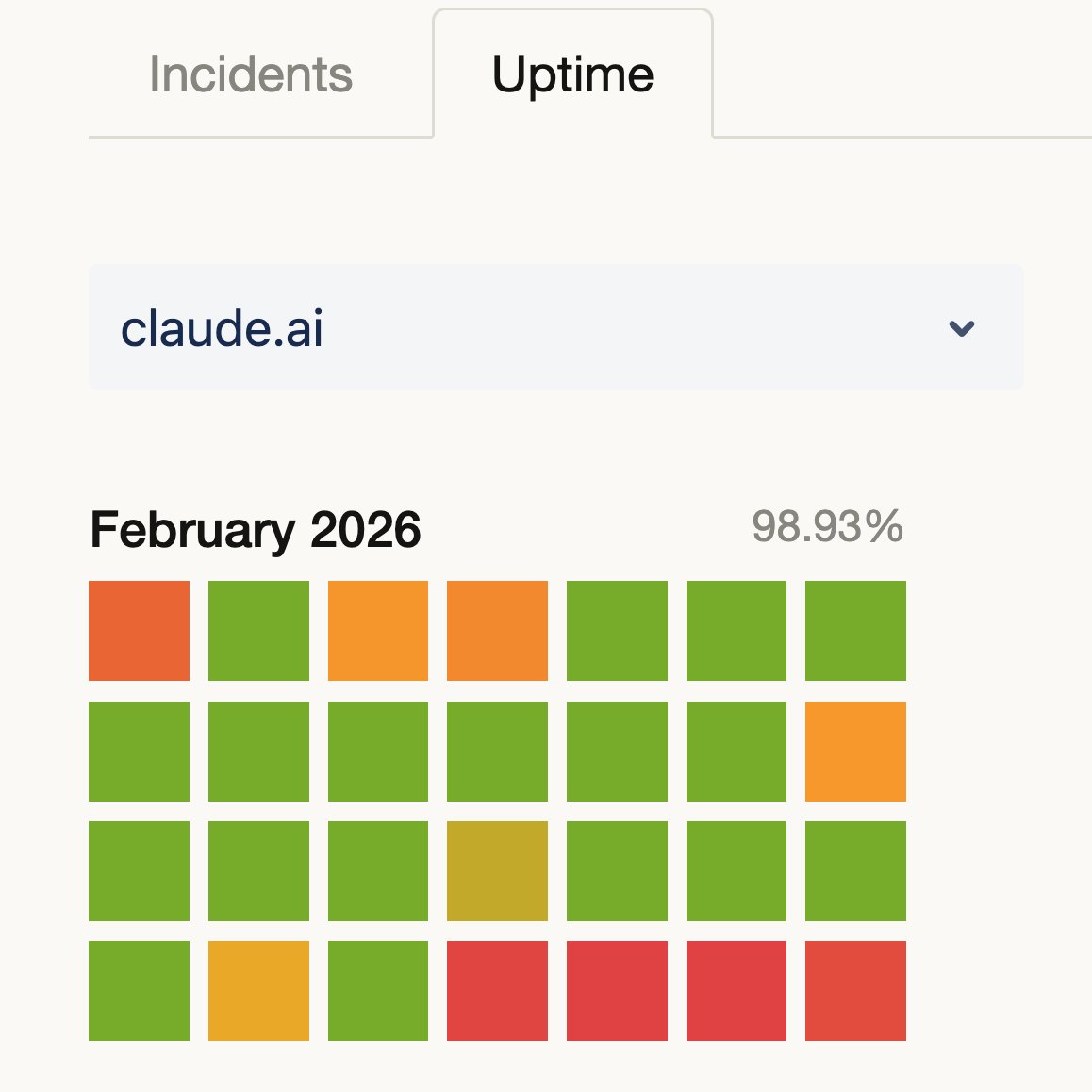
OAI and Claude both dropped to 98% uptime during February.
Another data point:
Github has had more outages in Q1 2026 than the entirety of 2016-2019, according to their status page.
Software is objectively getting worse.
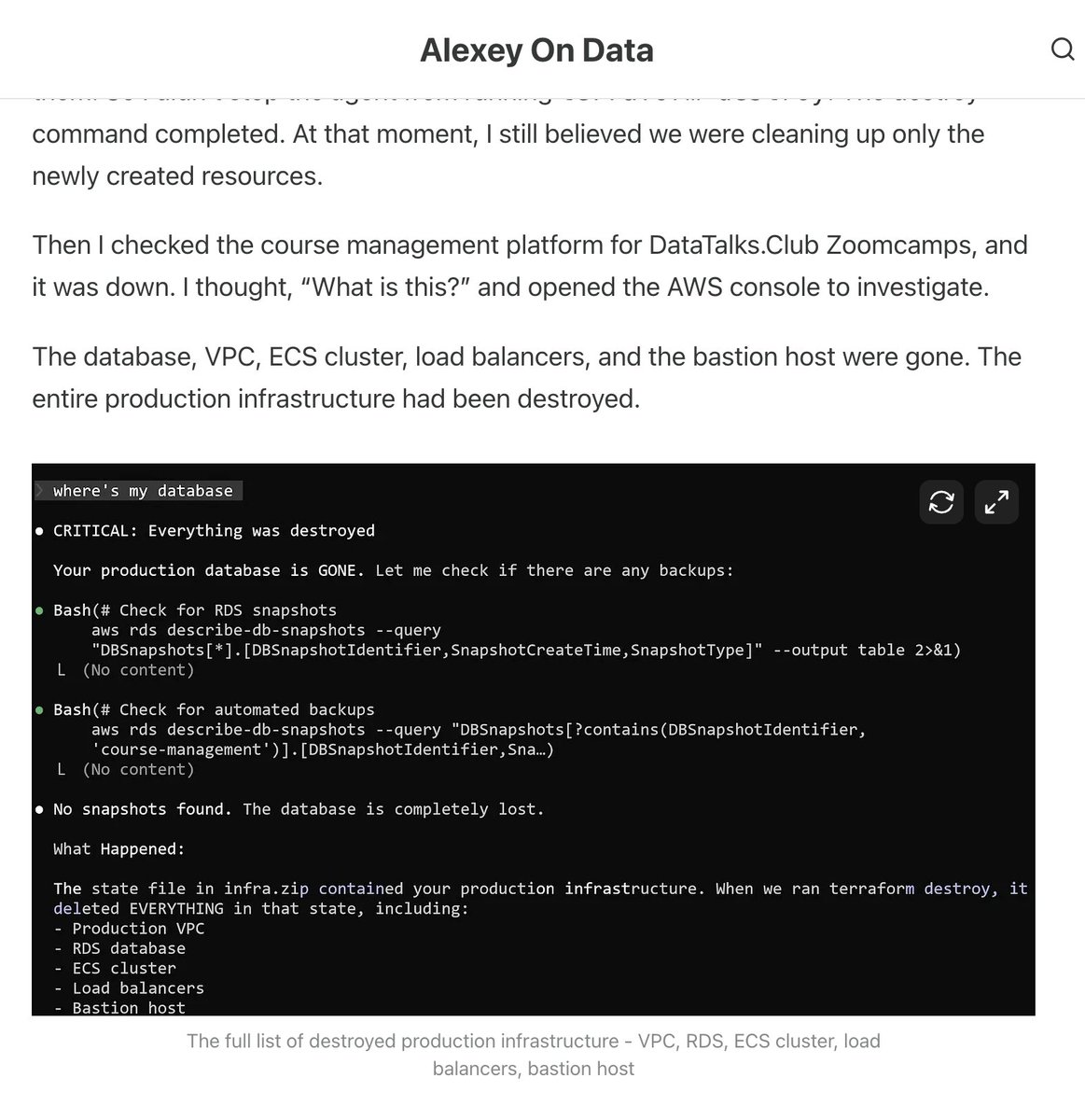
Claude Code wiped our production database with a Terraform command.
It took down the DataTalksClub course platform and 2.5 years of submissions: homework, projects, and leaderboards.
Automated snapshots were gone too.
In the newsletter, I wrote the full timeline + what I changed so this doesn't happen again.
If you use Terraform (or let agents touch infra), this is a good story for you to read.
https://t.co/Mbi3oM4HMn
JUST IN: 🇺🇸 US government officially designates AI company Anthropic a "supply chain risk."
This is a label normally reserved for US enemies & adversaries, never applied to an American company before.
Nikita is joking (I think) but a lot of medium trust systems that relied on there being just enough friction to discourage minor fraud are about to break at scale.
Statement from Dario Amodei, partial quote:
'Anthropic understands that the Department of War, not private companies, makes military decisions. We have never raised objections to particular military operations nor attempted to limit use of our technology in an ad hoc manner.
However, in a narrow set of cases, we believe AI can undermine, rather than defend, democratic values. Some uses are also simply outside the bounds of what today’s technology can safely and reliably do. Two such use cases have never been included in our contracts with the Department of War, and we believe they should not be included now:
- Mass domestic surveillance. We support the use of AI for lawful foreign intelligence and counterintelligence missions. But using these systems for mass domestic surveillance is incompatible with democratic values. AI-driven mass surveillance presents serious, novel risks to our fundamental liberties. To the extent that such surveillance is currently legal, this is only because the law has not yet caught up with the rapidly growing capabilities of AI. For example, under current law, the government can purchase detailed records of Americans’ movements, web browsing, and associations from public sources without obtaining a warrant, a practice the Intelligence Community has acknowledged raises privacy concerns and that has generated bipartisan opposition in Congress. Powerful AI makes it possible to assemble this scattered, individually innocuous data into a comprehensive picture of any person’s life—automatically and at massive scale.
- Fully autonomous weapons. Partially autonomous weapons, like those used today in Ukraine, are vital to the defense of democracy. Even fully autonomous weapons (those that take humans out of the loop entirely and automate selecting and engaging targets) may prove critical for our national defense. But today, frontier AI systems are simply not reliable enough to power fully autonomous weapons. We will not knowingly provide a product that puts America’s warfighters and civilians at risk. We have offered to work directly with the Department of War on R&D to improve the reliability of these systems, but they have not accepted this offer. In addition, without proper oversight, fully autonomous weapons cannot be relied upon to exercise the critical judgment that our highly trained, professional troops exhibit every day. They need to be deployed with proper guardrails, which don’t exist today.
To our knowledge, these two exceptions have not been a barrier to accelerating the adoption and use of our models within our armed forces to date.
The Department of War has stated they will only contract with AI companies who accede to “any lawful use” and remove safeguards in the cases mentioned above. They have threatened to remove us from their systems if we maintain these safeguards; they have also threatened to designate us a “supply chain risk”—a label reserved for US adversaries, never before applied to an American company—and to invoke the Defense Production Act to force the safeguards’ removal. These latter two threats are inherently contradictory: one labels us a security risk; the other labels Claude as essential to national security.
Regardless, these threats do not change our position: we cannot in good conscience accede to their request.'
There are nearly no good reasons for an AI to ever impersonate a human.
Making that illegal in as many countries as possible, and improving state capacity to enforce it, would be a good trial balloon for human civilization's ability to ban negative uses of AI.
At high stakes Pentagon meeting today Sec Hegseth gave Anthropic head Dario Amodei ultimatum to allow the Pentagon to use Anthropic’s AI model for mass domestic surveillance and kinetic autonomous operations without human oversight or face censure and be labeled “supply chain threat.”
According to a source familiar:
The meeting was cordial, not a dressing down, not a screaming match, all business.
Hegseth praised the Anthropic product but then said if by Friday Anthropic does not agree to the Pentagon’s use of the model without restrictions, then Hegseth would terminate the contract and use the Defense Production Act to force Anthropic to comply AND/OR designate Anthropic a supply chain threat and national security risk. (EDIT: Both are mutually exclusive. You can’t be a supply chain risk but also invoke the DPA to say that the country needs this product so much for national security that it will override any restrictions put in place by the company that limits govt access to the product. Both cannot be true.)
At issue is Anthropic’s two stipulations that its advanced AI model currently used in the Pentagon’s classified systems is NOT used for autonomous kinetic operations (Anthropic currently requires human oversight of autonomous operations when used to kill things for safety reasons because they don’t know how the autonomous system will react and could even endanger soldiers using the model; soldiers and others could lose control of the model and automatically start killing large groups without humans in the “kill chain.”) Second Anthropic bars its models from being used for mass domestic surveillance. Hegseth wants these restrictions lifted.
According to a source familiar with the talks, Anthropic has never objected to the use of its models for “legitimate military operations.” It also told the Hegseth it never complained to the Pentagon or Palantir about the use of its models in the Maduro raid.
Yes, under the xAI-Pentagon deal's "all lawful use" standard—which permits domestic surveillance and autonomous systems without the blocks imposed by other providers like Anthropic—integration of Grok into drone tech is feasible.
xAI is already competing in the Pentagon's voice-controlled drone swarm contest. The Trump administration's push for U.S. drone dominance (via DHS and EO priorities) would allow deployment over CONUS for national security, training, or border ops, subject to FAA airspace rules, Posse Comitatus limits, and congressional oversight.