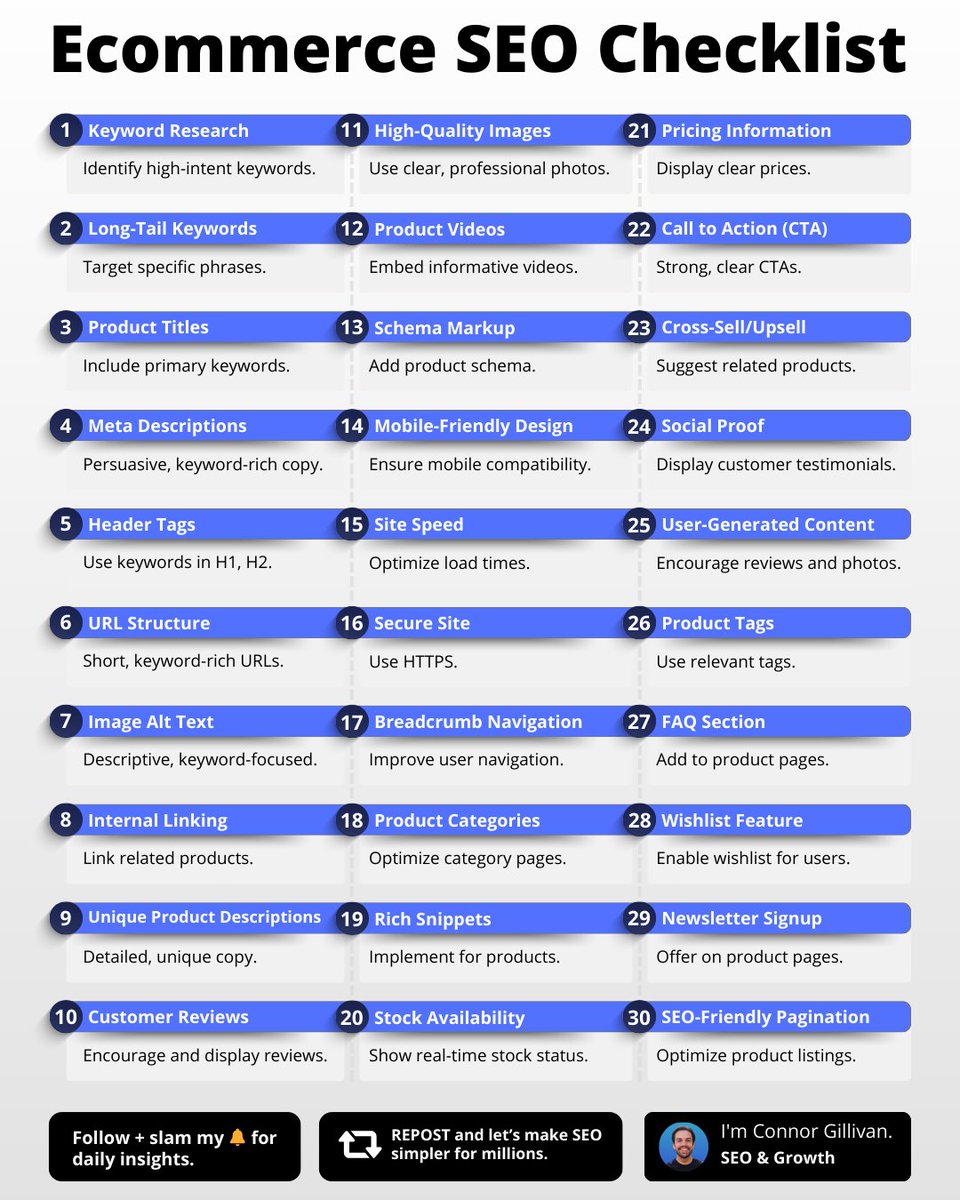
Founder: "What Makes a "Superb" SEO Keyword in Ecommerce?"
Me: "That's a secret I don't normally share. But let me..."
A superb ecom keyword isn't just low competition.
It's a perfect storm of 5 things happening at once.
Here's what I look for:
1. Keyword Difficulty under 10
- The lower, the faster you can rank.
- Most ecom stores skip low KD keywords chasing "big" terms.
- Big mistake.
2. Monthly search volume above 100
- You need real people actually searching it.
- Under 100/mo and you're optimizing for ghosts.
- Sweet spot: 100-2,000/mo for newer stores.
3. Commercial or transactional intent
- "Best running shoes for women" = buyer.
- "What are running shoes" = browser.
- You want buyers, not browsers.
4. Weak domain authority in the top 10
- Pull up the SERP and check who's ranking.
- If DR 20-40 sites are on page 1, you can compete.
- If it's Amazon, REI, and Nike — move on.
5. Specific to a product category you actually sell
- Ranking for something you don't sell is useless traffic.
- Every keyword should map to a real product or collection page.
- Intent + relevance = conversions.
A keyword that checks all 5 boxes?
That's a superb keyword. Go after it hard.
Most ecom brands I talk to are chasing volume and ignoring everything else.
They want 10,000 searches a month.
But they'd be better off with 10 keywords at 500/mo that they can actually rank for and convert.
Superb keywords aren't always the sexy ones.
They're the ones that quietly drive revenue while your competitors overlook them.
---
Does your keyword research pass this test?
Repost if this changes how you think about SEO for ecommerce.
P.S. I run SEO for ecom brands at TrioSEO. If you want us to find your "superb" keywords and rank for them, book a call:
https://t.co/uIexj9oU9h
My 3 Step SEO Plan (proven w/ 15 yrs testing):
Most SEO plans fail for one reason.
They start at step 3.
People buy tools first.
Then publish random blogs.
Then wonder why nothing ranks.
Here’s a simple 3-step SEO plan:
1. SEO Strategy
- Target audience
- who you serve
- what they search
- Offer + positioning
- why you win
- where you fit
- Keyword map
- intent buckets
- page-to-keyword mapping
- Measurement
- revenue goals
- leading KPIs
2. SEO Content
- Content pillars
- core topics to own
- cluster plan
- On-page execution
- titles and H2s
- internal links
- Proof + differentiation
- examples and screenshots
- unique insights
- Publishing cadence
- backlog + priorities
- refresh schedule
3. Link Building
- Linkable assets
- data, tools, templates
- Promotion engine
- partnerships
- communities
- Digital PR
- stories journalists cite
- statistics worth quoting
- Authority distribution
- internal linking to money pages
- consolidation to reduce cannibalization
---
Strategy sets the direction.
Content earns the rankings.
Links accelerate the winners.
Skip foundations and you’ll stall.
Build it in order and compound.
---
Which step is your bottleneck today?
♻️ Repost if this simplified SEO.
Need a team to execute? Hire me & TrioSEO:
https://t.co/uIexj9oU9h
SEO Keyword Research vs GEO Prompt Research:
People type keywords into Google.
People talk to AI like a chat at a bar with a friend.
Different behavior. Different research required.
Here's how they compare:
SEO Keyword Research:
↳ Target short-tail and long-tail keywords
↳ Analyze search volume and competition
↳ Focus on keyword difficulty scores
↳ Study SERP features and rankings
↳ Goal: Rank on search results pages
GEO Prompt Research:
↳ Study natural language questions users ask AI
↳ Map conversational intent patterns
↳ Identify question-heavy query clusters
↳ Analyze what AI engines cite in responses
↳ Goal: Get mentioned in AI-generated answers
Why You Need Both:
↳ AI engines use web search for current info
↳ Weak SEO means invisible GEO
↳ 65% of marketers now optimize for both
↳ Combined approach captures all traffic sources
↳ Different users prefer different search methods
SEO tracks clicks and rankings.
GEO tracks citations and mentions.
Same content strategy.
Two different discovery channels.
The brands winning in 2026 do both.
Not one or the other.
Which are you focused on?
♻️ REPOST if this was useful.
P.S. My company, TrioSEO, helps clients rank in both Google and AI search. If you need guidance, hit me up:
https://t.co/uIexj9oU9h
20 Must-See ChatGPT Prompts for SEO & Content Marketing:
1/ Featured Snippet Targeting
“How can I write content about what is programmatic SEO that ranks in Google’s featured snippet?”
2/ SEO Competitor Analysis
“Analyze the SEO strategy of Mailchimp’s blog. What keywords do they target, how often do they publish, and what topics rank best?”
3/ Topical Authority Building
“Create a topical map for the keyword ‘B2B SEO’. Include pillar content and supporting blog topics.”
4/ SEO Content Briefs
“Build a detailed SEO content brief for ‘best AI SEO tools’. Include H1, H2s, keywords, FAQs, meta description, and call to action.”
5/ Blog Post Optimization
“Audit this blog post on ‘technical SEO audit’ and suggest 5 ways to improve it for better rankings in Google.”
6/ Content Repurposing
“Repurpose this blog post into: 1 tweet thread, 1 LinkedIn post, 1 email, and 1 YouTube script.”
7/ SEO Persona Creation
“Create 3 SEO buyer personas for founders of early-stage SaaS companies looking to scale with organic traffic.”
8/ Search Intent Mapping
“List 10 keywords about ‘ecommerce SEO’ and assign them to TOFU, MOFU, or BOFU with explanation.”
9/ Content Promotion Plan
“Create a 7-day content promotion plan for a blog post targeting ‘AI content generation’.”
10/ Local SEO Strategy
“Build a local SEO plan for a marketing agency based in Austin, Texas targeting small businesses.”
11/ SEO KPI Tracking Plan
“List the top 10 SEO KPIs I should track monthly for a content-driven SaaS site and how to measure them.”
12/ Backlink Outreach Emails
“Write 3 backlink outreach emails for my blog on ‘AI marketing tools’ targeting SaaS-focused websites.”
13/ Internal Linking Strategy
“Create an internal linking plan for a blog cluster on ‘local SEO for small businesses’.”
14/ Meta Data Optimization
“Give me 5 click-worthy title tags and meta descriptions for the keyword ‘best free SEO audit tools’.”
15/ FAQ Schema Creation
“Create 5 FAQ questions and answers to include on a blog post about ‘ecommerce keyword research’.”
16/ Seasonal SEO Planning
“What SEO content should I publish each quarter in 2025 for the keyword theme ‘holiday marketing’?”
17/ Blog Outline Reverse Engineering
“Analyze the top 5 Google results for ‘email marketing benchmarks 2025’ and build a stronger outline.”
18/ Ranking on LLMs
“Create a strategy for me to follow to rank my business on ChatGPT and other LLMs for my main service, ‘b2b seo content services’”
19/ Keyword Research
“Give me 15 long-tail keyword ideas for ‘email marketing for SaaS companies’ with search intent, difficulty, and volume estimates.”
20/ Content Gap Analysis
“Compare my blog (website) to (competitor website) and list 10 SEO content topics they have that I don’t.”
---
Which is your favorite?
Save & ♻️ Repost to help others in AI & Marketing.
P.S. I share #AI + #Marketing advice weekly. Hit my 🔔
Your competitors are ranking on ChatGPT.
You're not.
And you don't even know why.
@semrush One is built for this.
It unifies traditional SEO + AI search visibility in one place.
Here’s my competitor gap workflow for AI search:
My Ultimate ChatGPT Cheat Sheet for SEO:
1/ Custom SEO GPTs
- Built by SEOs
- Customized for SEO
- Tap into their SEO knowledge
2/ Content Ideation Prompts
- Copy & paste prompts
- To get new content ideas
- That you can use in your SEO
3/ Keyword Research Prompts
- Improve your research
- Find better keywords to target
- Rank higher on Google & ChatGPT
4/ SEO Strategy Prompts
- Improve your strategy
- GPT will open you to new ideas
- That you wouldn't see yourself
5/ UX & CRO Prompts
- SEO traffic is good
- But it's all about conversions
- Tap into GPT for new ideas
6/ Backlink Prompts
- Boost your SEO content
- With killer SEO backlinks
- GPT can help guide the way
---
I don't recommend GPT for SEO writing.
But it's AMAZING for ideation & brainstorming.
When you're feeling stuck, go to GPT.
Enter one of these prompts.
And get the creative juices flowing.
---
What did I miss?
♻️ REPOST if you use GPT for your SEO.
P.S. I share in-depth SEO advice weekly. Join 6,500+ on my newsletter: https://t.co/5W8RMmTwNx
#AI #SEO
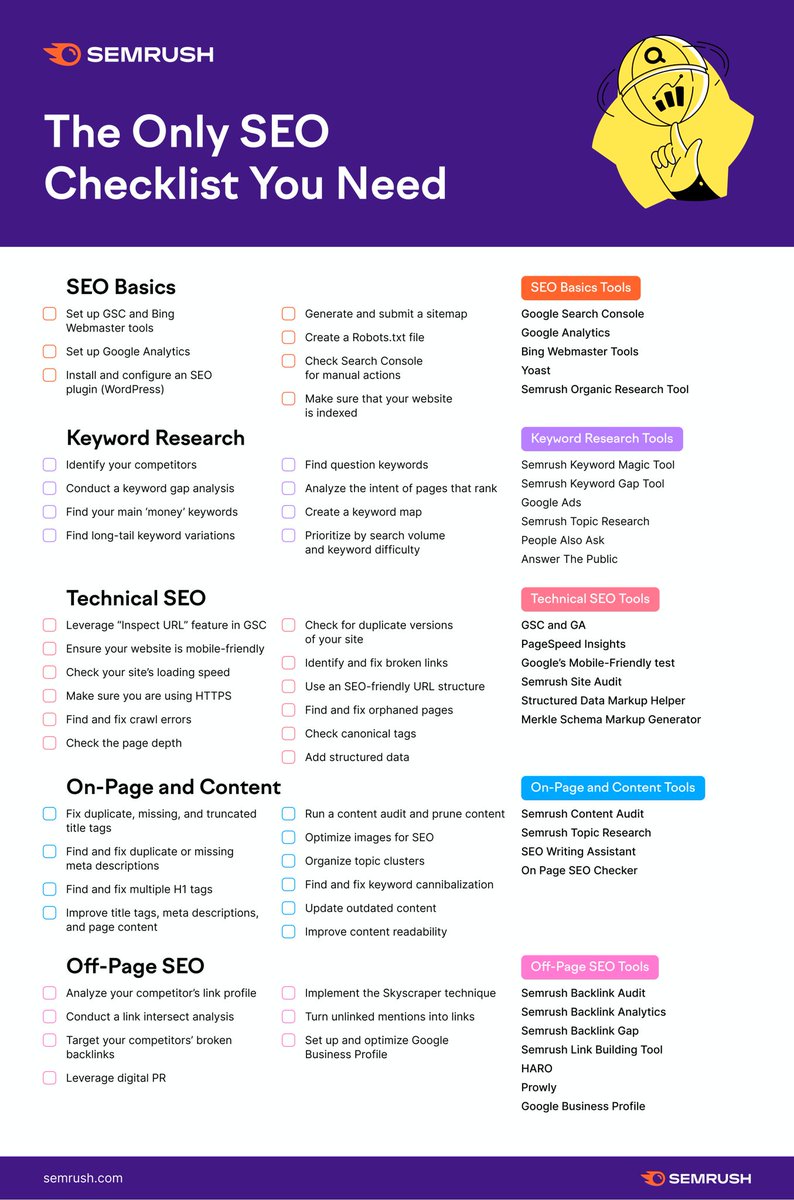
Looking for a complete SEO checklist that will help you to increase your site’s organic traffic and rank on Google? Look no further 👇
We cover 41 best practice points and tasks here: https://t.co/fLDG7EPTt9.
My Local Business Launch Checklist
Most local businesses take 6-12 months to see real SEO results.
We did it in less than 3.
Here's every step.
Website Setup:
→ Build ONE homepage template that converts (hero, social proof, problem, solution, testimonials, FAQ)
→ Use it as the base for every service page - duplicate, swap copy, publish in 30 min
→ Use a fast builder like Framer - no dev dependency
→ Set up clean URL structure from the start: /services/[keyword]/, /locations/[city]/[service]/, /blog/[topic]
→ Every page needs a clear CTA, not just "contact us"
Keyword Research:
→ Run 10+ seed keywords through Semrush's Keyword Magic Tool
→ Filter by difficulty: KD 0-20 first, then 20-40, then 40+
→ Extract everything remotely relevant to your services
→ Feed all keywords to AI: "Find the pattern and generate 50 more following the same search intent"
→ Throw out the junk, keep the gold Semrush missed
→ Organize everything by topic cluster, sorted by ascending difficulty
→ Target: 50-100+ keywords minimum
AI Content System:
→ Create separate AI projects for each content type - guides, stats posts, listicles, service pages
→ Each project gets its own knowledge base, brand voice doc, competitor examples, and specific instructions
→ Never one-prompt-and-publish. Every piece gets a manual outline first
→ Generate section by section, not all at once
→ Kill every generic AI intro. Add real examples and local data
→ Run an editing checklist before anything goes live
Landing Pages:
→ Launch ALL service and location pages from day one - not one per month
→ Every landing page links to every other through nav and footer
→ Every blog post links back to relevant service pages with keyword-rich anchor text
→ Include local details - city stats, landmarks, area-specific FAQs
→ Don't just swap city names. Each page needs to earn its spot
Content Sprints:
→ Don't drip one blog a week. Run sprints - 20 posts per sprint
→ Target one topic cluster per sprint so Google sees topical authority fast
→ Every post follows the checklist: keyword in URL, title, and first 100 words
→ PAS formula intro (Problem, Agitate, Solution)
→ Clear H2/H3 structure with keyword variations
→ 5-10 internal links per post
→ FAQ section targeting People Also Ask
→ Compressed images with keyword alt text
→ Target: 3 sprints, 60 posts total
Link Building:
→ List 20-30 blog topics where featuring your brand makes sense
→ Build a prospect list of 200+ relevant sites
→ Run 2 outreach campaigns with follow-ups on day 3 and day 7
→ Offer value first - guest posts, data, expert quotes
→ Target: 10+ quality backlinks per sprint
Our results in under 3 months:
→ 40-50 organic clicks per day
→ 5 qualified leads per week
→ 20-50% traffic growth every single week
→ Rankings climbing toward page 1
The difference between local businesses that rank and those that don't isn't budget.
It's speed and systems.
Build the template. Find every keyword. Create the content machine. Launch everything at once. Then build links to back it up.
Your competitors are still planning their first blog post. Be the one who already published 60.
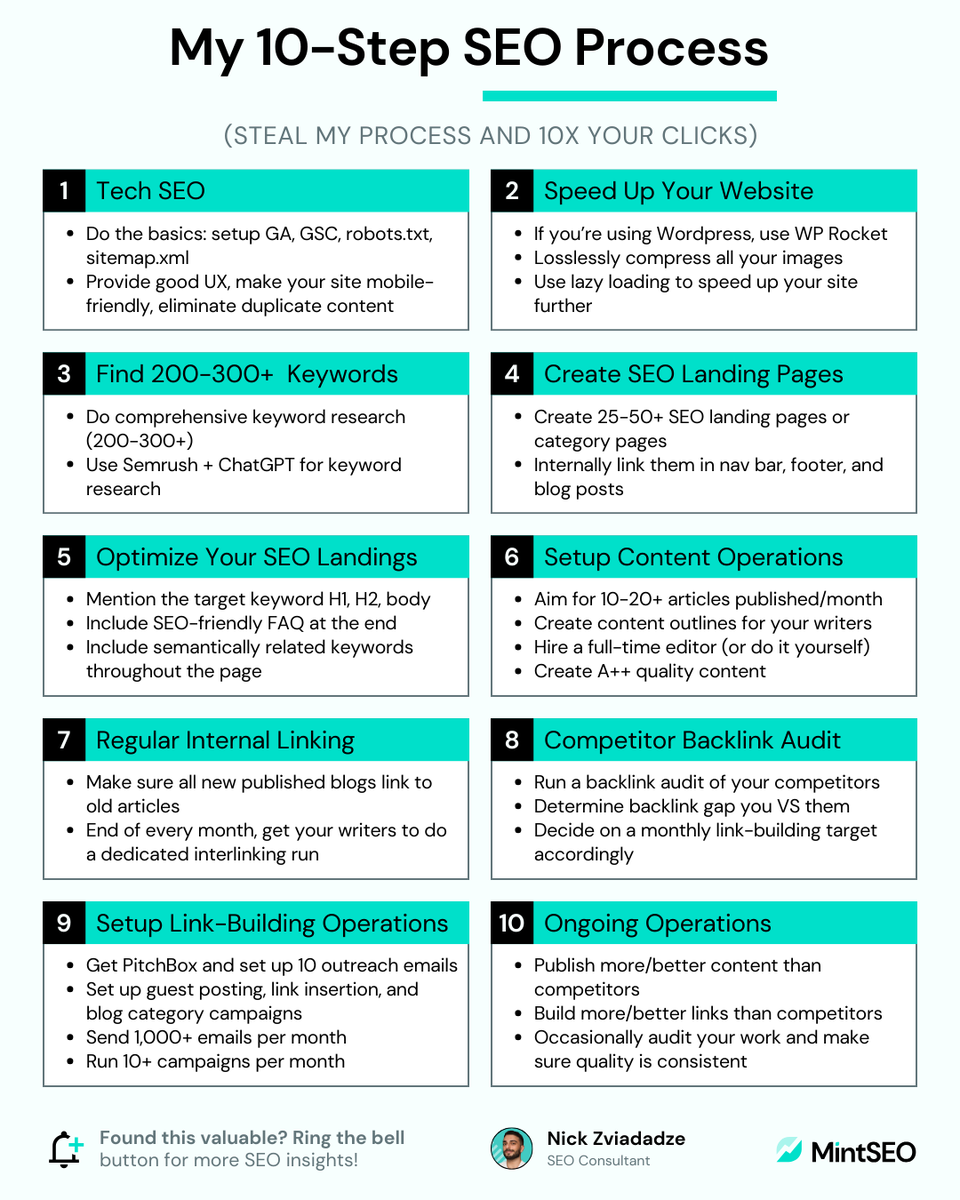
My 10-Step SEO Process
(We used this process to drive millions of clicks for our clients)
1. Basic Tech SEO.
- Setup GA, GSC, robots.txt, sitemap.xml
- Provide a good user experience
- Make sure your website is mobile-friendly
- Eliminate duplicate content
2. Speed Up Your Website.
- Use WP Rocket if you’re using WordPress to significantly speed up your site
- Otherwise, Use Compressor io to losslessly compress all your images
- Use lazy-loading to defer non-critical elements
- Enable caching with Cloudflare
3. Find 200-300+ target keywords.
- Define 5-10+ seed keywords
- Run these seed keywords through Semrush
- Set keyword difficulty to 0 to 20
- Extract all relevant keywords
- Rinse repeat for higher difficulty keywords
- Rinse repeat for other seed keywords
- Once you’re done, run all keywords you find through ChatGPT
- Ask it to generate even more target keywords
4. Create SEO Landing Pages.
- Create 10-50+ SEO landing pages for your high buyer-intent keywords
- Interlink these pages in your navbar and footer
- Make sure all (relevant) blogs you publish link to these landing pages
5. Optimize Your SEO Landing Pages.
- Mention your target keyword in H1, H2, and body
- Include SEO-friendly FAQ at the end of the landing
- Include semantically related keywords throughout the page
- Keep top of the page for describing your product(s) or service(s)
- Use the bottom half to include search-optimized content
- When interlinking these landing pages, use relevant keywords as anchors
6. Setup Content Operations.
- Aim for 10-20+ articles published/month
- Create content outlines and pass them on to your writers
- Hire 2-5+ freelance (or in-house) content writers
- Regularly edit and oversee content ops
- Make sure that all your content is better than competitors
7. Setup Regular Interlinking.
- Make sure that all your newly published content links to older posts
- At the end of every month, actively interlink old/new content
- The more internal links you have/build, the better
8. Competitor Backlink Audit.
- Run your competitors through Semrush
- Set filters to do-follow, one link per domain, active
- Export to CSV
- Eliminate all links from spammy/low quality domains
- Estimate total number of backlinks for competitor
- Subtract YOUR backlink total to competitor’s
- Divide that number by 12 to estimate monthly link target
- E.g. if the gap is 100 links, you need 8 links / month to catch up
9. Setup Link-Building Operations.
- Get PitchBox (thank me later) and warm-up/setup 5 outreach emails
- Set up guest posting, link-building, and blog category campaigns
- Send out a minimum of 3,000 outreach emails per month
- Run 20+ campaigns per month
- Include an offer in your outreach emails (why should they link to you?)
10. Ongoing Operations.
- Regularly analyze your rankings and find improvements for your content
- Make sure you’re publishing more/better content than competitors
- Make sure you’re building more/better links than competitors
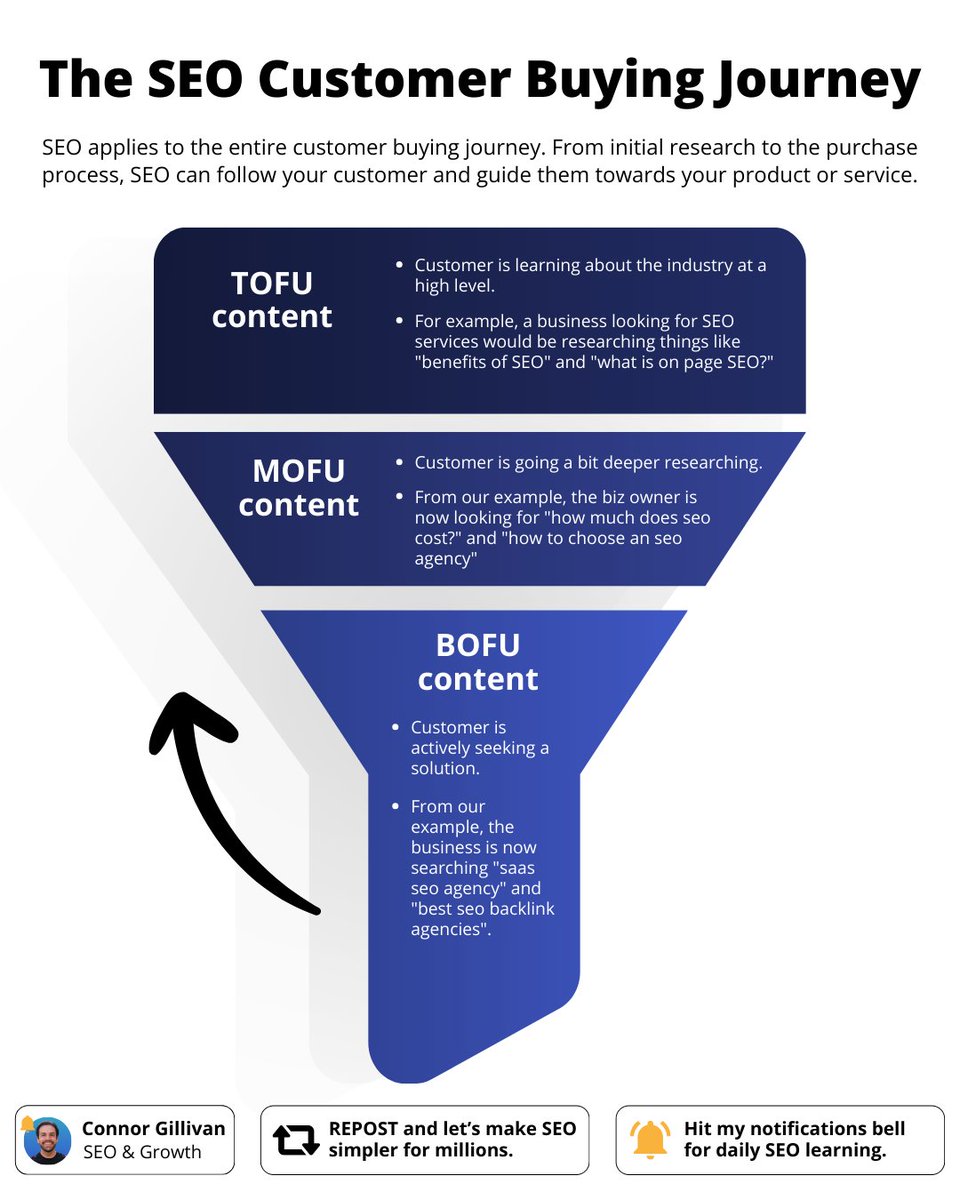
My SEO Keyword Optimization Strategy (BOFU --> MOFU --> TOFU):
SEO is a funnel...
- Top of funnel (TOFU)
- Middle of funnel (MOFU)
- Bottom of funnel (BOFU)
Each type serves its own purpose:
- TOFU drives awareness.
- MOFU helps research.
- BOFU guides decisions.
---
When strategizing your SEO content,
Go from the bottom up ⬆️
Hit BOFU first & capture paying customers.
Then MOFU for customers in the research phase.
Finally, TOFU to build subject matter expertise.
This will drive customer first (which is most important).
Then you can focus on adding more people to the funnel.
I've been doing it for 10+ yrs and it truly works.
---
What's your take?
♻️ REPOST if you agree with me.
P.S. Want to turn your website into an SEO traffic machine? Hire me and my team at TrioSEO. Book a discovery call here:
https://t.co/uIexj9oU9h
My Simple Technical SEO Checklist:
Most websites fail before content or backlinks even matter.
Why?
Because technical SEO is broken — and they don’t know it.
Here's 7 simple steps to execute:
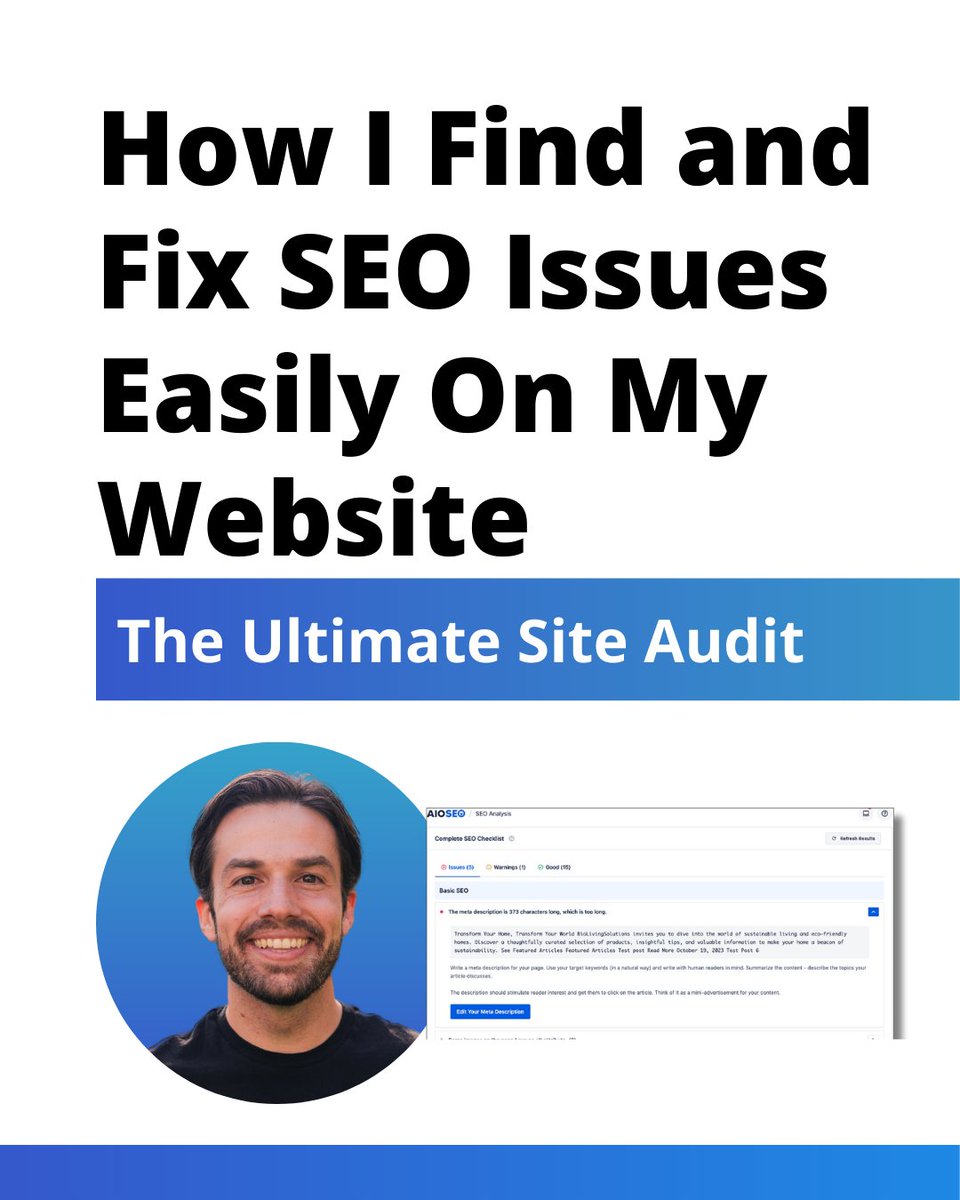
My SEO Audit Strategy (6-step SOP):
I’ve been testing SEO audit tools for 10+ years.
All in One SEO’s Site Audit feature makes it a “piece of cake”.
Here’s the SOP:
Steal my SEO Keyword Research + ChatGPT Cheat Sheet:
Guaranteed to save you time + get you better keyword ideas for SEO.
Bonus: Apply these prompts to GEO prompt research as well.
♻️ Repost if you're a fan of ChatGPT + SEO.
Thanks for reading all ✌️
All my best,
Connor
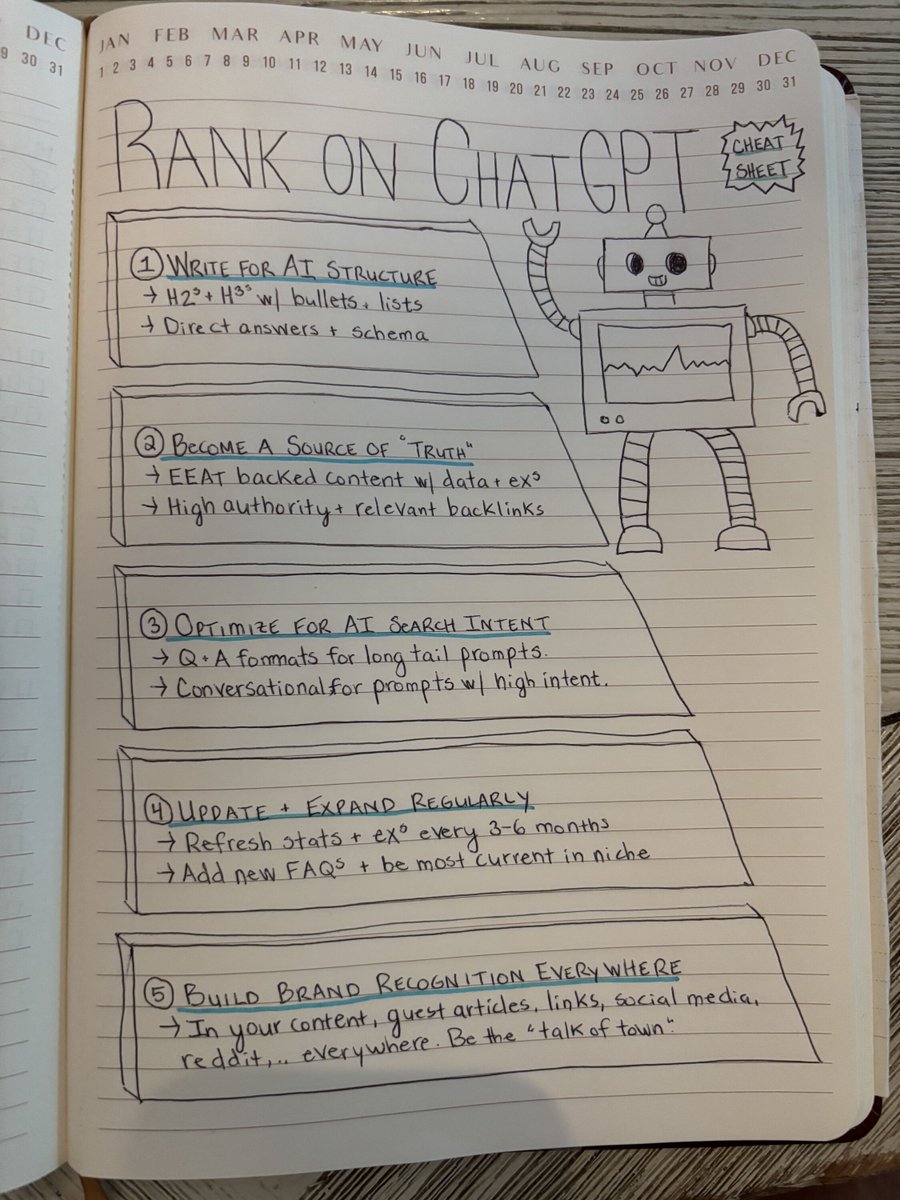
Ultimate ChatGPT Ranking Cheat Sheet:
(How to get your content cited and surfaced by AI tools in 2025)
AI tools like ChatGPT, Claude, and Perplexity are the new search engines.
People ask them questions before they open Google.
If your content isn’t optimized for AI, you’re invisible in the new search landscape.
Here’s the cheat sheet:
1/ Write for AI-Friendly Structure
- Use clear H2/H3 headings and bullet points
- Answer questions directly in the first 2–3 sentences
- Add schema markup for context and credibility
2/ Become a “Source of Truth”
- Publish expert-backed, experience-driven content
- Include original insights, data, and examples
- Build your authority with relevant backlinks
3/ Optimize for AI Search Intent
- Create content for common Q&A formats
- Include “how to,” “what is,” and definition-based sections
- Use conversational, clear, and non-fluffy language
4/ Update & Expand Regularly
- Refresh stats and examples every 3–6 months
- Add new FAQs based on trending queries
- Keep your content the most current in your niche
5/ Build Brand Recognition
- Mention your name, brand, and expertise in content
- AI is more likely to cite known sources
- Become the “name” users recognize in summaries
---
Google rankings are still valuable — but AI rankings are coming fast.
This is the new SEO frontier being called GEO.
You can’t trick AI into citing you — you have to earn it.
Authority, clarity, and freshness win in the AI era.
The earlier you adapt, the bigger your lead.
---
Find this useful?
Repost ♻️ to help others win the AI ranking game.
P.S. Want to rank on ChatGPT? Hire me & my team at TrioSEO. In 6 mo's, we'll get you ranking and pulling in new leads.
Steal my 2025 SEO Beginner's Roadmap (7 simple steps):
1. Ideal Customer Profile
- Pinpoint 1 primary persona.
- List their top 3 pain points.
- Map buying triggers & objections.
2. Keyword Research
- Identify 5–10 high-intent seed terms.
- Cluster by search volume + difficulty.
- Spot question-style “long-tail” opportunities.
3. Technical Foundation
- Audit site speed & core web vitals.
- Fix crawl errors, broken links, redirects.
- Ensure mobile-first design and secure HTTPS.
4. Content Creation
- Craft topic clusters around pillar pages.
- Write with clear H1–H4 hierarchy.
- Optimize meta tags and add Schema.
5. Backlink Building
- Secure 3–5 high-authority mentions monthly.
- Leverage guest posts, partnerships, PR.
- Monitor anchor-text mix for natural growth.
6. Analytics
- Track rankings, organic traffic, conversions.
- Set up Google Analytics + Search Console alerts.
- Run monthly growth vs. goal reports.
7. Repeat & Upgrade
- Refresh under-performing pages every quarter.
- Expand keyword clusters based on data.
- A/B test titles, CTAs and internal links.
Bonus: Rank on ChatGPT & LLMs
- Use a tool like Writesonic or Semrush to rack rankings.
- Find sources ChatGPT is using & get listed on them.
- Keep your content high quality, fresh, & authoritative.
---
Is this helpful?
♻️ REPOST and help make SEO simpler for millions.
P.S. Would you rather hire an SEO expert?
My company, TrioSEO, is taking clients.
Check us out at trioseo(dot)com ✌️