These works produced by Barbara Nessim in the 1980s emerge from a stage when computer technology was still undeveloped. Low resolution and limited color palette appear not as aesthetic choices, but as conditions imposed by the technology itself.
#digitalprimitivism#barbaranessim
The Norpak IPS-2 Videotex system operates at a resolution of 256×200 with a palette of only 12 colors. These images were captured by photographing the screen.
Source: https://t.co/H9gLbhaCIT
@gingerbeardman
These works produced by Barbara Nessim in the 1980s emerge from a stage when computer technology was still undeveloped. Low resolution and limited color palette appear not as aesthetic choices, but as conditions imposed by the technology itself.
#digitalprimitivism#barbaranessim
The face is fragmented into planes. Color does not define form—it cuts through it. The image does not represent reality; it re-encodes it. This marks one of the rupture points of digital aesthetics.
At a time when computer graphics were still in their infancy, she was among the first artists to approach the digital image as an aesthetic problem. Her work does not question what the digital can do, but how it appears.
#earlydigital#computergenerated#pixelart
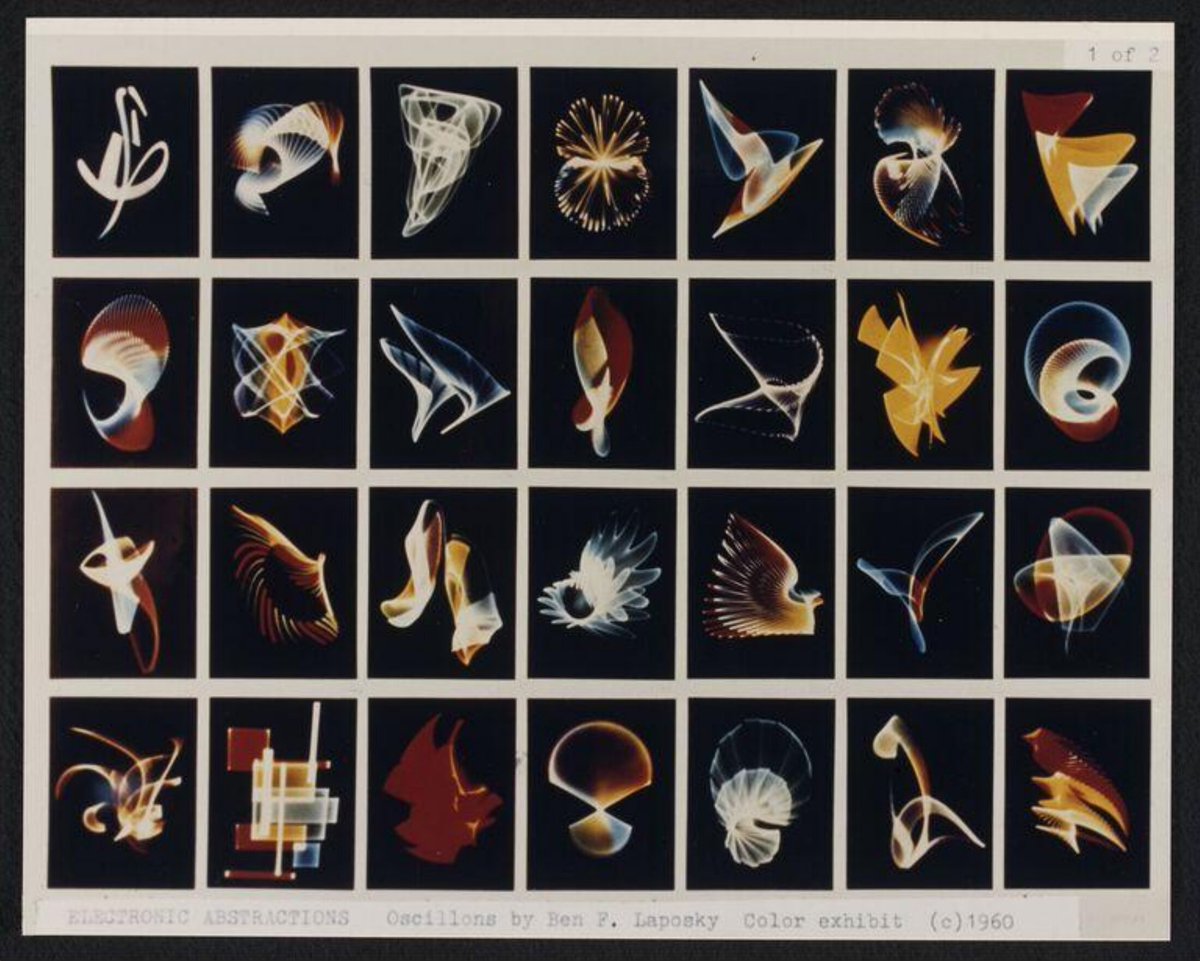
In the 1940s, the earliest computer graphics were generated using analog computers and displayed on oscilloscopes. Among the pioneers of this work were Ben F. Lapofsky and Herbert W. Franke.
#digitalprimitivism#digitalprimitiv#computergraphic
Don P. Miller, Sentinel #1, computer-manipulated image
7 x 9.75 in., 1989
Don P. Miller, Sentinel #2, computer-manipulated image
7 x 9.75 in., 1989
Don P. Miller, Mutation—Cir, computer-manipulated image 11 x 8 in., 1989
#digitalprimitiv