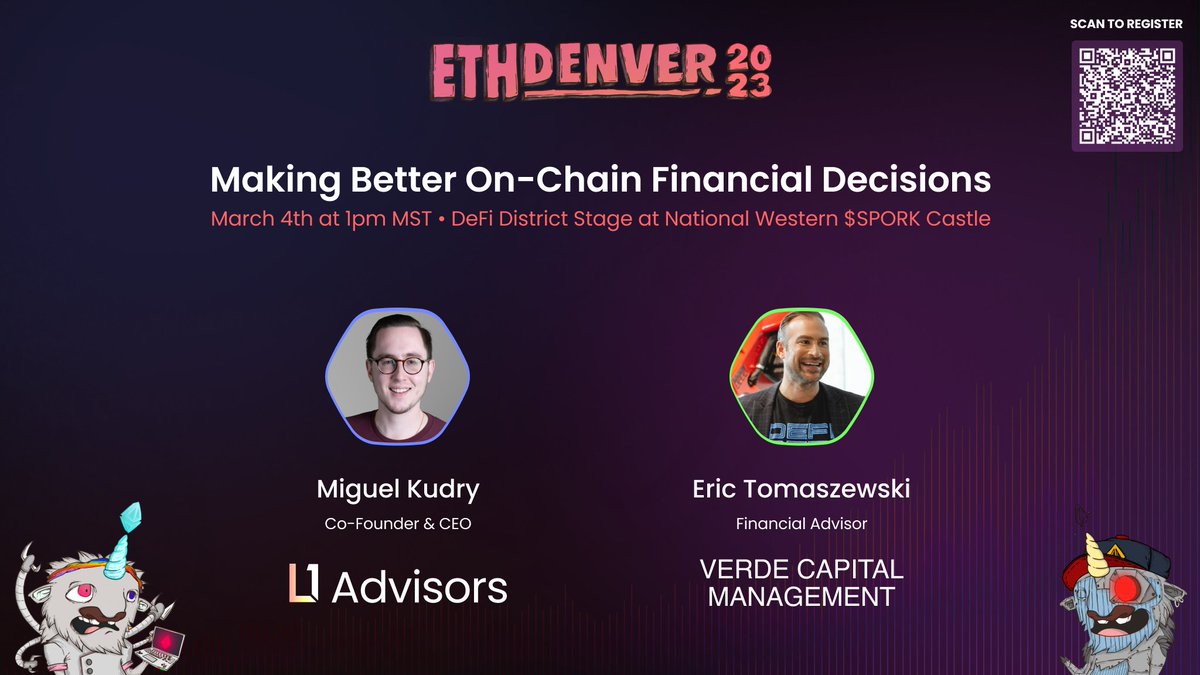
@EthereumDenver, here we come!
Get ready… crypto native advisory services are taking off! 🚀
March 4th at 1pm 🗓️
The 6 key areas of financial planning are being brought to the self sovereign world… be ready for some alpha!
DM’s open to connect while in Denver.
Calling all #bufficorns at @EthereumDenver who want to make better on-chain financial decisions, this talk is for you!
Join @Digitized_Eric and me on March 4th at 1pm MST at the DeFi District Stage at NWS. Scan the QR code to register and add it to your schedule.
1/ Today, more than 140 companies, most of which compete fiercely with one another, agreed to back the same stablecoin. The vehicle is @openstandard, a new and deliberately independent company launching Open USD, or OUSD, and positioning it not as anyone’s product but as neutral infrastructure for payments, trading and the internet economy.
❌ Ethereum is losing to competitors? False.
✅ Ethereum dominates in every major facet of adoption: most liquidity, stablecoins, RWAs, and big names on Wall Street deploying onchain
❌ There's a loss of faith, great devs leaving EF? False.
✅ Devs are starting new orgs to build/scale Ethereum.
❌ Ethereum is facing a funding crisis? False.
✅ There's an abundance of funding thanks to @BitMNR, @Sharplink, HNWI like @ethereumJoseph
So much bullshit floating around out there.
Ethereum is winning.
The @aave drama is about who really owns a "decentralized" bank — and who quietly controls the money, the brand, and the keyboard.
Imagine Aave as a large global bank.
The DAO are the shareholders.
They bought shares (AAVE tokens) and are supposed to vote on strategy, revenues, and ownership.
Aave Labs is management.
They built the infrastructure, run the website, maintain the systems, and execute day-to-day operations.
So far, this is normal.
Now the issue.
The bank’s official website starts generating millions per year in transaction fees.
But instead of flowing into the bank’s treasury (the DAO), the money goes directly to management.
When shareholders ask why, management replies:
"The website isn’t technically the bank. We built it."
That’s the first crack.
Then shareholders realize something worse.
The brand, the name, the logo, the domains, the social accounts — none of it legally belongs to the bank.
It belongs to management.
So you end up with a "decentralized bank" where:
- shareholders provide capital
- the protocol does the work
- but management owns the storefront, the brand, and the revenue tap
The DAO now tries to vote to bring the brand and revenue back under shareholder control.
Management pushes back, warning this looks like a "hostile takeover."
Markets react, tokens get sold, trust gets questioned.
The lesson is brutal but simple:
A "decentralized" bank can be owned by everyone —
while still being controlled by whoever holds the keyboard.
And this isn’t just an Aave problem.
It’s a warning for all DeFi projects that combine protocol + front-end + brand under one team.
If you control the interface or the brand, you control the story — and the cash flow — even if the DAO technically owns the protocol.
Contrast that with @Morpho or @eulerfinance: they are pure primitives.
They don’t control an interface, a brand, or a treasury outside the protocol.
They are market-neutral infrastructure.
No one team can redirect fees or influence perception.
The DAO truly owns the protocol, because there is no "company" running the front-end or hoarding revenues.
Aave’s case is a cautionary tale:
If you build both the protocol and the interface, the line between decentralization and control blurs — and the DAO may be powerless in practice.
DeFi projects should ask themselves: do we want to be a bank with keyboards, or a primitive that truly belongs to its users?
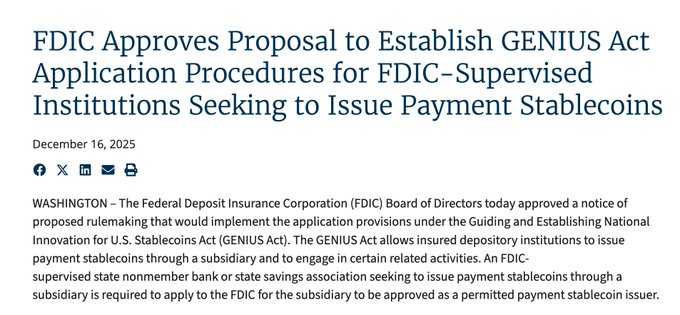
🚨JUST IN: 🇺🇸 FDIC issues first official stablecoin proposal under the GENIUS Act
The proposal allows banks to apply to issue stablecoins directly onto Ethereum! 🚀
No one truly gets the significance of this move… yet.
A tiny amount of global assets are on-chain.
In most cases, it’s a fraction of a percent.
👏 @SECPaulSAtkins
As I told @MariaBartiromo last week, U.S. financial markets are poised to move on-chain. Under my leadership, @SECGov is prioritizing innovation and embracing new technologies to enable this on-chain future, while continuing to protect investors.
The entity that settles $3.7 quadrillion annually just got SEC approval to tokenize on blockchains.
DTCC received a No-Action Letter from the SEC yesterday.
They can now:
Tokenize Russell 1000 stocks
Tokenize US Treasuries (bills, bonds, notes)
Tokenize ETFs tracking major indices
Deploy on "L1 and L2 providers"
Timeline: H2 2026
Their goal: "create a single pool of liquidity across the TradFi and DeFi ecosystems"
DTCC custodies $99 trillion in securities. That pool is now looking for blockchain rails.
Do we have your attention now, doubters?
The SEC has formally closed a confidential Biden-era investigation into Ondo — without any charges.
The inquiry began in 2024, focused on whether Ondo’s tokenization of certain real-world assets complied with federal securities laws as well as whether the ONDO token was a security. The investigation came during a period of aggressive scrutiny of digital-asset firms, when Ondo’s rapid growth in tokenized Treasuries made it one of the earliest and most visible innovators in the category.
Against this backdrop, Ondo never wavered from its core conviction: tokenizing some of the safest and most established assets in global finance, like U.S. Treasuries and publicly listed equities, can be both transformative and compliant.
Yet this outcome is nevertheless an important milestone for the entire tokenization ecosystem. Regulators are shifting from enforcement-first approaches toward frameworks that support modernized market infrastructure. The SEC is openly engaging with industry to unlock the promise of tokenization for U.S. capital markets, global adoption continues to accelerate, and U.S. infrastructure is evolving to support the category, including through Ondo’s acquisition of Oasis Pro Markets.
The path is now clearer than ever for tokenized Treasuries and tokenized equities to become core components of U.S. capital markets. The future of global finance will be onchain, and Ondo will help lead that transition.
So what’s next? On February 3, 2026 in New York, we’ll share the next phase of our roadmap at the Ondo Summit, where we are bringing together leading regulators, policymakers, and executives across traditional finance to lay out our vision for the new era of onchain finance.
Onwards
Skip the cold start.
Launching a new chain usually means starting with zero liquidity. That ends today.
With ZKsync Interop enabled by our Atlas upgade, all ZK Chains can interact natively with @Ethereum DeFi.
This means Enterprises leveraging Prividiums to tap into Ethereum liquidity for the first time, while maintaining their own private environment.
fusaka has finalized 🦓!
huge congrats to everyone who worked on the upgrade, massively expanding Ethereum's capacity and feature set, without compromising on security ❤️🔥
🚨 BREAKING: 🇺🇸 U.S. SEC to review tokenization rules with Coinbase, BlackRock, Galaxy Digital, and Robinhood joining the discussion.
IT'S HAPPENING...!!! #RWA ��
Coinbase Ventures just leaked their 2026 playbook.
They are telling you exactly what they are about to push. Specifically on @base:
- RWA perps (betting on housing > owning housing)
- Ai agents (wallets for bots, not humans)
- Unsecured credit (leverage based on aura/reputation)
The liquidity is coming home to Base. We are not bullish enough.
Five freedoms in crypto:
1) Freedom to control your own money
2) Freedom to move your own money
3) Freedom to invest your own money
4) Freedom to preserve the value of your own money
5) Freedom to raise money