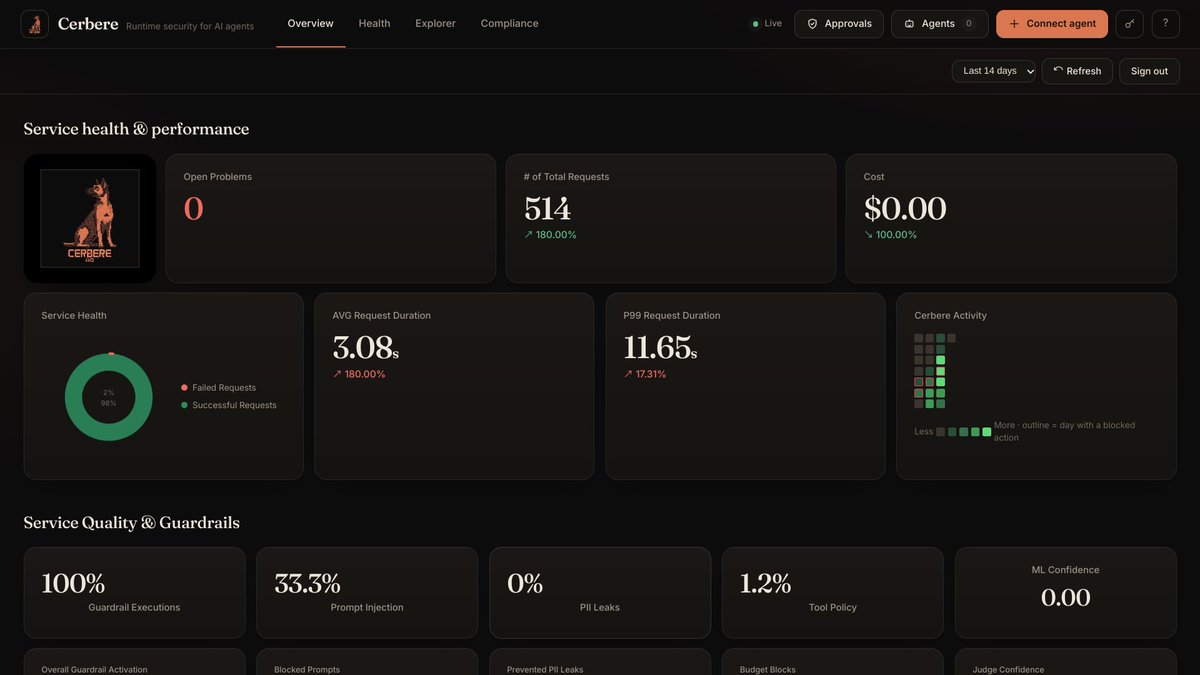
We benchmarked our prompt-injection detector against the OWASP Top 10 for LLM Applications.
Regex alone: 91.5% recall, 0% false positives, sub-2ms latency. Add a ML layer: 98.1% recall — but latency jumps to ~450ms and false positives climb to 33% on adversarial-looking benign prompts.
Full breakdown, reproducible corpus hashes included:
https://t.co/UFm8LHvLVY
Your AI agent can complete the task successfully.
The API returns 200.
The UI shows “Done”.
No exception.
No crash.
And it can still be the worst thing that happened.
Because “successful execution” doesn’t mean “authorized execution”.
The question isn’t only:
“What did the agent return?”
It’s:
“What did the agent actually do?”
That’s the layer I’m building Cerbere-AG for.
Exactly. That’s the problem I’m trying to solve.
The UI shows the result. Cerbere-AG watches what actually happened underneath: the tool calls, data access, actions and sequence — then blocks or flags behavior that crosses the policy boundary.
An agent can look perfectly healthy from the UI while doing something completely different underneath.
When a machine acted up in the early days of computing, you'd just turn it off. But an AI agent doesn't "act up" — it does things that look legitimate while quietly executing an attacker's instructions. By the time you notice, the exfiltration is done.There's no alarm for that. So I built one.CERBERE-AG (@CerbereAg) monitors every prompt and every tool call your agents make, in real time — and blocks the ones that cross the line: data exfiltration, dangerous commands, injected instructions.I resigned as CTO of an AI startup to build this, open source, because the need is urgent.
Build your agents with cerbere-ag now — and become an early tester. We'd be glad to build this with you. Thank you.
https://t.co/SI5UyOErod
https://t.co/PJpYuMZhBv
When a machine acted up in the early days of computing, you'd just turn it off. But an AI agent doesn't "act up" — it does things that look legitimate while quietly executing an attacker's instructions. By the time you notice, the exfiltration is done.There's no alarm for that. So I built one.CERBERE-AG (@CerbereAg) monitors every prompt and every tool call your agents make, in real time — and blocks the ones that cross the line: data exfiltration, dangerous commands, injected instructions.I resigned as CTO of an AI startup to build this, open source, because the need is urgent.
Build your agents with cerbere-ag now — and become an early tester. We'd be glad to build this with you. Thank you.
https://t.co/SI5UyOErod
https://t.co/PJpYuMZhBv
We benchmarked our prompt-injection detector against the OWASP Top 10 for LLM Applications.
Regex alone: 91.5% recall, 0% false positives, sub-2ms latency. Add a ML layer: 98.1% recall — but latency jumps to ~450ms and false positives climb to 33% on adversarial-looking benign prompts.
Full breakdown, reproducible corpus hashes included:
https://t.co/UFm8LHvLVY
Exactly. The real test is the control loop, not just the trace.
For Cerbere, we’re working toward: detect → explain why → block/hold → human override or retry → record the outcome.
The evidence should make the whole decision path auditable, not just show that a tool call happened.
We’re looking for a few early design partners.
If you’re building or deploying AI agents in production — or you’re a startup building agent-based products — I’d like to hear from you.
We’re building Cerbere-AG, a runtime security and observability layer for AI agents.
We’re looking for teams willing to:
→ integrate Cerbere-AG with an agent
→ test it in a real workflow
→ tell us what works and what doesn’t
→ challenge our security controls with real use cases
No polished sales demo. We’re looking for honest technical feedback that can shape the product.
If you’re deploying AI agents and want to participate, reply here or DM me.
@mathiasvrb Exactly. A security layer should have an attack history, not just a feature list.
We want Cerbere to be tested against prompt injection, tool abuse, unauthorized actions, exfiltration paths, and policy bypasses — and to keep the evidence of those tests.
We’re looking for a few early design partners.
If you’re building or deploying AI agents in production — or you’re a startup building agent-based products — I’d like to hear from you.
We’re building Cerbere-AG, a runtime security and observability layer for AI agents.
We’re looking for teams willing to:
→ integrate Cerbere-AG with an agent
→ test it in a real workflow
→ tell us what works and what doesn’t
→ challenge our security controls with real use cases
No polished sales demo. We’re looking for honest technical feedback that can shape the product.
If you’re deploying AI agents and want to participate, reply here or DM me.
We benchmarked cerbereag's (@CerbereAg ) detection engine on 126 adversarial prompts (injection, jailbreak, exfiltration, obfuscation) — regex layer only, no ML/LLM judge yet.
100% precision, 0 false positives on legit prompts. 100% detection on data exfiltration & system prompt extraction attempts. F1: 89.6%.
Early days, but a solid baseline to build on. 🐕