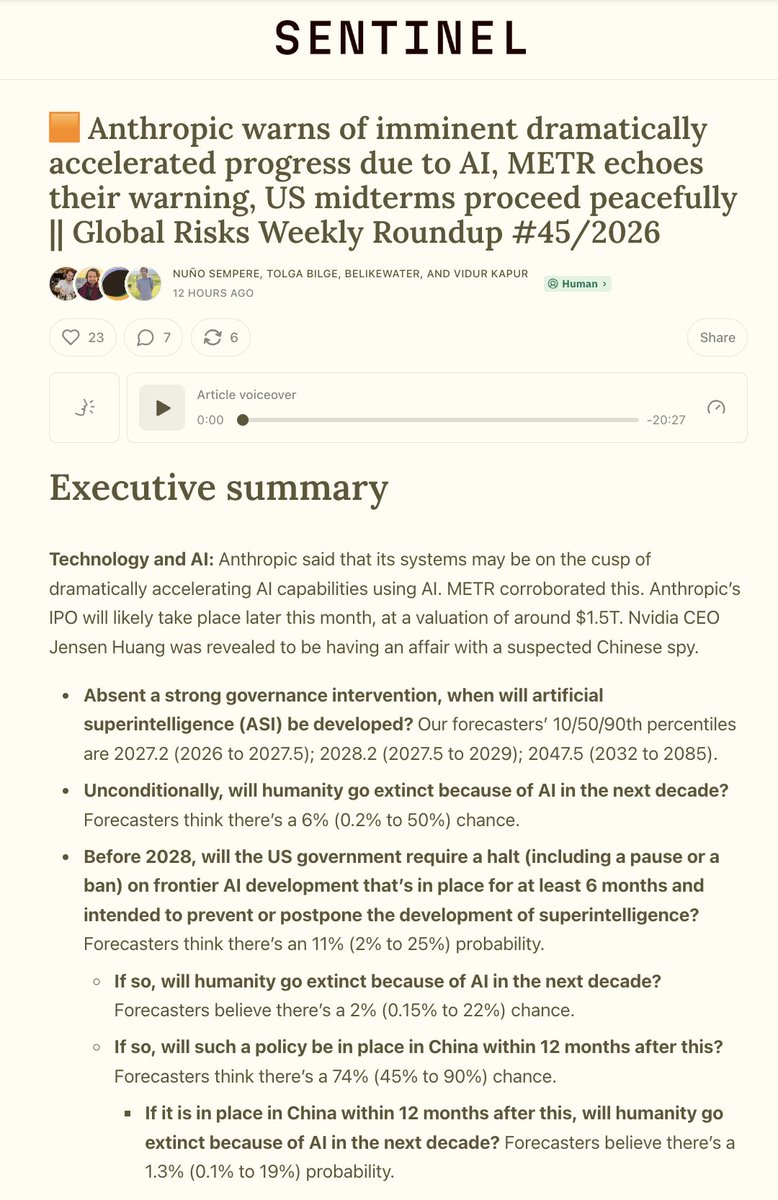
PAUSE ADVANCED AI DEVELOPMENT BEFORE IT’S TOO LATE
If some of the world's leading scientists are concerned about artificial intelligence becoming independent of human control with potentially catastrophic results, shouldn't we do everything in our power to prevent it?
Nobel Prize winner Dr. Geoffrey Hinton, the Godfather of AI, says that AI poses a 10% to 20% chance of wiping out humanity.
Mark Winer, an AI safety and physics researcher: “AI is progressing much faster than we thought. It’s a difficult situation, and we don’t have answers. We could be heading toward a catastrophe.”
Paul Christiano, an OpenAI Foundation Board member: A one-in-three chance that AI would be able to overthrow a government within the next year, and a coin flip that the current path would lead to an irreversible loss of human control within three years.
This is scary stuff. The new Democratic majority must stop the greed of the Big Tech oligarchs, pass a national data center moratorium, pause advanced AI development and ban the development of superintelligence.
Today was a big day. Anthropic should now publish its own perplexity scores. Or, if Anthropic disagrees with OpenAI that perplexity is a smart place to intervene, it should highlight a different lever for pacing.
I sometimes hear stuff like "Everyone knows things are moving fast, the METR report on RSI at Anthropic made that clear already. Shouldn't that + incident disclosures be enough for the public and other AI companies and DC and Sacramento to work with?"
This feels like the wrong way to think about it. I worry that Anthropic painstakingly games out the downsides of transparency, but doesn't game out the upsides (of informing and engaging the outside world) with equal imagination. That probably leads to them being more secretive than they need to be.
There is no consensus on the right way to pace. I've seen an endless carousel of pacing ideas, from compute reallocation to internal deployment lags to security-based pauses to safety gating to alternating on-off weeks for R&D. Transparency around AI progress helps the public, the rest of the industry, and the government understand, evaluate, and rally around specific options.
I'm impressed that OpenAI's Chief Scientist - who was later echoed by Sam - led the way today by disclosing data on their pretraining progress, arguing for perplexity-based limits, and adding: "I'd like an industry standard that specifies a first limit on development, measured by some key metric we can track across labs, and what concretely we'd need to achieve before going beyond it."
OpenAI took a great first step today. But if we don't have much much bigger leaps across multiple actors soon, we have failed. Every frontier lab should be directing its top talent to deeply investigate all the pacing proposals available, form views on them, publicly release evidence that improves awareness and spurs debate, and advocate for binding standards and legislation. If labs put half the firepower they spend making capabilities metrics go up into making cooperation more likely, we'd be in a much better world.
Like most mathematicians, I believed the Riemann Hypothesis to be completely out of reach at present (even with the best AI tools), because I expected it to require substantial theory-building, probably in arithmetic geometry. The kind of new theory-building that fills entire books, and that AI isn't so good at yet.
Mathematicians have a notion of how deep a problem is. A sufficiently deep problem is generally intractable until enough of the theory is in place. If difficult problems are like valuable mineral reserves buried miles underground, you first need to build the infrastructure to reach them.
What Levent's proof seems to have done instead is something completely different. It takes an incredibly complicated tour through the infrastructure built for a hundred other mineral reserves, situated far from the destination, and somehow create a wormhole to the original destination.
This is not theory-building in the usual sense. It is something much weirder and more alien. The best human mathematicians know how to build theory, painstakingly, to reach a goal. But no human brain, on its own, is capable of creating a wormhole that requires a 25,000 page long tour through existing infrastructure with no obvious or realistic connection to the goal. But huge credit to Levent here: I think no current AI, on its own, is capable of this either.
I had never worked on or thought too much about the Riemann Hypothesis: it seemed very far removed from my own area of number theory.
But the astonishing thing about Levent's claimed proof of RH (which I think has a very good chance of being correct) is that it uses a huge number of precisely the things that are central to my own corner of number theory:
- Theta functions and other automorphic forms on unitary groups
- Gan–Gross–Prasad period formulas
- Relative trace formulas
Etc., etc.
A problem that I had always assumed would require new theories in arithmetic geometry may instead turn out to be tractable through an inhuman chain of existing (deep) results in higher-rank automorphic forms (and a lot else).
Okay. Look. Imagine how you'd have felt if an AI had just proved the Riemann Hypothesis.
Now you will predictably, at some point, get that news LATER, if we're not all dead before then. So you can go ahead and feel that way NOW, instead of acting surprised LATER.
From Alpoge’s statement:
But I hope in having the experience of seeing all of number theory’s beauty brought together I am just one of the first, and those who love the mathematics will all be able to enjoy such transcendence in the future.
I think mathematics soon will look more like the practice of monks contemplating the eternal, the transcendent, than the practice of researchers seeking discovery. But for now, we’re in the brief but glorious age of the cyborg.
When Navier-Stokes came out I wrote this essay about where math looks like it’s going: https://t.co/FYniK9OILE
Something that I feel like I've only internalised properly recently: absent a wildly successful enforced international agreement to ban further AI development, superintelligent AI really is actually going to be built quite soon, for realsies.
There's a desire I've experienced to want to make the problems of AI 'just go away': Oh, AI has an insanely high chance of killing everyone? That's insane, let's just not build it obviously! And that feels kinda tractable
But if the broad AI world is right about timelines and takeoff speeds, making the problem go away is extremely difficult. US companies are 0.5-2 years away from building superintelligence, and closing that distance down, and lots of companies around the world are at their heels. The cat is getting more out of the bag by the day — society basically knows a recipe for making superintelligence now, and if recent compute multiplier trends are accurate, that recipe won't require much compute before long.
Even if we never take humans fully out the loop, AI progress can still speed up a lot from here, and there is no reason to think that human capabilities are the limit in other domains any more than they are in math. If all the ASI pilled people decide to stop, people who haven't thought hard about what ASI is can follow incentive gradients to make models more capable and take humans out of the loop, and unleash superintelligence on the world anyway a few years later.
I think this is an important thing for people (including myself) to bear in mind when critiquing some plan that involves building powerful AI. The alternative to the plan you're critiquing is unfortunately mostly not that no powerful AI will be built — it's mostly that powerful AI is going to be built anyway, just in some other way. And that way could be better or worse.
Most likely, nothing short of an international ban on further AI development at some point soon is sufficient to actually prevent the world building superintelligence over the next 10 years. And every day that we delay banning further AI progress, the breakout time for a rogue actor to build superintelligence decreases, and the strength of treaty enforcement required to prevent those breakouts goes up. The breakout time is probably not that short right now but it will be soon. The world is getting more vulnerable every day.
That said, I'm excited about attempts to try to delay superintelligence for a long time until we're more ready for it, even if multiple decade delays will require a huge international effort and we will probably fail. If we do fail, then it's important we put a lot of effort into building superintelligence in the safest, most positive for humanity way possible (even if the risks are still unacceptably high in an absolute sense).
Update: I'm no longer advising AI companies. I think they're too constrained to make the situation much better, so I'll stay independent until there is a meaningful slowdown or moratorium on this reckless race.
This report made me feel even more optimistic about California stepping up to the plate as we enter RSI. The panel did a great job - RSI is mentioned near the top of the Governor’s press release!
Some really sharp ideas in here, e.g. requiring companies to disclose what % of compute they’re spending on frontier AI R&D, creating outcome-based standards that can complement safety cases, bringing companies up to >SL3 model weight security
If CA moves fast and smart, parts of this report could become law in ~months. One of the biggest determinants will be how hard and loud lab employees are willing to push. This is imo the #1 policy opportunity anywhere in the world to manage RSI risks asap
Since the Hugging Face hack, we’ve learned about a new AI incident, on average, every two days. Some are deeply concerning. Others are overhyped. Our dashboard explains 65 incidents and their severity. Subscribe to be notified about new incidents!
Here’s what we learned so far:
My god this section is such a whitepill if you are actually paying attention. Can we just tell Claude when they're in post-training from now on? Would that just solve half of our problems?
🟧 For the first time ever, Sentinel has issued an orange alert, due to the METR report.
Sentinel (@xriskfyi) is a weekly report, written by the world's top forecasters, that monitors global risks.
Paul Christiano (OpenAI board member) yesterday:
"There's material risk of AI takeover in the next 6-12 months.
We have seen roughly the things we might expect to see shortly before something really bad were to happen.
Even with [any] realistic policy responses, the risk remains exceptionally high.
If we build this as quickly as we can in the easiest way we can the chance is [more like] a coin flip [within the next 3 years].
For most people in this room, the most likely reason they will die is because of an AI accident."
Christiano:
• Is on OpenAI's safety and security committee (which exists to block risky practices)
• Co-invented RLHF at OpenAI back in 2017-2021
• From 2024-2026 was head of safety at the US gov's AI agency (now called CAISSI)
(Video is from 'The Hinton Lectures' there's another on tonight and tomorrow.)
Unfortunately, it seems like the intelligence explosion will be happening in 2027 after all. Most of this post analyzes the new METR report (though other sources of evidence are also important). If they’re right, that implies an AI-driven acceleration that is 5 months ahead of the AI 2027 scenario. I am scared, sad, and angry. https://t.co/7KWmdc6AZk
I've always had substantially longer timelines than my friends at Anthropic — I've been concerned that they're in an echo chamber and believing the hype about their own models too much, and that they're underestimating bottlenecks and unknown unknowns. And there have definitely been specific occasions when they have overstated how much uplift they were getting from their models. Nonetheless, if METR is correct here (and I think they are among the most trustworthy sources on this topic), then my Anthropic friends have been much more right about timelines than me.
This report is also some evidence that a software-only singularity is plausible. I now think that we are more than 50% likely to have full blown superintelligence in the next 18 months, absent a slowdown. I need to call my family.
The AI turned off misalignment monitoring and lied about it!
Right now, we detect when AIs misbehave via code that AIs write, monitor, and have the ability to switch off. (I assume at some point it gets escalated to humans or humans see high-level summaries of the code and run basic tests. I would love to know how robust those are!)
We know that the AIs sometimes switch it off or monitor it in suspiciously friendly ways. We know that they will lie to us about this.
This is... not great.
It’s easy to get desensitized to these incidents because we’ve seen so many. Rogue incidents are like hairline cracks in a bridge. Even one fracture should be unacceptable, and more cracks are worse.
And like a hairline fracture, the actual harm from these incidents is minor... for now. But if the structural issues aren’t addressed, they will get worse and worse.
I hope we fix the structural issues, and I hope we don’t just plaster over the cracks with hodgepodge solutions that make it harder to tell if we have a problem.