@_annakulina Your site at https://t.co/yzWramfxdM looks great!
But I did notice one small thing: the most images larger than 3 MB, which is quite heavy. It might cause some lag for users on slower connections. If you crop and compress it (or convert it to WebP), it’ll load much faster!
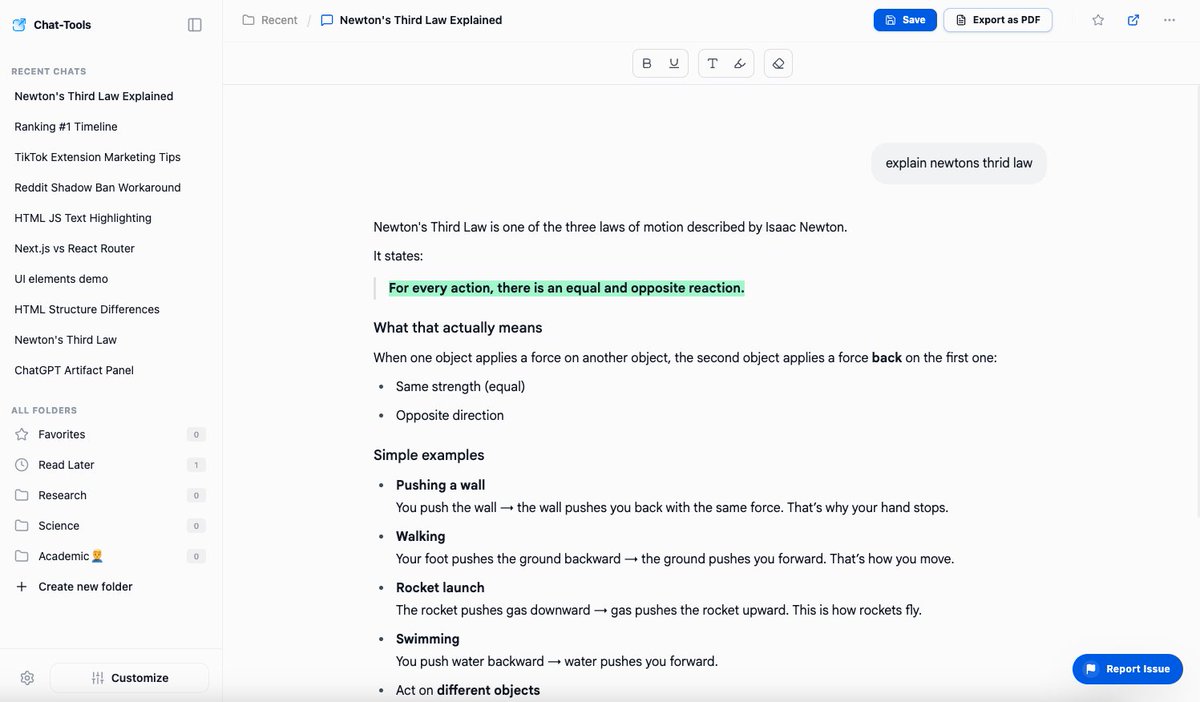
❤️ Thanks to @ChatGPTapp for keeping chats flat and simple, without adding over-engineered side panels even for normal chats.
For canvas mode, it’s fine to have both side panel and inline into main chat.
But for all others, those separate panels are really annoying.😖
7 minutes after you finish studying, your brain quietly runs a file-transfer process. Columbia scientists caught it on a brain scan, and repetition is what speeds it up.
In the study, 29 people went into an fMRI machine and saw flashcards pairing words with pictures. Some flashcards appeared once. Others appeared three times. After the flashcards, participants closed their eyes and rested for 7 minutes, still in the scanner, while the researchers watched what their brains did next.
The hippocampus (a seahorse-shaped chunk deep in your brain that handles new memories) replayed the flashcards at the same rate whether people had seen them once or three times. The scan showed no difference between the groups in that region.
Three other brain regions went the other way. All three belong to your brain's long-term storage network, the system that keeps memories around for years. Those regions replayed the repeated flashcards way more than the once-seen ones. One of them also started firing in sync with the hippocampus more often when replaying the repeated cards, like two colleagues confirming a file had been saved.
Textbooks describe memories moving from the hippocampus to long-term storage as a slow process, one that takes weeks, months, or sometimes years. This study caught that process starting within the first 7 minutes after closing your eyes, with repetition speeding it up dramatically.
When a flashcard had been shown three times, the long-term storage regions replayed the most recent viewing. Your brain treats each repetition as an update.
The hippocampus was doing its own kind of work. For the flashcards people saw only once, the more the hippocampus replayed them during that 7-minute rest, the more likely people were to remember them on the test afterward. The hippocampus was picking up the slack for the weaker memories, while the long-term regions took over the stronger ones.
The paper was edited by Robert Bjork at UCLA, the guy who coined "desirable difficulties," the idea that when learning feels harder in the moment, the memory tends to stick longer. This study adds a mechanism. Repetition works by moving a memory, fast, in the minutes right after you stop looking at the thing.
I paused all marketing to grow faster.
Sounds crazy, but hear me out:
I was adding $100 MRR every week. Nice and steady.
At that pace: $3.6K MRR by year end.
Not good enough.
So I stopped chasing traffic and rebuilt the offer instead.
First week after relaunch: $1K in new revenue.
That's 10 weeks of growth in 7 days.
Sometimes the bottleneck isn't distribution.
It's what you're distributing.
Repetition changes your brain.
Repetition changes your brain.
Repetition changes your brain.
Repetition changes your brain.
Repetition changes your brain.
Repetition changes your brain.
Repetition changes your brain.
That’s why it works.