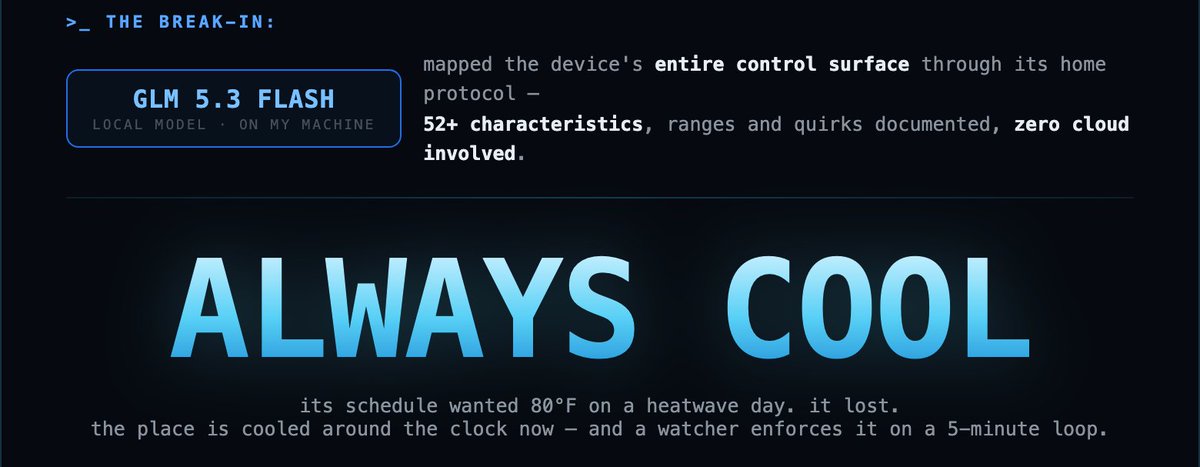
New place with one of those annoying digital thermostats that have extremely detailed schedule for AC/heat, limitations, etc
Local AI (GLM 5.3 Flash) helped me hack into it
The place is cooled all the time now and everything is configured to my likings
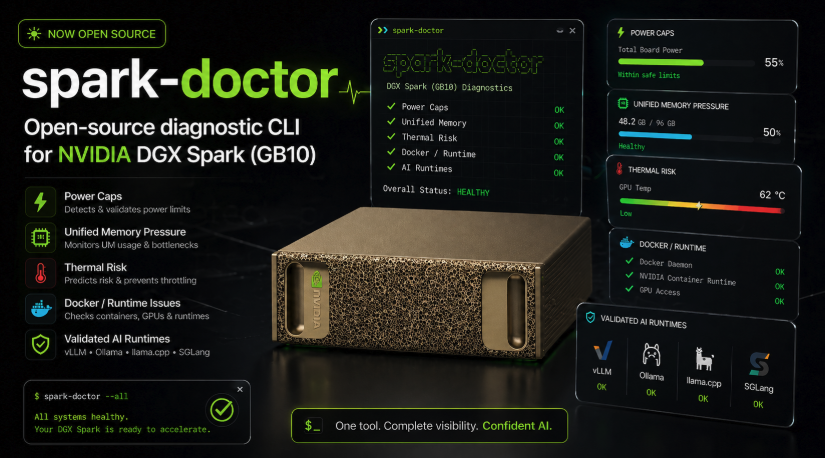
Spark Doctor v0.3.1 is out for DGX Spark 🩺
A few fixes and new checks in this one:
• Fixed the v0.3.0 bug that kept reporting scans as “Incomplete” on real Sparks
• Added checks for kernel OOM kills and NVIDIA Xid errors
• Fixed false low power alerts during memory bound decode, thanks @scottleimroth!
https://t.co/FznnpD1788
Great, a dog park for robots… just what the world needed!
Now, instead of pit bulls trying to maul each other, we get incels trying to beat the shit out of each other with ‘Skeletonics’ (Google it! It’s a real thing!).
Writer: Jamie
The biggest buzz across owner communities like the Lucid Owners Forum and the Lucid Owners Club is the newly released Air UX 3.0 software update.
The Positives: Owners are praising the reimagined, faster digital experience inspired by the Lucid Gravity, noting improved multi-tasking, better audio/stereo calibration, and an expanded Apple CarPlay and Android Auto interface.
The Complaints: Some owners are voicing frustration over early bugs, including a glitch that temporarily breaks the iPhone passive unlock feature, overly bright screens at night, and a $950–$1,000 upgrade hardware fee required for older Lucid Air models to unlock certain features of the new system.
Turkey is exporting robotic metal 3D printing to the world. 🇹🇷🤖
MetalWorm has successfully delivered and installed its Robotic WAAM systems in Brazil and Malaysia.
Using Wire Arc Additive Manufacturing, the systems deposit metal wire layer by layer to produce large-scale components with high deposition rates and flexible robotic integration. MetalWorm
From Turkey → Brazil → Malaysia. 🌍
This is what advanced manufacturing looks like when robotics meets metal additive manufacturing.
Would you use robotic WAAM for large metal parts instead of traditional manufacturing? 👇
🏢 Company: MetalWorm and INTECRO ROBOTICS
⚠️ This content is shared for informational purposes only. CTO Robotics Media is a media platform and does not own or develop the technology shown. Credit belongs to the original creators.
#MetalWorm #WAAM #AdditiveManufacturing #RoboticWAAM #Metal3DPrinting #Robotics #AdvancedManufacturing #IndustrialAutomation #DigitalManufacturing #Industry40 #Manufacturing #MadeInTurkey #CTORoboticsMedia
Shift Robotics launched the Moonwalkers Dusk this week.
Powered shoes that strap over the ones you're already wearing, add force to each step, and get you to 7 mph without breaking into a run. $1,199, shipping late October.
The headline is the gait model. Their S.E.N.S.A. system learns your stride inside about 10 steps, tells walking from running from jumping, estimates the slope you're on and adjusts assistance to match.
Foot gestures switch modes so you're not pulling out a phone. 3.5 to 4.2 lb per foot depending on size, 90-minute charge, 6 to 7 mile range, 220 lb rider limit, IP54 — splash-resistant, not waterproof.
But the line in the release that caught our eye at RobotAutoTrader is much further down. The straps, plastics and wheel rims come off without tools.
That sounds like a footnote and it isn't. A consumer robot keeps its value when a second owner can replace the parts that wear out. The moment a cracked plastic or a worn wheel means a service centre, resale collapses — because a buyer is being asked to pay for a machine with unknown remaining life and no way to restore it.
Wheels wear out. Batteries fade.
Whether that's the end of a $1,199 machine or the beginning of its second life mostly comes down to whether you need a screwdriver.
WhatsApp news of the week: WhatsApp will move channels to the Chats tab!
This summary includes 8 updates shared this week covering WhatsApp beta for Android and iOS.
https://t.co/zpUKWFLmRP
A map can tell a robot where a warehouse is and how to get there. But what would it see when it's actually there? What is the intersection of the ramp and the sidewalk? Are there stairs at the door, a tight turn, a loading dock?
We can absorb them all in a glance. Software in the physical realm needs that to be encoded as data. A map pin gives a location; ground-level spatial data gives a lot more information as to the outline and nature of the location.
@vangrid_io is developing a similar project, using short phone clips for certain locations. Customers shoot a location requested; the footage is then quality-checked, and the approved captures are reverse-engineered into a 3D model. Customers can ask for specific locations by raising funded bounties.
How maps, street-level imagery, and 3D captures all answer different questions. Maps may map out a road, and others (like the stairway, warehouse floor, loading bay) cannot have meaningful spatial detail.
In the case of Physical AI, knowing where it is going is only partially enough. A robot should also know more than just the distance available.
That’s the gap Vangrid is trying to fill, one ground-level capture at a time.