"As an #EU and #NATO member, #Bulgaria 🇧🇬 must balance economic opportunities with #China 🇨🇳 against risks to national security, Western alliances, the rule of law, and democracy."
More on this in my & A. Metodieva's analysis:
https://t.co/fL1CIUZJFh
@gmfus@GMF_ECE
🤝 Romania, Moldova, and Bulgaria have a unique opportunity to deepen cooperation on security, infrastructure resilience, democratic institutions, and regional connectivity. New analysis from GMF’s Dimitar Keranov highlights why this moment matters.
🔗 https://t.co/CLWp5tNvyt
🇧🇬 GMF's Dimitar Keranov spoke with The Guardian about what Bulgarian Prime Minister Radev's first months in office signal for the country's position in Europe.
“If he is given enough time...we could expect him consolidating his power more and more, blocking some reforms that are not really in his interest, or even turning this pro-Russian rhetoric into even more pro-Russian policy in practice. We need to be aware that, right now, he’s also just testing the ground.”
🔗 Read here: https://t.co/Rc4xeDQwKD
🇪🇺 “It will delay things because the moment you start implementing or introducing some new processes it will be full of uncertainties . . . every new reform will need to first be tested.”
GMF's Dimitar Keranov spoke to @FT about the EU's debate over gradual integration proposals for candidate countries.
🔗 Read the piece by @HenryJFoy and @mdunai: https://t.co/FOXLD7x7MD
✔️The Resilience Podcast Series explores how CSOs stay resilient in challenging environments, covering digital security, fundraising, communication, psychological resilience, and shrinking civic space in Central & Eastern Europe.
✔️Episodes in 🇬🇧🇸🇰🇭🇺
https://t.co/KvREpiB3To
📚 Ready to strengthen your organization's resilience?
Explore free learning resources on digital security.
Available in 🇬🇧🇭🇺🇸🇰
Start Learning | https://t.co/N0m33gJ6OF
Interesting read by @dimker89 for @gmfus. #Bulgaria’s relations with #Albania and #Kosovo are unusual in the Balkans. They are not burdened by territorial disputes, competing historical claims or a legacy of bilateral conflict. This gives Sofia, Tirana and Pristina political space for cooperation that is rare in the region.
https://t.co/XbrIbv2RZP
🇬🇧New episode out now: @dimker89 speaks with Bilyana Wegertseder about civil society resilience in 🇧🇬 #Bulgaria - covering civic pressures, digital vulnerabilities, trust networks, and what organizations need to stay resilient.
🔊Listen here: https://t.co/lqkxH5D2p9
🔐 Your digital security journey starts here!
From strong passwords to spotting online threats, this introduction to digital security helps CSOs build safer habits in a complex digital world.
Explore Chapter 1: https://t.co/JK7VFq5lOS
New resource for civil society📙
🔍https://t.co/N0m33gJ6OF offers free, self-paced digital security training for activists, journalists, CSOs.
📝Learn practical ways to secure accounts, communications, devices, & response plans.
Available in 🇬🇧 🇸🇰 🇭🇺
https://t.co/XNbVyY7S8x
"Without dismantling the influence networks from the Communist era, you could not expect the democratic quality to be very high."
GMF expert Dimitar Keranov spoke to the @nytimes on Bulgaria's struggle to break free from the legacy of its Communist-era intelligence apparatus.
🔗 Read the article: https://t.co/RUy6aUproj
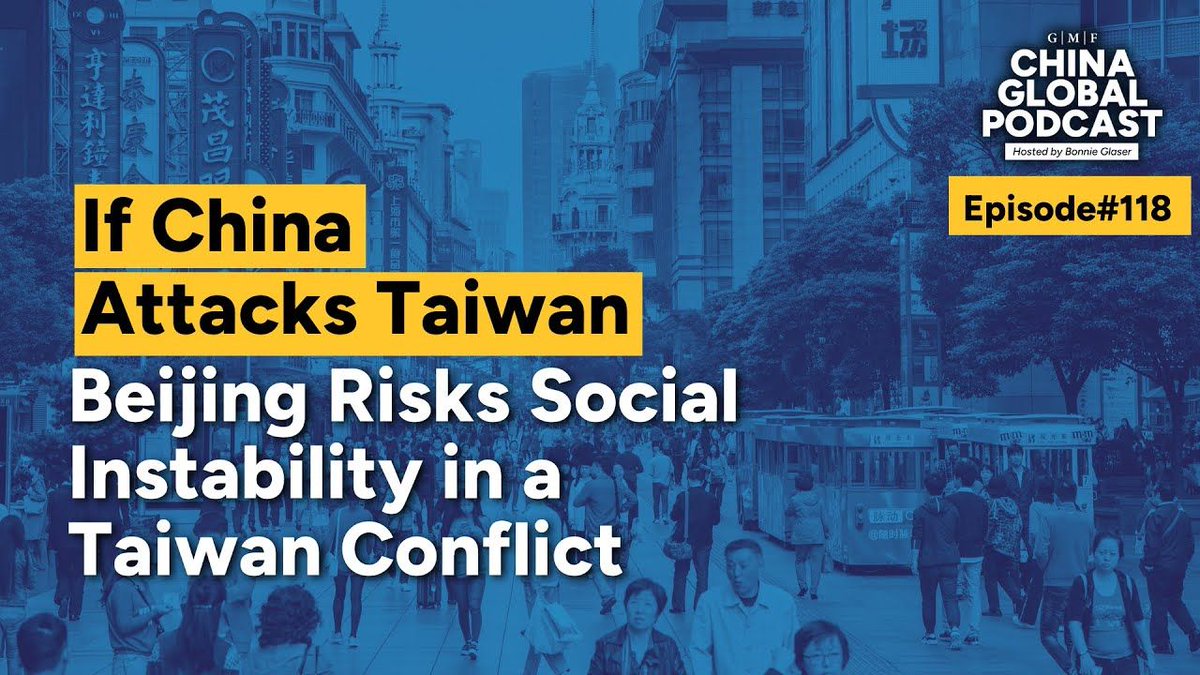
🇨🇳 New China Global Podcast episode is out!
This is part 2 of a 3-part series that examines the potential consequences for China if a military operation against Taiwan were to fail.
In each episode, @BonnieGlaser speaks with authors of a recently published GMF study looking at how a failed operation could impact China’s economy, military, social stability, and its global standing.
Joining Bonnie this week are associate professor at the University of Texas at Austin, @SheenaGreitens, and associate political scientist at the RAND Corporation, Jake Rinaldi, to discuss potential costs for China’s domestic social stability.
🎧️ Listen: https://t.co/4YxsdBkaWi
📣 GMF is pleased to welcome Beniamino Irdi as a nonresident senior fellow on the Global Power Shifts team.
His areas of expertise include the geopolitics of the Mediterranean, great-power competition, democratic resilience, and hybrid threats.
He is the founder and chief executive officer of HighGround, a political-risk consulting firm based in Italy. Beniamino previously spent 17 years in the Italian government, focused on foreign policy, national security, and strategic affairs.
More info: https://t.co/6IHQIbvSMa
“Much of that resistance appears to come from fears that inflation will increase as merchants round prices up during the changeover. Those fears are not so much about the euro but about general economic worries and skepticism about officialdom”, GMF’s Dimitar Keranov told @AP.
As Bulgaria debates joining the euro, fears over inflation and distrust in institutions — amplified by disinformation — are shaping public resistance.
➡️ Read the full article: https://t.co/cKJwuBWC1V
Mass protests in Bulgaria have triggered the resignation of Prime Minister Rosen Zhelyazkov after less than a year in office.
GMF’s Dimitar Keranov told The New York Times: “The protests may have started because of the budget, but actually it’s about where there is corruption in the government, which ultimately serves the public interest,” noting that many Bulgarians believe corruption is “being perpetuated by politicians who favor alignment with Russia.”
➡️ Read the article: https://t.co/FIo2lTr884
Russia’s full-scale invasion of Ukraine has pushed the Black Sea region to the forefront of Europe’s security concerns.
In their latest analysis, GMF’s Laurențiu Pleșca and Etienne Soula examine the hybrid threats and election undermining democratic resilience in Armenia, Georgia, Moldova, and Romania, and argue that Europe must treat support for civil society as a core security strategy in the region.
🔗 https://t.co/nWHnjYr0Qu
That’s a wrap on 2025!
This year GMF:
✨ Advanced ideas that shaped the transatlantic debate from security to trade
📊 Informed policymaking at the highest levels
🌍 Empowered the next generation of transatlantic leaders
🏙️ Partnered with Ukrainian cities to support sustainable and inclusive recovery
🤝 Convened conversations that mattered the most and brought transatlantic insights into the world
Thank you for being a part of GMF in 2025!
Explore some of this year's highlights in the GMF year in review, and help make next year's work possible:
📈 In the special edition roundup of the competitiveness check, GMF experts examine how recent strategic and legal decisions are shaping transatlantic alignment as well as the top five trade-related developments.
➡️ Read the full roundup here: https://t.co/m3Oa8DxJmf
🇩🇪 “Merz’s government has still been unable to chart a course for economic reform and persuade voters that better days lie ahead. Merz’s bold moves on defense spending have confirmed Germany’s leadership role in Europe, but at a cost to his domestic popularity.”
In their Foreign Affairs op-ed, GMF’s @SudhaDavidWilp, together with CFR's @LianaFix, examine the German Chancellor's debt-financed push on defense and economic reform—and the domestic political challenges it has created for Germany’s leadership in Europe.
📗 Read the piece: https://t.co/o9qLmogTjb