4th year Physics PhD Student @Stanford @SLAClab - analyzing collision data from the LHC @CERN with the @ATLASexperiment and working on future e+e- colliders.
🚀 The latest issue of ILC NewsLine is out!
This edition features a special report on the recent Linear Collider Vision Community Event at CERN. Stay updated with the latest news and insights! 📩✨
https://t.co/uwVwG4z2Fu
#LCvision#ILCNewsLine
A lucky day for physics at the #LHC 🍀
Earlier today, the Large Hadron Collider reached an integrated luminosity of 100 inverse femtobarns – equivalent to ten million billion collisions – delivered to the @ATLASexperiment and the @CMSExperiment in 2024, with 28 days of proton–proton collisions to go. This is a first-time achievement in a single run of the #LHC.
Luminosity is an important indicator of the performance of an accelerator: it is proportional to the number of collisions that occur in a certain amount of time. The higher the luminosity, the more data the experiments can gather for #physics research.
Do you remember why there is no data referring to the period from 2018 to 2022? Here’s a hint: #LHCRun3
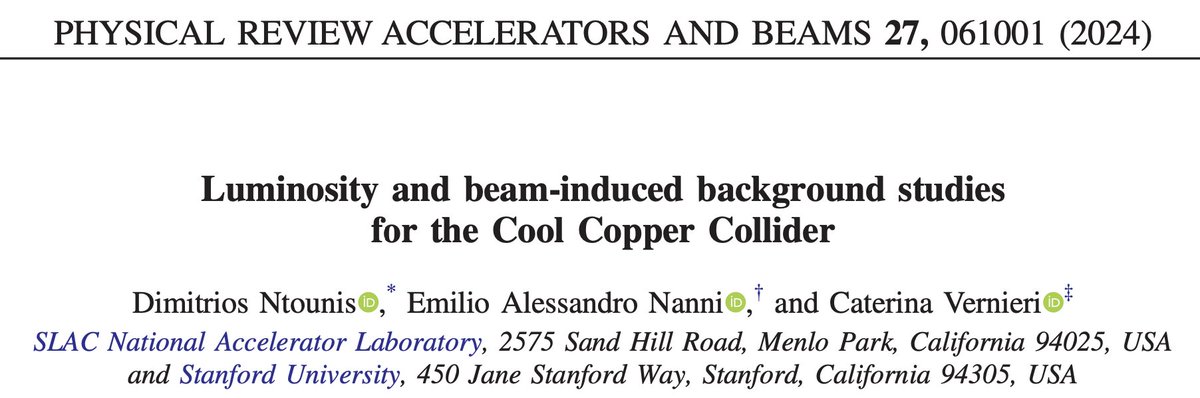
9/ 📜 Dive into the full paper for the detailed analysis, simulation results, and full comparison. Thanks to @Stanford@SLAClab@ENERGY@doescience for supporting this work!
https://t.co/q1OGJFUPT9
5/ 📊 We use simulations to optimize the beam parameters for C3, enhancing luminosity without increasing the background. We propose a new parameter set, achieving around 40% higher luminosity compared to the baseline scenario while maintaining similar background levels.
8/ 🤝 More detailed accelerator & detector studies are necessary to fully evaluate the feasibility of C3 but this work is already an important step towards realizing the next generation of particle colliders. We all need to work together to achieve this!
4/ 🎇 Beamstrahlung, radiation from the intense beam focusing, is a key consideration. We found C3’s beamstrahlung parameters comparable to other colliders, ensuring the effective performance of the detectors without excessive background.
3/ 🔍 Key parameters for C3 include beam sizes focused down to the nanometer size to achieve target luminosities. We discuss how beam-beam interactions impact the achievable instantaneous luminosity and the creation of background particles.
2/ 🌟 Why C3? High luminosity is key for precision studies of the Higgs boson and other fundamental particles. We show that C3 can achieve collision rates comparable to other proposals but with more manageable beam-induced background fluxes. #HiggsBoson#HiggsFactory
From the Editors: A Daily reporter was falsely imprisoned on $20,000 bail, violating his rights as a reporter. His arrest constitutes a threat to the freedom of the press, and we are disappointed in the actions of officers and the University. https://t.co/0hZwcadpaf
#DidYouKnow that there are 6 kinds of quarks? They're up, down, charm, strange, top, and bottom. Quarks and gluons are the building blocks of protons and neutrons. Learn about @ENERGY's research on quarks @BrookhavenLab, @JLab_News, @SLAClab & @Fermilab: https://t.co/TY9LQ9ANHI
📈More than #OpenData, CMS continues to move towards #OpenScience 💪
🎉The statistical analysis tool used to find the #Higgs boson, along with the full statistical model and the data used to make the measurements are now available to all! 🎉
▶️ https://t.co/61zkFCH0bH... @CERN