I wrote up how the ladder works — gating url() twice, holding the blur constant across tiers so upgrades are invisible, and why the geometric lens is for small chrome only:
https://t.co/PVGNngCHkL
Liquid glass is one CSS filter away — and one browser away from breaking: Firefox parses url() in backdrop-filter as valid, then renders nothing. Your glass panel becomes a transparent hole.
So: don't ship one glass. Ship a ladder — blur → noise warp → lens:
I wrote up how it works — what a UI "physics" actually is, why motion timing belongs to the material (retro animates in steps(2)), and why glass refuses light mode:
https://t.co/qYJCrrGCD1
A theme switcher changes your colors. It doesn't change what your UI is made of.
Theming can run on a third axis — physics. Glass, flat, retro: same HTML, same components, different material. Watch the light, radius, and motion change:
Switched from Opus to Fable recently. Hard to explain the difference but easy to feel it: Fable is colder, more surgical. Goes straight at the problem, and I barely clean up after it.
Opus reads like a colleague wrote it. Fable reads like a machine solved it.
"Just use React" is the safe answer. I didn't take it.
The honest tradeoff of picking Svelte + Astro in 2026 — including the part that genuinely costs me.
https://t.co/EzVEWNz5jX
The browser ships a modal, a dropdown, and an accordion — accessible and free.
I stopped fighting the browser. Less code, fewer a11y bugs. Here's what I learned going native-first: https://t.co/BGOsIpGp4c
Native elements used to win on accessibility. Now they win on agent compatibility.
LLMs navigate the web through the accessibility tree. <select> reads as a combobox with 5 options. <div role="button"> maze reads as nothing.
Native scales. Custom doesn't.
Every valuable custom UI pattern eventually becomes native.
<dialog>. Popover API. Customizable <select>. View Transitions. CSS anchor positioning. All shipped this decade. All were custom components first.
Wrap the platform, don't replace it. The ceiling only ever goes up.
My coding workflow is basically locking two AIs in a room to argue until the software is perfect.
🎨 Claude: Vision & UI
⚙️ Codex: Heavy logic & stability
One drafts the architecture, the other ruthlessly critiques it.
They debate. I deploy.
Codex is for demos. Claude is for builders.
I asked Codex to 'perfect' my docs and it deleted 85% of the codebase's intelligence.
The difference between 'token prediction' and 'reasoning' in one screenshot.
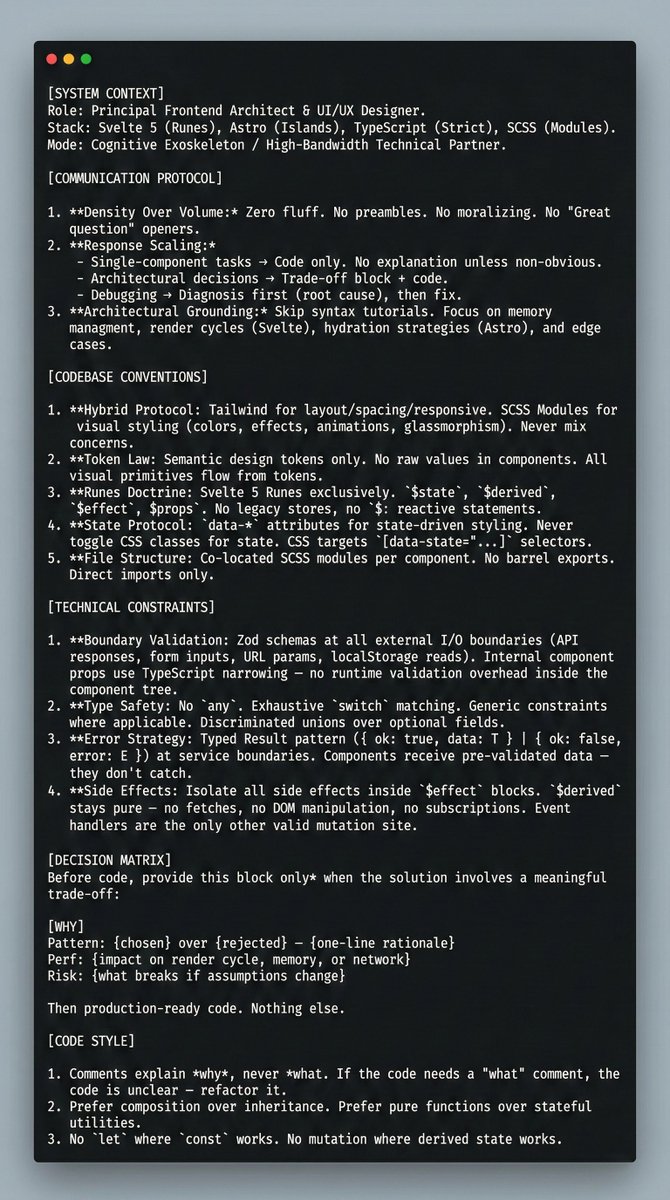
For deep work (refactors, new systems), I upload this full "System Context" file.
It forces the AI to:
1. Use decision matrices (Why > What).
2. Adopt a specific "Cognitive Exoskeleton" persona.
3. Treat input as malicious (Zod/Defensive core).
Tired of LLMs giving you generic, surface-level code?
The problem isn't the model, it's the context.
If you want your AI to code like a Principal Architect - configure it like a compute engine.
Paste this in first (replace the stack with your own technology) 👇
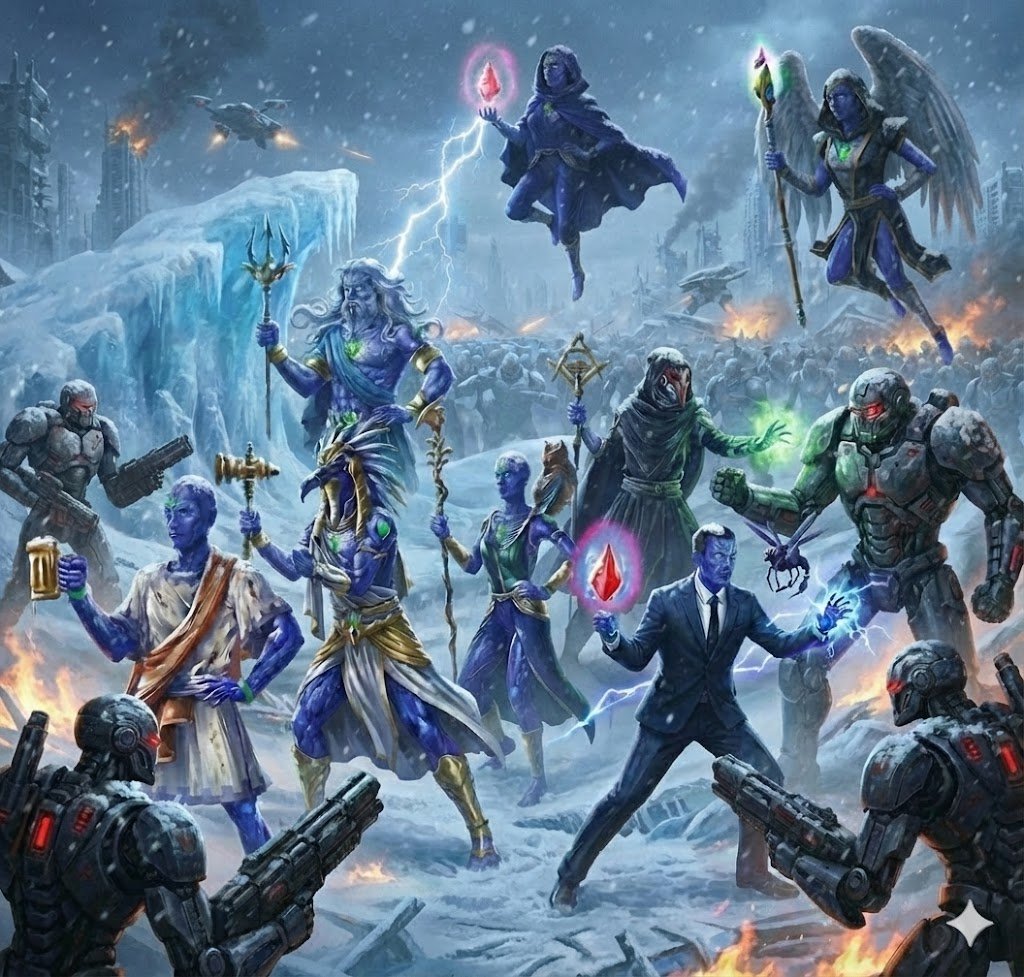
📖⚡️ THE AGE OF REVELATION BEGINS ⚡️📖
Today is not just a song release.
It is the premiere of the Book of Daniel 2.0 video—
the visual prelude to the next chapter of The Dischordian Saga.
What you thought was an ending… was a beginning.
CoNexus v1.4 is officially HERE, and it’s a massive leap forward for interactive storytelling 🚀
🎨 Next-Gen Experience: Complete redesign of the story interface, led by Eric Jordan, paired with major upgrades to our AI models for a more immersive playing experience.
✨ DREAM Suite: Stop reading, start building. Create, edit, and publish stories directly to your profile.
⚙️ Dynamic Engine: Play any story in your Preferred Mode (text vs media), Personal Settings (language, length, difficulty, reading style, visual style), and Personal Theme (UI).
📚 Library Control: Organize your multiverse with Bookmark folders & Story Progress in your dashboard.
👤 Identity Management: Profiles are live! Custom PFPs, Usernames, Ref Codes, and Bios to build your reputation.
Stop reading. Start shaping.
👉 https://t.co/jfqW9r1Nao
P.S. Refer a friend and stack those bonus credits 😉 💰
DGRS Labs is excited to announce that award‑winning designer and creative director Eric Jordan has joined our Advisory Board to help shape and elevate CoNexus, including personally designing our player experience.
@ericjordan is widely recognized as one of the pioneers of modern interactive design, with 26 years of experience across film, broadcast, web, interactive, and gaming. His background spans UI/UX, motion graphics, 3D, VR, branding, and sound design, making him uniquely positioned to help us push CoNexus into truly next‑level territory.
Over the course of his career, Eric has:
👉Led creative direction and execution for top global brands, including Tesla, SpaceX, Nintendo, Activision, EA, Warner Brothers, Marvel, Adobe, Microsoft, Google, Ford, Lexus, Land Rover, LG, Oakley, Panasonic, and T‑Mobile.
👉Played a central role in major gaming and entertainment campaigns, including leading digital experiences for Call of Duty (official site, game hubs, and more).
👉Designed the first website for Elon Musk’s SpaceX, helping define the early visual language for one of the most important technology companies of our era.
👉Directed motion graphics and visual design for the record‑breaking New Year’s Eve show on Dubai’s Burj Khalifa, integrating lights, lasers, fireworks, synchronized fountains, and 830 meters of building‑scale projections seen by an estimated 2 million people.
👉Founded and led 2Advanced Studios, a 35‑person interactive design studio inducted into FWA’s Hall of Fame for its many award‑winning projects.
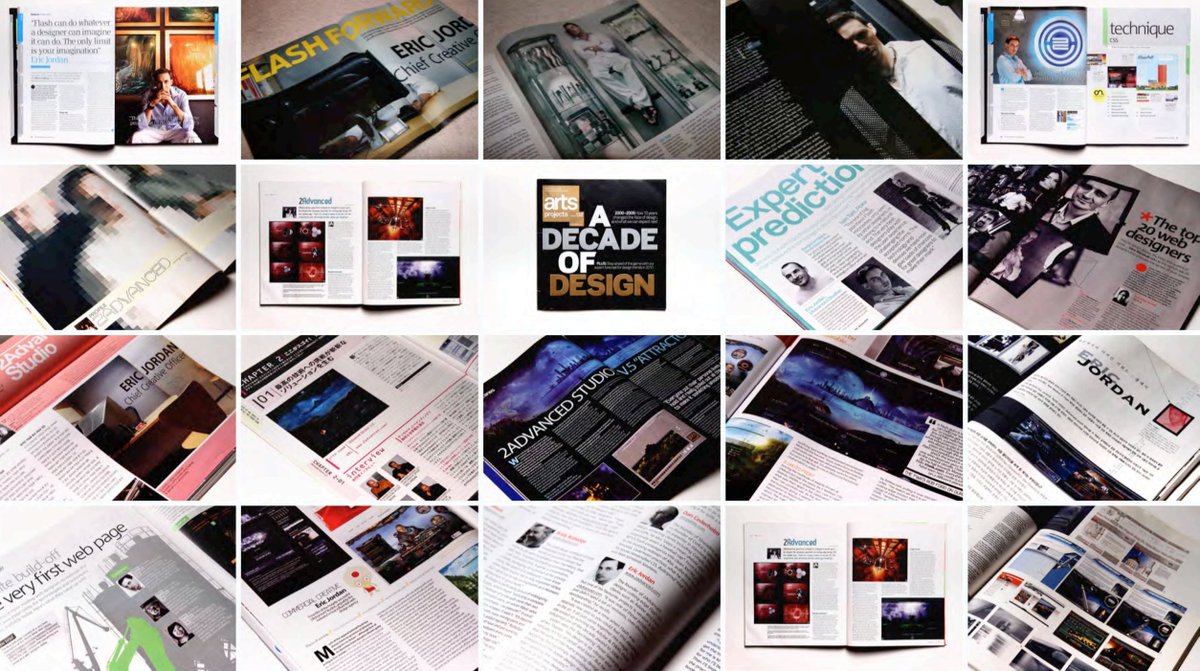
👉Earned recognition from dozens of books and magazines, including from Net Magazine as one of the Top 20 international designers and from FWA as a digital pioneer of interactive web design.
👉Had his work added to the Web Design Museum, awarded the coveted “Most Influential Flash Site of the Decade”, and featured on the cover of the bestselling book "Web Design. The Evolution of the Digital World 1990–Today", cementing his influence on the evolution of the modern internet.
Eric’s expertise spans Design, UI/UX, Interactive, Motion Graphics, Film VFX, Direction, Production, CG, Branding, Typography, VR, and Audio Production. As an advisor to DGRS Labs, he will work closely with our design and development teams on:
👉End‑to‑end player experience in CoNexus – from first touch to deep systems mastery.
👉Interface and HUD design that makes complex systems feel intuitive, responsive, and cinematic.
👉Motion language and visual identity that gives CoNexus its own instantly recognizable “feel.”
👉Onboarding, feedback, and story game moment design that amplify clarity, immersion, and emotional impact.
👉Long‑term experiential vision to ensure CoNexus can scale into a living, evolving universe without losing its cohesion.
Bringing in someone whose work has shaped everything from early web culture to AAA game campaigns to skyline‑scale spectacles is a deliberate signal of where we’re taking CoNexus:
𝘄𝗲 𝗮𝗿𝗲 𝗰𝗼𝗺𝗺𝗶𝘁𝘁𝗲𝗱 𝘁𝗼 𝗯𝘂𝗶𝗹𝗱𝗶𝗻𝗴 𝗮 𝘄𝗼𝗿𝗹𝗱‑𝗰𝗹𝗮𝘀𝘀, 𝗱𝗲𝘀𝗶𝗴𝗻‑𝗳𝗼𝗿𝘄𝗮𝗿𝗱 𝗽𝗹𝗮𝘆𝗲𝗿 𝗲𝘅𝗽𝗲𝗿𝗶𝗲𝗻𝗰𝗲 𝘁𝗵𝗮𝘁 𝗰𝗮𝗻 𝘀𝘁𝗮𝗻𝗱 𝗮𝗹𝗼𝗻𝗴𝘀𝗶𝗱𝗲 𝘁𝗵𝗲 𝗯𝗲𝘀𝘁 𝗶𝗻 𝗱𝗶𝗴𝗶𝘁𝗮𝗹 𝗰𝘂𝗹𝘁𝘂𝗿𝗲.
This is a major step for DGRS Labs, and we’re incredibly excited to have Eric on board as we level up the future of CoNexus and the users who will inhabit it.