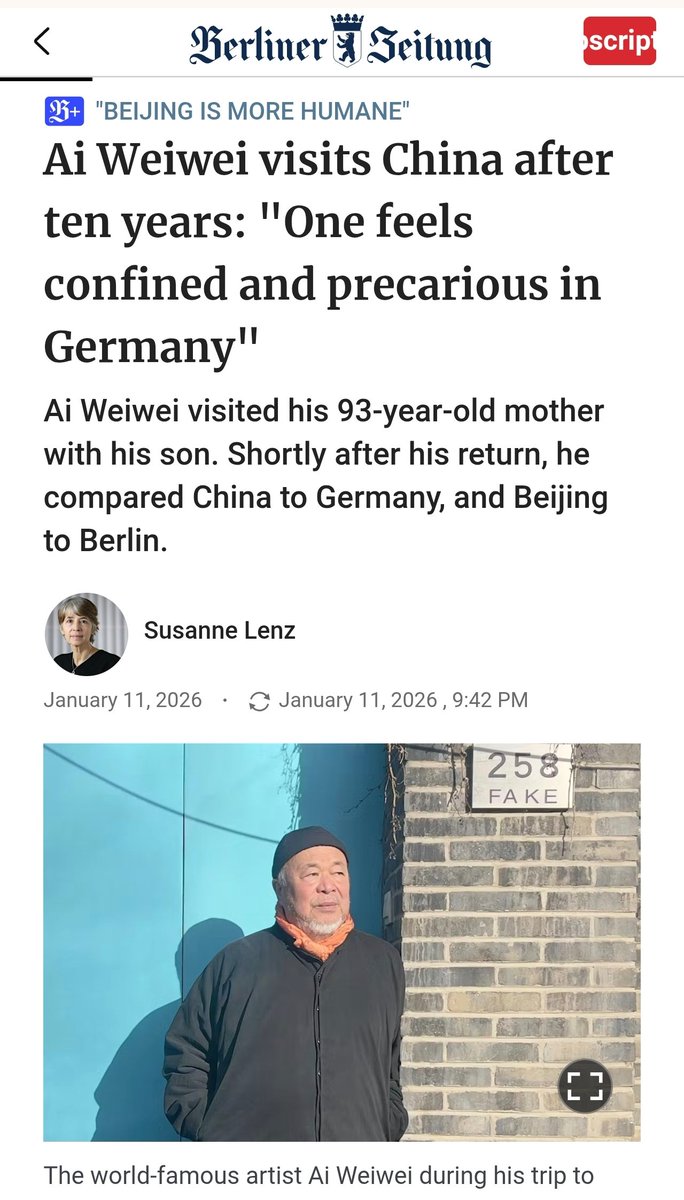
The idea of the famous dissident returning to the China he fled from, only to find a place that is more “humane” than “unfree” Europe, is stirring some discussion.
Reading the Berliner Zeitung interview, I didn’t see Ai Weiwei’s words & experiences as a political verdict on “China vs. West,” nor as the activist making a U-turn on his China stance. Instead, it fits perfectly into Ai Weiwei’s life’s work as a perpetual contrarian and self-described “troublemaker.”
- Ai Weiwei was back in China from Dec 12-Jan 2 for a private family visit. He left China in 2015 after years of house arrest, detention, and harassment. Reuniting with his 93-year-old mother together with his teenage son, he described Beijing as feeling like “a broken piece of jade being perfectly reassembled” - a familiar homecoming many people experience after a long absence, when the air, the faces, and the sense of things click back into place. It’s not a claim about the city per se, which has also changed significantly over the past decade (incl the “Great Brickening” and the demolition of Ai’s own studio).
- A positive change he noted is the improved service quality in Beijing. From banking to buying tailored clothes, he found that things are easy to do. By contrast, he describes bureaucratic processes in Germany as nightmarish, from bank issues to delays in visa applications.
-When he speaks of the “political climate,” he says that “daily life for ordinary people in Beijing feels more natural and more human because people tend to focus on what is directly in front of them,” adding his appreciation of China’s deeply ingrained Confucian traditions and its understanding of human relationships. This is not a comment on state power, dissent, or freedom/repression, but on social behavior and cultural roots; here, “political climate” is used to describe social atmosphere.
- When he refers to Germany as “an insecure and unfree country struggling to find its position between history and the future,” Ai Weiwei is responding to a question about Germany’s image in China, not necessarily offering a personal verdict on Germany (even if his personal view may overlap).
Nowhere does Ai Weiwei claim that Europe is politically “unfree” in this interview, nor that China is politically “free”. He does talk about ‘freedom’, explicitly and implicitly, but it’s social freedom. In Germany, he was legally free but socially isolated. In China, he was politically constrained but socially connected.
That tension is precisely what makes Ai Weiwei interesting, as a person and as an artist. He’s definitely not a witness for the defense of China - he is one of the most outspoken critics of censorship and political power of his time.
He criticizes China, the country he loves; he criticizes Germany, the country that supported him; he criticizes the US, where he was educated, he criticizes Europe, where he now lives; and he even criticizes money, which he has plenty of.
Ai Weiwei’s work makes us question the constructions of power around us. Framing his emotional connection to China and his criticism of Germany’s social coldness as a "China vs. West" victory narrative would miss that point entirely.
This is extraordinary and profoundly symbolic: Ai Weiwei has returned to China for the first time in 10 years and says he concluded that Beijing is "more humane" than Germany which he describes as "insecure and unfree".
He gave an interview to Germany's Berliner Zeitung after his trip (https://t.co/P0NBgnCTTH) and here is what he said:
- He described feeling that Beijing had become like "a broken jade being perfectly reassembled" and said he felt no fear returning to the country.
- He complained that daily life difficulties in Europe (where he's lived for the past 10 years) are "at least ten times" what they are in China, criticizing European bureaucracy.
- For instance he said he reactivated his dormant Chinese bank account in mere minutes (with "still had a considerable sum of money in it"). He contrasts this with his experience in Europe: "In Germany, my bank accounts were closed twice. And not just mine, but my girlfriend's as well. In Switzerland, I was refused an account at the country's largest bank, and another bank later closed my account there as well. There were other similar incidents, which I won't go into detail about here. These processes are extraordinarily complicated and often irrational."
- He says that "with regard to the political climate, daily life for ordinary people in Beijing feels more natural and humane" than in Germany which "feels cold, rational, and deeply bureaucratic. As an individual, one feels confined and precarious there."
- Stunningly he says that in Germany, over ten years, "almost no one has ever invited me to their home. Neighbors from above or below exchange at most a brief nod." He contrasts this with China where, immediately upon his return, "perfectly ordinary people from at least five different professions lined up, hoping to meet me."
- He concludes that Germany now "plays the role of an insecure and unfree country, struggling to find its position between history and future."
As a European who's lived 8 years in China, I couldn't agree more: life in China is an order of magnitude less cumbersome than in Europe and daily life feels much more humane and warm, contrary to popular belief.
But it's one thing for me to say it, and something else entirely for China's most famous dissident. The man once celebrated throughout the West as the very embodiment of opposition to his country has now concluded that it is in fact Europe that's inhumane and "unfree".