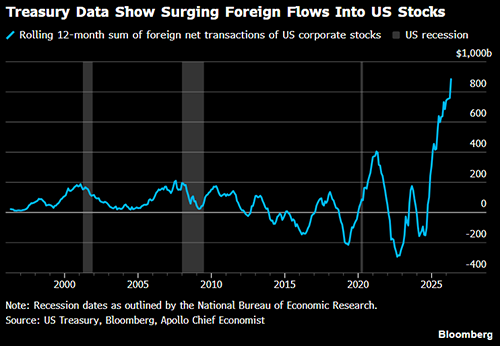
One of the first lessons I learned at Merrill was from Robert Farrell: Foreign investors tend to commit heavily to U.S. stocks near major market tops.
In 2021, foreigners poured a record $400 billion into U.S. equities - at the time, a historic level.
Over the latest 12 months, that figure has more than doubled to $900 billion.
Foreign ownership of U.S. stocks now stands at a historic $20 trillion, nearly 20% of the market.
Every week, a cabal of thieves steal dozens of phones, wallets and other valuables from tourists and hold the items for ransom. The culprits? Monkeys. https://t.co/bsiu0xX91G via @WSJ 🤣🤣
Banks seek to offload risk to avoid ‘choking’ on data centre debt https://t.co/1ZKHnfETJT via @ft JPMorgan and MUFG, have spent more than six months distributing $38bn of construction debt tied to a data centre project leased to Oracle in Texas and Wisconsin,
Bessent says Europe is too weak to guarantee Greenland’s security https://t.co/ScmNY4dzwN via @ft
The Treasury secretary insisted that the new levies should not make countries distrust the US, and said the US president was being “strategic”. “Always live in the moment,”SERIOUSLY
Magic has no limits !! After all Xmas is around the corner Hohoho!! OpenAI takes stake in Thrive Holdings in latest circular deal https://t.co/qEBKMpvhdv via @ft
The $1 Trillion Mega Deal: Where Does OpenAI’s Money Come From?
“Circular Revenue” and “Equity-for-Purchase”: The Financial Engineering Behind a Trillion-Dollar Order
OpenAI’s financial magic is realized through two distinct yet logically connected models—those with AMD and NVIDIA.
Together, these two structures illustrate how AI compute power has evolved from a mere capital expenditure (CAPEX) into a financialized and securitized asset class.
(1) The AMD Model: Performance-Based “Equity-for-Purchase”
The partnership with AMD is unprecedented in semiconductor history.
On the surface, it looks like OpenAI is agreeing to purchase up to 6GW worth of AMD Instinct GPUs, valued at roughly $90 billion.
However, the essence lies elsewhere: AMD granted OpenAI warrants—the right to purchase up to 160 million AMD shares at a nominal price of $0.01 per share.
This structure is, in effect, a financial formula that converts hardware purchases into stock options.
If AMD’s stock price rises to $600 due to large-scale GPU adoption, the total value of the equity OpenAI can exercise would be about $96 billion—almost equivalent to the total GPU purchase amount.
In other words, if the collaboration succeeds and the market rewards it, OpenAI could effectively “acquire GPUs for free.”
The beauty of this structure lies in its performance-linked equity incentive.
AMD’s long-term valuation becomes directly tied to OpenAI’s infrastructure growth.
As AMD’s stock rises, OpenAI can liquidate the exercised shares to raise cash,
and use that cash to purchase subsequent GPU batches—creating a self-sustaining capital recycling loop that dramatically reduces its capex burden.
(2) The NVIDIA Model: The More Direct “Circular Revenue”
The partnership with NVIDIA is even more straightforward.
NVIDIA plans to invest up to $100 billion in OpenAI over the next decade.
This capital will, in turn, be used by OpenAI to purchase NVIDIA GPUs.
Goldman Sachs defines this structure as “Circular Revenue.”
That is, the money NVIDIA invests ultimately returns to NVIDIA’s own revenue line.
It appears as revenue growth on paper, but in accounting terms, it’s a self-reinforcing cycle where supplier financing flows back as company revenue—
hence investors must evaluate the quality of such earnings with much greater caution.
Goldman Sachs’ Analysis: OpenAI’s Actual Cash Flow Structure
Beneath the elegant surface of this financial engineering lies a massive funding gap.
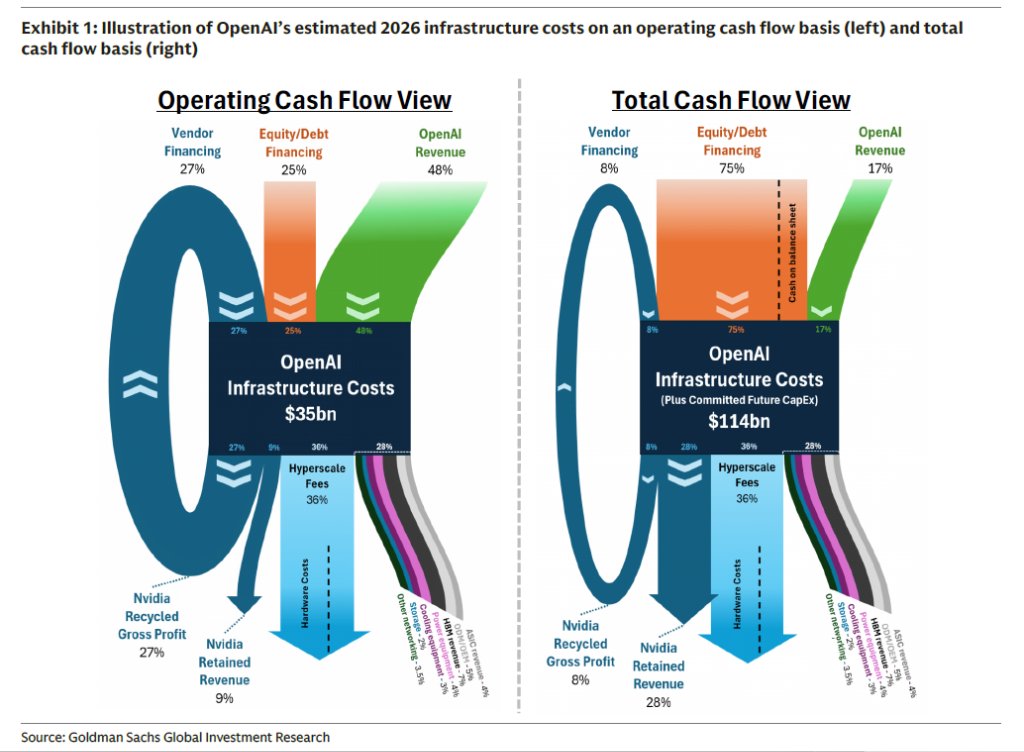
Goldman Sachs breaks down OpenAI’s financials into two parts: Operating Cash Flow and Capital Commitments.
▪ From the operating cost perspective:
• By 2026, OpenAI’s annual infrastructure operating expense is projected at $35 billion.
• Funding composition:
• Internal revenue: 48%
• Vendor financing: 27%
• External capital (equity + debt): 25%
Viewed narrowly, this structure seems self-sustaining.
▪ But once capital commitments (large-scale CAPEX) are included:
• Joint data center construction with NVIDIA: ~$60 billion
• Project “Stargate”: ~$19 billion
→ Total funding need: ~$114 billion
Under this broader lens, the structure becomes sharply imbalanced:
• External capital dependency: 75%
• Internal revenue contribution: 17%
• Vendor financing: 8%
In short, OpenAI’s own cash flow is far from sufficient—its future hinges entirely on continued inflows of massive external capital.
This colossal “AI infrastructure empire” cannot be sustained without liquidity from financial markets.
⸻
“AI Boom or Grand Bubble?”
This structural transformation has generated an explosive wealth effect in the short term.
After OpenAI announced its partnerships:
• Oracle’s market capitalization surged by $244 billion
• AMD’s market capitalization rose by $63 billion
This in turn reinforced market confidence, creating a self-reinforcing feedback loop within the financialized AI ecosystem.
However, that same loop is now flashing bubble warning signals.
⸻
Key Risks
① Credit and Growth Risk
Moody’s issued a warning on Oracle’s credit rating, citing “excessive reliance on a single customer—OpenAI.”
The entire AI infrastructure ecosystem rests on the assumption that user growth and monetization will continue exponentially.
If that assumption cracks, the entire circular structure could collapse.
② Cost Discipline Risk
A Silicon Valley investor described OpenAI as “a company born without cost discipline.”
Sam Altman himself declared, “Profitability isn’t even in my top 10 priorities.”
That mindset is an asset when liquidity is abundant—but becomes a fatal flaw when markets tighten.
③ Structural Industry Risk
Goldman Sachs notes that NVIDIA’s customer composition is shifting rapidly.
Instead of the traditional stable hyperscalers,
the share of AI startups and sovereign AI funds dependent on external financing is surging.
By 2027, their respective contributions to NVIDIA’s revenue are estimated at $66 billion and $46 billion.
This is a short-term growth driver—but it also magnifies volatility and valuation risk.
⸻
Conclusion: The Frontline of a Grand Financial Experiment
OpenAI’s $1 trillion “GPU empire” is not just a technology investment—
it is a grand experiment intertwining financial innovation, industrial alliances, and market expectations.
At its core lies “Circular Financing”—an expansion built on the collateral of future expectations.
Whether this experiment becomes the foundation of the next industrial revolution
or collapses into a credit-fueled mirage of circular leverage and speculative euphoria remains to be seen.
What is clear, however, is that OpenAI—together with global capital markets—
has already taken its seat at the largest betting table in human financial history,
under the name of AI.
@vonderleyen Making large concession to aggressor party will only embolden this player to ask for more.
Pathetic loser deal which will come back to bite.
Cleveland Fed President Beth Hammack says she’s hearing from firms that aren’t sure how much tariffs will go up, so they are beginning to implement a sequence of rolling price hikes to avoid a larger, one time increase in prices. Some firms that haven’t faced tariffs are also raising prices because their competitors, who do face tariffs, have raised prices.
“That certainly would be the type of environment where the tariffs could be more inflationary rather than just a one-time increase of the price level.”
Hammack said it could be a while before the Fed has visibility on whether and how to change rates.
“I don’t want to put a time frame on it, but I think it can be a while…. We might need to wait longer than you would otherwise if you had a clearer picture of where things are.”
seriously??What is MSTR's upside potential,? Strategy Incorporated has 91.14% upside potential, based on the analysts' average price target. Strategy Incorporated has a consensus rating of Strong Buy which is based on 11 buy ratings, 0 hold ratings and 0 sell ratings.