Pinning versions in requirements.txt doesn't protect your Python app from PyPI supply chain attacks.
If a compromise occurs on PyPI, an attacker can hijack a release tag or tamper with wheel binaries without bumping version numbers.
The fix? Pin SHA-256 hashes in requirements.txt or verify wheel digests during CI/CD package installation.
Here is how we verify package hashes in production Python build steps before pip execution.
#Python #DevOps #Security #SoftwareEngineering
@laravelnews@Crell Solid advice from Larry. Starting with RFC feedback and real-world edge cases builds 10x more credibility than dropping a massive paradigm shift on day one.
@ShaneDRosenthal@laravellivedk Congrats on speaking at Laravel Live Denmark! The European Laravel community energy is always incredible. Hope you enjoyed Copenhagen!
@PovilasKorop Replacing endless feed scrolling with quick 5-minute AI feature prototyping is such a high-leverage shift. Small micro-tasks drafted in minutes compound fast over a month.
We recently completed the full Workout module rewrite for NitroFIT28 in Flutter. Experience premium workout routines and tracking: https://t.co/wg7utZJFKK
We rebuilt our hybrid Capacitor mobile stack into native Flutter for NitroFIT28.
Rewriting a production cross-platform app wasn't about shiny new tech:
• Hybrid web view DOM sync couldn't handle smooth 60 FPS workout overlays
• Rest timers and animated reps counters lagged during heavy background tasks
• Mobile state split across JS bridges led to subtle UI bugs under bad network conditions
In Flutter, custom reactive composables & clean widget layers solved it:
• Zero-lag animated rep overlays with automatic step timers
• Isolated state management across workout execution & victory screens
• Clean skeleton state loaders that eliminate layout shift
Modern mobile apps demand native smooth frame rendering.
What's your stance on Web View / Hybrid vs Native Flutter in 2026?
#VueJS #Flutter #MobileDev #Frontend #SaaS #AppDevelopment
Most SaaS cancellation forms are a total waste of time.
A generic "Why are you leaving?" survey with 5 radio buttons doesn't save subscribers.
It just logs their frustration on the way out the door.
We replaced generic offboarding with a conditional 3-branch retention flow:
• "Too expensive" ➔ Offer instant 1-click 50% discount for 2 months
• "Not using it right now" ➔ Offer 60-day account pause (keep data intact)
• "Missing a key feature" ➔ Route to direct founder call / roadmap link
The result?
18% of cancelling subscribers chose an alternative option and stayed.
Stop asking for feedback when customers leave.
Start offering real solutions before they hit cancel.
#SaaS #IndieHackers #ProductGrowth #Churn #CustomerRetention
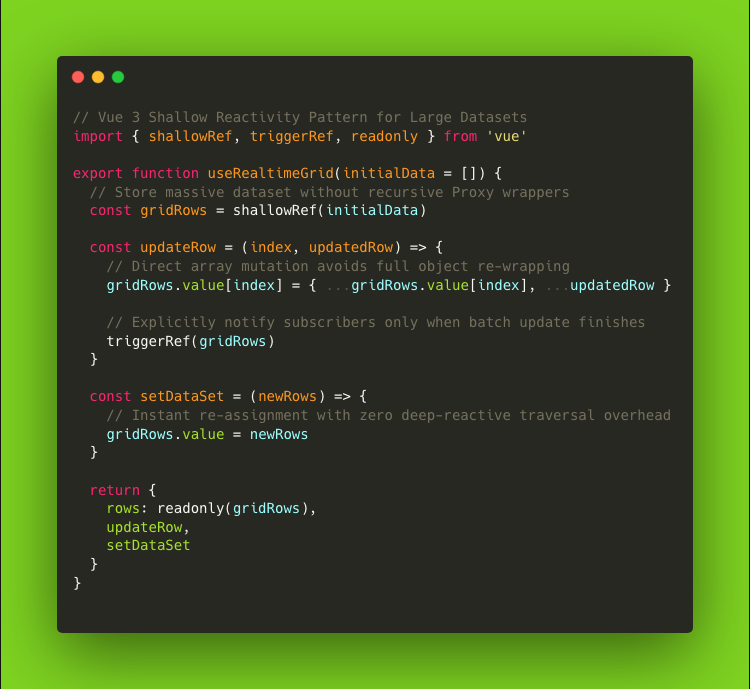
Using `ref()` for 10,000+ row data feeds will tank your Vue 3 app performance.
Why?
Standard `ref()` creates deep reactivity proxies for every nested property.
When high-frequency WebSocket updates stream in:
• Memory usage balloons from tens of thousands of Proxy instances
• Garbage collection spikes trigger micro-stutters
• Re-renders block main thread UI execution
The solution is `shallowRef()` + `triggerRef()`:
• `shallowRef()` tracks root `.value` assignment only
• Object mutations skip recursive reactivity overhead
• `triggerRef()` manually signals Vue when mutations complete
Result: 90% reduction in GC pauses and butter-smooth rendering.
#VueJS #Frontend #JavaScript #WebDev #Performance
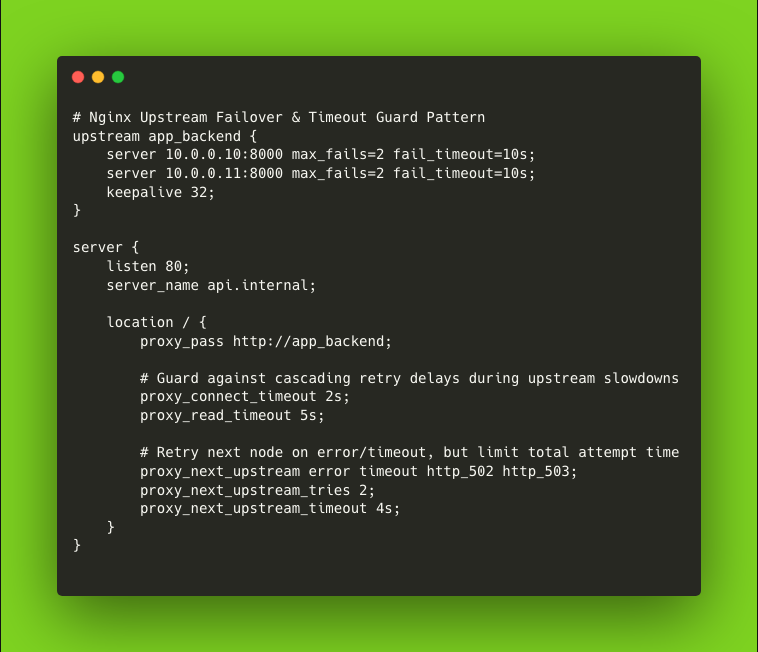
Default Nginx proxy settings will destroy your microservices during an outage.
When an upstream app node slows down or drops requests:
• Standard timeout is 60s
• Retries cycle through all bad nodes endlessly
• Client request pools fill up in seconds
• A single node failure cascades into a total platform outage
The fix isn't adding more servers.
It's configuring strict failover boundaries:
• Lower `proxy_connect_timeout` to 2s
• Cap `proxy_next_upstream_tries` to 2
• Limit `proxy_next_upstream_timeout` to 4s
Fail fast. Failover cleanly. Keep the rest of your system alive.
#DevOps #Nginx #Infrastructure #SystemArchitecture #CloudComputing
@enunomaduro 100%. AI tools lower the barrier to translation across frameworks/languages, but attribution and respecting original maintainer work remains non-negotiable.
@PovilasKorop Read-through filesystem is huge for asset & media migrations across S3/R2 buckets. Eliminates the need for custom fallback logic or batch syncing up front.
Relying on raw LLM prompts to handle core business logic is a recipe for silent production failures.
LLMs are probabilistic prediction engines — not deterministic function callers.
High-scale AI infrastructure wraps LLMs with deterministic schema validators, strict output parsers, and automated fallback handlers. The real engineering leverage isn't prompt engineering — it's defensive boundary engineering around un-trusted AI outputs.
#AI #SoftwareEngineering #SystemDesign #DevMindset #TechLeadership
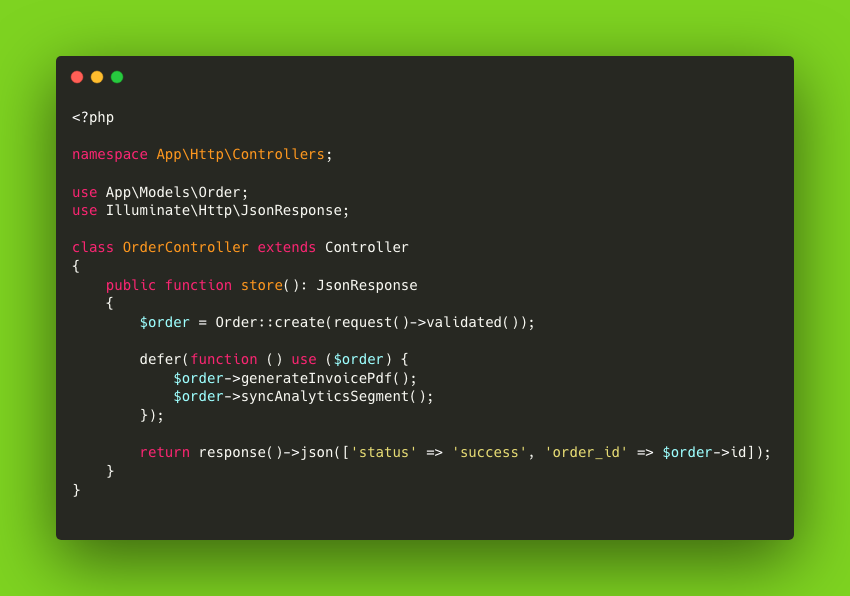
Dispatching heavy queue jobs just to send a confirmation log or sync analytics after an HTTP response adds unnecessary Redis worker overhead.
Laravel's `defer()` helper executes heavy closures right after the HTTP response is sent to the client — without keeping the user waiting.
Response time drops from 380ms to 18ms while audit logs and secondary API calls finish safely in the background.
Here is how to offload post-response tasks without Redis queue bloat:
#Laravel #PHP #WebDev #Backend #SoftwareArchitecture
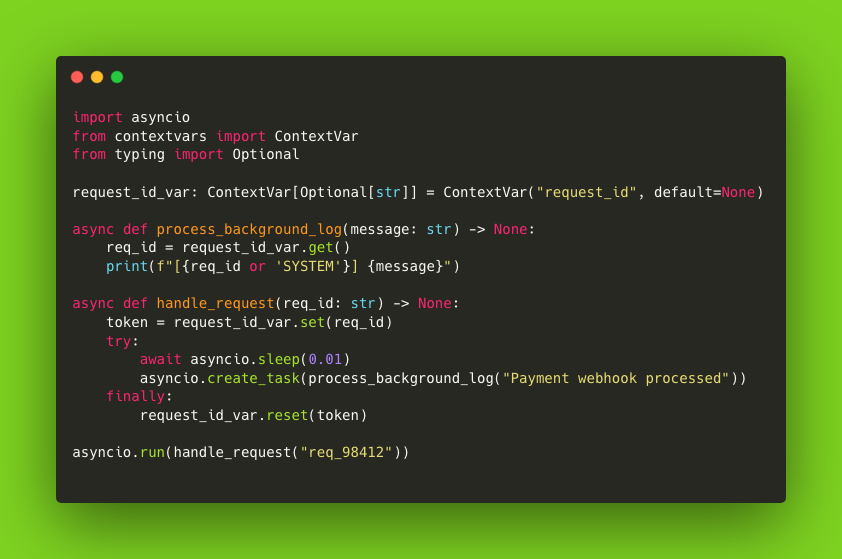
Passing request IDs through 12 async function signatures in Python is an anti-pattern.
Global variables leak across async tasks because event loops reuse threads. `ContextVar` solves this natively by isolating state to the async execution context.
`ContextVar.set()` returns a token to safely restore context in `finally` blocks, preventing memory and trace leakage across concurrent workers.
Here is how to trace background tasks without breaking function signatures:
#Python #AsyncIO #WebDev #Backend #SoftwareEngineering
@ferron_web Exactly, it is standard Nginx proxy caching! The "micro" just refers to the ultra-short TTL (1 second) to cache dynamic/real-time content without serving stale data.
And 100% agreed on bypassing the app stack entirely that’s where the massive throughput gain comes from. ⚡
A 1-second Nginx microcache can reduce backend database load by 99% during traffic spikes.
When 5,000 concurrent users request the same feed or dashboard endpoint, hit backend services only once per second instead of 5,000 times.
Combining proxy_cache_valid with proxy_cache_use_stale updating ensures stale cache is served instantly while background updates fetch new data.
Here is the exact production snippet.
#devops #nginx #backend #infrastructure #sysadmin
Pure API SaaS products are commoditizing at record speed.
When an AI agent or wrapper can replicate a backend endpoint in an afternoon, your defensibility isn't your API—it's your workflow integration.
Products that embed directly into daily operations, UI component builders, and user administrative workflows command 3x higher retention.
Here is the 3-layer stack that turns software into an irreplaceable workflow moat.
#saas #indiehackers #buildinpublic #startups
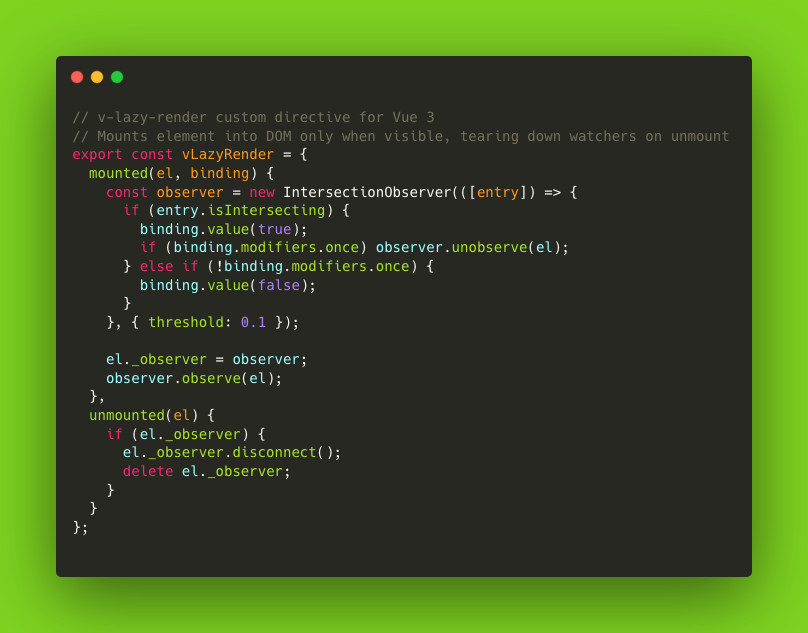
Stop rendering 50 complex Vue components at page load.
If your dashboard list renders heavy charts or rich tables below the fold, reactive state allocations destroy initial frame rates.
A simple Vue 3 custom directive wrapping IntersectionObserver keeps heavy components unmounted until scrolled into view—and cleans up automatically on unmount.
Here is the 20-line directive we use in production.
#vuejs #javascript #webdev #frontend
@enunomaduro Partial function application in PHP 8.6 is going to make functional pipelines so much cleaner. Excited to see native Duration handling without custom Carbon wrapper boilerplate too.