You would expect the outer edge of our solar system to be freezing cold. Instead, NASA’s Voyager 1 encountered a scorching region of plasma so intense that scientists have called it a “wall of fire.”
When the spacecraft crossed the heliopause, the invisible boundary where the Sun’s solar wind meets interstellar space, it recorded temperatures between 30,000 and 90,000°F (17,000–50,000°C).
This is not actual fire. The extreme heat is created when the outgoing solar wind collides with the thin gas, dust, and magnetic fields of the interstellar medium. As the solar wind slows and compresses at this boundary, its kinetic energy is transformed into thermal energy, superheating the surrounding plasma.
Surprisingly, despite these blistering temperatures, the region would not feel hot to the touch. Temperature measures the average speed of individual particles, but the plasma at the heliopause is incredibly sparse, containing only a handful of particles per cubic centimeter. With so few particles, there is almost no heat energy available to transfer.
Voyager 1 also detected a sharp drop in solar particles and a dramatic rise in high-energy galactic cosmic rays, confirming it had left the protective bubble of the Sun’s heliosphere and entered true interstellar space.
Scientists determined the plasma’s extreme temperature by analyzing tiny waves in the plasma triggered by solar eruptions, then combining those density measurements with theoretical models.
The heliosphere serves as Earth’s first line of defense against dangerous cosmic radiation. Beyond it lies the raw environment of the Milky Way. Today, more than 15 billion miles (24 billion kilometers) from Earth, Voyager 1 continues its historic journey, still sending back valuable data from this distant frontier.
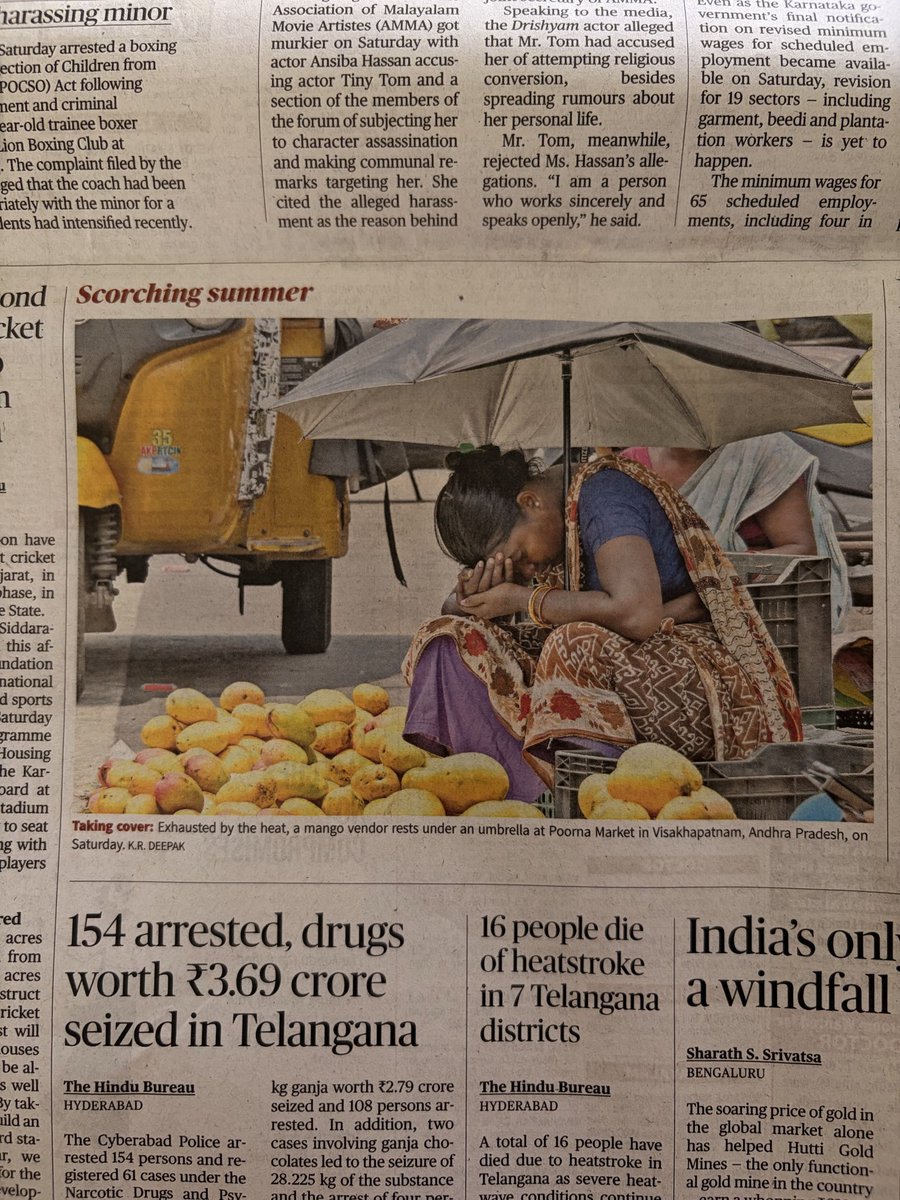
Heartbreaking photo.
India has ALL of the world’s 50 hottest cities. But do you see any evidence on our streets and public spaces that shows our authorities care? We have millions of street vendors like this woman in the photo, all left to fend for themselves.
From hydration centres to heat shelters, there’s so much governments could do. But why bother when you could stoke religious tensions and get by?
Our gig workers are often the worst affected. They are forced to spend the day on the streets, waiting for orders. Neither food delivery apps, nor @urbancompany_UC bothers with erecting shelters workers can use to escape the heat. And we, as the public, don’t really care.
Cockroaches, indeed.
Be Wise Selfish - His Holiness the Dalai Lama shares a simple but powerful idea: true self-interest lies in caring for others. Combining intelligence with warm-heartedness is what makes a human being — and ultimately the world — truly happy. A reminder that the path to a happier humanity runs through knowledge and education, one person at a time. Video originally recorded on August 18, 2020.
He was Satyendra Nath Bose, an Indian physicist whose quiet brilliance in the 1920s forever altered our understanding of the quantum world.
In 1924, Bose, then a 30-year-old professor in British India, sent a groundbreaking manuscript directly to Albert Einstein. The paper offered a novel, more elegant derivation of Planck's law for blackbody radiation by treating light quanta (photons) as indistinguishable particles—a radical departure from classical statistical methods. Impressed by its insight, Einstein personally translated the work into German and facilitated its publication in the prestigious Zeitschrift für Physik.
This exchange sparked a brief but profound collaboration. Einstein extended Bose's statistical approach to material atoms, predicting a bizarre new state of matter at ultra-low temperatures: what we now call a Bose-Einstein condensate (BEC), where particles behave as a single quantum wave. Bose's original framework became known as Bose-Einstein statistics, and the class of particles that obey it—those with integer spin, including photons, gluons, W and Z bosons, and the Higgs boson—was later named bosons in his honor by Paul Dirac.
Unlike fermions (matter particles like electrons), which obey the Pauli exclusion principle and cannot occupy the same quantum state, bosons can pile into identical states en masse. This "social" behavior underpins extraordinary macroscopic phenomena: the coherent light of lasers, the zero-resistance flow in superconductors, and the collective quantum coherence in BECs.
Despite the monumental impact—his statistics describe half of all fundamental particles and enabled key advances in quantum field theory, condensed matter physics, and particle physics—Bose remained remarkably unassuming. He continued teaching at universities in Dhaka and Calcutta (now Kolkata), mentored students, pursued ideas in X-ray crystallography, unified field theory, and other areas, and never sought the spotlight. Nominated several times for the Nobel Prize (notably for Bose-Einstein statistics and his later work), he was never awarded it, and his name rarely appears in popular accounts of 20th-century physics.
There's a poignant humility in his story: a man whose legacy literally names one of the two fundamental families of particles in the universe, yet whose personal fame never matched the scale of his contribution. Bose reminds us that true influence often arrives without fanfare. Some breakthroughs echo through textbooks and technologies, while their creators work in the background, content to let the universe carry their ideas forward—even if history's spotlight rarely finds them.
Money shot: “Services shouldn't ban people from using arbitrary hardware and operating systems in the first place. Google's security excuse is clearly bogus when they permit devices with no patches for 10 years… It's for enforcing their monopolies via GMS licensing, that's all.”
Apple and Google are gradually expanding their use of hardware-based attestation. They're convincing a growing number of services to adopt it. Google's Play Integrity API and Apple's App Attest API are very similar. Apple brought it to the web via Privacy Pass, which Google intends on doing too.
Google's Play Integrity API requires hardware attestation for the strong integrity level and is gradually phasing in requiring it for the more commonly used device integrity level. Apple already has it as a requirement. Over the long term, this will increasingly lock out hardware and OS competition.
The purpose of these systems is disallowing people from using hardware and software not approved by Apple or Google. This is wrongly presented as being a security feature. Banks and government services are the main ones adopting it but Apple and Google are encouraging every service to use it.
Apple's Privacy Pass brought hardware attestation to the web to help with passing captchas on their own hardware. Many people saw that as harmless since few sites would be willing to lock out non-Apple-hardware users. Apple and Google are both likely to bring broader hardware attestation to the web.
Google's reCAPTCHA is planning an approach where they use Privacy Pass on Apple hardware, their own approach on Google Mobile Services Android devices and a QR code scanning system to require an iOS or Google certified Android device for Windows and other systems:
https://t.co/7rQnioRa8A
Banking and government services increasingly require using a mobile app where they can use attestation to force using an Apple or Google approved device and OS. Apple's privacy pass, Google's 'cancelled' Web Environment Integrity and now reCAPTCHA Mobile Verification are bringing this to the web.
Current media coverage for reCAPTCHA Mobile Verification misunderstands it and the impact of it. They're bringing a hardware attestation requirement to Windows, desktop Linux, OpenBSD, etc. by requiring a QR scan from a certified smartphone to pass reCAPTCHA in some cases. They could expand it more.
Control over reCAPTCHA puts Google in a position where they can require having either iOS or a certified Android device to use an enormous amount of the web. Google defines certification requirements for Android which includes forcing bundling Google Chrome, etc. It's enormously anti-competitive.
Google's Play Integrity API bans using GrapheneOS despite it being far more secure than anything they permit. It also bans using any other alternative. This isn't somehow specific to an AOSP-based OS. You can't avoid this by using a mobile OS based on FreeBSD instead. You'll just be more locked out.
Google's Play Integrity API permits devices with no security patches for 10 years. The device integrity level can be bypassed via spoofing but they can detect it quite well and block it once it starts being done at scale. The strong integrity level requires leaked keys from TEEs/SEs to bypass it.
It doesn't provide a useful security feature, but it does lock out competition very well. Services requiring Apple App Attest or Google Play Integrity are primarily helping to lock in Apple and Google having a duopoly for mobile devices. Play Integrity is more relevant due to AOSP being open source.
Governments are increasingly mandating using Apple's App Attest and Google's Play Integrity for not only their own services but also commercial services. The EU is leading the charge of making these requirements for digital payments, ID, age verification, etc. Many EU government apps require them.
Instead of governments stopping Apple and Google from engaging in egregiously anti-competitive behavior, they're directly participating in locking out competition via their own services. Requiring people to have an Apple device or Google-certified Android device is anti-competition, not security.
reCAPTCHA Mobile Verification will currently work with sandboxed Google Play on GrapheneOS but it clearly exists to provide a way for them to start using hardware attestation on systems without it. People without an iOS or Android device will be locked out when this is required even without that.
This isn't about security or any missing functionality. GrapheneOS can be verified via hardware attestation. Google bans using GrapheneOS for Play Integrity because we don't license Google Mobile Services and conform to anti-competitive rules already found to be illegal in South Korea and elsewhere.
Services shouldn't ban people from using arbitrary hardware and operating systems in the first place. Google's security excuse is clearly bogus when they permit devices with no patches for 10 years but not a much more secure OS. It's for enforcing their monopolies via GMS licensing, that's all.
Ok here's my wishlist:
- The ability to install unsigned apps painlessly
- The ability to access Android/data Android/obb with a basic file manager(no root required)
- The ability to disable all Google services and apps on my phone with the press of a button
- Google services becomes open source and is replaced with "Android Services"
- Root access with a basic check in the developer settings
- Blob emojis