@anishmoonka There’s not enough dynamic range in these specific stills to indicate noticeable halation that the anti halation layer of the film stock wouldn’t completely inhibit.
Published today in @Nature: We've unified calibration with computation on our Willow processor, training a reinforcement learning agent to stabilize the logical qubit and pave the way towards a quantum computer that continuously learns from its errors.
Read more: https://t.co/MUAaxkfimN
@ObtainerOf This is undoubtedly one of the greatest things ever written. An true stroke of genius. The effortless blend of memetics in the tone of some anon-DFW/Pynchonian hybrid voice lives eternally in my head.
@MartinShkreli Atoms will run into scaling issues just like superconducting circuits. Some tech advances required in laser beamforming to compete with how quick circuits can be applied. Same as other neutral atom startups - still intriguing progress so quickly.
🚨BREAKING: Microsoft open sourced a 4B parameter model that generates production-ready 3D assets from a single image, and the speed numbers are genuinely hard to believe.
It's called TRELLIS.2 and it uses a new geometry format called O-Voxel that can be converted to a textured mesh in under 100 milliseconds on CUDA, which means real-time 3D asset generation is now actually within reach.
Most image-to-3D tools force you to pick between speed, quality, and topology correctness. TRELLIS.2 refuses that tradeoff by representing geometry natively in a sparse voxel format that supports arbitrary complexity from the start.
→ Outputs GLB files with full PBR texture maps ready for Blender, Unity, and Unreal Engine
→ Pretrained TRELLIS.2-4B checkpoint available directly on Hugging Face with model card and usage details
→ Web demo live now so you can test it without installing anything
4.6K stars. MIT License. 100% Opensource.
Link in comments.
Excited to share that our paper "Nanophotonic waveguide chip-to-world beam scanning" is now published in Nature. Congrats Matt Saha and the team at @MIT-QPAI, @MITREcorp , @SandiaLabs , @Axiomatic_AI, University of Arizona, and CU Boulder.
This work introduces a NEMS-photonic beam scanning platform for a new generation of light engines with massive parallelism.
Key results:
• 68.6 mega-spots/s/mm² beam-scanning at CMOS-level voltages
• RGB video produced from a cross section equivalent to 2 iPhone pixels.
How is this possible? the number of distinct spatial optical modes modes is ~ Area/(λ/n_eff)²). Because our device scans the waveguide (tiny mode cross section), that mode density approaches the fundamental limit, which is ~ 2 OM higher than what are
normally considered ultra high resolution displays
MIT News: https://t.co/uZryizHvyP
Open access: https://t.co/iW2Pu2JMGi
#Photonics #Nature #MIT #QPAI #Nanophotonics
Floquet engineering is often limited by weak light–matter coupling and heating. Now it is shown that exciton-driven fields in monolayer semiconductors produce stronger, longer-lived Floquet effects and reveal hybridization linked to excitonic phases.
https://t.co/riytAqZ6gg
@nntaleb Consider bulbs that have a knob for color temp. The warm lights in the first picture make a cozier more relaxing atmosphere in the evenings but the colder light on the right in the second post provides a functional light. One must choose the appropriate ambience for workload.
This Stanford paper pokes a hole in one of finance’s favorite excuses: “the data is too noisy.”
For decades, quants have argued that raw prices are useless without handcrafted indicators layered on top. This paper asks a cleaner question. What if the signal is already there, and we’ve just been looking at it the wrong way?
The author builds a model that predicts bullish versus bearish moves for S&P 500 stocks using nothing but raw price data. No indicators. No factor libraries. Just daily OHLCV plus adjusted prices that explicitly reflect dividends and splits.
The trick isn’t more data. It’s representation.
Instead of treating time series as sequences, the paper treats rolling price windows as spatial objects. Each window becomes a structured matrix, closer to an image than a chart. That lets convolutional filters detect local patterns like momentum shifts, volatility clustering, and structural breaks from corporate actions.
This borrows intuition from computer vision, not classical econometrics.
The dataset spans up to twenty years per stock with institutional-grade pricing. Ten channels feed the model, and sliding windows create dense training samples without synthetic tricks. Normalization keeps everything scale-invariant across features.
Architecturally, it’s a deep 1D CNN. Early layers focus on short-term structure. Deeper layers pick up longer trends. Compared to recurrent models, the CNN handles volatility spikes and event-driven jumps with more stability.
The task is simple but strict: predict direction, not returns, across horizons from a few days to a month. Training is tuned carefully, and convergence looks clean rather than suspicious.
The results are what make people uncomfortable.
Several large-cap stocks hit validation accuracies in the high 80s and low 90s. JP Morgan reaches around 91 percent on longer horizons. The curves suggest real learning, not a quick overfit.
The author stays cautious. This doesn’t model costs, execution, or slippage. But it does show something important. Deep models can internalize market mechanics directly from raw price tensors, including distortions most pipelines smooth away.
The larger implication cuts deep.
Feature engineering may matter less than how you frame the data. By choosing the right inductive bias, the model learns structure humans usually try to hardcode.
Treating financial time series like image-like objects isn’t a gimmick. It’s a serious alternative to decades of handcrafted assumptions, and it challenges the idea that markets are unreadable without heavy human intervention.
Read the full paper: https://t.co/VcFfAPhjAf
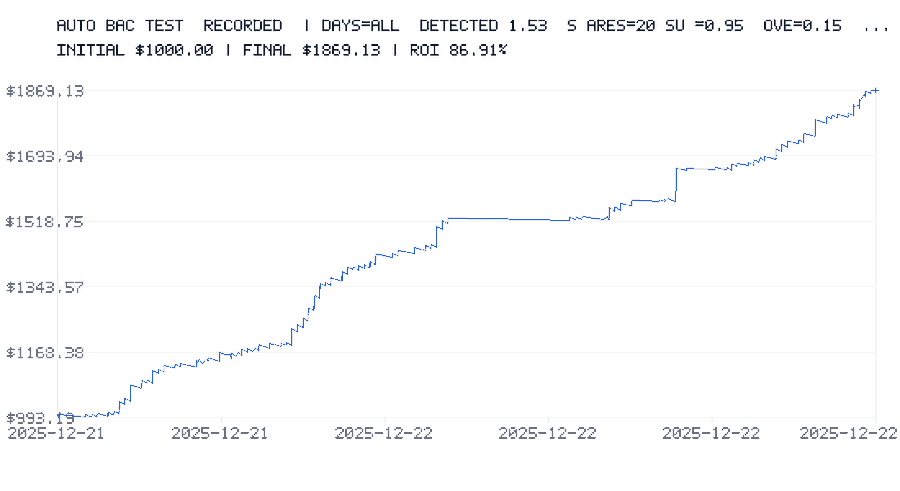
study @the_smart_ape‘s polymarket bot, backtested with +86% roi in just a few days
most ‘arb bot’ threads are just PnL screenshots. this one is has undergone a through a research methodology
tldr: @Polymarket arb is a parameter + execution game.
this is a case study in microstructure + parameter design:
- the same both show 2 vastly different results with diff parameters: conservative +86% (fees+spread), aggressive –50% in 2 days
- the strategy is exploiting temporary orderbook dislocations early in each 15-min round, then engineering a hedge where UP + DOWN < 1 (after costs).
- so he did the correct thing by building a first hand dataset (6GB of 1s best-ask snapshots) and replay deterministically
- record more stress slippage/latency, model fill probability, and define kill-switches.
- then optimize infra (colocation/VPS, Rust, dedicated RPC) only after the strategy is robust.
the bot is the easy part.
the hard part is building a repeatable calibration + risk framework.
Nvidia is buying Groq for two reasons imo.
1) Inference is disaggregating into prefill and decode. SRAM architectures have unique advantages in decode for workloads where performance is primarily a function of memory bandwidth. Rubin CPX, Rubin and the putative “Rubin SRAM” variant derived from Groq should give Nvidia the ability to mix and match chips to create the optimal balance of performance vs. cost for each workload. Rubin CPX is optimized for massive context windows during prefill as a result of super high memory capacity with its relatively low bandwidth GDDR DRAM. Rubin is the workhorse for training and high density, batched inference workloads with its HBM DRAM striking a balance between memory bandwidth and capacity. The Groq-derived "Rubin SRAM" is optimized for ultra-low latency agentic reasoning inference workloads as a result of SRAM’s extremely high memory bandwidth at the cost of lower memory capacity. In the latter case, either CPX or the normal Rubin will likely be used for prefill.
2) It has been clear for a long time that SRAM architectures can hit token per second metrics much higher than GPUs, TPUs or any ASIC that we have yet seen. Extremely low latency per individual user at the expense of throughput per dollar. It was less clear 18 months ago whether end users were willing to pay for this speed (SRAM more expensive per token due to much smaller batch sizes). It is now abundantly clear from Cerebras and Groq’s recent results that users are willing to pay for speed.
Increases my confidence that all ASICs except TPU, AI5 and Trainium will eventually be canceled. Good luck competing with the 3 Rubin variants and multiple associated networking chips. Although it does sound like OpenAI’s ASIC will be surprisingly good (much better than the Meta and Microsoft ASICs).
Let’s see what AMD does. Intel already moving in this direction (they have a prefill optimized SKU and purchased SambaNova, which was the weakest SRAM competitor). Kinda funny that Meta bought Rivos.
And Cerebras, where I am biased, is now in a very interesting and highly strategic position as the last (per public knowledge) independent SRAM player that was ahead of Groq on all public benchmarks. Groq’s “many chip” rack architecture, however, was much easier to integrate with Nvidia’s networking stack and perhaps even within a single rack while Cerebras’s WSE almost has to be an independent rack.
> be me, Jonathan Ross
> Stanford compilers nerd, allergic to inefficiency
> spend years staring at CPUs doing “clever” things slowly
> realize the problem isn’t software
> it’s the damn hardware lying to you
>
> modern chips:
> caches guessing
> branch predictors gambling
> schedulers shrugging
> latency vibes-based
>
> decide this is stupid
> ask a forbidden question
> “what if the chip just… did exactly what the program says?”
>
> no caches
> no speculation
> no surprises
> no excuses
>
> design a chip that executes instructions
> in order
> every time
> at ludicrous width
>
> 144-wide VLIW
> SRAM everywhere
> DRAM nowhere
> timing so deterministic you could set a watch by it
>
> everyone else:
> “this will never work”
> “developers don’t want this”
> “where’s the cache”
>
> ship it anyway
>
> fast forward
> LLMs show up
> turns out transformers are just
> embarrassingly parallel math
> predictable
> repetitive
> allergic to cache misses
>
> GPUs:
> fast but moody
> great at throughput
> awful at consistency
> latency spikes like a heart monitor in a horror movie
>
> Groq:
> same tokens
> every run
> same timing
> zero jitter
> silicon doesn’t lie
>
> developers blink
> “wait… my inference latency is fixed?”
>
> hyperscalers squint
> “this thing is weird”
> “why does it feel faster than the FLOPs say”
>
> because FLOPs were never the point
> time was
>
> invent the anti-GPU
> no training glory
> no benchmark cosplay
> just raw, deterministic decode speed
>
> AI agents start caring about tail latency
> suddenly p99 matters more than TFLOPs
>
> NVIDIA notices
> leather jacket energy intensifies
> realizes inference ≠ training
> and determinism is not optional
>
> signs a $20B licensing deal
> not to replace GPUs
> but to admit something quietly
>
> inference isn’t training
> and determinism is a feature
>
> moral of the story:
> everyone optimized for average speed
> Jonathan optimized for truth
>
> turns out the future of AI
> needs at least one chip
> that always tells the truth