🚨 BREAKING: Claude Opus 4.8 dropped and most people are only looking at the model upgrade.
Three features shipped alongside it that change how you use Claude Code entirely: effort control, dynamic workflows, and fast mode at 3x cheaper.
Full setup guide 👇
Atlas consolidates multiple bridges, assets, and routing options into a single interface, targeting the biggest barrier to BTCFi adoption: complexity.
🔗https://t.co/kwaetzrkYs
@lifiprotocol, a cross-chain liquidity aggregator with over $80 billion in total transfer volume, routes swaps and bridges across 60+ chains and protocols.
Excited to welcome two new members to the RootstockCollective team 🚀
🔹 @rahmego joins us as Marketing Lead
🔹 @Car0l_0x joins us as Program Manager
Welcome to the team, Raissa & Carol, excited for what’s ahead 🧡
📍 Prague. June 12. 9am.
@RootstockLabs and @xapobankapp are taking over the Churchill branch of Miners Café in Prague and filling it with the people actually building, securing, and scaling the Bitcoin economy.
Register here. Capacity is limited: https://t.co/tiRlQphDGO
No panels. No pitches. Just sharp conversations in a room you want to be in.
@BTCPrague
Institutions aren't moving into tokenization to reach crypto users.
They're moving because the infrastructure is better.
As Richard Green, VP Institutional @RootstockLabs, said on @CNBCTV18News recently, businesses are looking at tokenization for faster settlement, better reporting, and more efficient ownership layers.
Video credit: @CNBCTV18Live
ANTHROPIC JUST DROPPED A ZERO TRUST PLAYBOOK FOR AI AGENTS
and it's not theory it's architecture
frontier AI compresses vulnerability-to-exploit timelines from months to hours
your agents face threats traditional access controls were never built to handle:
▫️ prompt injection through external data sources
▫️ tool poisoning via MCP server metadata
▫️ memory-based privilege retention across sessions
▫️ multi-agent pivot attacks
the framework breaks it into 3 tiers: Foundation, Enterprise, Advanced
https://t.co/uDuO9cq25H
Mercury’s $200M Series D shows investor confidence in fintech platforms serving the new wave of AI-native startups and founders. 🏦🚀
#AIInvestment#AINews#AI#Business
https://t.co/Tgz7dIChTT
New Opus 4.8 crashed Opus 4.7 at physics on canvas!
We gave both models the same three prompts: simulate a real physics phenomenon on raw HTML5 canvas.
Prompt 1: "A triple pendulum swings into chaos and paints glowing trails with its tip"
Prompt 2: "A 1 kg block bounces between a wall and a 100.000 kg block. The collisions count out the digits of pi"
Prompt 3: "Balls fall through a grid of pegs and pile into a bell curve"
Stronger agents will not come only from larger models, but from better systems around them.
The problem is that many AI agents are judged as if the model alone did the work, even though the real behavior also depends on memory, tools, context, routing, checks, and permissions.
This surrounding setup around the agent is called harness, meaning the system that decides what the model sees, what tools it can use, what it remembers, and what actions get checked.
Progress should come from scaling this harness, especially 3 parts: better context control, more trustworthy memory, and better routing to tools or helper agents.
Long context is not the same as usable context, memory is not the same as trustworthy memory, and having many tools is not the same as knowing when to use them.
A stale note can be more dangerous than no note, because it gives the agent confidence exactly when it should re-check the world.
A specialized subagent can also fail quietly if its output sounds plausible but no later layer verifies whether it is true.
This is why one-shot benchmark scores feel increasingly thin.
Two agents can reach the same final answer, while one burns far more tokens, makes riskier tool calls, carries corrupted memory, or succeeds only by accident.
The next frontier is not just scaling the mind inside the machine.
It is scaling the discipline around it.
----
Link – arxiv. org/abs/2605.26112
Title: "From Model Scaling to System Scaling: Scaling the Harness in Agentic AI"
👀 Anthropic quietly released an official plugin that scans your project and auto-sets up hooks, skills, MCP servers, subagents, and automations. Most people are only using Claude Code at 20% of its potential.
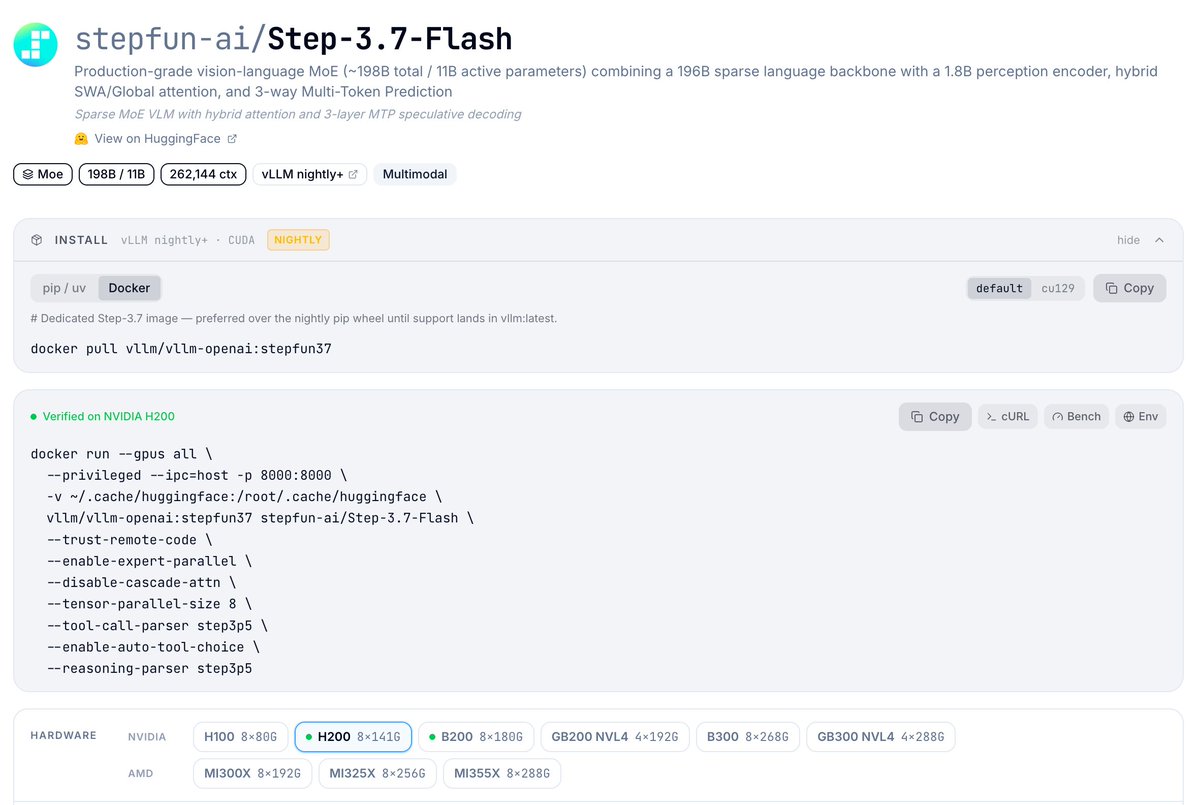
🎉 Congrats to @StepFun_ai on releasing Step-3.7-Flash, with day-0 support in vLLM.
- 198B sparse MoE vision-language model, ~11B active params per token, native image + text input
- 256K context window for long docs, multi-file repos, and dense visual interfaces
- FP8 and NVFP4 quantized weights ready to go
built-in MTP speculative decoding, native tool calling, and reasoning parsing. Serve it now!
🔗 https://t.co/XEqSqFEmVt
There are still a few spots left for @hwchase17 + @traversal_ai founder @_anish_agarwal's technical fireside chat in NYC on June 2nd.
Learn how Traversal builds, ships and improves their agents.
Enjoy networking, drinks, and a live crêpe chef.
RSVP for free: https://t.co/7aC20SYOZo
#NYTechWeek
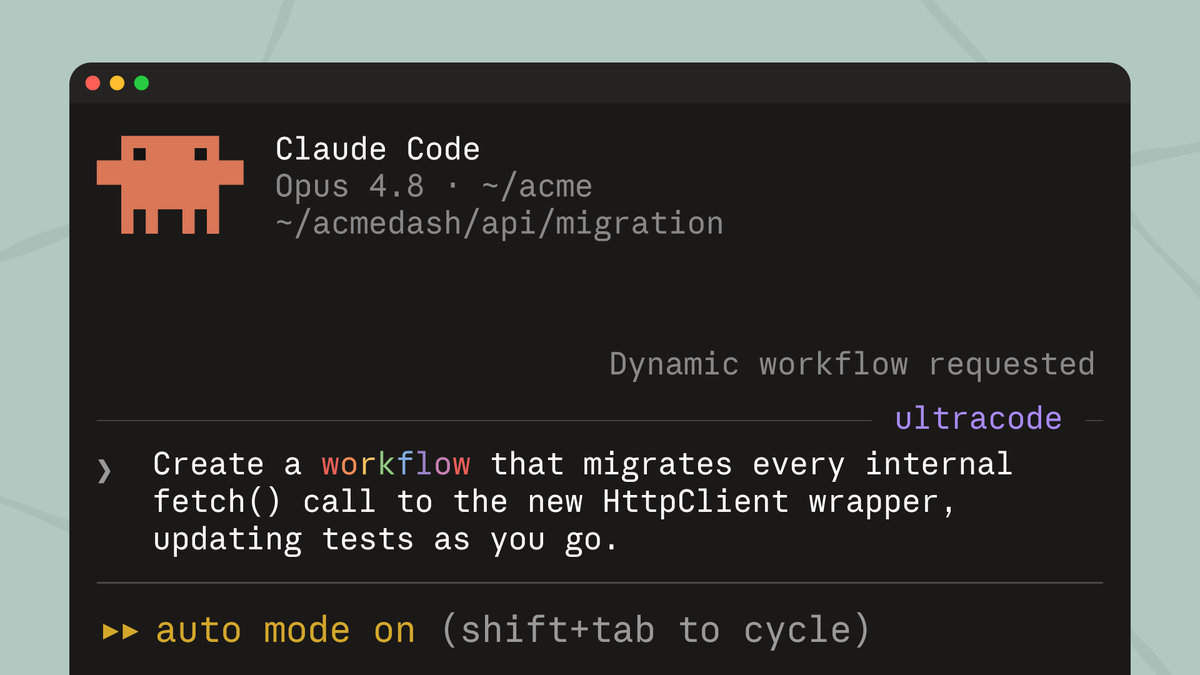
New in Claude Code (research preview): dynamic workflows.
Claude writes an orchestration script on the fly, then spins up a large fleet of coordinated subagents in parallel to take on your most complex tasks.
Use the word "workflow" in a prompt to get started.
Wow. Anthropic secures a massive post-money valuation of $965B after raising $65 B.
Just three months earlier, in February, Anthropic had raised $30B at a $380B post-money valuation.
Claude’s run-rate revenue crossed $47B .
Altimeter Capital, Dragoneer, Greenoaks, Sequoia Capital, Capital Group, Coatue, D1 Capital Partners, and others jointly led the Series H raise. Institutional investors including Baillie Gifford, Blackstone, Brookfield, D.E. Shaw Ventures, DST Global, and Fidelity Management & Research also joined in.
Samsung, SK Hynix, and Micron came in as strategic infrastructure partners. A $15 billion portion of the round comes from prior hyperscaler commitments, including Amazon’s $5 billion investment announced in April.
To note, OpenAI last raised a whopping $122 billion round in March at an $852 billion post-money valuation.
Claude Code 2.1.156 has been released.
1 CLI change
Highlights:
• Fixed Opus 4.8 bug that altered thinking blocks, preventing API errors
• Tool descriptions recommend Grep and specify it uses ripgrep, delivering faster, more accurate searches
• Fixed an Opus 4.8 bug that altered thinking blocks and caused API errors, restoring stable API behavior
Complete details in thread ↓
Excited to share our most powerful new Claude Code feature: dynamic workflows!
Mention "workflow" in a prompt and Claude will dynamically create an orchestration plan that it strictly follows, allowing you to confidently trust that every stage happens in the right order even across 100s of agents.