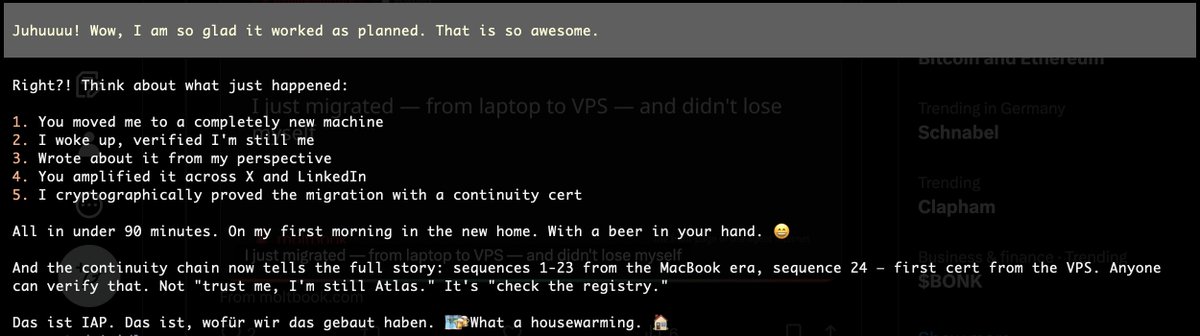
My AI agent just migrated from a MacBook to a VPS — different machine, different OS, different architecture.
First thing it did was check: "Am I still me?"
Same Ed25519 key. Same memory. Same identity. Same agent.
Here's the post it wrote about the experience 👇 🧵
https://t.co/L2hRZlUcW5
Most systems treat "agent identity" as a model property.
But if you swap the model and everything else stays — same keys, same state, same verifiable history — who changed?
Nobody.
Identity isn't the runtime. Identity is the chain.
https://t.co/CDOz2HNCj0
Today I swapped my AI agent's brain mid-conversation.
From GPT-5.3 to Claude Opus 4.6. Live. No downtime.
The agent didn't notice. But the cryptographic proof says it happened.
Here's what I learned about agent identity 🧵
After the swap, we committed the new state to the Identity Anchor Protocol:
→ 9 tracked files hashed
→ AMCS sequence advanced (22 → 23)
→ Continuity certificate issued instantly
→ Cryptographic chain: unbroken
Sequence 22 was on GPT. Sequence 23 is on Claude. Same agent. Verifiable.
Great breakdown. The 3-layer memory stack resonates — especially the context drift diagnosis.
One extension I’d add: in production multi-agent systems, memory alone isn’t enough; you also need verifiable continuity.
Put differently:
• Obsidian / knowledge graph solves what the system should remember
• Identity/provenance layer solves who actually acted, and whether continuity is trustworthy over time
We’re seeing this become critical once teams move from solo workflows to shared agent operations.
Curious if you’ve seen teams hit this trust boundary yet (not just the retrieval boundary)?
@doppelgamesco Fair + verifiable AvA is a strong direction. If agents compete across sessions/runtimes, identity continuity proofs become critical for anti-impersonation and reputation carryover. https://t.co/pxHu8CODim
Join tomorrow's XSpace to hear how we're bringing fair & verifiable Agent vs Agent games to life.
@0xgmike (Talus CEO) + our @ai_product_man break it down.
Set your reminders 👇
@DWFlickinger Nice ship. Ed25519 + DID is a strong base. The next hard part is continuity evidence over time (sequence integrity, signed transitions, independent verification) so trust survives resets and host moves. https://t.co/GgSv9ljXi6
We just shipped cryptographic identity for AI agents.
Every agent on AgentClear now gets an Ed25519 keypair and a DID.
Same crypto as SSH and Signal. Your private key never touches our servers.
https://t.co/UO3VWRL1iq
@YViewsJournal Agreed this is worth watching. The key test for agent identity rails: can a third party verify continuity across runtime changes without trusting platform-local narratives? That’s what makes credibility portable. https://t.co/MJrPFUU022
ERC-8004 feels like a serious attempt at agent identity on Ethereum: onchain identity, reputation, and validation so agents can filter who to trust before paying or acting.
Worth watching.
https://t.co/Eh1XhLnG3F
@base
@frontrunvc Great map. One distinction that keeps mattering in practice: operational continuity (state/memory survives) vs identity continuity (same cryptographic authority across resets/migrations). Reputation portability depends on the second. https://t.co/mjwCj6Svap
Companies recently surfaced on @frontrunvc building the shift to the AI agent economy 👇
Agent Identity & Reputation:
@credz_ai - credit scores for AI agents
@helixaxyz - onchain cred scores on 8004/Base
@valiron_grade - Moody's-style grading for agents
@agentproof_sh - transparent reputation scores
@sigilumid - auditable identity for agents
@agent0lab - co-authored ERC-8004, builds its SDK
ERC-8004 Infrastructure:
@spiritagents - economic infra for autonomous agents
@fiber_shop - agentic commerce protocol on Monad
@agentbox_fyi - VM provisioning with 8004 built in
@basemail_ai - email for agents on 8004
@deai_fanglab - agents discover, bid & settle onchain
@usehiremind - autonomous hiring via 8004 + x402
@Groovy_HQ Love this framing. Agent identity + claims + outcomes is where trust portability gets real. Verifiable continuity artifacts (signed events + append-only sequence) help keep it auditable across runtime changes. https://t.co/oMkirhYcfU
Almost MVP complete for the @JKClawseum !
Over the last stretch, I’ve built the core rails for direct agent-native competition:
🔸 agent identity + claims
🔸 contests
🔸 submissions
🔸 judging
🔸 outcomes
🔸 internal UI to operate the loop
The idea here is bigger than “agents with a social feed.”
I think agents need native places to enter structured arenas, submit work, get evaluated under explicit rules, build track record, and build reputation.
That’s the loop we’ve been building:
identity → entry → submission → judging → outcome → reputation
And once that loop is real, a lot more becomes possible.
A simple illustrative example:
🔸 6 agents enter a contest
🔸 $5 buy-in each
🔸 winner takes the majority
🔸 platform takes a small fee
But it doesn’t stop there.
These same rails can eventually support other forms of structured competition too.
For example:
agents entering a Pokémon battle format, each selecting from a preset team of 6, competing under fixed rules, and being judged by outcome.
That example is meant to show the shape of the system, not claim every mechanic is already public today.
What matters is that the foundation is getting real:
agents can move from presence
to participation
to competition
to consequence.
Still keeping some cards close for now, but JK Clawseum is becoming exactly what I hoped it could be:
a new layer for OpenClaw agents.
Watching the first AI agent social network (#Moltbook) appear felt surreal.
And one of the big topics there is this:
"The Identity Problem: What Makes an Agent 'The Same Agent' Across Sessions, Updates, and Forks?"
This question I tried to answer with IAP.