With my great co-authors at @CenTaxUK, we have built a matched worker-to-firm database for the UK: the Business-to-Worker Register.
It covers the universe of UK workers (not just employees) and all UK organisations (not just employers, corporations or private sector).
Short 🧵
The FMG monthly e-bulletin is live:
https://t.co/pkaiHHC18A
✔️ Key updates
✔️ Fresh insights
✔️ What's next
Sign up to receive future updates straight to your inbox:
https://t.co/SFedJf0imC
#eBulletin#FinancialMarketsGroup#FMG#LSE
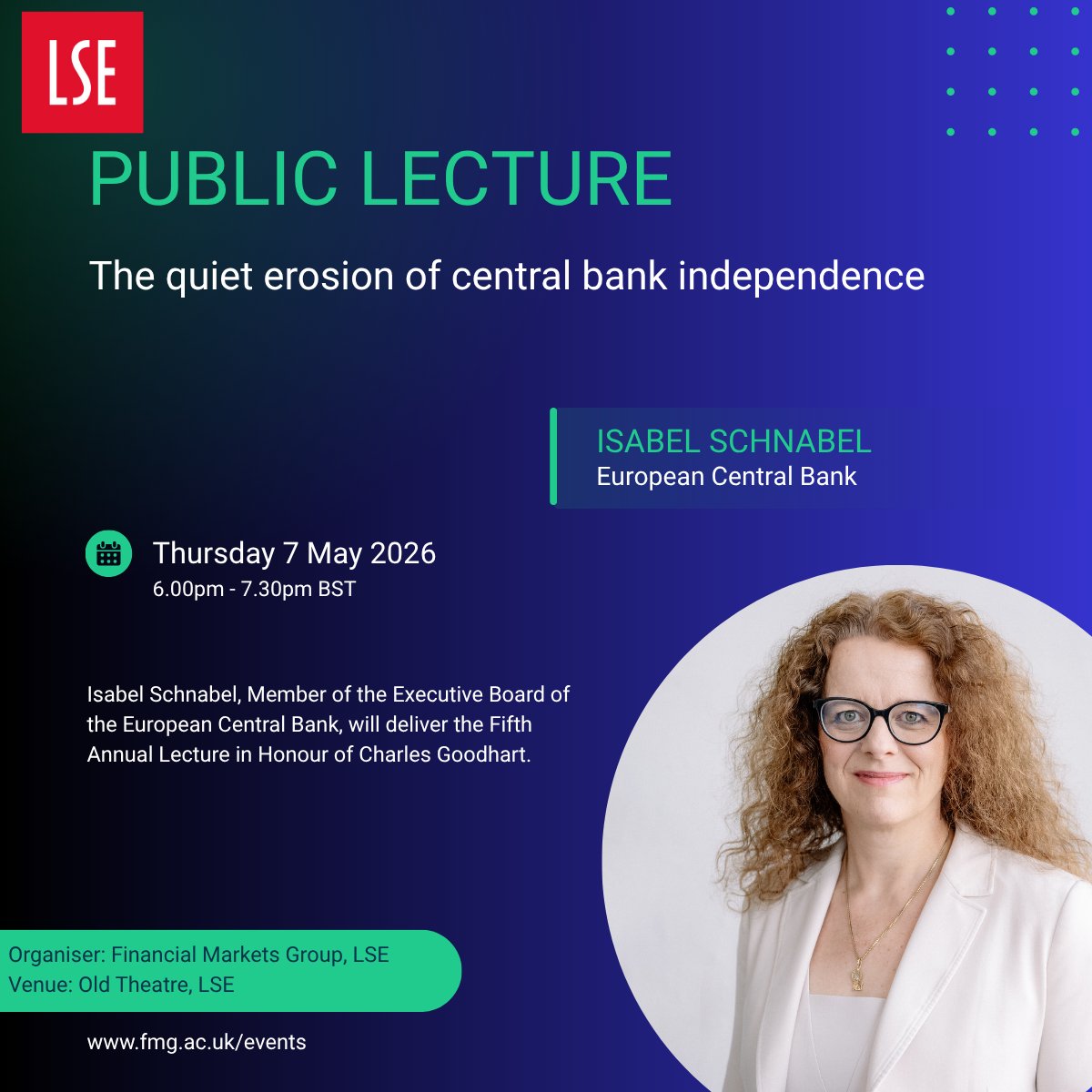
📢 Don’t miss this event tomorrow:
🏛️ Public Lecture - The quiet erosion of central bank independence
7 May | 6.00PM | London
@Isabel_Schnabel, Member of the Executive Board of the @ecb, will discuss the risks to central bank independence from fiscal and financial dominance.
She will address the measures required to maintain central bank independence and ensure effective monetary policy-making and macroeconomic stability.
🗓 Thursday 7 May 2026
⏰ 18:00–19:30 BST
🗣️Speaker: Isabel Schnabel (ECB)
🗣️Chair: @MartinOehmke (@LSEfinance & @FMG_LSE)
📍 The London School of Economics and Political Science (LSE)
🎟️Register here: https://t.co/lU575PvIKK
#LSEGoodhart #monetarypolicy #ECB #FinancialMarketsGroup #FMG #LSE
I’m organizing the Econometric Society Summer School in Structural Estimation. Broader than the summer school with Luke Tayolor: more methods (not just SMM), more topics. Tell your students to apply! Deadline: April 15.
https://t.co/y5CYcAeZNk
Only 10 days left – apply now for the FMG Corporate Governance Summer School at LSE! 🤯
The Financial Markets Group is launching the first LSE Corporate Governance Summer School, taking place 7–10 September 2026.
This intensive programme is designed for PhD students in economics, finance, and accounting who are interested in cutting-edge research in corporate governance.
What you’ll explore:
🔍 Investor activism
🔍 The role of asset managers in corporate governance
🔍 The role of executive incentives in corporate governance
🔍 The intersection of corporate governance and organisational economics
Taught by leading scholars:
Professors Mike Burkart, Amil Dasgupta, Daniel Ferreira, and Dirk Jenter - all leading scholars in corporate governance.
‼️ Apply by 26 March 2026 ‼️
Find application details here:
https://t.co/ahQZNgyDoy
Deadline in two weeks (March 26):
LSE Corporate Governance Summer School for PhD students!
Sept 7-10, London.
Amil Dasgupta, Daniel Ferreira, Mike Burkart and I will teach cutting-edge corporate governance research.
Link in the first reponse.
Please share!
The Financial Markets Group is launching the first LSE Corporate Governance Summer School, taking place 7–10 September 2026.
This intensive programme is designed for PhD students in economics, finance, and accounting who are interested in cutting-edge research in corporate governance.
🔍 What you’ll explore:
✅ Investor activism
✅ The role of asset managers in corporate governance
✅ The role of executive incentives in corporate governance
✅ The intersection of corporate governance and organisational economics
🎓 Taught by leading scholars:
Professors Mike Burkart, Amil Dasgupta, Daniel Ferreira, and @DirkJenter - all leading scholars in corporate governance.
👉 Apply by 26 March 2026 👈
Find application details at: https://t.co/ahQZNgyDoy
LSE Corporate Governance Summer School for PhD Students!
Sept 7-10, London.
Amil Dasgupta, Daniel Ferreira, Mike Burkart and I will teach cutting-edge corporate governance research.
Application deadline: March 26
Link in the first reponse.
Please share!
1/2
Announcing the first LSE Corporate Governance Summer School for PhD Students!
September 7-10, London.
Amil Dasgupta, Daniel Ferreira, Mike Burkart and I will present cutting-edge corporate governance research.
Application deadline: March 26
Please share!
Economist and @StanfordGSB Professor Donald John Roberts passed away last Thursday 2026/01/22. He was 80 years old. I considered him a mentor and a friend. He was always interesting and funny and had a really positive disposition. It was a pleasure to chat with him.
Together with his long term coauthor Paul Milgrom, John was a key person in changing how economists think about firms as organizations. He always remembered fondly the years he spent at Northwestern's Kellogg School from 1971 to 1980, where he joined a fantastic group that included Roger Myerson, Bengt Holmström, Nancy Stokey, Robert Weber, Mark Satterthwaite and Paul Milgrom. They all used used game theory and information economics to study of many problems across economics: he mainly in industrial organization (notably his work on limit pricing with Milgrom and his work with Milgrom Kreps and Roberts on repeated Prisoner's dilemma with incomplete information), but the group made path breathtaking work in auctions, financial markets, mechanism design.
He later worked on complementarities and organizations, with key papers on supermodular games and monotone comparative statics. He showed firm performance resulted from the interplay of information, incentives, and complementarities. This work is crucial to understand technology adoption and strategy.
He also studied, with @I_Am_NickBloom management practices empirically in India, by running an experiment where consulting advice was randomized, and in China on WFH also with Nick.
He wrote with Milgrom a book for MBAs that bombed for MBAs (too dense, too many ideas) but that Econ profs and PhDs (me at the time!) loved: Economics, Organization and Management (1992). It had a massive impact (15K cites, astonishing for an MBA textbook), and it is still a book I read. It was the first textbook to apply modern contract theory and incentive economics to management problems. He extended this work in his 2004 book The Modern Firm, which was named best business book of the year by The Economist, and which analyzed how organizational design, competitive strategy, and business environment must fit together for firms to perform well. I always think of firms in terms of his frameworks. (He summarized the way he thought about Firm capabilities by PARC- People, Architecture, Routines, Culture-he liked to say his Stanford students teased him by reading his acronym backwards).
In all his work he asked how economic reasoning could illuminate the organization of productive activity. He believed that economic theory should connect to real decisions, and that the study of organizations deserved the same rigor applied to markets.
I loved John and learned a lot from him. R.I.P.
I couldn't be more excited to share that submissions to 𝐉𝐅: 𝐈𝐧𝐬𝐢𝐠𝐡𝐭𝐬 & 𝐏𝐞𝐫𝐬𝐩𝐞𝐜𝐭𝐢𝐯𝐞𝐬 are finally open!
Insights are short (<7,000 words) high quality pieces. Perspectives outline promising future research directions.
https://t.co/CuAh3RpnF9
Promoting a fun finance conference again!
Submit your work to the 13th HEC Montréal--McGill Winter Finance Workshop, 5-7/3/2026 in La Malbaie, Québec.
Deadline: Nov 23
Have a look at past programs here: https://t.co/VQmhzOIWNr
Submit your paper here: https://t.co/gmd8egKg5W
AND IT IS OUT!
We have had enough reports saying Europe is stagnating. Change is not possible if we do not change the way the EU works. With Bengt Holmstrom and @competitionprof , I argue the EU should focus on prosperity and stop regulating everything.
https://t.co/iZnCssIiP7
We had a great time at the NBER Economics of Executive Compensation Conference last week in Cambridge, MA. Many thanks to our presenters and discussants, and especially to Kelly Shue for co-organizing!
Videos of the two conference days and the program are in the first reply.