Another highlight from the @IEA WEO:
The coal-to-chemicals sector in China "already consumes more coal than the entire EU power sector."
(Perhaps time to focus on this vast and relatively little known industry of China, key to its industrial prowess?)
h/t @JasonBordoff
@RubenBaetens Een ander beheersmodel: is dat een vriendelijke omschrijving voor subsidies en verplichtingen, of belasten en verbieden van alternatieven ? Warmtenetten hebben een hoge kapitaalskost, al op de dag van de eerste klant... Nieuwe & grote klanten vragen vooral koeling (en hebben WP)!
Peter Thiel makes a very important point in his latest interview: we moralise far too much. Think German Energiewende.
Thiel explains that moral judgement has increasingly replaced functional judgement. Instead of asking whether something actually works, we rush to classify it as morally good or evil.
The confusion starts with the word “good”, because it has two completely different opposites:
- The moral opposite of good is evil.
- The functional opposite of good is bad.
These are two entirely different axes. Yet public discourse increasingly folds them into one. Particularly the progressive left wants to occupy the moral high ground. So everyone virtue-signals — or pretends to, often without the slightest competence to judge the virtue in the first place.
Enter the climate crisis. Too much CO₂ is declared evil. Overnight, everybody knows we are in a climate emergency. Any doubt becomes morally suspect. After all, the IPCC consensus has declared it so. A Ferrari can now be declared morally “evil” because it burns too much fuel. Yet it remains an exceptionally good car.
And here lies the political trap: once something has been declared morally good, its advocates start treating that moral classification as evidence that it is also functionally good — that it actually works. And even if it works demonstrably worse, it doesn’t matter. It’s virtuous..!
But obviously the two may have absolutely nothing in common. A policy advertised as virtuous can be functionally terrible: incompetent, ruinously expensive or incapable of achieving its stated objective. Worse, once all its consequences are counted, it may turn out not to have been virtuous in the first place.
Germany’s Energiewende is the textbook example. Nuclear was morally branded “Hochrisikotechnologie” by @Die_Gruenen — high-risk technology — from the 1970s onwards. Dangerous. Irresponsible. Wind & solar became the virtuous alternative: “renewable”. And once that moral hierarchy was established, the engineering and economic questions became irrelevant: Does the resulting electricity system actually work better and cheaper?
Of course not. Nuclear power was one of the great scientific achievements of the 20th century: enormous quantities of cheap electricity from tiny quantities of energy-dense uranium, virtually no operational CO₂ emissions, little land use and dispatchable generation from massive rotating machines that also contribute to grid stability.
More importantly, it is also one of the safest forms of electricity generation mankind has ever developed. Yet German Greens spent decades morally slandering it. And Germany was hardly alone. Across much of the West, nuclear became something morally suspect rather than an extraordinary feat of engineering.
Doubt, rather than gratitude, accompanied nuclear. The doubt of the ignorant. Yet by some obscure moral code, ignorance itself suddenly earned a seat at the table. Expertise became optional; moral conviction became qualification. A child could command a global audience on questions of energy systems. How dare you?
Meanwhile, physics doesn’t care about false virtue signalling. A TWh of solar is not functionally identical to a TWh of nuclear — not at night, not in winter and not even at noon on a summer day if it is generated in the wrong place or exceeds consumption at that moment.
Why? Bc an electricity system has never been about producing enough TWh over a year. It has always been about timing and location too. Electricity must be produced at the precise time and location it is demanded, while generation and consumption must remain continuously balanced because the grid itself cannot store electricity.
That is Thiel’s message: The Energiewende — replacing nuclear with wind and solar — proved neither functionally competent nor virtuous. It was one gigantic $2 trillion amateur hour.
Two years after Mario Draghi warned Europe faced an “existential” threat from economic decline, his plan to make the continent competitive has become the EU's official agenda.
But implementation lags behind rhetoric.
Here’s our assessment of progress 👇
https://t.co/NPcEp1IlKV
@KilowattSpook Klopt. Deze post ging bewust over het tariefmechanisme: RAB, kapitaalkost en afname. Wie welke kosten draagt is de volgende vraag: allocatie. Die verdient een aparte discussie. Komt later 🙂
Waarom stijgen de nettarieven?
3 cijfers om de evolutie van de Elia-tarieven te begrijpen (2019-24):
RAB: 4,8 → 6,9 miljard €
10: ~0% → 3,9% (nu)
Afname: 74,2 → 64,3 TWh
Meer kapitaal, hogere kapitaalkost en minder MWh om de kosten over te verdelen.
https://t.co/YCr30phOg1
De gebrekkige politieke reactie op de brand in de Hoge Venen was geen probleem van bevoegdheidsverdeling. Die is kraakhelder.
Wie naar een institutionele oorzaak zoekt, richt zijn vizier beter op de bijzondere financieringswet.
Mijn column in @tijd 👇
https://t.co/NzJv4Vl5yg
Norge, Sverige og Finland gik for ikke lang tid siden sammen om et brev til EU kommissæren Dan Jørgensen.
De laver en venlig diplomatisk tilsvining at Danmarks energipolitik.
"Europe needs to focus on the total system costs of the energy system". Imodsætning til kun at kigge på prisen på en given energikilde uden dets afledte omkostninger.
"A crucial factor in reducing system costs is to use existing infrastructure more efficiently. For this purpose, fossil-free, plannable power is crucial."
Okay. De 3 lande mener altså at omkostningerne til infrastruktur, elnet og balancering stiger ved ustyrlige energikilder. Det siger den danske venstrefløj ellers ikke er tilfældet.
"Sufficient dispatchable baseload power is of utmost importance for a well-functioning power system"
"Overreliance on cross-border connections or on a single type of energy production, will rather lead to a more expensive system for EU citizens and companies, resulting in increased electricity prices, higher security of supply risk and lower competitiveness."
Danmark er skyldig i præcis disse ting. Totalt afhængige af crossborder kabler, for snævert valg af energityper, og derved skyldig i at slække Europas konkurrenceevne.
Vi kunne tage skeen i den anden hånd. Gøre vores naboer glade og gøre os selv en kæmpe tjeneste. Det kræver bare at vi tager SMR atomkraft seriøst. Ligesom LA siger 👍
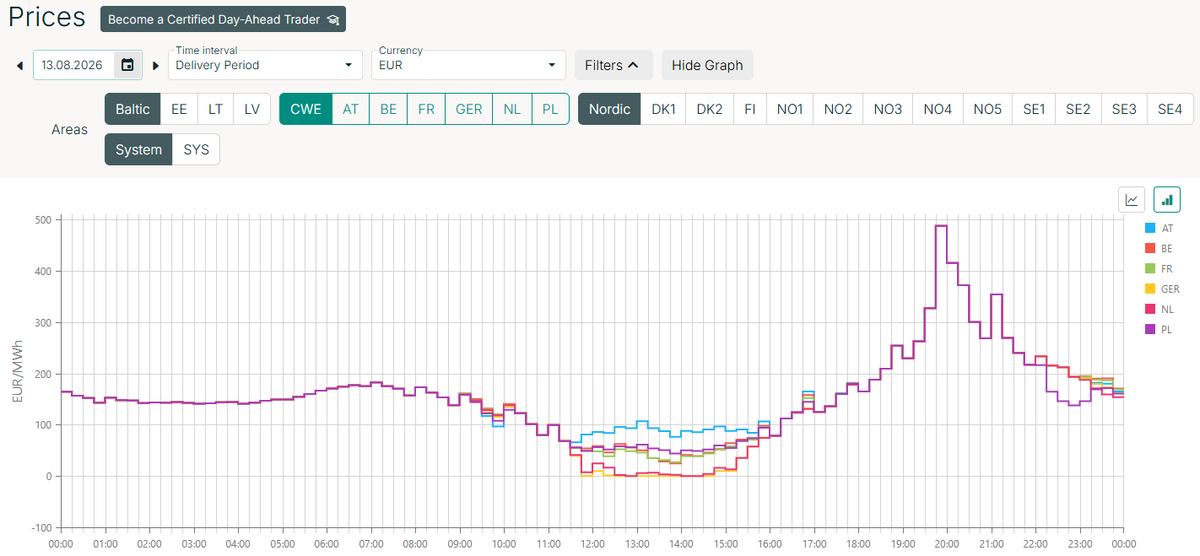
Siamo arrivati vicini al punto critico...lo sapevamo da 15 anni almeno; siamo ora a quasi 50 GW fotovoltaici e 14 eolici, e il picco del prezzo di borsa stasera è 250 €/MWh.
E -badate bene- il prezzo di borsa rappresenta solo una componente della bolletta; delle altre componenti legate alla crescita di solare ed eolico, le pricipali sono: 1) gli incentivi (circa 9 miliardi ancora nel 2026, soprattutto per solare ed eolico e briciole per le altre rinnovabili, perchè per esse non c'è spazio per ulteriori sviluppi); 2) la remunerazione dell'energia che già buttiamo via nelle ore centrali della giornata, per ora da marzo a maggio, poi vedremo; 3) la remunerazione delle batterie con le quali una parte dell'energia prodotta in eccesso può essere accumulata e rimessa in rete dopo il tramonto; 4) la remunerazione della rete di trasmissione e distribuzione, inclusi gli investimenti per gli enormi ampliamenti necessari a convogliare verso i luoghi di maggior consumo energia generata in modo sparso sul territorio (in particolare, quel poco di eolico che si può produrre in Italia è al Sud).
Se qualcuno ancora diffida delle simulazioni e pensa si debba continuare a installare sempre più solare ed eolico, studi il caso Germania: un vero manifesto sull'illusione delle fonti variabili, stagionali e sincrone: 100 GW solari e 100 GW eolici e le bollette più care d'Europa accompagnate da emissioni 10x quelle francesi.
In Italia abbiamo bisogno al più presto di una flotta nucleare che, insieme alla giusta quota di solare eolico e batterie, ci consenta di affrancarci dal gas e dalle bizzarrie della sua quotazione.
Sino a quando quella flotta non sarà in esercizio, dobbiamo installare solo quanto serve di solare, batterie e quel po' di eolico che si può, che, a complemento della flotta nucleare, realizzerà il mix ottimale. Non un kW in più. A meno che, chi vuole, non lo faccia a mercato, senza certezza di remunerazione!
E se nel transitorio la quotazione del gas continuerà a restare sopra i 50 €/MWh, occorrerà riavviare le nostre centrali a carbone per il tempo che serve.
Proprio come fanno in Germania, ora e chissà per quanto ancora, se non torneranno anche loro al più presto al nucleare!
Tarieven netwerken tot 2040 elektriciteit en gas stijgen met resp. 100% en 20%. Bij 30 GW wind op zee en excl. inflatie.
Reden: Bij stroom moet enorm geïnvesteerd worden, terwijl bij gas afschrijvingen vrijwel gelijke tred houden met dalende vraag.
#grafiekvandedag FIEN'26.
Léon Trotski avait théorisé "La Révolution permanente".
@vonderleyen invente "La crise gazière permanente".
Ma dernière interview pour @atlantico_fr 👇
https://t.co/c5n3WQlG3j
@Laveyne_J "iets waar we al 15 jaar van weten dat het een doodlopend straatje is". Was het maar waar: Europa vraagt nog steeds (groene) waterstof in brandstoffen, zie RED 3 art 25, een bindende doelstelling.
Wind & zon worden goedkoper, de elektriciteitsprijs is soms zelfs negatief.
Waarom wordt de elektriciteitsfactuur dan niet automatisch goedkoper?
Omdat productiekost ≠ marktprijs ≠ systeemkost ≠ factuur.
Ik probeer het uit te leggen in deze korte nota: https://t.co/BKVXXnirSv