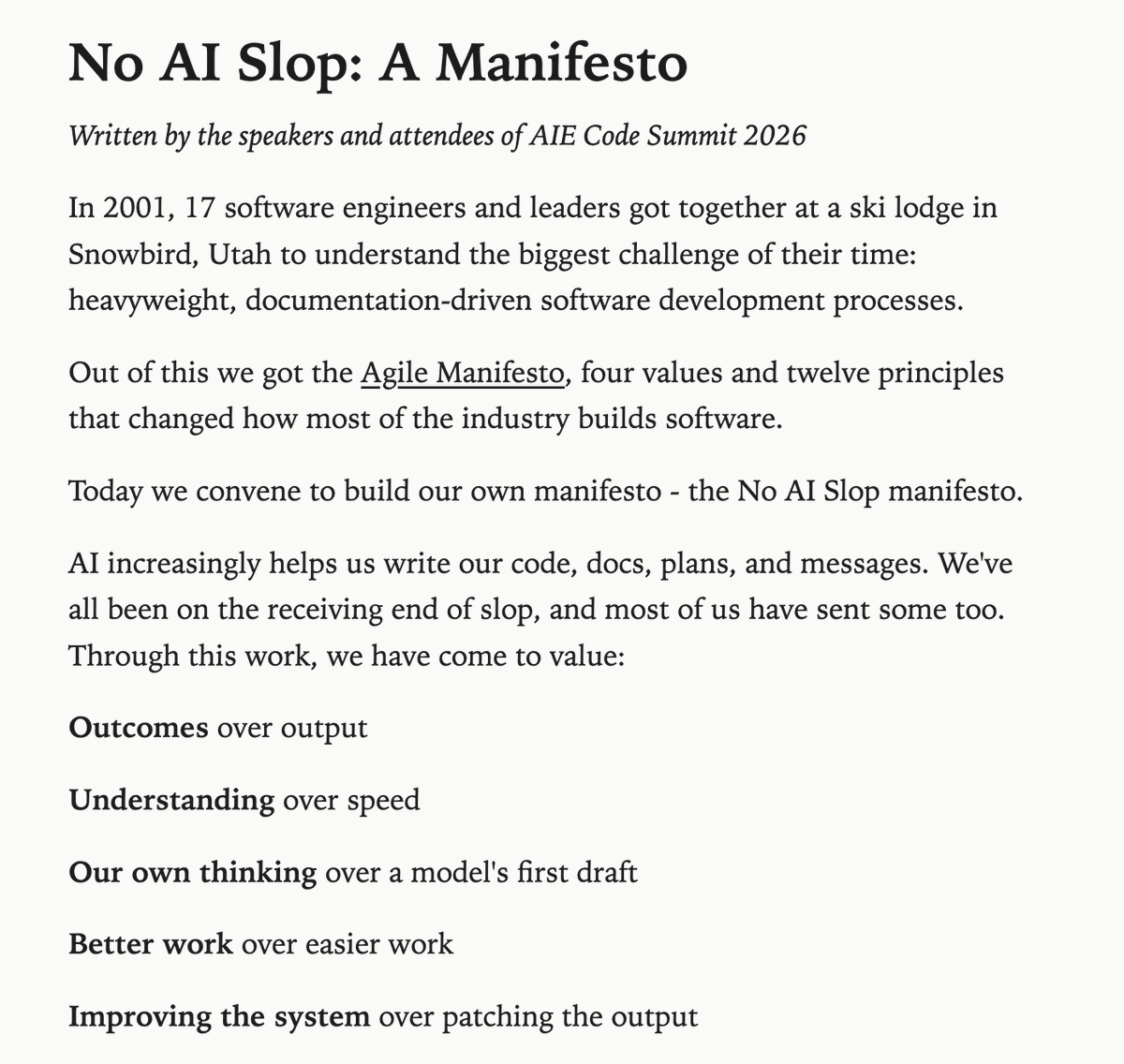
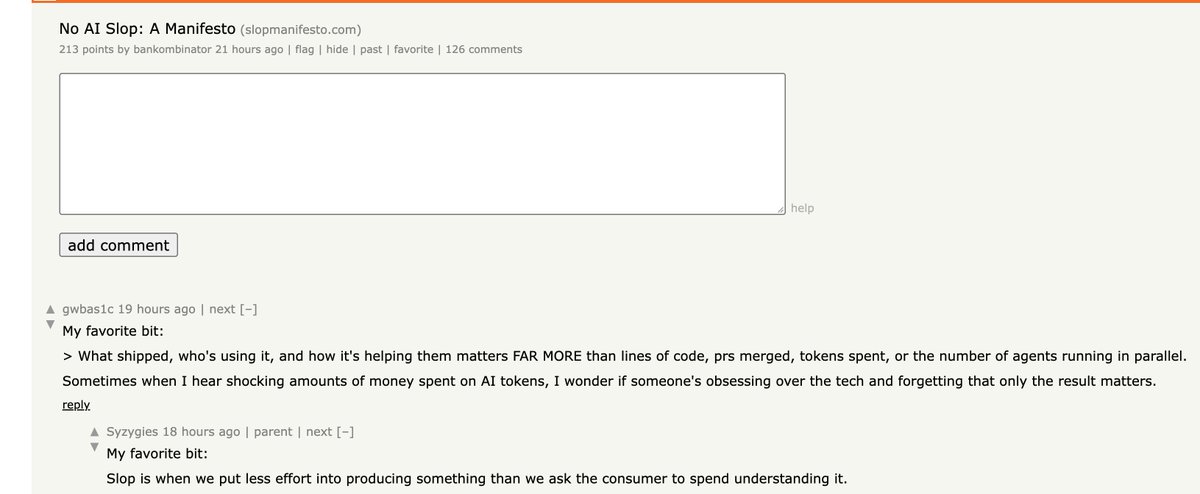
a few days ago we published the "No AI Slop Manifesto" at @aiDotEngineer Code Summit in SF, written in collaboration with many of the speakers and attendees
It already hit the front page of hacker news, has 300+ signatures including folks from Baseten, SpaceX, OpenAI, PostHog, Shopify, Glean, ZoomInfo, and legendary builders including
@swyx@poteto@kentcdodds@mihail_eric@audreyt@altryne@traviscline@philipkiely@TejasKumar_
read and sign it at slopmanifesto dot com
some of my favorite points
> AI cannot replace human judgement, it can only amplify our judgement (or lack thereof).
> We own the intent, taste, and consequences of what we ship, however much AI helps us make it.
> There will always be alpha in reviewing *something*. As models improve, we may stop reading most of the code. We may still review a plan, design, or result, because if we don't, we just get the same output as everyone else.
quick fixes considered harmful: you might be making your agents write worse code when you ask for the smallest or quickest possible change
what seems like a harmless bandaid may lead to that pattern being copied by the next agent. before you know it that pattern has spread everywhere
we used to write bandaid fixes by hand because we rarely had the time to do the right thing. agents change this calculus. sometimes you want it to fix the root cause instead even if it’s more invasive
Built a physical simulation of a record player with WebGL2 and Web Audio. It's *shockingly* accurate: https://t.co/MBNaTfKoai.
Instead of playing a song, it works by converting it into the physical shape of a groove. Then a simulated stylus rides those walls 384,000 times a second, and you hear the voltage that motion would induce in a cartridge.
So the crackle, the pops, the wow/flutter, the dull inner grooves are natural byproducts of the simulation. You can also "DJ" the record.
(The converted songs are in the public domain or CC-licensed. Code is linked for you to remix and re-deploy.)
What is an implicit state machine?
Your apps are full of state machines, which is the logic that says "when we're in this state, and this event happens, now we're in this state" (given, when, then).
Sometimes those state machines are clearly mapped out (switch statements, reducers, tables/maps, libraries like XState for the more complex ones, etc.) and the logic is explicitly enumerable.
And sometimes it's not. The ad-hoc logic is spread all over the place. That's how developers typically code, and that's how agents typically vibe-code (they learned from you). Those are implicit state machines.
What's wrong with implicit state machines? It's not clear what state transitions are possible, so you might have "allowed" states that should have been impossible without knowing it. Agents make the same mistakes.
You can get all tests passing and your code review agents (even the well-funded ones) can say "LGTM" and you can *still* have very bad bugs because an implicit state machine allowed unexpected or illegal behavior. (Remember the Apple FaceTime bug?)
So yeah, making your app logic explicit is important.
Formal proofs of tens of millions of lines of code are not a ridiculous thing anymore and within the realm of what should be considered when designing new systems.
a point i keep trying to emphasize when i talk about software factories is that the idea is really just "bring engineering rigor to how you deploy coding agents." this is what i mean by factory engineering
when you think of it through that lens, you naturally move to a mindset where you want to define all your agents in code, measure everything they do, and systematically improve their roi
then you start backing out the infra you need to do that, and at the end of the day, that's a software factory
the anti-pattern is assuming that one way of using agents is better than another because you've seen someone tweet about harness X or model Y.
most engineers get this but it does bear repeating - when someone tweets that their thing is better they probably have some vested interest in it because there is so much at stake economically with these harnesses and models.
the better approach is to adopt tools that let you actually measure what works on your own workflows. buy the tools to do the measurement, don't buy any one model or harness
We're moving away from individual secrets, MCPs, and workflows that live on each person's independent agent setup, and unifying them so the team can agree on how agents should behave.
One set of model selections, one secrets / MCPs definition, one dashboard to track cost and quality… everything. It moves engineers away from tweaking their personal setups, and towards proposing changes that the whole team can benefit from.
I got a lot of inspiration talking to the brightest minds in the fields @badlogicgames and @mitsuhiko.
At @deepseek_ai we believe in scaling across agent harnesses and aim to provide good support to @pidotdev among all the major harnesses in the world in each generation of our models.
Today we're launching the Sunra API.
Every leading image, video, audio and 3D model through one key, each at its maker's own API price. Pay as you go, with no subscription and no markup.
The models are ready. Your app is next.